The Love Pirate and the Bandit’s Son by Laura James – Review

The Love Pirate and the Bandit’s Son: Murder, Sin, and Scandal in the Shadow of Jesse James by attorney Laura James was published in 2009, but we thought we would mention it because the book contains a detailed look at one of Joplin’s lesser known scandals involving one of the most influential men in early Joplin history.

Zeo Zoe Wilkins was a charming osteopath who also a cunning opportunist. Her prediliction for marrying men, taking their money, and then divorcing them led some to call her a “vampire.”

After meeting 72 year old banker and former Joplin mayor Thomas W. Cunningham, Zeo Zoe sought to marry him and, in the process, seize his assets for herself. There was only one problem: Thomas had a common-law wife, Tabitha Carr Taylor Cunningham. Zeo, however, pushed ahead with her plans and married Cunningham. She kept him sequestered away from his friends, took over half a million dollars in cash, sold his bank to a rival, and disposed of his real estate holdings. Cunningham launched a divorce suit, claiming he was Zeo’s slave. In the end, the marriage was anulled. Zeo Zoe received a generous settlement while Cunningham returned to Joplin and to Tabitha. But Zeo Zoe’s story did not end in Joplin. She continued her scandalous ways until she met a brutal end in Kansas City. Her murder was never solved, but among those suspected of killing her was her one-time lover, Jesse James, Jr.

Despite the campy title, Laura James has produced an entertaining and well documented narrative account of Zeo Zoe Wilkin’s sinful life, and in the process has provided an in-depth look into one of Joplin’s lesser scandals that, for a brief moment in time, captured the nation’s attention.

Joplin’s Historic Districts

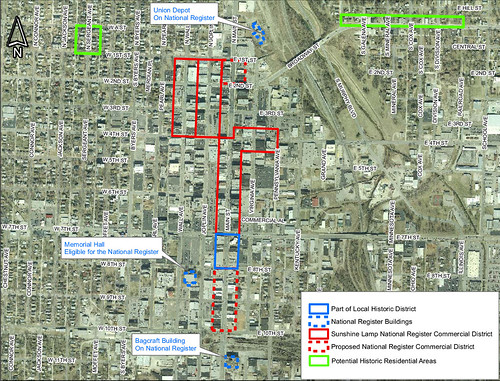
Last month we were greeted with the good news that the Missouri Advisory Council on Historic Preservation had approved 21 buildings in the 800 to 900 block of Main Street for registration on the National Register of Historic Places (it requires a final approval in D.C. from the keeper of the National Registry).  Later this week (hopefully!), we’ll bring you news and information on Joplin’s next proposed historic districts.  Until then, here’s a chance to understand where Joplin’s current historic districts are located, as well proposed districts.  For a larger view of the map, just click on the image. (Then click on the Back button on your browser to return here)

The Estimable Mr. Worth

Jimmy Worth

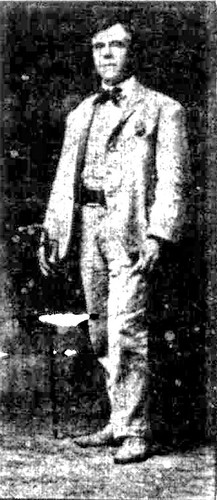
Joplin’s flamboyant James “Jimmy” H. Worth, who was known to periodically advertise for a wife, announced to the Joplin News-Herald that he was returning to his farm in Franklin County, Indiana, to solve a mystery. Worth, in addition to his property in Indiana, was the eccentric owner of the Worth Block which is now the site of Spiva Park at the northeast corner of Fourth and Main streets.

Worth’s one hundred and fifty acre farm was planted in cherry, apple, peach, and pear trees. Perhaps more notable was the large cave located on the farm which, according to Worth, “ticks, ticks, ticks, just like a monster clock, day after day, year after year.” Previous attempts to explore the cave beyond three hundred yards ended prematurely due to bad air which Worth said made “one’s breath come in painful gasps.” But the bad air was not enough to stop at least one brave creature from calling the cave home.

Worth claimed “a big bear that escaped from a wrecked train ten miles from my farm once took refuge in the cavern and for weeks the natives of Franklin County enjoyed daily bear hunts that netted them nothing, for the big brute was successfully concealed in the far corners of the cave, the ominous clock-like ticking, apparently, holding no horrors for his bearship.” It was later discovered and removed from the cave.

Jimmy asserted his belief that the ticking noise was not the result of dripping water as the cave was reportedly dry. Instead, he claimed that the cave was the artificial construction of “cave-dwellers centuries ago” based on broken flint projectiles, bones of animals, and what Jimmy thought was a “deformed human skull.” He declared he would find out what types of bones were in the cave and discover the source of constant ticking.

If Jimmy did find out what caused the ticking noise, the News-Herald must have found his explanation dull, as it failed to report Worth’s findings.


Source: Joplin News Herald

February Joplin Metro Magazine History Offerings

The Joplin Metro Magazine has a couple offerings in the area of Joplin’s history for the February issue.  Perhaps its biggest piece covers the history of the Joplin Little Theater.  In operation since 1939, the Joplin Little Theater is purportedly the oldest running community theater west of the Mississippi.  The other facet of Joplin history presented concerns some of Joplin’s residents who have gone off to find a fortune in Hollywood, including the well known Dennis Weaver.  No stranger to Joplin after he found success, Weaver was more than happy to film commercials for Missouri Southern State University, which he had attended when the school was known as Joplin Junior College.

Joplin Metro Magazine can be found for free at various business locations around Joplin or you can read it online here.

A Joplinite Takes a Bath

Americans have always loved a good excursion and they love health fads even more. Men as varied as Robert E. Lee and Franklin Delano Roosevelt enjoyed a good soak in hot springs. E.R. Moffet, Jr., son of one of the most significant men in Joplin’s history, engaged in a soak at Hot Springs, Arkansas at the turn of the century. As his descriptive letter indicates, not everyone enjoyed their experience at the baths.

“Editor of the Joplin Daily Globe:

Hot Springs Ark. Nov. 20 —

I arrived here yesterday and thought I would give you my views of the place and express my opinion of the first bath.

I took my choice of some 15 bathhouses situated upon the U.S. reserve and, fortifying myself against surprise, I boldly opened the door and there I met a man behind a counter with a 55 cent smile and a bunch of keys with a rubber band to each key. Upon making my wants known, he returned to a row of boxes like the boxes in the safety deposit department of a bank, and drawing out a box, he pushed it toward me.

I told him I did not want it — I came for a bath. He explained that I was to put all my earthly belongings into the box, so, having had to pay for my bath in advance, I had only three coppers and a nickel left, but in they went, and he put the box back and as it locked there I thought I was fleeced. He took one of the keys corresponding to the number of the box and slipped it onto my wrist telling me to let it remain there.

Well, as I had broken the ice, I was open for everything. As each 55 cent bath is entitled to a 15 cent attention I was put in the hands of a son of Africa who knows his business. He assigned me to a certain room to disrobe and gave me a robe to don, and I shortly went forth. Going to the bath, we went through the cooling rooms where some eight or ten men were cooling off. Passing through a door, we come to the finest place I ever saw: marble floors, marble partitions between baths, tubs, all supported with brass and porcelain as clean as could be.

My attendant being a man built on the Jeffries order, I soon saw after getting into the bath I was in for it. I remonstrated, but he said I wanted my money’s worth. After rubbing about all the skin off, he took me to a wire cot, laying me out, wrapped me up, and handed me a cup of hot water saying, “Have one on me.” The water was as hot as coffee and could only be supped, the degree of heat being something near 175 degrees.

While lying there I saw a sign saying, “Ladies in the cave.” I called my attendant and said, “Let’s go to the cave,” but he made me lie still. I kept watching that sign and presently it flopped over and it was the word, “empty.” Then my attendant said, “You can now go to the cave.” I said I was not particular now, but I went.

I found a cave some five feet wide, six feet high, and about thirty feet long, and as hot as hell or hotter. This cave is used for bad cases of heart trouble — love, for instance. The heat in the cave is natural, coming from the rocks, and is a most wonderful thing. It is lighted up and one is not allowed to stay in it over eight minutes.

After returning to the bath room, I was asked if I wanted to take a sweat. As I had sweated only about 5 gallons I thought I could stand a little more so he opened an iron door and invited me to step in. I went and out I came — I thought I was done for. The water in the room was it comes from the ground and steam rises from it all the time. But I managed to get in again and stay. Talk about a Turkish bath! They are not in it. I could only stay a few minutes and then called to be released. Getting out of the sweater, as the cloister is called, I asked what next.

I was led to the shower room where I believe ten thousand small streams of water about the size of a knitting needle shot at you with about 40 pounds of pressure. They came from every conceivable direction and in striking you they sting very sharp. I concluded the thing had gone far enough and I begged for quarter, but my attendant said, “You isn’t near through yet.” I had enough, however, and after having a pound or so more skin rubbed off, I was allowed to go into the first cooling room and presently to my place of starting.

After dressing I went to the office. There the key was removed from my wrist, the box unlocked, and my money turned over to me with the remark, “Call again.” I guess not — I know when I get enough.

E.R. Moffet, Jr.”


Source:  Joplin Daily Globe
Titanic Thompson – A Joplin Hustler

For those interested in the seedier aspects of Joplin’s past, they might be interested in the newly released biography of Alvin Clarence Thomas, better known as “Titanic Thompson.”  Thompson, a native of nearby Rogers, Arkansas, spent some time in Joplin and had a reputation for literally betting on nearly anything.  It was in Joplin that Thompson purportedly earned the nickname Titanic, which came from “sinking” anyone he came across.  The new book, Titanic Thompson: The Man Who Bet on Everything, by Kevin Cook, a former editor of Sports Illustrated, published by W. W. & Norton Company, offers 284 pages on the life of the hustler.

Perils of the Mines – Snapshot 1910

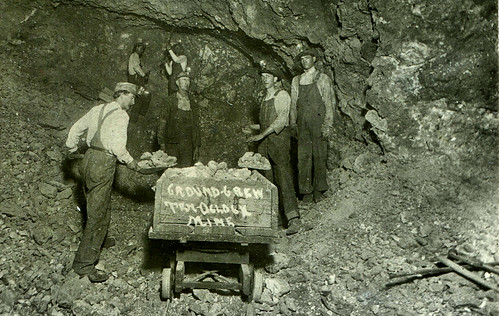
In the background, two miners examine the roof of the mine.

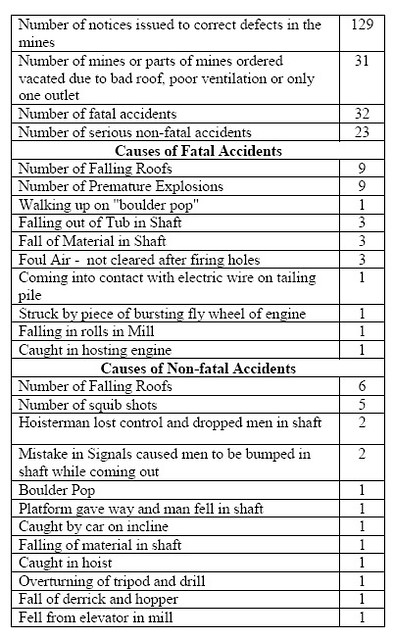
From the beginning, lead and zinc mining in the Joplin district was a dangerous means to make a living, and if lucky, a fortune, too.   The year 1910 was considered a good one, respectively, when compared to 1909 when 51 miners lost their lives.  In 1910, in contrast, only 32 miners were killed in the pursuit of the valuable ore.   Every year, mine inspectors from the state toured the mines which surrounded Joplin to ensure compliance with mining laws and to note deaths and the causes behind them.  In 1910, two inspectors toured 551 mines and 65 accidents.  Here are the results and a snapshot of mining in Joplin in 1910.

In summary, the most dangerous element in a mine came from above.  Of the combined deaths and serious injuries, falling mine roofs accounted for 27% of the victims.  The next deadliest was the more obvious danger of explosives in the form of premature explosions, squib shot (involved in the dynamiting process), and to a degree, the foul air which was caused by failing to blow out the air in a mine following an explosion.   Sadly, even entering and exiting a mine bore a certain amount of lethal danger, as our previous post on the unfortunate Number 52 noted.


Source: Joplin News Herald

From the beginning, lead and zinc mining in the Joplin district was a dangerous means to make a living, and if lucky, a fortune, too.   The year 1910 was considered a good one, respectively, when compared to 1909 when 51 miners lost their lives.  In 1910, in contrast, only 32 miners were killed in the pursuit of the valuable ore.   Every year, mine inspectors from the state toured the mines which surrounded Joplin to ensure compliance with mining laws and to note deaths and the causes behind them.  In 1910, two inspectors toured 551 mines and 65 accidents.  Here are the results and a snapshot of mining in Joplin in 1910.

Joplin Before Urban Renewal

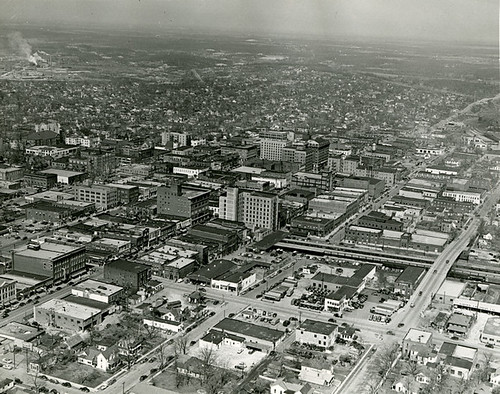
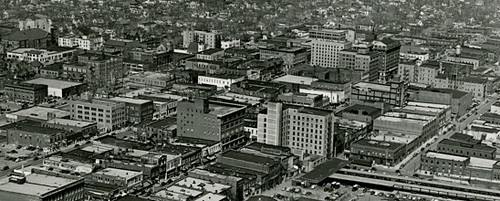
It is obvious to many the impact urban renewal had on Joplin’s downtown area. While the parking lots are many, many may not recall what once stood in those locations. In the photograph below, taken in 1955, we have a rare opportunity to see the downtown of Joplin right before the beginning of urban renewal in the following decade. See how many of the historic buildings you can spot. We’ll post again this weekend pointing out what is where.

Joplin, 1955.

Printed with permission from the State Historical Society of Missouri.

Close up on the downtown area.

Feel free to click on the images for slightly bigger versions.  Unfortunately, the internet publishing policy of the State Historical Society prevents us from offering larger versions.

Source: State Historical Society of Missouri

A Soiled Dove Returns

Florence Woodson was hailed as one of “the most notorious denizens of the north end.” She had spent “many long and tedious hours behind the bars” and “years in dives of ill fame” when her mother appeared in Joplin and forced her to return home. Florence, it was said, had left her home in Springfield years before and journeyed to Joplin’s tough North End where she found work as a soiled dove. She soon gained the reputation as one of the “toughest of the tough.”

When her mother arrived, she found her daughter in jail, held on a charge of prostitution. Their meeting was “a heart rending scene” as Florence’s mother told her that Florence’s father had died from grief after she left home. Florence promised to leave her life on the streets and return home to Springfield. She was released from jail and left Joplin. It was rumored that she had indeed returned to the straight and narrow, but she eventually returned to Joplin, hoping to visit the “scenes of her dissipation” while on an excursion to nearby Carthage.

Florence, however, found that Joplin’s North End had changed. Many of the “resorts” were deserted; some even partially destroyed. Once the scene of “music, dancing, and wrong-doing galore,” reform-minded middle-class women had led a somewhat effort to drive the prostitutes, gamblers, and criminals from the North End, many of whom were African-American.

The police, alerted to Florence’s return, arrested her in a rooming house on Main Street. She begged that if released she would never return to Joplin. The judge fined her $5 and costs before releasing her. Florence reportedly caught a train back to Springfield. One more soiled dove had come and gone, but there would always be more to fill the bars and boarding houses of Joplin.

Source: Joplin News-Herald

Joplin’s Pulitzer Prize Winning Baseball Player

“A great gentleman, a great writer, has gone.”  So concluded an obituary in the St. Louis Post-Dispatch of the journalist Bart Howard.  Among the many newspaper writers to pass through Joplin on the staffs of the News Herald and the Globe, Howard is among the most prominent.

Bart Howard was born in Worchester, Massachusetts in 1871.  As a boy he walked the privileged halls of Phillips Exeter Academy.  He attended Williams College where he excelled at athletics.  Howard did not graduate from the school, but left early after upsetting the faculty with a paper which mocked certain giants of Greek history.  From New England Howard eventually made his way to Joplin around 1901 and found a job with the News Herald.  He initially provided coverage of Joplin’s triumphs and failures in the Missouri Valley baseball league.  Howard had developed a love for the game in college, and briefly played professionally as a left handed second baseman as a means to supplement the meager income of a young journalist.

Howard did not remain merely a sports writer, but expanded to general news coverage.  After a few years, the talented journalist was noticed by the owners of the Globe and they hired Howard away from their competitor and placed him on the editorial staff of the Globe.  At the Globe, Howard rose to the position of managing editor, and oversaw Ben H. Reese, later a managing editor of the St. Louis Post-Dispatch and Wesley Winans Stout, later an editor of the Saturday Evening Post.  It was also during his time in Joplin that Howard met and married Ann Picher, of the mining company Pichers.

For a number of years Howard worked at the Joplin Globe until once again his ability was noticed and this time hired by the St. Louis Post-Dispatch.  In the Gateway City, he worked as a journalist before a brief return to Joplin, then found work in Columbus, Ohio and Oklahoma City, Oklahoma.  Ultimately, Howard returned to St. Louis and the Post-Dispatch and became an editorial writer.  It was in this capacity that Howard won the Pulitzer Prize in May, 1940 for a series of four editorials entitled, “Europe’s Emperor,” “After the Battle,” “The Golden Age,” and “The Kingdom of Democracy.”  Not long after his win, Williams College opted to make their former student a Doctor of Humane Letters.

Howard was unable to enjoy his laurels.  On February 12, 1941, he collapsed at lunchtime, dead of a heart attack.  The Globe made sure to note the passage of its one time editor, a man who had traded the plush and privileged world of Massachusetts for the rough and tumble streets of Joplin.  Howard may have also been one of the few professional baseball players to ever win the coveted Pulitzer.  The Post-Dispatch printed summaries of the four editorials which had won Howard his great literary prize, and wrote lovingly of its former writer.  An editorial by the paper said of Howard’s writings:

“Behind his writings was, above all, a great and passionate love for humanity and for justice.  It was a humanitarian sense, a warm affection for all his fellows, that embraced their every activity.  He could breathe righteous indignation into his pages of copy paper, when oppression or intolerance or corruption came into the news.  The leavening shaft of humor served to debunk the pretensions of the pompous, or to reduce a raging controversy to its proper teapot proportions, but Bart Howard had a flaming sword in that typewriter when there were wrongs to oppose.”

The Post-Dispatch, as noted above, then concluded, “A great gentleman, a great writer, has gone.”

Sources: Missouri Digital Heritage, St. Louis Post Dispatch, and Joplin Daily Globe.