A Playground Not For All

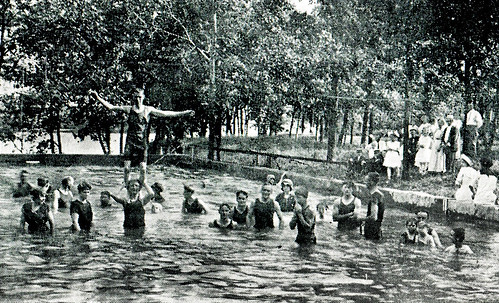
Joplin swimming pool circa 1913

African Americans were generally not welcomed at swimming pools like this one at the Joplin Country Club.

In 1910, the total black population of Joplin was approximately 800 individuals out of a total population of approximately 32,000.  Thus, the African American community represented only about 2.5% of the city’s population.  Despite being such an insignificant portion of the population, the de facto laws of segregation were in strong effect in 1913.  The effect of the segregation struck one prominent Joplin businessman when he took his son to the local playground.  He recounted, “The other night I went to the playground with my son.  It made my heart ache to see the wistful faces of the negro children outside the fence, and know that they could not enter.”

It was not merely the denial of the playground to the black children that upset the businessman, but also that, “Unlike white children the negro kiddies cannot have the swimming privilege of the amusement parks of the district.”  Additionally, the businessman noted, “they are not allowed to attend many moving picture theaters, and are confined to a balcony in those places they are allowed to enter.  The streets and alleys are the only places they are welcome.  When they grow up they are unwelcome almost everyplace they visit.  It is not right.”

As a result of the segregation, the businessman pledged $250 to the establishment of a playground where black children, as well the general poor, could visit and play.  It would not be the first donation by a businessman to benefit the black community of Joplin, previously Thomas Connor had paid for the construction of four African American churches some years earlier.  Such sentiments were a start toward a better approach to a society of different races, but unfortunately along the reasoning of “separate but equal,” not equality for all.  The solution in 1913 Joplin was not to open the playground to children of all races, but to simply build another playground.

Source: Joplin News-Herald, 1910 United States Census

A Receipt of the Past

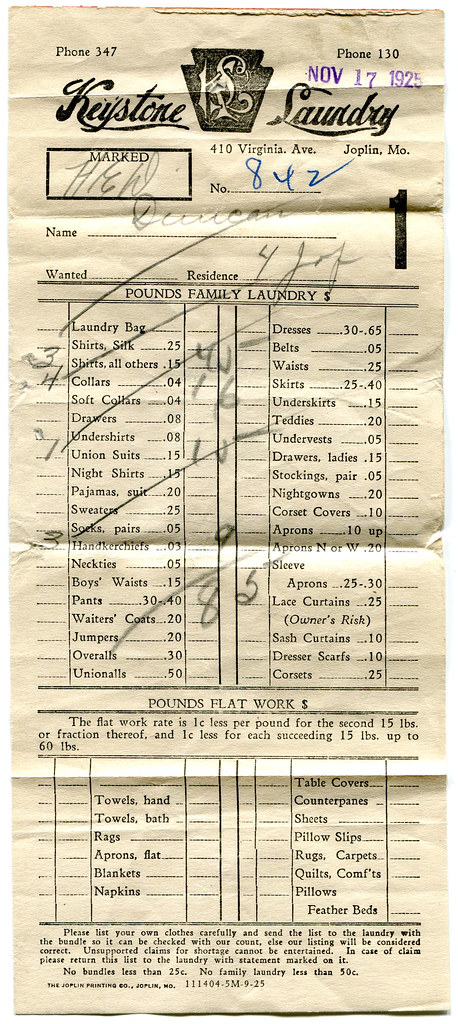
Should you somehow travel back in time to Joplin, 1925, and find yourself with a bag of dirty clothes, one option would be the Keystone Laundry, located at 410 Virginia Ave.  Below is a receipt from the laundry from 1925.  There’s more than a few items on the receipt that simply don’t come up in conversation anymore.   To our knowledge, there’s no connection between the Keystone Laundry and the Keystone Hotel (located at 4th and Main).

Receipt from the Keystone Laundry, 1925

Receipt from the Joplin's Keystone Laundry, 1925.

The Banishment of Seers

A few posts ago, we mentioned that Victorian Americans participated in palmistry, spiritualism, and séances.  Throughout the years Joplin was home to numerous psychics, seers, and fortune tellers. An issue of the Joplin Morning Herald from 1895 announced, “Madame Zita LaRoux, the famous trance medium, may be consulted on all affairs of life for a short time only at 619 Joplin Street. She gives valuable advice on all subjects — love, marriage, divorce, lawsuits, business transactions, etc. Names and dates given.”  But by 1913, the city fathers were tired of palmists, seers, and mediums, and subsequently prohibited them from practicing within city limits.
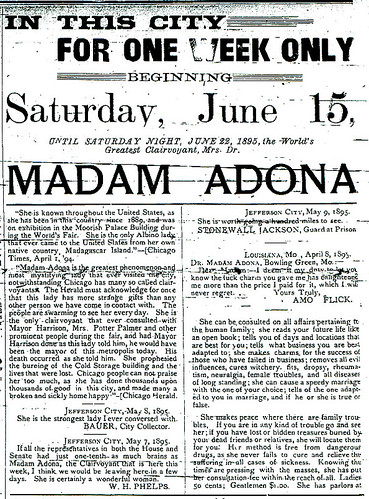
Ad for traveling fortune teller

An ad for a traveling fortune teller visiting Joplin with testimonials

Unsurprisingly, clairvoyants and their followers were upset by the city council’s decision. Joplin City Attorney Grover James, who “took charge of an aggressive fight to drive from the city ‘seers’ and ‘mediums’ that have remained since the passage of an ordinance barring them from practicing in Joplin” received threatening letters. In one week’s time, James received half a  dozen letters after his successful conviction of Mrs. T.J. Sheridan.

One letter read,
Mr. City Attorney,

City Hall

You think you are awful smart to prosecute a pore woman becauz she ain’t of your religion, doan’t you? Your talk at the trile was rite funny. Ha, ha. We’ll git you yet. Watch out.”

Another letter said,

Grover James

Joplin, Mo.

I write this to let you know that you may have misjudged the character of the people you are fighting. In persecuting worshipers you show an ignorance that is amazing. Many men have been shot for less than what you have done.”

Some people mailed Mr. James spiritualist publications while others stopped by his office to urge him to drop his campaign against fortune tellers and palmists. James, however, just smiled in response. He told the Joplin News-Herald, “I have found that many Joplin society girls attend séances and believe the stuff told them by mediums. When I started to gather evidence I supposed that I would have to obtain it from ignorant and superstitious persons. I found, however, that the elite of Joplin society are some of the best patrons of the mediums. Daughters of the most prominent Joplin citizens can tell me all I want to know about the ‘seers’ I am prosecuting. It may be that I will have half a dozen of the younger social set at the next fortune teller’s trial in police court.”

James confided he had gathered evidence against a local clairvoyant that “should be an eye opener to mining men that have the curtained rooms of mystics for their base of operations.”

According to James, “A woman ‘seer’ told a mining man just where to drill in order to strike ore. She said, however, that there was but one drill man that could find the stuff. She then described the man very closely. Half a dozen bids were made on the work. All of them were very low and reasonable but the mine operator was not satisfied. Finally a man came to him that fitted the woman’s description. His bid was thirty cents higher than any other but it was accepted.” The city attorney then claimed, “It has been shown that this drillman was kept in lucrative employment by the fortune teller who doubtless got a rakeoff for throwing him the work.”

Within a week, the “Reverend” Mary E. Anderson was arrested in Joplin for violating the clairvoyant ordinance. A few days prior to her arrest, Police Matron Vernie Goff visited Anderson in the psychic’s home at 731 Joplin Street and asked Anderson to read her fortune.  Anderson informed Goff that she would first have to buy facial cream and then she would read Goff’s fortune. Goff complied. She purchased a tube of facial cream that normally cost nine cents in a drugstore from Anderson for one dollar. The purchase completed, Anderson read Goff’s fortune.

According the Joplin News-Herald, Goff learned many “interesting things about herself and family that she had never known.”  Anderson claimed Goff had a long lost “Uncle Jim” and told her that her investments in an Arizona gold mine were a smart choice. The only problem was, according to Vernie Goff, is that she did not have an Uncle Jim, nor did she have any investments in gold mines.

Goff told the News-Herald that “the only money she has sunk in stocks was down on her father’s farm near Springfield, where she owns a little stock — that is some cows, calves, and such.”

At around the same time, two young boys had visited Mary Anderson and asked to have their fortunes read. She told them that her fee was one dollar. Unable to pay, the boys decided instead to testify against her in court. There was no need, however, as Police Matron Goff, Mrs. F.B. Cannon, and Miss Wathena Hamilton testified for the prosecution two weeks later. Like Goff, Cannon and Hamilton had both visited Anderson to have their fortunes read for one dollar. Anderson did not help her cause when she took to the stand, only to be caught “contradicting herself on many things.”
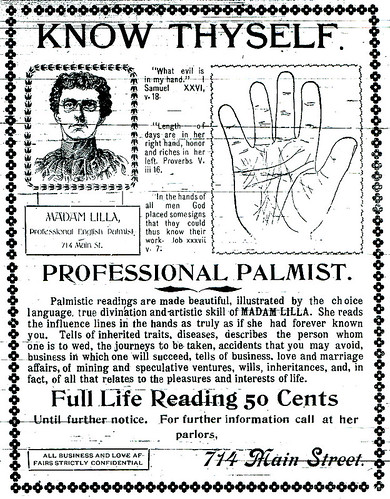
Ad for a Joplin Palm reader

An ad for a Joplin palm reader before the prohibition was put in place.

After a three hour trial, Mary Anderson was found guilty and fined one dollar and costs, as it was her first offense. She balked at paying the fine, but when told she would be taken to jail, Anderson borrowed a dollar from her attorney to pay the fine. She remarked, “I won’t have that News-Herald telling about me being behind the bars. I’ll pay the fine first.”

James’ campaign against palmists, mediums, and clairvoyants drove members of Joplin’s spiritualist community to Webb City. The News-Herald remarked, “One of the most notorious ‘seers’ of Joplin purchased property in Webb City and makes the city his home. He is doing a rushing business, it is understood.” But just as in Joplin, spiritualists were not welcome. The News-Herald reported that, “It was when a man came here from Columbus, Kan., for a ‘reading’ and became insane because of things told him by a ‘seer’ that Webb City businessmen began to wonder what became of the much talked of clairvoyant ordinance which was to have prohibited fortune telling in Webb City.”

Source: Joplin News-Herald, Joplin Morning Herald
A story from an earlier Joplinite

W.S. Gray, a machinery dealer located at 718 Jackson Avenue in Joplin, regaled a News-Herald reporter with stories of working for Moffet and Sergeant in the early 1870s.

Gray told the reporter, “I saw an article about the Cave Creek, Ark., zinc district in your Sunday issue,” he said. “it reminds me of the good days; it reminded me of the longest hike I ever undertook — a nice little 300-mile jaunt, all the way from Cave back to Joplin; and say, my friend, I always liked fish, but let me tell you I ate so many fish on that hike that I couldn’t even look a bottle of fish scale glue in the face for two years; and I snubbed one of my best old friends, John Finn, because the son of his name made me sick — but I’ve since recovered and can eat as many fish today as ever.”

He continued, “I was in the employ of the Moffet and Sergeant smelter here when I received an offer to be superintendent of construction at an air furnace that was to be built in the Cave Creek, Ark., district. It was my first job as supe and I was so proud of it. I broke the sweat band in my hat. It was about ’76 when we lined up for duty in the Arkansas wilds and began work on the new smeltery. Some time later things were running fine and we shipped a couple of carloads of lead — the pigs being carried overland in wagons to Russellville, Ark. When we came back to work again at the furnace the head bookkeeper drove over to a little place to get some drafts cashed. He sold the team and never came back — and not a cent of money did I get for my first job as superintendent. So the smelter closed down, and Lem Cassidy and myself — Cassidy is long since dead — started back afoot for Joplin. We knew the houses would be few and far between and that our grub must largely consist of fish. We laid in enough tackle to carry us through and started. Grasshoppers made the best bait imaginable and we had no trouble keeping our larder well stocked. We carried a little skillet, a coffee pot, and blankets with us. It was in the fall of the year, and walking was delightful. I have aways looked upon this jaunt as one long vacation. We took our time and enjoyed the beauties of the country. Sometimes we were fortunate in getting bread and vegetables from farmers, but such occasions were rare.”

According to the annual Report of the Geological Survey of Arkansas for 1905, lead mining began in the Cave Creek, Arkansas, mining district in 1876. “The pig lead was hauled by wagon to Russellville on the Little Rock and Fort Smith Railway and thence shipped to Pittsburg, Pennsylvania.”

Source: Joplin News-Herald

Mayor Hume: “No baby raffling in this man’s town!”

Just past the bright intersection of 4th and Main streets, a Joplin police wagon pulled up under the glowing lights of the Connor Hotel.  As the police entered the hotel they were joined by the city’s mayor, Guy T. Hume, intent on arresting N.B. Peltz.  Peltz was working in cooperation with the Provident Association, the successor organization to the Charitable Union, which had been largely run by the city’s ministers.  As Peltz was led out of the Connor Hotel in handcuffs he protested, “I am doing this for charity.”  By this point a crowd had gathered and Hume replied coolly, “That makes no difference.  Raffling off babies is against the law and you know me.  Too many complaints have been made.”

In fact, the baby raffle was actually part of a charity fair to be held by the Provident Association and the Joplin Benevolent and Protective Order of Elks between May 10th and May 13th.  Among the fundraising efforts connected to a fair was a raffle for a $500 lot in Spring Park at a cost of fifty cents a ticket, as well the chance to win a pony and cart for a ten cent ticket.  The tickets were sold by a “Flying Squadron” that consisted of some of Joplin’s prettiest girls who rode around on “dreadnoughts” in the form of cars with flags and flyers which advertised the fair.  Other enticements included a $75 scholarship to the Joplin Community College and six months of free instruction at the Calhoun School of Music.  Activities included a beauty show, music, an Elks’ Museum of Unnatural Wonders, cigars, refreshments, a country store, a flower booth, a dance, and fortune telling.

Before he was placed into the paddy wagon, Peltz continued to contest his arrest, “Why, Mr. Mayor, you couldn’t arrest me if I announced ten days ahead of time that I proposed to get drunk, could you?  Then why can you arrest me because this announcement has been made?”

The announcement of a baby raffle had caused some consternation.  Rumors floated around town that the baby to be raffled off might be exhibited at the Provident Association’s headquarters at 509 Main Street.  Concern had come from within the Provident Association which was divided on the issue of the baby raffle.  The majority believed that a significant amount of money was to be made from such a raffle, while the minority grumbled that it would be well enough to just raise that amount without resorting to such a raffle.  In response to Peltz’s question, Mayor Hume shrugged and replied, “Just jump into the patrol wagon and you can explain to Judge Kelsey later.”

Seated inside the patrol wagon, Peltz was hauled off to the jail.  Although several guests at the Connor Hotel offered to help Peltz, he instead asked G.F. Newberger to post his bond.  Once freed, Peltz announced he would fight the arrest and claimed, “I am backed in this by some of the best people in Joplin.”  Never the less, Peltz pointed out, “the mayor can’t prove that I intend giving away the baby.  The parents can do that, can’t they?”  He went on to point out that the parents did not object, which would make it hard to prove he was guilty.  The mayor, Peltz declared, “is butting into some trouble.”

Told later of Peltz’s words, the mayor simply laughed, “Take it from me, there will be no baby raffling in this man’s town while I’m mayor.”

The question of the reality of a baby raffle eludes us.  Some investigation into the matter found examples of baby raffles where the baby in the end was switched out for a young piglet, while another example was noted in a January, 1912 Popular Mechanics, in Paris, where orphaned babies were actually raffled off to find them homes.  Know anything of baby raffles?  Please comment and let us know!

Sources: Popular Mechanics, “A History of Jasper County and Its People,” by Joel T. Livingston, and the Joplin News Herald, 1910.

Gypsies and Joplin

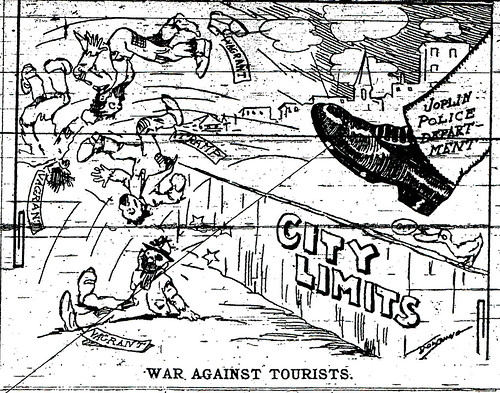
Joplin Police kicking out unwelcomed "tourists."

The Joplin Police kicking out unwelcomed "tourists."

In mid May of 1911, visitors arrived on the outskirts north of Joplin.  Their presence immediately brought about disapproval and a visit from the Joplin police.  The police had been notified of the arrival of a “tribe of Gypsies” at what was called their “usual camping ground.”  Gypsies or Roma, or Romani, as they presently prefer to be called, were not welcome visitors to Joplin.  The Joplin News Herald, captured the feelings of the Joplin police chief, Joe Myers, who claimed that most (but not all) of the gypsies were of the type who would do anything but work for a living.  Chief Myers added, “It is our intention to make life such a burden for them that they will not want to remain here long.”

One reason for the lack of hospitality came from the Joplin police department’s claim that a month long visit by the gypsies the year before had been accompanied by an explosion of “petty robberies, begging and small crimes.”  The new arrivals hardly had time to unhitch their horses before the police arrived to inform them that no license would be granted to them to fortune tell.  The News Herald reporter was told that the police force was expected to “make life miserable for them generally.”

The gypsies eventually packed up and departed Joplin only to face the likelihood of similar treatment in the next town. Their treatment at the hands of the Joplin police was not uncommon; tramps, transients, and migrant workers often faced the same fate upon arriving in town. Loafers, idlers, and hoboes were not welcome in many towns across the country, including Joplin. The gypsies that sauntered into Joplin were fortunate they were not sent to the city’s work house to break rocks like so many tramps and vagrants had before. Instead, these free spirits were encouraged to move on, lest an anticipated crime wave break out.

Source: Joplin News Herald, 1911.

Charles Schifferdecker: Bottling Beer Even Faster

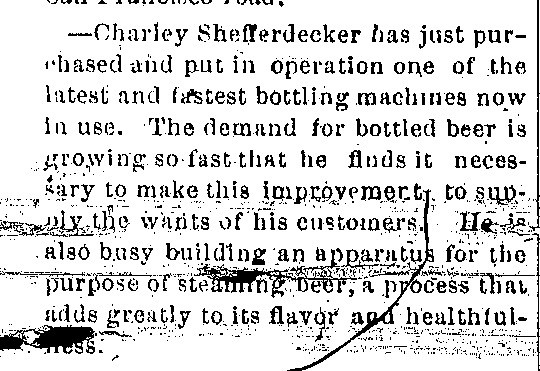
Charles Schifferdecker was one of the richest men in Joplin and his elaborate red stone home still stands. A source of his wealth was beer and this article from 1880 notes Schifferdecker’s purchase of a new bottling machine due to high demand of the young mining town.

Schifferdecker bottling machine article

Article from the 1880 Joplin News Herald

Source: Joplin News Herald

A Haunting in Joplin

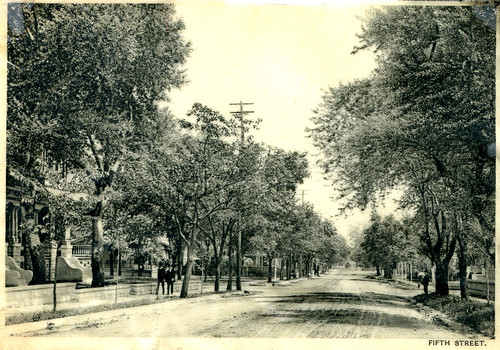
A typical Joplin residential neighborhood

A typical Joplin residential neighborhood

Some Victorian Americans participated in palmistry, séances, hypnotism, and several strains of spiritualism.  Despite this predilection for the occult, one rarely finds stories of ghosts or haunted houses in the early Joplin newspapers, although palmists and psychics would occasionally set up shop in town.  The morning after Halloween, the newspapers often mentioned pranks that had taken place, such as taking someone’s gate off its hinges and hiding it.  Perhaps Joplin was still too young to have ghost stories.

One of the few stories we have read in the papers is the story of a house that stood at the southeast corner of D and Wall streets.  Numerous former residents alleged that they heard “sounds weird and strange, which could only have been made by inhabitants of the spirit returning to earth.” Its reputation had left it neglected and forlorn.  The house sat the center of a fifty foot lot and stretched “from within about ten feet of the front walk to the rear fence, and is constructed in such a manner as to appear winding, the rooms being set in and out from a line connecting the center of the two ends of the building.” A front porch post had fallen.  Grass and weeds surrounded the house.

Neighboring residents used the house as a threat when faced with an unruly child.  When threatened with spending a night in the house, most neighborhood children “ready and willing to do most any task imposed on them or to comply with any request of their parents.”

Some people insisted the noise came from a large family of rats that had taken up residence in the house.  A reporter from the Joplin News-Herald spent the night in the house.  He reported that, “When all was still and quiet a sound as of a body falling to the floor caused a dull thud that sent the blood coursing through the arteries of all those sleeping in the house.” A search of the house turned up nothing.  Doors were heard to squeak as if they were being opened, but upon checking, the reporter and his cohorts found the doors were still securely looked.

Neighbors remarked that “there have been tow to five tenants each month, and most them have left with tales of hair raising experiences.” A woman interested in living there, however, told the reporter, “If the ghosts are real ones, the gun will not hurt them and if they belong to this earth, the gun will soon put a stop to them.”

Source: News-Herald, 1906

Globe Article Covers the Closing of Howsmon’s

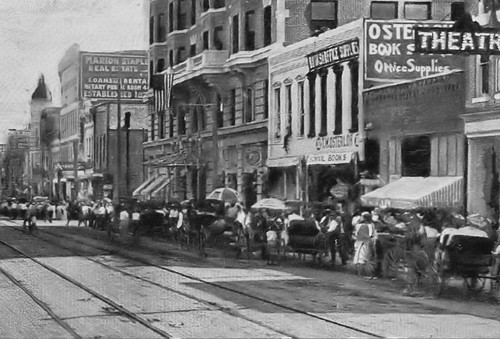
Last Friday, the Joplin Globe covered the shuttering of Howsmon’s Office Supply and Furniture Company, a 47 year old business.  As the article notes, Howsmon’s began with the purchase of Spurgeon’s Bookstore, which originally was Osterloh’s Bookstore that had opened in 1890.  Osterloh, in addition to selling books, was also an avid photographer and is responsible for a number of early Joplin photographs.  While Howsmon’s didn’t remain in the original building for long, Osterloh’s bookstore was located on the 300 block just a few yards north of its towering neighbor, the Connor Hotel.  Below is a photograph capturing a busy day in front of the bookstore:

Osterloh's Bookstore

Osterloh's larger sign, obstructed by its neighboring theater's sign, advertised book and office supplies. The structure two buildings down is the Connor Hotel, dating this photograph after 1908.

Source: The Joplin Globe

Memorial Day in Joplin

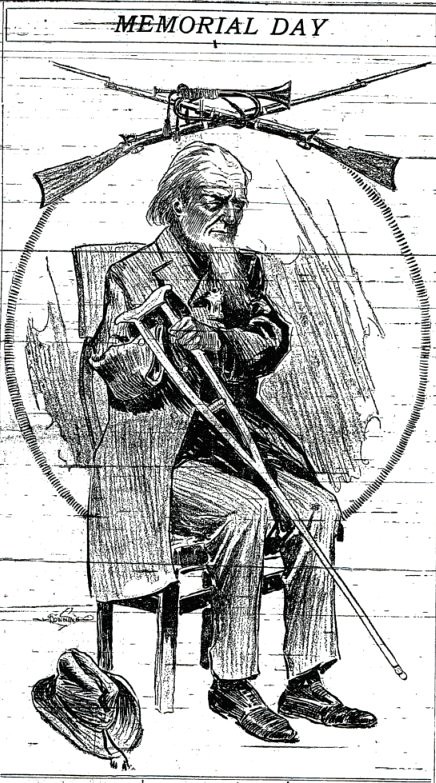
An illustration in a 1907 Joplin newspaper celebrating Memorial Day.  True to the holiday’s origins, it’s a sketch of a Civil War veteran.  Joplin had a unit of the Grand Army of the Republic and was home to a number of Civil War veterans.  We at Historic Joplin thank all our veterans for their service.

Joplin Memorial Day illustration

Joplin Memorial Day illustration

Source: The Joplin Globe