Life as a Hello Girl

In 1910, the Joplin News-Herald ran a story about the advantages of working as a “Hello Girl.” The News-Herald remarked that while it might not be fun to “sit up to a switchboard and come in contact with the varying dispositions of several hundred people each day” there were “some things about the work of the central girl at the Home Telephone company’s office in this city that probably come to no other working girls in town.”
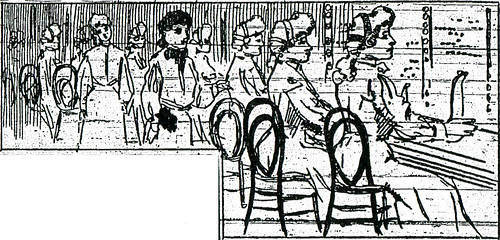
Hello Girls operating the telephone board

Hello Girls operating the telephone board

Despite hearing about “heartless corporations” the News-Herald assured readers that this was not the case with the Home Telephone Company located in a building on Joplin Street.  Since 1906, girls were treated to an on-site “culinary department and lunch rooms.” The News-Herald reporter, unable to curb their enthusiasm, gushed, “A lunch room and a kitchen in the telephone plant!” On “pleasant days” a light lunch was served, but when the weather turned bad, regular dinners were served that were, “equal to those of the best restaurants in town.” Girls were guaranteed a free lunch twice a day.

When the operators were at work on Thanksgiving, Christmas, and other holidays, the company served large dinners in the company dining room so that the girls could at least have a hot dinner during the holiday.  Empty stomachs and “improper food”, the company believed, could affect an employee’s disposition.  Lunches and holiday meals meant, “congenial employment, pleasant surroundings, and the saving of considerable money in the course of a year.”

Even more astonishing, at least at this time in history, was the fact that the company also had “baths, individual lockers, and a rest room, or sitting room” that was overseen by a “regularly employed matron.” Should a girl seem exhausted or ill, she would be sent to the rest room or home.  Mrs. R.L.Whitsel, the company’s matron, was hailed as, “experienced and efficient.”
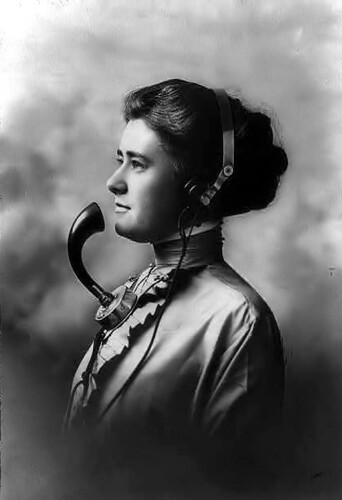
A telephone operator circa 1911.

This unnamed telephone operator from 1911 is representative of telephone operators of the time.

If the weather was nasty, the company paid for closed carriages to pick up girls at their homes to bring them to the office.  Once their shift was over, a carriage would transport the girl safely back to her home.  The company’s management realized that “healthy, happy, and well cared for girls are more likely to be cheerful and pleasant to their patrons and more prompt in service than girls who are overworked and neglected.” Wet clothes were considered “hard on the disposition and health of the girls and the telephone company prefers to have its employees happy and cheerful, even if that means occasional bills for carriages.”

Given the number and types of jobs available in Joplin at the time, it appeared that if a young woman could secure a job as a Hello Girl, she found herself with a relatively comfortable means of income.  It also represented a time period when society felt that young women deserved an extra amount of protection from the theoretical evils of the business world, where vicious characters lurked to take advantage of young, innocent women.  Never the less, this legacy of care from the Victorian world seemed to offer some of the women of Joplin a safe and inviting place to work.

Source: Joplin News Herald, 1910
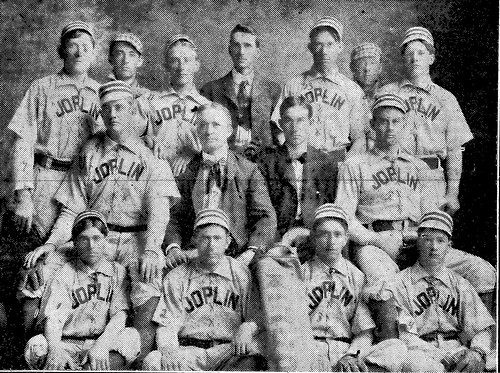
Joplin’s First Organized Baseball Team – The Colts Who Became the Miners

By the turn of the century, baseball had an established presence in Joplin in the form of amateur teams, both black and white.  However, what Joplin did not have was a professional team and the Joplin Base Ball Association was created to change this fact and to “promote the great national game in this city.”  The lead men behind the club was Arthur C. Cox, treasurer, Don W. Stuart, secretary and a manager of the Club Theater, and John A. Campbell, president.  Joplin was to play in a six team league called the Missouri Valley League, the other teams involved were from Jefferson City, Springfield, Sedalia, Coffeyville, and Iola.

The Joplin Miners

The Joplin Miners of 1902

The Colts, as they were initially named, had their first home at Cox Park and were watched by cheering fans in a brand new grandstand that seated 1,500.  The grandstand featured special boxes for the scorekeeper and the press, plus 12 private boxes for those willing to pay for the privilege of a good seat.  A good seat was needed as apparently for the first time in Joplin baseball history, only the players and umpires were allowed on the field.  Under the grandstand, locker rooms complete with showers awaited the teams before and after the games.

The team was managed by Claud A. Marcum, considered locally as a seasoned baseball veteran who oversaw a “galaxy of stars.”  Outfitted in uniforms ordered from Rawlings Sporting Goods of St. Louis, the team won their season opener against Springfield at Springfield, 11 to 6.  Unfortunately, the Colts promptly loss their home opener against Springfield a few days later.  By the end of the season, two notable events had happened.  Joplin had failed to win the league pennant or even place in the upper half of the league and the Colts had changed their name to the Miners.  From the end of 1902 and for many decades to come, the Miners provided Joplin with a team to cheer for and a pastime to enjoy.

Featured left to right in the photograph above are: Top Row — Wright Wickizer, catcher; an unnamed pitcher; Bert Dunn, pitcher; Claud Marcum, manager; Arthur “Rip” Reagan, pitcher; Peck Harrington, catcher and outfielder; and Lefty Greer, pitcher.  Middle Row — Earl Taylor, pitcher, Don Stewart, secretary of the club; Arthur “Art” Cox, treasurer of the club; and William “Dolly” Gray, first baseman.  Bottom Row — Bert “Monk” Senter, shortstop; Jimmie Underwood, outfielder; Fred Tullar, third base; and Dick Bayless, outfielder.

Sources: The Joplin Globe, “Angling in the Archives” by Charles Gibbons.

Well I Never!

During the summer of 1917, Joplin Police Desk Sergeant Walter Finch answered the telephone to find an upset woman on the other end of the line.  The woman demanded that the police immediately send officers to her neighborhood.  Finch, puzzled, asked the caller what the emergency was.  He was informed that, “There are some women near here who are wearing trousers and I want the police to stop it.” Sergeant Finch, not knowing what to do, asked Joplin Mayor Hugh McIndoe for advice.  McIndoe responded, “Well, this is a new era for women, and if the garments are not improper I see no reason why the women should not wear them.” Detective Charles McManamy and Police Sergeant Ezra Hull were sent to “censor the garments.”  Upon their arrival at the residence, the two officers observed two women in overalls.  The two men conferred.  McManamy was agreeable to women in pants; Hull disagreed.  McManamy won out and the two women were told “they could continue to attire themselves in the ‘new era clothes.'”

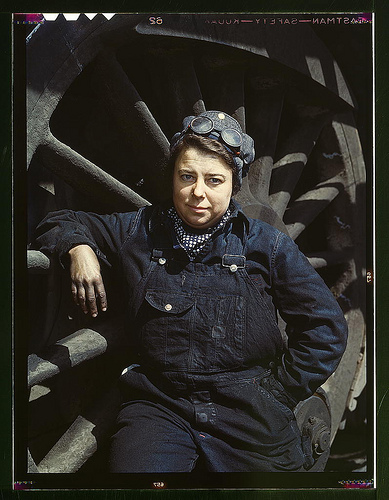
Woman in Overalls

By the Second World War, it'd become quite more socially acceptable for a woman to wear overalls.

Source: The Joplin Globe, Library of Congress

Letters to the Joplin Police Chief

In 1907, the Joplin Police Chief Myers shared some of the letters he received on a daily basis with the Joplin Globe.  The letters offer a glimpse of life in Joplin and the surrounding areas.  Some the letters he received were mundane, such as the following letter:

“Cherryvale, Kan., Oct., 21, 1907.
Joplin City Marshal, Joplin, Mo.

Will you please see and inform me if there are any girls wanted to attend to lunch counters.  If so, I can send an experienced one, and please give me the number and the price of wages.  Let me hear soon.  Respectfully,

S.A.T.”

The Globe jauntily remarked, “The chief of police has not answered the above letter because of the fact that he is not running an employment agency.  In fact, if the chief answered all of the letters of this nature he receives he would have to hire a private secretary.”

Another letter that Chief Myers received read,

“Cassville, Mo.  Oct.  22, 1907.
Chief of Police, Joplin, Mo.

Dear Sir — Will you please inform me by enclosed card if a woman by the name of Ella Hailey is in your city.  She may be working in one of your hotels.  Please phone hotels and see if she is there.  Oblige, A.C.H.”

The Globe noted that the “last letter is somewhat out of the ordinary as he addresses  the chief as ‘dear sir’ and actually says ‘oblige’ in ending his letter.  The majority of the letters simply tell the chief of what they desire him to do and let the matter pass.”

Other letters were in response to an earlier missive from a Joplin man, C.T.  Plimer, who was hunting a wife.  One woman from Platt City, Missouri, declared, “Now please understand I am not a man hunter, for I never gave this subject much thought.  I think that I will fill the bill and the description, except having the several thousand dollars.  I have some nice property here.  I have visited in Joplin and like your city very much.”

The “most amusing letter” that Chief Meyers received, according to the Globe was one from an African American man in Fort Scott, Kansas, who wrote,

City marshal, be on the lookout for a young colored woman by the name of Leatha B—-.  She is a brown skin, good looker, good hair, a pair of earrings with blue sets, and a finger ring with a blue set in it.  She might go by the name of Leatha C.  She wears a long black coat, a black hat turned up on the side with a band with a red stripe in it, a nice black dress, and a changeable silk underskirt.  I just bought them for her.  There is a young brown skin man by the name of Will Julien.  If you catch them arrest them both and lock them up until you hear from Butler or Mr.  George Julien.  If she is there and ain’t working and running the streets, make her leave town.  Yours truly, Andy B.

P.S.  — Make her come home; she ain’t got no business down there.  I have got a good home for her and she don’t want for nothing.  Make her leave town.  She left this afternoon at 3 o’clock.  Telephone back at my expense.” — Andy B.

We’re not sure if Leatha returned to Andy B.  in Fort Scott or not, but it was probably not the last time that Chief Myers received a letter from the hopeful and the lovelorn.

Source: The Joplin Globe

There were Miners, and there were Bankers

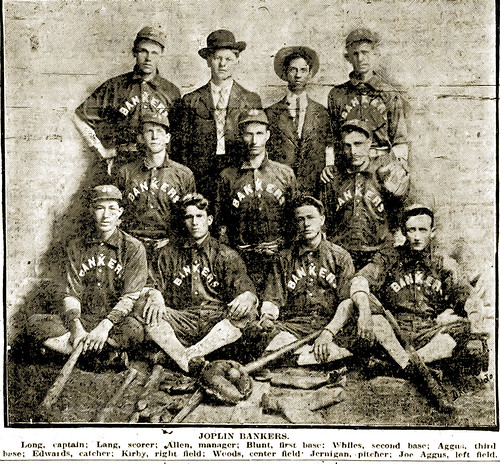
While Joplin had its first professional baseball team in the form of the Colts who became the Miners, it did not mean that others put down their gloves and bats.  One group of men who continued to play, perhaps as an amateur team, were the Joplin Bankers.  Note, the team consisted of the bare minimum to play with one man for every position.

1907 Joplin Bankers baseball team

The 1907 Joplin Bankers baseball team.

Source: The Joplin Globe

A Plunge Down a Sixty-Foot Shaft

Every day hundreds, if not thousands, of automobiles rumble through downtown Joplin.  Most drivers  go about their business without a thought that there may be empty mine shafts below their wheels.  We here at Historic Joplin do — which is not to say we’re afraid of our vehicle plunging into a gaping chasm on Main Street, but in an area riddled with mine shafts, tunnels, and sinkholes, the ground giving way does happen from time to time.  Mine shafts even presented a threat to folks, who despite having a familiarity with the dangers of working in the mines, had the misfortune to make a misstep.  Or, in the case of James “Jim” T.  Bodine, the wrong way home.

In the summer of 1904, Jim Bodine was on horseback herding the family cow home for the night.  As he passed south of Twenty-Sixth Street, he had to ride through some brush when he and his horse unexpectedly encountered an abandoned mine shaft.  Bodine, who was a, “well known and very popular mine superintendent and operator,” undoubtedly knew about mine safety, but riding your horse into a mine shaft in the middle of the night was something he had thought little about up to this point.  Bodine’s horse pitched forward into the shaft.  It managed to dig its forelegs into the mine shaft so that it seemed as if it would be able to get both itself and Bodine out of the shaft.  Unfortunately, its legs buckled and the two plunged sixty feet into a water-filled mine shaft.

An abandoned mine shaft via Bureau of Land Management

Abandoned mines poise significant danger risk in any mining area, such as this one located in California.

Both man and horse surfaced with Bodine still in the saddle.  The horse struggled to keep its nose above the water.  Bodine tried to sit in the saddle as long as he could, but realized the horse could throw him at any time, so he slipped into the water.  His head throbbing from a bump to his head, Bodine managed to climb two or three feet onto the walls of the mine shaft.  As the strength began to leave his arms, he began to cry for help.  There he remained for over an hour yelling for help.  In the water below Bodine, his horse was “plunging and striking his feet right and left.” Gritting his teeth, he sank his fingers “into the sides of the shaft as far as possible.”

Fortunately for Bodine, a Mrs.  Carter was passing by when she heard his cries for help.  She “ran to the shaft, shouted a word of encouragement to Mr.  Bodine, and then ran for help.” Mrs.  Carter brought James Ingram, D.E.  Krokroski, and H.  Dillon back to the mine shaft.  There the three men lowered a rope to Bodine which he tied around his waist.  Together the men pulled Bodine up to the surface where he was rushed home.  Four doctors were summoned, but found that Bodine was in good shape despite his harrowing ordeal.

Bodine later told a Globe reporter, “There was a time when I thought I would have to give up and fall into the water.  After Mrs.  Carter looked into the shaft and then ran for assistance it seemed hours before assistance came.  I felt my strength gradually giving away, and it seemed that every minute would be my last.” Even as the rope was being lowered to him, Bodine confessed, “I thought I would not e able to keep my position until I could get it tied, but it is remarkable how a man’s strength will stay by him when his life is at stake.” As for his horse, several men tried to extricate it, but as of the newspaper’s deadline, they had not been able to pull it out of the shaft.

Source: The Joplin Globe

Children on a Debauch

In today’s society one often hears, “Well, when I was kid we never…”

In the spring of 1900, Joplin police officers Grant Buzzard and John Chester found four young teenagers, two boys and two girls, engaged in a “drunken debauch” on Joplin Creek.  The two experienced officers were shocked by the sight of what the Joplin Globe called, “the most horrible story of youthful depravity yet recorded in Joplin.”  The two girls, Vida McElroy and May Sherman, reportedly the “daughters of women of shame and reared possibly in a brothel” were passed out in the muddy creek bed.  McElroy was fifteen, Sherman thirteen.  McElroy’s mother reportedly kept a “bawdy house in the North End” and Sherman’s mother allegedly worked at the “Red Onion” brothel.

Upon investigation the officers discovered that the two boys, Sam Belstine and George Littler, purchased at least two and half pint bottles of whiskey as well as some bottles of blackberry wine from Nick Christman’s saloon.  They met up with the two girls and headed out to Joplin Creek just off of East Seventh Street.   There they proceeded to split the liquor between them and have a roaring good time until the officers arrived on the scene.

The girls were put in the officer’s buggy while the boys were forced to walk back into Joplin in front of the horses.  The Globe commented, “Nurtured in shame and their minds poisoned from infancy by reason of the influences about them…both girls are wild and young.”  The two boys, Sam Belstine and George Littler both about fourteen, were described as, “men of low character.”  Littler’s father, Tom, was “well known to the police.”  Belstine, who worked as a newspaper boy, was the son of the owner of the Southern Bar at the corner of Twelfth and Main Streets.

Interestingly, while the authorities vowed to send both girls to the State Industrial School for Girls in Chillicothe, Missouri, they did not express their intent to send the boys to the Missouri Reform School for Boys in Boonville, Missouri.  W.A. Root, the bartender who sold the liquor to the boys, was expected to face prosecution for selling liquor to minors.

Image of Missouri State Industrial Home for Girls

Image of Missouri State Industrial Home for Girls from Missouri Digital Heritage

Source: The Joplin Globe, Missouri Digital Heritage

More Trouble at the Silver Moon Saloon

In the rough and tough world of Joplin’s saloons, it seems excitement was never far away.

Henry Moon, the proprietor of the Silver Moon Saloon in August 1904, did not suffer fools.  Will Sowder was in a bad mood.  It ended, of course, with bloodshed.

Sowder, whose real name was Will Davis, was the stepson of Deputy Marshal Frank Sowder.  Perhaps Sowder felt this relationship gave him special privileges.  He had already faced arson charges earlier in the year, but was acquitted. Or maybe he just didn’t care after a night of heavy drinking with his friend Mike Ryan.  In any event, Sowder got into an argument with Moon.  Heated words were exchanged. Sowder lunged behind the bar and hit Moon.  Moon hit the floor and Sowder jumped on him.  He was in for a surprise, though, because Moon was able to draw his revolver.  With a squeeze of the trigger, Moon shot Sowder in the leg, then hit him over the head with the gun.  Sowder staggered and fell, leaving a pool of blood on the floor.

An ambulance picked Sowder up and took him to his home at the southeast corner of Fourteenth and Wall Streets.  There he received medical attention from Dr. Tyler who felt that Sowder would recover from his wounds without any problems.  Moon, however, was hauled off to the home of Justice Potter who turned Moon over to Constable Arch McDonald.  Moon bonded out after he ponied up $1500.  He refused to talk to a Joplin Globe reporter about the incident.

In the end, it was just another night in Joplin.

Source: The Joplin Globe

Big Trouble in Little Joplin II

Life is never easy for immigrants in a foreign land.  The Chinese immigrants in Joplin had to deal with much more than simply petty crime as this story reveals.

Jung Gue, owner of a laundry on West Fifth Street, was not about to let “Dirty Billy” Williams rough him up.

The shirtless Chinese immigrant, clad only in a coat and trousers, testified in police court [as rendered by a Globe reporter], “Boy name Slim Bacon bring laundry to me. I think him velly good boy. He want to change him shirt and put clean shirt on. I telly him to go in back room and he go.”

When Slim Bacon, described as a “young street urchin” who occasionally worked as a waiter in a nearby “chop suey parlor,” departed the premises, he took Jung Gue’s only shirt with him. As Jung Gue told the police judge, “When he gone I find my shirt gone. Only shirt me have. Cost two, three dollars, maybe.”

The laundryman continued, “Yesterday Slim, he come back. I look at him and he got two shirt on, one mine. I try to make him give me shirt, him velly bad. Den dis boy, he name ‘Dirty Billy,’ he hold me, grab me around like dis and Slim, he run away, and Dirty Billy, him velly bad, him pick up rock and say him will throw rock on me. I call de policeman.”

As explained by the Globe reporter, Gue and Hop Chow Lee were about to make Slim hand over the stolen shirt when “Dirty Billy” Williams “butted into the argument, held Jung until Slim had fled, and then threatened Jung with a stone. Billy very patriotically declared to the judge that he wasn’t going to let any Chink run over a white man.”

Judge Bourn, however, disagreed with Dirty Billy and fined him $3 and costs. Bourn declared, “I never knew of these Chinamen ever bothering anybody. They tend to their own business, but there is a crowd of boys around there forever bothering them, and I am going to put a stop to it.”

Bourn, according to the reporter, had patronized Gue’s laundry for five years. This prompted Dirty Billy’s attorney to declare Bourn was prejudiced, but Bourn overruled on “account of the absurdity of a man being friendly to a man who had done his laundry for five years.” Before leaving the courtroom Gue shook hands with Bourn, who bid Gue ‘good evening’ in Chinese. The Chinese immigrant crowed to the Globe reporter, “Judge Bourn him velly good man.”

As for Slim Bacon, he was declared a fugitive and was doubtlessly still clad in Jung Gue’s good shirt.

Source: The Joplin Globe

The Reminiscences of G.O. Boucher — Part IV

Historic Joplin believes in allowing the people of the past to speak for themselves.  As a result, the language they use may offend those sensitive to harmful words that are no longer acceptable in today’s present society.

The Story of Bear Fighting Blackwell

“The First dry goods store in West Joplin was started next to ‘Big Nigger’ Lee’s grocery store by a man the name of D.M.  Brazill, in the fall of 1871.

One old timer who arrived in Joplin about this time and who furnished considerable amusement was a man known as ‘Bear Fighting’ Blackwell.  He brought four big bears with him and for some time after he arrived he kept his business to himself.  Finally, after he had things ready, he advertised a dog and bear fight.  After all was ready he stretched a large canvas around a space which was filled on the day of the fight by the village sports.  In the center of the space he had a big grizzly chained to a stake and surrounding him were five or six youngsters holding their dogs.

Betting was at a high pitch and as well as I can remember it was about 2 to 3 to one on the bear.  When all was ready for the fight, Blackwell gave the bear a big plate of honey and after it had the plate he yelled, ‘Turn your dogs loose!’ The fur flew and it looked as if the dogs would soon use up the bear.  When it was all over the bear was uninjured while there were several dogs limping around.

The bears were turned over to the butcher and Mr.  Blackwell used the money which he had accumulated to build a nice brick building at the corner of Second and Main streets.  This was the first opera house in West Joplin, but the dog and bear fight or something else brought ‘Bear Fighting’ Blackwell bad luck, and the old man got into trouble and was sent to the penitentiary.  Several years after that he was turned out and went to Oklahoma, where he married a squaw who had a large tract of land and plenty of money.  He laid out the land in town lots and was the founder of the present city of Blackwell.”

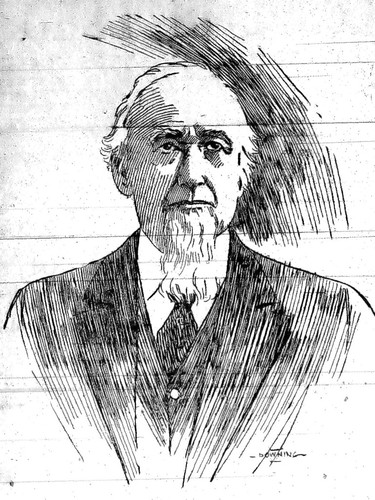
Drawing of A.J. "Bear Fighting" Blackwell

Drawing of Henry "Bear Fighting" Blackwell in his later years.

This concludes G.O.  Boucher’s memories of early Joplin.

Source: Joplin Globe.