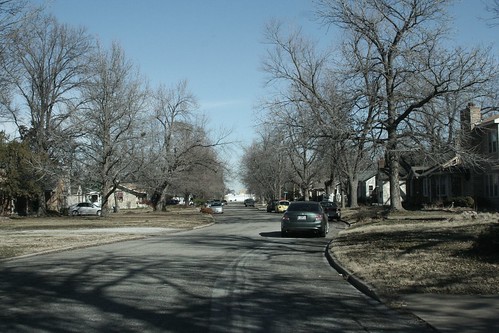
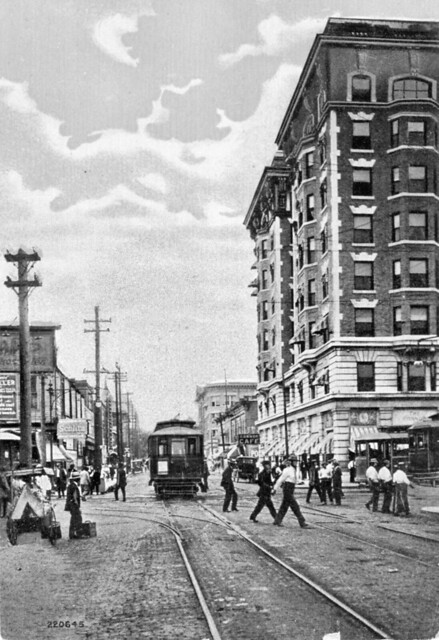
Have a Great Fourth of July!

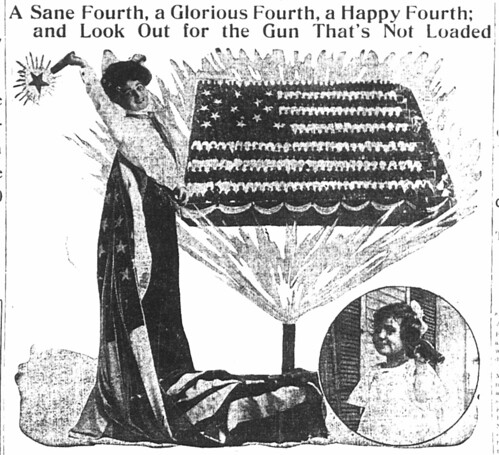
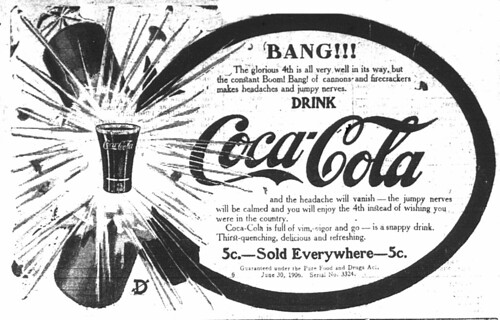
The Fourth of July was as popular a holiday in Joplin in the past as it is today. The same emphasis on safety with fireworks continues today, though, perhaps not so much the worry on loaded firearms. A local paper illustrated the dangers of firecrackers, be it from boys throwing them at passersby in the street for laughs to other boys using the explosives as potential tools in arguments. One such event occurred as written:

“Three negro boys were walking down Fourth street this morning with their pockets bulging with fire crackers. As they passed the Miners Bank building two young men, prominent in business circles, began to “kid” the boys about the Jeffries-Johnson fight. The negroes became “riled” and in a moment were willing to take their contemporaries on. In the meantime, one of the negroes, who gave his name as Fred Jackson, stepped behind a telephone post and lit a big fire cracker. It exploded in his hand and the boy’s cries drowned the arguments. In an instant the miniature race war ceased. The young men grabbed the negro and carried him to a drug store, where he was given medical aid. the negroes apologized for their quarrel and the white boys “Set ’em” up for the sodas.”

To Cure Evils: The Joplin Automobile Club

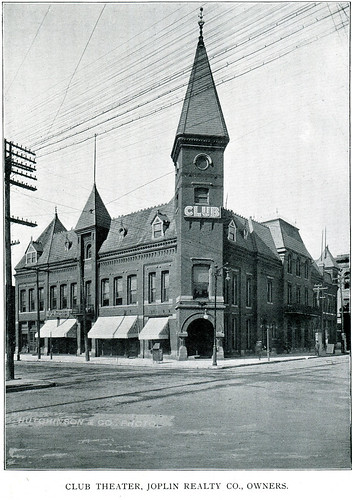
The founding members of the Joplin Auto Club met at the meeting room of the Joplin Commercial Club located at the Club Theatre.


“To cure evils,” was the purpose of the establishment of the Joplin Automobile Club, a branch of the Southwest Missouri Association. In the February of 1911, the city of Joplin was faced with the new problems and dangers of a populace that increasingly turned toward motorized travel in the streets. In response, the city attorney, W.M. Andrews, oversaw a crack down on motor vehicle violations with a veritable flood of arrests and fines. Outrage was immediate. In the quarters of the city’s Commercial Club “bankers, doctors, lawyers and businessmen,” the elite who could afford automobile ownership, demanded answers from Andrews. Andrews, in turn, was blunt. Fourth Street, the city prosecutor decried, had turned into a race track and “only miracles have prevented deaths as a result of fast and reckless driving.”

At issue was a city ordinance which required illuminated numbers on cars to help Joplin’s police department identify and arrest offenders. A number of owners complained that the length of their car identification numbers made adherence an impracticality. Andrews, however, was undeterred and argued of the dangerous driving, “This must be stopped. If there are no numbers on the machines how can an office detect the guilty parties? Within the past two weeks there have been several people injured by autos, and in one instance a woman and two children were thrown from a buggy.” In compromise, Andrews stated that adherence within ten days would result in a dismissal of charges and fines. Unsurprisingly, this was well received.

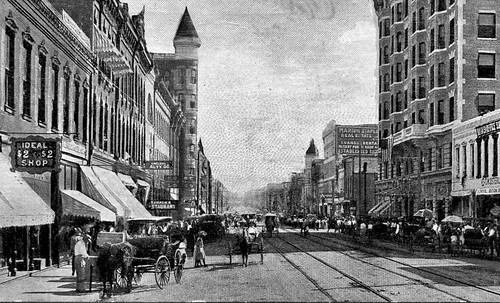
Taken sometime after 1908, this photo reveals that at least 3 years before the creation of the Joplin Automobile Club, Main Street was still mainly a place of horse and buggy.


The car owners were not without a sense of responsibility for their machines of a new century. The Joplin Automobile Club was only part of a series of clubs created throughout Jasper County, with additional clubs associated with the other towns of the county. Approximately 100 men joined that February with the expectation that membership would grow as word and knowledge of its existence spread.

Two weeks later, the men gathered again to elect officers. Taylor Snapp was voted president, Fred Basom and Victor Young, vice-presidents, A.H. Waite treasurer and W.M. Pye, secretary. At the same meeting, the club voted to create reward money for the arrest and conviction of individuals who sought to ruin the enjoyment and lives of car owners. $100 for a car thief, $25 for someone stealing a part of a car, $10 for anyone who cut a tire or threw rocks at a car or its occupants. Interestingly, the club also voted to encourage a crack down on teamsters, who “persist in taking the entire road and who refuse to permit automobiles to pass” in violation of state law. It was Snapp, in this capacity as president who later spoke for the club after a car accident resulted in the creation of Joplin’s first motorcycle police officer. In short, however, the Joplin Automobile Club came into existence as a means for mostly wealthy men to protect their interests in the new and expensive world of car ownership. The distinction of car ownership would fade eventually with the production of cars affordable by all, such as the Ford Model T.

A Car Accident

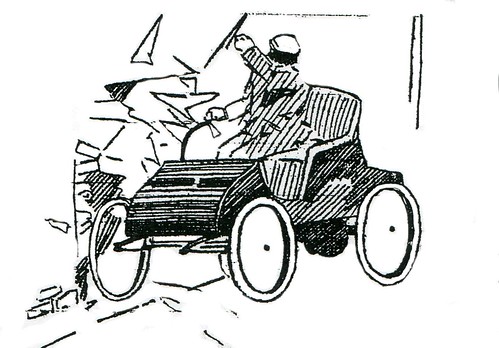
A sketch of one of Joplin's early car accidents.


“Great Excitement prevailed for a time, but this soon subsided…” In 1906, automobiles were still a new and intriguing sight on the streets of Joplin. The motorized fire engines were still a dream and the road mainly belonged to horse drawn buggies, wagons and trolleys. Thus, it was still quite a newsworthy event when one of the new machines accidentally plowed through the front of A.C. Webb’s automobile establishment at 2nd and Joplin street. A Joplin paper described the event:

“The automobile has always been noted for its liability to do things, but this characteristic was fully demonstrated yesterday afternoon when a runabout of this make crashed…tearing down a large portion of the building, breaking the glass in both windows and doors and not injuring the machine in the least.”

The unfortunate driver was Gus Mattes who had attempted to drive the vehicle into Webb’s shop but instead failed to slow down and completely missed the entrance, but did not miss the brick wall (“with great force.”) Surprisingly, despite the fact that Webb’s shop had suffered damage described alternatively as “demolished” and “splintered” the actual automobile received only a “crack in the glass of one of the lamps.” Before the day was done, the shop was already under repair, and undoubtedly, Mr. Mattes’ vehicle as well.

Incidentally, A.C. Webb’s shop was only a few blocks away from the Joplin Fire Department. When Joplin firemen responded to a fire a couple years later behind a steering wheel, its creator was Webb.

Who Killed “Joplin’s Poor Little Rich Girl”?

On May 28, 1950, Joplin’s swanky Roanoke neighborhood was the scene of a vicious crime that remains unsolved to this day. The body of forty-nine-year-old Gwendolyn Creekmore was found brutally bludgeoned and burned in the home she shared with her mother, Hallie Creekmore, at 915 North Sergeant. She had been beaten repeatedly in the head with a meat hammer. Mercurochrome, a poison, was also found at the crime scene. An autopsy later revealed the poison was present in her stomach and kidneys, but it was unclear if she had willingly ingested it. It was, as one press account declared, “The strangest death case in the modern history of Jasper County.”

Gwendolyn Creekmore, dubbed “Joplin’s Poor Little Rich Girl,” by the Joplin press, was born Elizabeth Gwendolyn McCarthy. When her mother Hallie married businessman William J. Creekmore in 1901, he adopted the young girl, and she became Gwendolyn Creekmore. When she was an infant, she contracted an unknown illness that impaired her mobility and ability to speak. Despite her physical ailments, Gwendolyn grew up in relative comfort in a protective household.

Her adoptive father, William J. Creekmore, was a successful businessman. He owned cattle ranches in Missouri, Kansas, and Texas; successfully speculated on large amounts of real estate at Tulsa, Oklahoma; and purchased Joplin’s Milwaukee Beer Company, a large wholesale liquor distributor.

During Oklahoma’s oil boom, Creekmore capitalized on his wholesale liquor business in Joplin, selling spirits to thirsty wildcatters across the state line. He soon branched out and, according to one account, his “illicit distribution network expanded into nearly every county in Oklahoma.” Creekmore was dubbed the “King of the Oklahoma Bootleggers.” He funneled his wealth into real estate at Jay, Oklahoma, and in 1912, built a handsome residence in Joplin’s exclusive Roanoke neighborhood at 915 North Sergeant.

Success came at a price: Creekmore caught the unwanted attention of the federal government. He spent time in an Oklahoma jail, and, later, two years in Leavenworth Federal Penitentiary for jury tampering. Although he swore that he was “out of the liquor business,” Creekmore was suspected of financially backing the region’s illicit liquor industry throughout Prohibition. In 1934, he died from complications from diabetes. Creekmore left his estate, estimated to be worth roughly $5 million in today’s money, to his wife. He was buried in the family plot in Lamar, Missouri.

Creekmore’s widow, Hallie, and adopted daughter, Gwendolyn, continued to live in the family’s Joplin residence after his death. By some accounts, Creekmore was overly protective of his adopted child, and reportedly did not allow Gwendolyn to date while he was alive. Shortly after his death, however, she married C.B. Farnahan. Farnahan stole the family’s sedan and left town, never to be seen again. Gwendolyn received a divorce in 1936 and subsequently married area resident Cliff Polston. The marriage lasted a year before the couple divorced. She was reportedly engaged to yet another suitor, but the relationship ended before the two married. Creekmore then began seeing Joplin resident Lee Moxley.

After Creekmore’s body was discovered, Moxley was brought in for questioning. Police also questioned her former husband Cliff Polston and the Creekmore family’s former yardman. Moxley claimed to have an alibi; insisting he had went to a family reunion, and then returned home. He later willingly went with Joplin detectives to Jefferson City to take a polygraph exam. Hallie Creekmore, who had been in ill health, insisted from her hospital bed at St. John’s Hospital that Moxley was supposed to bring her daughter by to see her at the hospital that evening. Moxley denied her statement.

Coroner Dr. W.W. Hurst stated that Gwendolyn Creekmore had been brutally murdered; that it was impossible she could have committed suicide. Police admitted that they were perplexed by the murder. They could not explain why a cocked .38 revolver belonging to the Creekmore family was found next to the telephone in the living room, why there was an old lamp cord in the middle of Creekmore’s bed, or why the basement door, generally kept locked, was found unlocked. Detectives were also puzzled that her expensive diamond jewelry was left undisturbed in the home. Despite a second polygraph, Lee Moxley continued to protest his innocence. A cab driver told the coroner’s jury that after he had picked Creekmore up from the hospital after she had finished visiting her mother, she had asked to stop by a pharmacy to buy poison. He refused and drove her home.

On June 5, as Joplin police officials continued to investigate Gwendolyn Creekmore’s murder, Mayor H. Chris Oltman ordered a departmental shake-up. Both Chief of Police Roy Isgrigg and the Detective Chief Luther Laster were demoted. Isgrigg, Laster, and special representative Everett Patrick were ordered to investigate Creekmore’s murder full-time. Mayor Oltman declared, “The Creekmore case is not going to be dropped.” He voiced his disgust that the police had failed to secure the crime scene, failed to take fingerprints, and had failed to prevent trespassers from entering the Creekmore residence. A month later, the police investigation failed to uncover any further leads, with authorities trying to decide whether or not it was a murder or a bizarre suicide. The case remains unsolved.
The Devil of East Joplin

Back one hot August summer in the 1920s, the Devil roamed the streets of East Joplin. A number of women and children reported a tall figure that resembled Beelzebub jumping out of the darkness at them and then running away. Mrs. W.H. Longacre watched in horror as a satanic figure ran in front of her car as she drove her children home. Mrs. Longacre’s report to the police went unheeded.

Doors were locked, windows were barred, and a small group of East Joplin men prowled the streets with their shotguns loaded. Rumors swirled as to whether or not it really was Old Scratch or just some harmless prankster. Some believed it was a prankster who wore armor underneath his costume to keep him safe from harm. After it became known that men were searching for the Devil armed with shotguns, Vard I. Cowan, a laborer for the Southwest Missouri Railroad Company, confessed to playing tricks on unsuspecting victims. He had used it at a church party earlier in the year and had such a good time that he continued to play tricks on residents the rest of the summer.

Some expressed their belief that Cowan’s antics were connected to the nearby Nazarene Church, but the pastor, Rev. F.C. Savage, denied that he or the church was involved with Cowan’s mischief. Mrs. Cowan, meanwhile, declared, “He has quit it. We don’t want to get into trouble.”

There were no further reports of the Prince of Darkness lurking on the streets of East Joplin.

Guest Piece: Leslie Simpson – Joplin’s Frank Lloyd Wright Usonian House

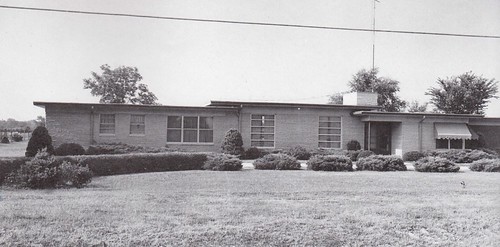
In the mid-20th century, Frank Lloyd Wright invented the concept of “Usonian” houses, which were based on the utopian ideals of simplicity, economy, and convenience. The first step in constructing a Usonian house was to lay down a concrete platform with cast-in heating pipes. Next came a grouping of brick supporting screens, creating a chain of linked boxes. The brick supports were topped by a series of flat concrete roofs, with a higher roof over the living-dining area and lower ones over the bedrooms and bath. The difference in roof heights allowed extra light to come in through clerestory window strips. Light also streamed in through floor to ceiling windows, usually overlooking a garden or pool.

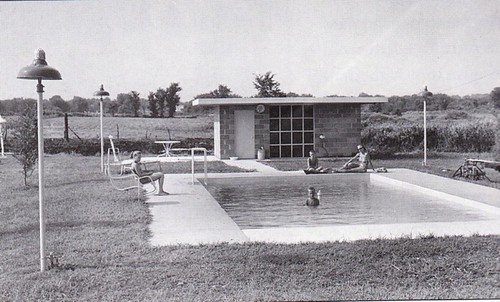
One of these Usonian designs was built on the outskirts of Joplin, ¼ mile west of Stone’s Corner on Highway 171. Joplin architect Robert Braeckel adapted Wright’s plans to construct this ultra-modern dwelling for Stewart and Naomi Ruth Stanley in 1950. All steel construction supported Carthage limestone walls and large expanses of glass. Copper tubing built into the floor provided radiant heat. The ultimate in modern living, the house also featured a pool and bathhouse.

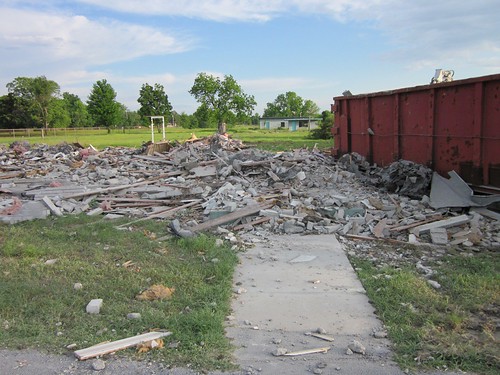
Unfortunately, I had to use past tense in my description; the house was demolished May 3, 2012. It is ironic as well since May is National Historic Preservation Month. This month’s Preservation Magazine devotes the entire issue to Frank Lloyd Wright architecture and the efforts to preserve it.


This piece was adapted from Leslie Simpson’s “Little House on the Prairie” that was published in Joplin Souvenir Album, G. Bradley Publishing, 2001. Photographs courtesy of Leslie Simpson and the Post Memorial Art Reference Library.

Leslie Simpson, an expert on Joplin history and architecture, is the director of the Post Memorial Art Reference Library, located within the Joplin Public Library. She is the author of From Lincoln Logs to Lego Blocks: How Joplin Was Built, Now and Then and Again: Joplin Historic Architecture. and Joplin: A Postcard History.

Currently at the Post Memorial Art Reference Library

From 1pm to 5 today, you can visit the Post Memorial Art Reference Library to see artifacts of Joplin’s past.  Ranging from a key to the Connor Hotel to an embroidered towel from the Keystone Hotel, plus a number of other items, you have the chance to get a glimpse of Joplin’s past through “fragments of people lives.”  The items come from the collection of Mark and Paula Callihan.  Additionally, also on display are a number of tornado recovery posters created to benefit Joplin charity in the months that followed last year’s catastrophe.   The Post Memorial Art Reference Library is located inside the Joplin Public Library.

Guest Piece: Leslie Simpson – Route 66: A Method to the Madness

I have always wondered why Route 66 took such a circuitous path through Joplin.  Coming in on West Seventh, it made a sharp turn left onto Main, then headed east on First over the viaduct.  It continued on Broadway, turning north on St. Louis; after crossing Turkey Creek, it took off at a 45-degree angle on Euclid.  It went a couple of blocks on Florida, then right on Zora and left on Range Line.  If it were not for the fact that Route 66 was built during Prohibition, one might wonder if the cartographers had been a little tipsy!


Route 66 through Joplin

Recently I was looking at some old plat maps of Joplin, and I noticed something.  The Southwest Missouri Electric Railway, an electric streetcar that was established in 1893 by Alfred H. Rogers, took an identical 45-degree angle after crossing Turkey Creek in its route from Joplin to Webb City, Carterville, Lakeside Park, Carthage and other points east.  The trolley line angled through Royal Heights, a separate village that had incorporated in 1907.  Eureka!  This information may be common knowledge, but since I did not know about it, I was excited to figure it out on my own.

Plat map showing the Electric Railway line north of Turkey Creek

At its peak, the railway company operated a huge fleet of streetcars and 94 miles of tracks in three states. But its days were numbered. As private ownership of motor vehicles increased, railway patronage dwindled. In 1925, the company began running passenger buses and phasing out its streetcars.  The Joplin stretch of Route 66 was under construction from 1927 through 1932.  After Royal Heights was annexed into the city of Joplin in 1929, the railway company removed the tracks through Royal Heights. The old track-bed was paved as Euclid and became part of the historic “Mother Road.”

The Architectural Legacy of Garstang & Rea: Barbee Park’s Grandstand

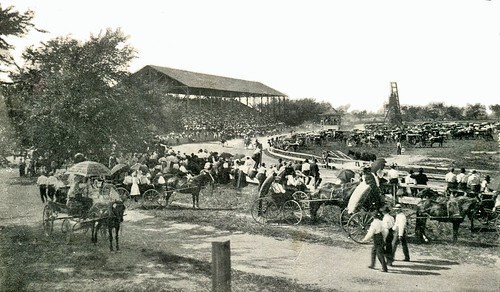
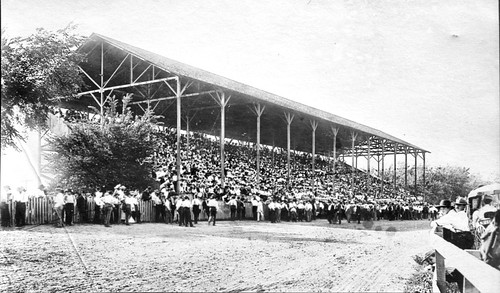
Edward Knell is credited with bringing the first “bred” race horse to Jasper County (as well the “art of embalming”) in 1889. The lucky equine was named “Ben McGregor” and cost Knell an estimated $3,000 dollars, quite the figure at the time. However, as early as 1872, even before Joplin came into existence, a race track was built just south of town that ran a half-mile long. Another race track was built in 1879, along with stables, an agricultural hall, and a grandstand. Gilbert Barbee, one time owner of the Joplin Globe, House of Lords, and Democratic party boss, bought this park and named it Barbee Park. The grandstand featured in both images was designed by Garstang & Rea for Gilbert Barbee’s “driving park” for a price of $6,500.

Barbee Park was home to countless horse races, but also served as the venue for such events like the Firemen’s Tournament that was held on the grounds in 1908. It was at the park where Joplinites got their first real glimpse of the speeding prowess of some of the first motorized fire engines in the nation, as well one of the last fire engine horse team races in the city’s history. Unfortunately for Barbee, in the middle of an April night in 1909, the grand stand caught fire and was a complete loss, despite the best efforts of Joplin’s fire department. The grand stand was never rebuilt and in the 1920s, Barbee’s son leveled the track area to develop a neighborhood.

As Joplin history expert Leslie Simpson writes in her book, Now and Then and Again: Joplin Historic Architecture, “He built the Barbee Court addition right on the old race course, preserving the graceful oval of elm trees that once surrounded it…The outline of the old race track can be traced by looping around from 17th to 19th Streets from Maiden Lane to the alley between Porter and Harlem Avenues.”

Harlem Avenue today.

A Photograph’s Story: Fourth and Main Street Joplin Turn of the Century

Here is a fascinating glimpse of a moment in time in Joplin’s history. Time to explore the story of the photograph of looking West on Fourth Street from Main Street:

First, let’s positioned ourselves and stand in the same place as the photographer. In front of us is the intersection of Main Street and Fourth Street. We are looking West in this photograph which tells us that out of sight, but immediately to our left is the Keystone Hotel. On the right, you can see the edge of the curb of the Worth Block, which means the House of Lords is just a quick jaunt around the corner.

Second, the Connor Hotel is across the street from us. The Connor Hotel was completed in 1908, so we now have an estimated time as to when we are standing at the intersection of Fourth and Main. If you look closely, you will recognize some of the stonework that is now outside the Joplin Public Library. When you look down the street from the Connor, you will notice a row of small buildings. These buildings were eventually demolished to make way for the Connor Annex, which was built in the 1920’s. Again, we have now created a time span for when we are looking: 1908 to 1920’s.

Third, beyond the small buildings, you will notice a tall building. Gone now, but only a few years old at the time of this photograph, the Miners Bank Building was home not only to the aforementioned bank, but also to one of Joplin’s premier architects, August Michaelis. If you squint, on the opposite side of the street framed by telephone and power lines, is a steeple. That steeple belongs to another of Joplin’s lost buildings, the Club Theater. It was home to the Joplin Commercial Club, which survives today in the form of the Joplin Area Chamber of Commerce.

Fourth, immediately across from the Connor is a two storm frame building. Until it was destroyed to make way for the Liberty Building (and current resident of the southwest corner of Fourth and Main), this was the oldest remaining building in Joplin at the time having been built in the 1870s.

Fifth, also of note, are of course the the trolleys and if you look close at the street, you can see a textured surface. Reportedly, these were macadam streets, which Joplin boasted of having many and might still exist in some form under her currently paved streets.