One can look at the northeast corner of Fourth and Main and wonder, what if?
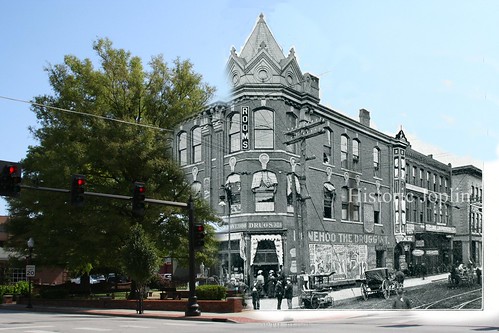
What if?
One can look at the northeast corner of Fourth and Main and wonder, what if?
What if?
If you have ever lived in Joplin, you have undoubtedly heard about the House of Lords. Usually one hears a story that goes like this: Bar on the bottom floor, gambling on the second floor, and a brothel on the third floor. After reading years of Joplin newspapers, we can honestly say that yes, there is truth in the story. There were slot machines, there were countless rounds served at the bar, and yes, there were prostitutes working the building. This excerpt from a letter describes what one resident saw one day while working downtown:
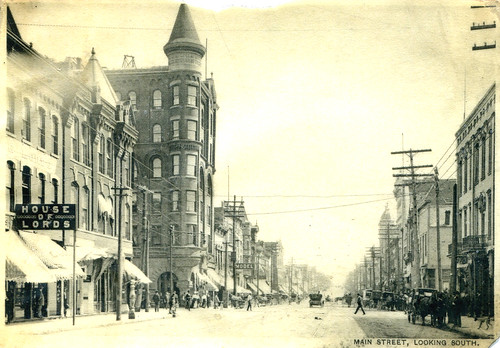
On the left, the House of Lords, on the right, the Joplin Hotel. Neither quite shared the same clientele.
“Two weeks ago last Saturday night, I, stood in front of the Joplin Hotel, and such a sight as was seen on the opposite side of the street cannot be forgotten. A drunken, brazen, disgusting prostitute stood in front of a window in the third story of the House of Lords as naked as when she came into the world, in plain view of the hundreds of people walking up and down the street, and not an officer with the courage or decency to prevent it. Ladies were obliged to turn their faces or leave the street; and I am told that the proprietor of the hotel cannot assign a lady a front room because of the character of the occupants in the building across the street. Sodom and Gomorrah were never sunk as deep in the depths of infamy and vice as this, and the prayers of the wives and mothers of Joplin will be answered.”
The tornado of May 22 was the worst to strike Joplin, but it was not the first.
In May, 1883, a tornado swept through Joplin and the news accounts of the event appear to echo recent events. Just this past week, a story about Laverne the cat, who was rescued after being trapped in the rubble after sixteen days aired on local news stations. In 1883, Charley Elliott’s dog was “in his store building when it fell. He was dug out next morning pretty badly bruised, but after a few hours he was alright. There were acts of generosity. E.R. Moffett, who would later die impoverished, walked up to an “old friend who he had worked with before he became a millionaire. ‘Crit, I’m damned sorry, I’m sorry $500,” and then gave a five hundred dollar check to the relief fund. Citizens scrambled to help each other. Judge Byers was “constantly busy distributing supplies to the needy who lost their all by the wild winds.” Doctors Fannie Williams and Mrs. Creech did “good work for the suffering ladies who were injured” during the storm. Miss Fannie Hall of Carthage gave her all to assist the suffering at the hospital. Oronogo, also hard hit by the storm, was the focus of a relief committee made up of some of Joplin’s leading socialites: Mrs. L.P. Cunningham, Mrs. J.B. Sergeant, Mrs. J.C. Gaston, and Mrs. Thomas Heathwood. Together these women sought to collect food, clothing, and bedding for those effected by the storm.
For others, the tornado brought excitement and curiosity. The Daily Herald remarked, “Some of the visitors Monday night seemed to regard the occasion in the light of a picnic. Frivolities and flirtations were engaged in that would have been regarded impudent at a circus. No apparent sympathy was exhibited for the crippled, bereaved, and homeless, while silly children took the place of sober sense.” Sightseers came to stare at a “bushel basket that lodged in the top of a large tree near the railroad track.” Telegraph poles at the train depot reportedly looked like “they had passed through a storm of musketry.”
And then there were those that lost their lives. Preliminary reports reported that the bodies of a Mr. Goodwin and his daughter were killed by the tornado. It is unknown how many others lost their lives.
The next significant tornado to hit Joplin was in April, 1902. The News-Herald proclaimed it was, “[The] Worst That Joplin Has Known.” A wind, hail, and rain storm converged upon Joplin around 4:25 p.m. in the afternoon in an area described as covering “Seventh Street on the north and as far as Seventeenth Street on the south” with the worst areas at Moffett and Bird streets from Thirteenth to Sixteenth streets and at Moonshine Hill. Property along Main and Ninth streets received substantial damage.
The News-Herald reporter must have not known about the Tornado of 1883 as they declared, “As Joplin has never experienced a real tornado, the people were unprepared and as it came upon them so unexpectedly, it as a wonder that more fatalities are not recorded.” Telephone and trolley poles were twisted beyond recognition making communication with neighboring communities impossible. Streetcars were unable to run due to the lack of electricity and piles of debris covering the tracks. One car caught at Twelfth and Main, Car Number 41, was struck by a telephone pole. Passengers inside were “thoroughly frightened and several actually said their prayers.” Strong wind was not the only threat to human lives. The pole was described as having fifteen double cross arms with three large cables and several hundred telephone wires. Workers roped off the street to prevent traffic and pedestrians from going near the car. Passengers shakily disembarked and walked home on foot.
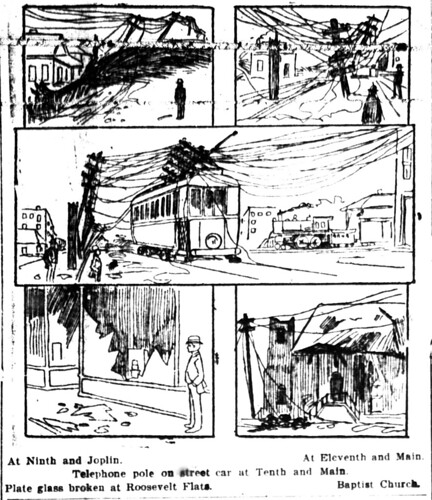
Illustration of the damage from the tornado.
A “solid sheet of water, besides some hail” fell, causing people to hide inside their homes. Willow Branch, the Tenth Street branch, and other small streams in and around Joplin began to flood, leaving many to seek dry ground as the streams became “turbulent torrent[s] of water, mud, and wreckage.”
The storm indiscriminately took human lives and property. It was reported that the two room house of William Hunter, who lived on the east side of Moonshine Hill, was carried for a long distance before it shattered. Mrs. Hunter, holding her baby Esther in her arms, was about to flee the house when the storm hit. A plank of wood flew past and hit her child in the head, mortally wounding it, while Mrs. Hunter sustained serious injuries. Her husband, a miner, was at work at the Dividend Mine when the storm rolled through Joplin. A neighbor, Charley Whitehead, came to Mrs. Hunter’s rescue. Other residents of Moonshine Hill suffered the same fate. Will Douglass’ home was obliterated. Lee Whitehead [perhaps related to Charley] and family also lost their home. The Methodist church on Moonshine Hill was a complete loss.
Arthur Cox, owner of Cox Baseball Park, was one of the “heaviest losers.” The storm destroyed the baseball park’s fence, the grand stand’s roof ripped off, and sustained overall heavy damage. The losses were estimated at $1,000. Cox, however, was not one to stand idly by. Within a day, W.J. Wagy was hired to rebuild the park in time for a game just a day after the tornado struck.
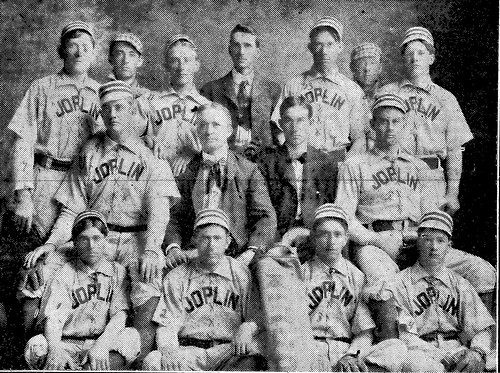
The Joplin Miners of 1902 who temporarily lost their home.
At the corner of West Ninth and Tenth streets, several homes were damaged, if not utterly ruined. An African-American family named Smith lost their house and P.B. Moser’s home was demolished. A.J. Stockton was fortunate — he only lost his kitchen.
For the impoverished residents who lived in “shanties” north of the Missouri Pacific roundhouse between Grand Avenue and the Frisco and Kansas City Southern tracks, their impermanent residences were blown away.
White and black churches were not left untouched. The First Baptist Church was “badly wrecked.” The Methodist Episcopal Church’s South Mission location at Tenth and Grand was “completely wiped away.” The African Methodist Episcopal Church on East Seventh street was also destroyed. Despite being a substantial frame structure, the roof was torn off and the walls subsequently caved in.
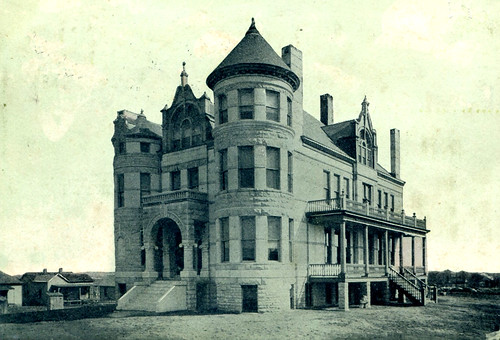
St. John's Hospital
The nuns at St. John’s Hospital were “buffeted and blown about by the wind as they strove in vain to keep out the sheets of water thrown against the west end south of the building which stands high and unprotected.”
Property damage was estimated at $50,000 and an estimated fifty to sixty houses destroyed. As soon as the storm passed, “ambulances and relief crews found work to do for many hours.” Mayor John C. Trigg released a proclamation that read:

“To the Citizens of Joplin — Authentic information having been received that the cyclone which visited the city of Joplin on yesterday, caused incalculable damage to many of our citizens and has been especially destructive to the poorer classes of our citizens in many instances to the extent of destroying everything they owned, leaving them destitute, houseless and homeless.
Therefore, for the purpose of alleviating the distress which prevails in the city and vicinity and to devise ways and means by the organization of relief corps, or by such practicable methods as may be suggested and agreed upon at a meeting of the citizens is hereby called to be held at the Commercial Club rooms, on the 25 inst., at the hour of 3 o’clock p.m. to consider the premises and take such appropriate action as may be deemed necessary therein.”

Mayor John C. Trigg
Joplin has always taken care of its own in times of need. When the committee met, it was agreed that many of those effected by the storm were impoverished miners who were in badly need of assistance, and a relief fund was created. Thomas W. Cunningham reported that when he checked on his rental properties in the damaged section of town he found that one of the families renting from him had been forced to cut their way out of the house. He decided that they “deserved the house” and “made them a deed for it.” His act of kindness was heartily applauded. It was thought that the family was that of I.W. Reynolds who lived at Thirteenth and Ivy. Mr. Wolfarth of Junge Baking Company pledged free bread to those in need. Arthur Cox and Don Stuart pledged the proceeds of the next baseball game to the relief fund. The Wilbur-Kirwin Opera Company decided to give a benefit performance for Joplin’s tornado victims.
Joplin rebuilt only to face another tornado six years later in 1908. That story and more in our next installment.
[Conclusion of Part I]
CHAPTERS ERASED FROM JOPLIN’S ARCHITECTURAL HISTORY
By Leslie Simpson
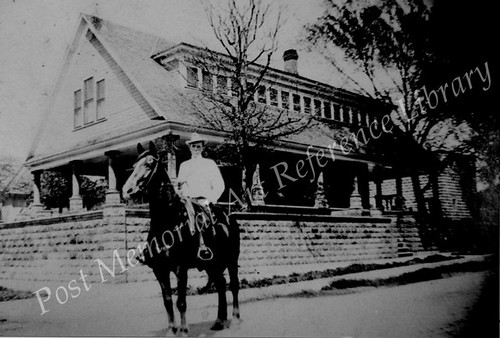
caption for photo: Carl Owen house at 2431 Porter. Built ca. 1911. Destroyed by tornado May 22, 2011 via Post Memorial Art Reference Library
I am having a difficult time knowing what to say. In fact, I hesitate to even write anything about brick and mortar, when human life, hopes, and dreams are what really matter. However, since I have written so much about Joplin’s architecture through the years, I feel compelled to say something. I have had several CNN reporters contact me for interviews, but I have not wanted to talk to them. First of all, I had not personally seen all the damage. It is impossible to get around, and I did not want to get in the way of emergency workers nor be a voyeur. Secondly, I just did not think I could articulate what has happened to my beloved Joplin. So now I will attempt some general (and unofficial) impressions of Joplin’s historic identity and how this incomprehensible tragedy has affected it. Also, rather than catalog specific buildings that have been lost, I will focus on three historic residential areas.
I begin with the historic town of Blendville in southwest Joplin, which was established in 1876 as “Cox Diggings.” The prosperous little community incorporated as Blendville, so-named because of the huge amounts of zinc blende in the ground. Thomas Cunningham owned the residential area, which he divided into lots and sold at low rates so that miners could afford their own homes. The city of Joplin extended its streetcar line to Blendville, with lines going south on Main to 19th Street, west to Byers, south to 21st Street, west to Murphy, then south to 26th. In 1892, Joplin annexed the village. Thomas Cunningham donated “Cunningham Grove” as Joplin’s first city park. The tornado took out most of the original Blendville area, including Cunningham Park and the historic water plant with some of the original equipment preserved inside.
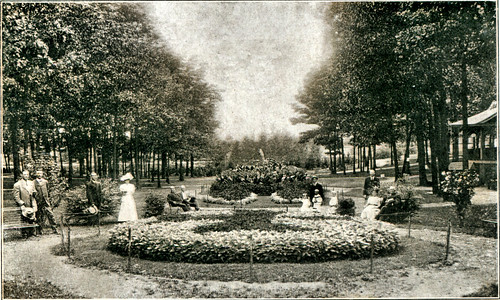
The next area of historic significance is “Schifferdecker’s First Addition”, a residential area developed in south Joplin beginning in 1900. The Joplin Globe referred to the area lying south of 20th Street and fronting on Wall, Joplin, and Main Street as “a beautiful new addition affording the most desirable building property” to be found anywhere in the city. A second addition continued development south of 20th on Virginia, Kentucky, and Pennsylvania Avenues as well as along 21st, 22nd, and 23rd Streets to the east and west. The residential district continued to expand to the south throughout the teens, twenties, thirties. The homes in the region ranged from high Victorian styles to bungalows and eclectic Tudors, Colonial Revivals, Spanish mission, etc. Tragically, this charming old neighborhood has been wiped out.
After World War II ended, Joplin families faced a housing shortage. Some Camp Crowder buildings were moved to Joplin, while others were dismantled to provide construction materials. Hundreds of small efficiency houses were mass-produced for veterans and financed through FHA. Many of these were built in the Eastmoreland area. As people prospered in the 1960s and 1970s, they built more substantial brick homes east and south of the new high school at 20th and Indiana. Although most people do not think of these homes as historic, they do have their own place in Joplin’s architectural history, and their loss is devastating as well.
Entire chapters of Joplin’s history have been forever erased. I have not even touched on the loss of churches, schools, medical buildings, and businesses. Again, I am not relating the loss of our buildings to the loss of our people. Joplin will rebuild. It has already begun. During the first week after the tornado, I saw a business being rebuilt in the midst of the war zone surrounding West 26th Street!
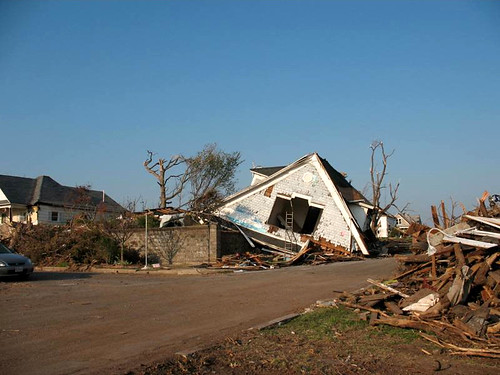
Porter House following Joplin Tornado. Photo by Leslie Simpson
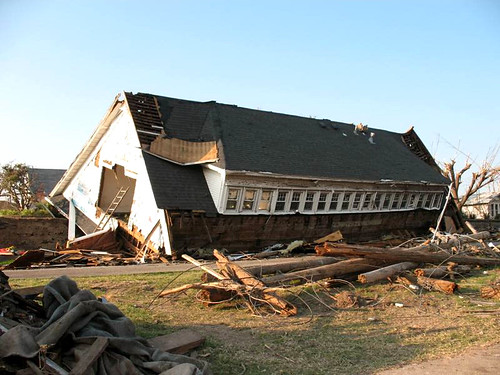
Porter House following Joplin Tornado. Photo by Leslie Simpson
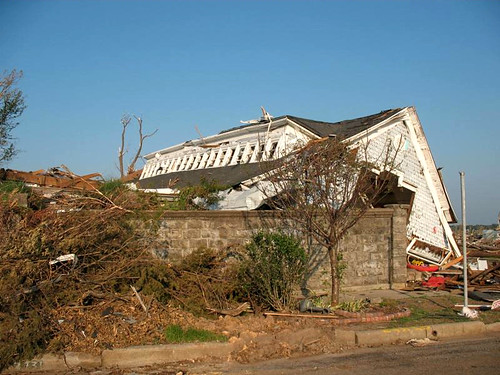
Porter House following Joplin Tornado. Photo by Leslie Simpson
Leslie Simpson, an expert on Joplin history and architecture, is the director of the Post Memorial Art Reference Library, located within the Joplin Public Library. She is the author of From Lincoln Logs to Lego Blocks: How Joplin Was Built, Now and Then and Again: Joplin Historic Architecture. and the soon to be released, Joplin: A Postcard History.
DOWN NOT OUT
By Leslie Simpson
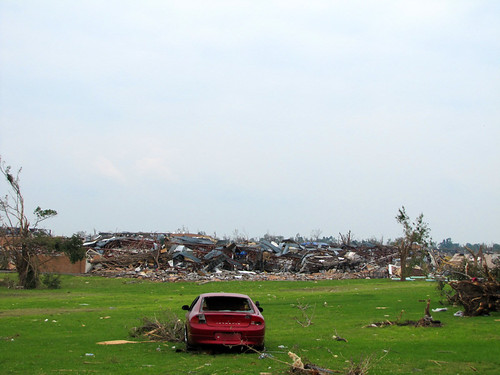
On a pleasant Sunday evening, May 22, 2011, an EF-5 tornado suddenly raged through densely-populated south Joplin. It destroyed almost everything in its path for 13.8 miles in distance and up to a mile in width.
The tornado smashed down in southwest Joplin, wrecking residential areas, Cunningham Park, schools, medical offices, and a major hospital complex, St. John’s. It headed east, obliterating untold acres of late nineteenth and early twentieth century houses. The storm’s wrath intensified as it forged east, razing businesses along Main Street, more neighborhoods, and Joplin High School. It wiped out much of the lifeblood of Joplin’s economy, the commercial strip on Range Line Road, then rampaged on, demolishing housing, banks, industrial buildings, and more schools and churches. It finally dissipated east of Joplin, after destroying or damaging an estimated 8,000 homes and businesses.
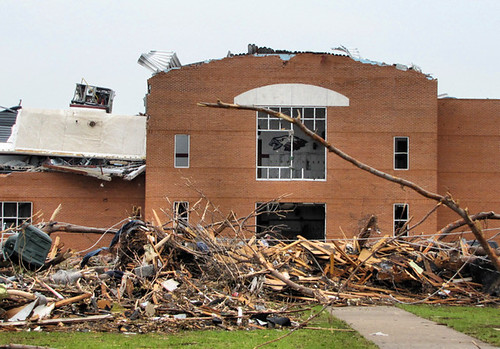
At the time of this writing, authorities have confirmed 138 fatalities, a number which continues to rise. More than 1,150 people sustained injuries. The Joplin tornado, the deadliest since modern record keeping began in 1950, ranks eighth among the deadliest tornadoes in U.S. history.
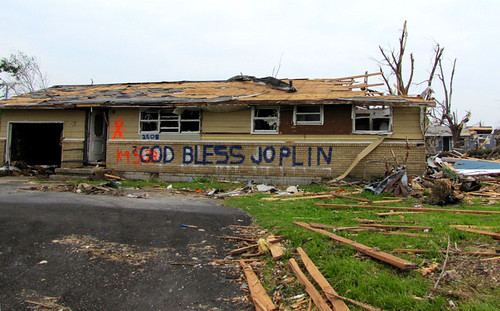
We are in shock. We drive familiar streets yet cannot even recognize where we are. The cruel landscape of endless rubble and shredded trees reminds us of shattered lives and endless grief. We have lost so much, and we are hurting on many levels. But our spirit is strong, as evidenced by the person who spray-painted “Down not out” on the shards of his former home.
Leslie Simpson, an expert on Joplin history and architecture, is the director of the Post Memorial Art Reference Library, located within the Joplin Public Library. She is the author of From Lincoln Logs to Lego Blocks: How Joplin Was Built, Now and Then and Again: Joplin Historic Architecture. and the soon to be released, Joplin: A Postcard History.
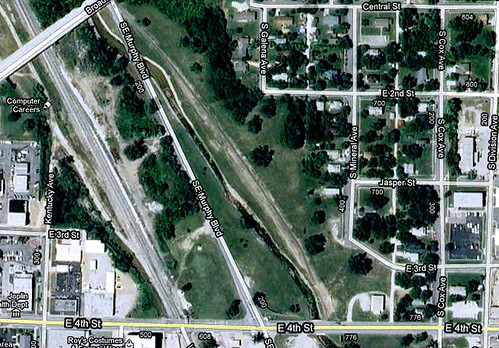
Present day bird's eye view of Third Street, Joplin. Via Google Maps.
Its absence regularly goes without notice, and unless one is driving along Third street, crossing Main Street eastward, its former utility cannot even be contrived. It is now just a missing space on the map and a memory quickly fading as those who once recalled its presence disappear from the community. It served Joplin for approximately forty or more years, in one form or another. It connected the city’s two halves, East and West Joplin, and finally offered a means to ascend Broadway Hill, an “unpaved, rocky” road that was “a terror to teamsters and distinctly unpopular with all classes of travelers.” It was the Third Street Viaduct.
The union between Joplin in the East and Murphysburg in the West to form modern Joplin in the early 1870’s was at first more apparent in paper than in geography. A small valley and creek generally separated the two, the area once known as the Kansas City Bottoms, and now the home of the Union Depot and parkland. It was the site of Joplin’s first mining endeavors. Thus, the road that connected the two ran through mining camps, which a Joplin Daily Globe reporter referred to as a “tenderloin” and one that law abiding travelers hesitated to venture through on their way from one part of the city to the next.
While the Southwest Missouri Railroad connected the two parts of the town with streetcar service by 1906, there was still not a quick or convenient means to go from the heart of the Joplin business district to the east Joplin. The result, as the Globe put it, was that “Main Street merchants watching the expansion of the city in all directions saw that East Joplin, closer to the business center than South or West Joplin, was being overlooked by home builders because of the inconvenient route…” A solution to the problem had first been proposed about four yeas before 1906, in a conversation between T.C. Molloy, and the owner of the Globe, and at one point, also the House of Lords, Gilbert Barbee. The answer was a viaduct.
Little came of the discussion, other than the belief that Third Street should serve as the location of the viaduct, bridging across the bottoms to the hilly part of East Joplin. It was not until 1906 that the topic finally made ground and in December, 1907 the City Council passed an ordinance calling for a special election to approve the selling of $50,000 in bonds. Mayor Jesse Osborne quickly signed off on the ordinance and an election held on January 15, 1908, resulted in an overwhelming approval from the electorate, 1,366 for and just 274 against. A sell of bonds occurred in May, and resulted in just over $51,000.
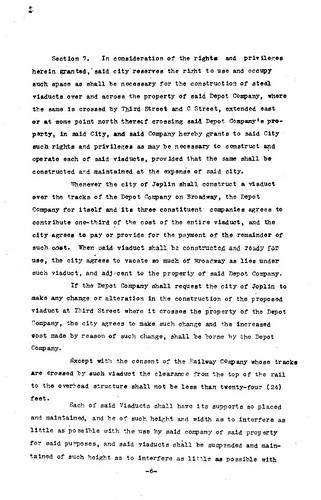
This page of the Scullin Franchise agreement required assistance in building the viaduct. Click on the image to be taken to a larger version.
Only a few months later, the construction of the viaduct was caught up in the debate concerning the granting of the Scullin franchise to establish and build a Union Depot in Joplin. It was not coincidence that Councilman Molloy took the forefront of the debate in the City Council meeting by vouching that as part of the deal, the Kansas City Southern Railroad would commit to paying approximately one-third of the Third Street viaduct. The Kansas City Southern was true to its word and the construction of the viaduct became part of the franchise that eventually was passed by the council and signed by Mayor Osborne on October 26, 1908.
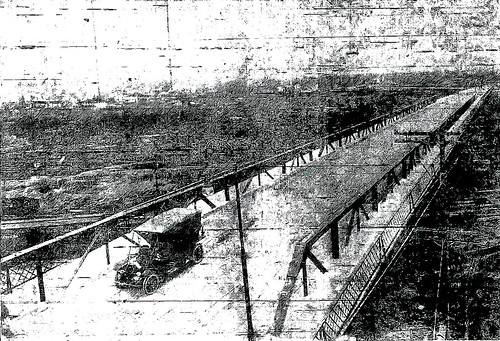
The viaduct upon completion.
In the end, the railroad ended up paying approximately $20,000 of the cost of the viaduct, and the Henry L. Doherty & Company successfully bid to construct the mostly steel bridge for $40,000. An additional $10,000 was also spent on building concrete pedestals, which required the use of a mining drill to ensure they were not placed over one of the many mine shafts which still honeycombed the area. The actual steel work of the bridge was crafted by the Southwestern Bridge Company, and sent in pieces from the plant and then sent to the site for assembly.
The actual construction was boastingly described, “The viaduct is said to be equal to any bridge of the kind in the United States from an engineering standpoint. It is of all steel construction with concrete flooring, covered by a three inch layer of creosoted wood blocks, laid paving fashion with asphalt filler.” The wood blocks were noted as a new innovation with “many advantages over brick of asphalt paving.” In fact, the blocks were “light, impervious to water, and are said to outwear bricks.” The floor of the bridge was concrete, reinforced with steel rods. Above this an actual paved street was laid out.
A colorized version of the newspaper photo from above allows for a better view of the viaduct's lamps. Via Missouri Digital Heritage
The viaduct was completed in the last week of September, all but the aforementioned paving, in 1909. It was one part of a signature moment for the city, which was flushed with a continual procession of beautiful buildings and other civic improvements being constructed. A period of growth yet unrivaled in the city’s history.
The viaduct was described as having “a six foot walk, raised eight inches above the level of the roadway and protected on the outer edge by a high latticed railing.” Light was provided by arc lights, each with the power of 2,000 candles. Powerful enough to not just illuminate the viaduct, but also designed to illuminate the dark area of the bottom land below.
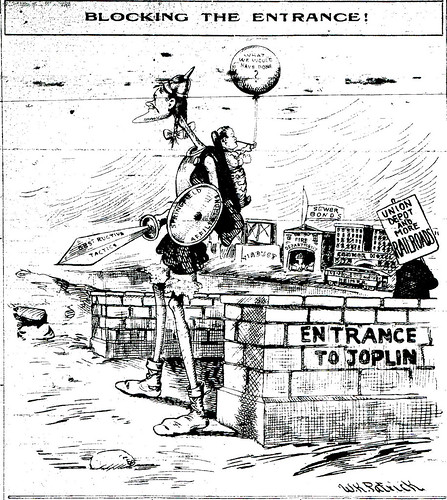
As this political cartoon illustrates, the viaduct was considered an achievement on the same scale as the Connor Hotel and the modern fire department.
The impact of the bridge was immediate. It was claimed that real estate values in East Joplin shot up anywhere from 100 to 300%, with new homes being constructed in the area. On the other side of the viaduct, new buildings were quickly being erected north of the busy business district of Fourth and Main streets. For the next several decades, the viaduct served as a landmark of Joplin, the conduit which connected the two parts of town and helped forged them into one.
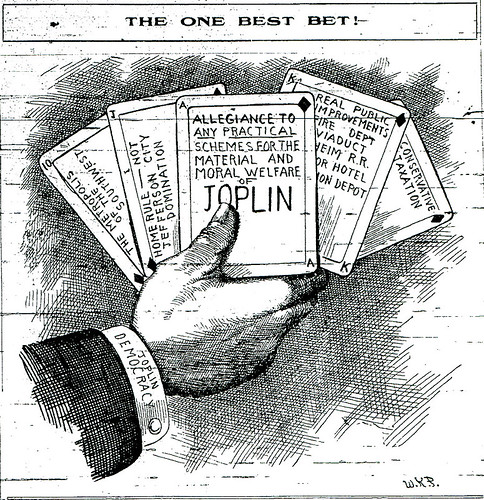
In another political cartoon, again the viaduct is in good company, as seen on the playing card above.
In what was at least one death connected to the bridge, Joplin Detective William Woolsey, was gunned down upon the span on December 8, 1917 in an attempted robbery. The officer had been crossing the viaduct with another when Frank Warren and Chub Hardin came upon the two. Warren shoved a gun into the detective’s stomach, but it was not enough to dissuade the Joplin police officer from pulling his own. In a tragic case of misfire, Woolsey got the drop on Warren and pulled the trigger with no result. By the time the shock wore off on both men, each tried to fire, Woolsey for the second time. This time Woolsey’s pistol worked, but so did Warren’s. The result was both men felled by fatal gunshot wounds to the abdomen.
The city sought to protect the community at large in 1924 by placing a load limit of 7,000 pounds on the viaduct. Likewise, it directed the Joplin Police to divert traffic from the bridge at the busiest times of day. As the years passed, the condition of the viaduct worsened. In 1943, the City Council made the fateful decision to close the bridge to all but pedestrian traffic out of fear of its “dangerous condition.” Two years later, as the Second World War was in its fourth year, the city was only able to make temporary repairs to the viaduct with the construction of a support column (to replace one which had broken). Due to the global conflict, materials and money were scarce, and it was hoped that much needed permanent repairs would happen after the war.
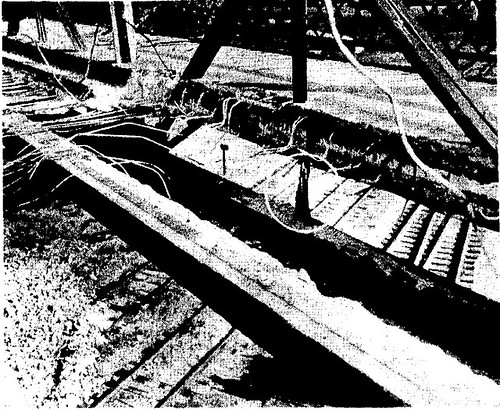
A disturbing example of the rust afflicting the viaduct, note the circled steel beam was once the same width as the beam above it.
The permanent repairs never arrived. By 1955, the viaduct had been effectively abandoned by the city for a decade. In February, the City Council made the decision to have the viaduct removed. Concerns existed, as the bridge continued to deteriorate, that pieces of falling concrete would strike pedestrians or vehicles below in Landreth Park or on Murphy Boulevard. The Council handed the task to the City Attorney, Loyd Roberts, while City Manager, J.D. Baughman could offer no expected cost of removal. One councilman, W. H. Clark, suggested that perhaps the Kansas City Southern might be induced to pay for some, if not all the cost. The argument was that the sulphuric acid in the coal burning trains had helped to erode the steel.
Two months later, the City Council reaffirmed its decision in April. It was not received happily by all. A hastily organized East Joplin Civic League appeared before the Council and argued that the viaduct be repaired, not removed. Alarmed at the prospect of being cut off from the city’s downtown, the League was supported by a petition of 75 signatories, and the treasurer, A.F. Brooks spoke on its behalf before the council. While Brooks believed the cost to repair was approximately $79,000, the City Council countered that Sverdrup & Parcel, Inc., an engineering firm from St. Louis, had estimated the actual cost at $192,000. That sum, arrived upon in 1953, undoubtedly helped push the Council to its position of removal over repair. Furthermore, an investigation by Traffic Lieutenant Clifford Hill, supposed that a repair would not be worth it unless Third street was strengthened and extended to Rangeline. Despite the protests of the East Joplin Civic League, the city moved forward on the viaduct’s destruction.
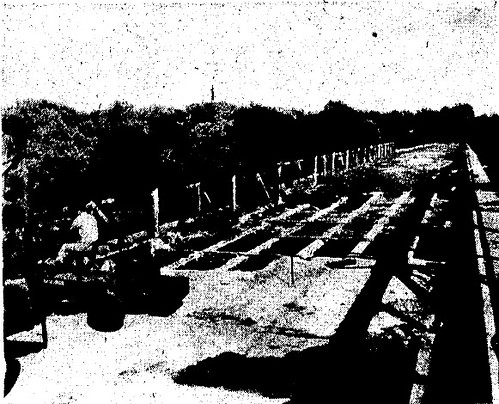
A view of the viaduct as demolition proceeded. The removal of the road surface exposed the viaduct's skeleton.
June saw the City Council instruct the City Manager Baughman to seek bids from companies for the viaduct’s removal. The hope, for the city, was to spend as little as possible and even possibly make money from the salvage value of the bridge’s materials. The contract was finally awarded in July to the V.R. Freer Construction Company, which offered to demolish the viaduct and pay the city $1,200 to salvage the steel. It was noted at the time that the concrete would be reused for civic improvements elsewhere.
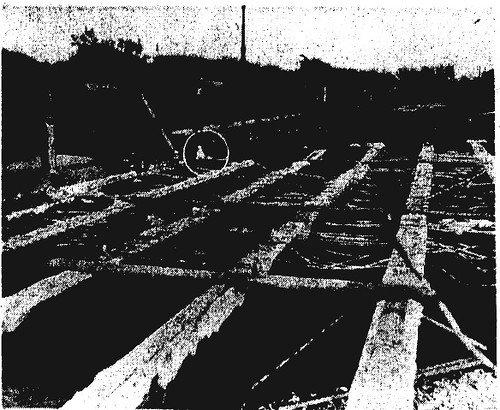
The demolition of the viaduct signaled the beginning of the end for many Joplin landmarks.
October saw the end of the viaduct. In its destruction, it provided over 1,000 tons of asphalt which at some point was likely applied to road building projects elsewhere by the city. At the time of demolition, it was argued that the steel of the bridge had been prematurely rusted by the train smoke, which created an odd contrast. The viaduct had been in part paid for by the railroads and by 1955, was being demolished because of it. A personal tragedy also accompanied the viaduct’s demise. Despite the deconstructed state of the viaduct, barricades at both ends, Joplin resident, Arthur Yates, decided to stroll across the viaduct only to fall through a hole and plummet 30 feet to the ground below. Luckily for Yates, he was not killed, but might have been paralyzed below the waist for life.
By 1956, the viaduct was gone. Third Street became something less than what it was and failed to become what it might have had the city elected to repair the bridge. It’s possible the viaduct was a victim of the wartime shortages of the Second World War or an unfortunate design that was exposed to the destructive effects of the iron horses that had helped spur its construction. None the less, it was among the first of many symbols throughout Joplin which had once been proud monuments to a city which had once burst with pride with expectations of a greater future.
Source: Joplin Daily Globe, Joplin Police Department website, Missouri Digital Heritage
In anticipation of our coverage of the 1903 Joplin lynching, we bring you photographs of the location of the tragedy: Second and Wall. It was at this intersection that Thomas Gilyard was lynched from the arm of a telephone pole by a mob. First is a drawing of the lynching that was printed in the Joplin Globe immediately after the lynching. The artist was Ralph Downing, who later went on to be an artist for the Kansas City Star (where he worked the rest of his career).
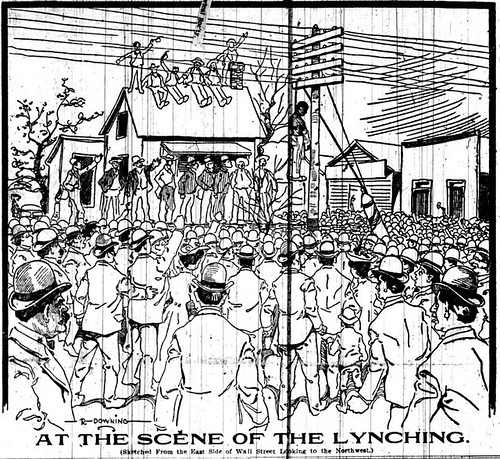
The lynching of Thomas Gilyard
The first photograph comes courtesy of the Post Memorial Art Reference Library and was taken just a couple months after the lynching, if not sooner.
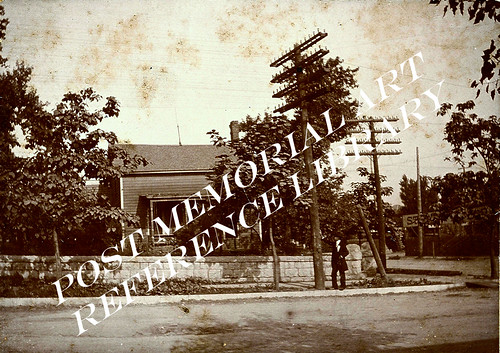
The back of the photo read, "Joplin, Mo. June 17, 1903. This is where Bro. C.H. Button and myself lodged at the home of Mr. Wilson. The telegraph pole is where a negro was mobbed and hung last spring. Taken by Prof. C.H. Button, J.R. Crank. Taken at Bible School Convention." Courtesy of the Post Memorial Art Reference Library, Joplin Missouri
The next photographs were taken just last month, December 2010. Regrettably, the time of day and the position of the sun got in the way of nailing a photograph from the exact same position. For identification purposes, the only surviving landmark from the gruesome moment is the stone retaining wall which you will find in all the images.
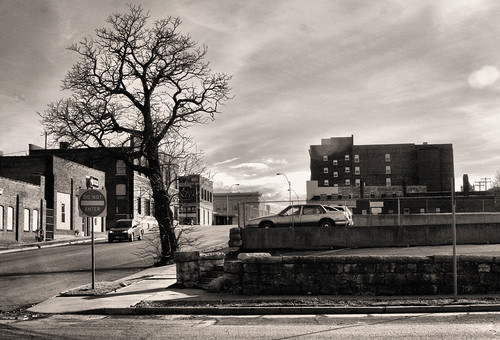
Second and Wall - Present Day
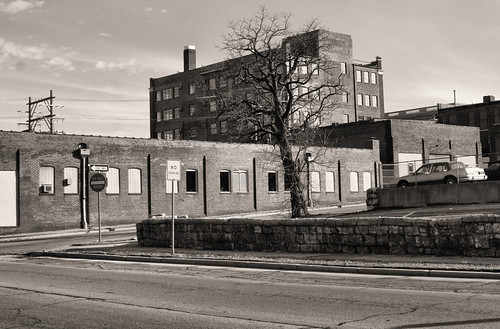
Second and Wall - Present day
If you don’t want to wait to learn more about the lynching, you can read about it in White Man’s Heaven by Kimberly Harper or pick up the most recent edition of the Missouri Historical Review.
Sources: Post Memorial Art Reference Library, Joplin Daily Globe, White Man’s Heaven by Kimberly Harper, and Historic Joplin Collection.
The Ozarks have always been abundantly blessed with springs, creeks, and rivers. Although Joplin’s neighbor to the south, Neosho, is hailed as the “city of springs,” Joplin was once home to the notable “Ino Spring.”
The Ino spring was located a half-mile west of Joplin near where two men, Frazier and McConey, had a brick ward in the early 1870s. The site became popular as Joplinites would drive out in the summer to cool off at the spring. The spring was described as a “stream of sparking water” that gurgled up from the side of a “slight uprising in the ground, not exactly a hill, but a knoll forming one side of a shallow gulley.” Joplin’s old-timers remembered the spring and it was tradition that “when the Indians roamed the prairie where Joplin now stands that they quenched their thirst” at the spring. By the turn of the century, it was “surrounded by numerous mining plants with immense pumps.”
The name of the spring came from the nearby “Ino” (I Know) Mining Company in upper Leadville Hollow. Reportedly the Ino mine was drained of water of almost 200 feet, but the little spring kept flowing. As Chitwood Hollow opened up to mining, it became known as the “Ino Spring.” Teamsters, lead and zinc haulers, coal haulers, and others stopped to water their horses at the spring as well as supplied water to the nearby Chitwood mining camp.
By the turn of the century, the citizens of Joplin were calling for pure water. In response, an unknown enterprising entrepenuer decided to haul water in from the Ino spring, despite competition from the Redell and Freeman “deep well wagons.”
It is unknown now if the spring still flows, we can only hope that it does.
Source: Joplin News Herald

This Month's Cover - click on the Image to Read the Issue
We recently offered an approving review of the Joplin Metro Magazine for its coverage of topics of local history. The coverage continues with the 6th issue of the magazine designated as a Halloween / Fall issue. The issue focuses on Joplin’s resident Spooklight, though perhaps not delving as much into the past attempts to figure out the mystery behind the light, as well the earliest encounters. It’s still a good primer to anyone unfamiliar with the spooklight.
The best part of the issue concerned the survey of haunted sights and places in the Joplin area, which included short histories behind the locations. Such places included the old Freeman Hospital (with photograph), Carthage’s Kendrick Place (with photograph), as well Peace Church Cemetery, where one of Joplin’s most notorious murderers now resides in an unmarked grave. It’s articles such as this one which help show how fascinating the history right around one’s corner can really be. Last is an article about haunted Ozark battlefields. If you haven’t had a chance to read Issue 6 of the Joplin Metro Magazine, you might be able to still find hard copies located around town or you can read it online at this location (click here!).
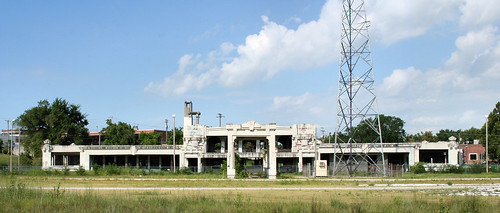
East Facade of Joplin Union Depot
This last weekend, the Joplin Globe offered up a summary of the present situation with the Union Depot. In addition, the Globe put together a short timeline of events for the Depot from its opening over 99 years ago.
The summary covers in brief the past attempts at restoring the Union Depot, including an offer in 1973 by the Kansas City Southern to deed the Depot to the city. That proposal was nixed by the then head of the Joplin Museum Complex, Everett Richie. The excuse given then was the danger that the active train tracks posed to the museum and its collection should it be moved to the location.
The Globe managed to speak briefly with Nancy Allman, who was the lead in the effort to restore the Union Depot in the 1980’s. Allman did confirm that she still had in her possession some items from the Union Depot. This is good news for the restoration of the Union Depot. Even if Ms. Allman may not want to donate or sell the items, perhaps she would at least allow the restorers to photograph and measure the items for reproduction purposes.
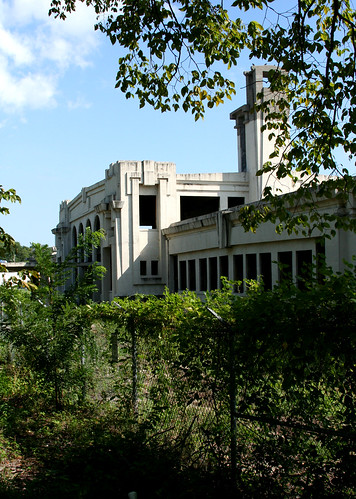
West Facade of Joplin Union Depot
The article also brings us via Allen Shirley the 3 Key Issues for the JMC about a move to the Union Depot. Let’s look at them one by one:
1) The Union Depot’s structural integrity.
Reports indicate that the work done in the prior restoration attempt went along way toward reinforcing and repairing structural integrity issues. In the walk through by the Joplin Globe with David Glenn, who was part of the restoration team from the 1980’s, Glenn comments on the strength of the building.
2) There’s less than 400 sq foot than the current museum.
As we’ve pointed out in previous coverage of the Union Depot question, there are two measurements being offered of the Union Depot’s space; one from the JMC and company, and one from Mark Rohr. It really boils down to the basement. One side counts it and the other side doesn’t. The basement also brings about another issue, as we’ll address below. There’s no reason more space cannot be constructed to supplement the Union Depot and done so in a simple, elegant and complimentary manner to the Union Depot. Here’s an off the cuff idea: enclose the concourse extending from the depot with glass, creating a beautiful glass hallway, and have the end of the concourse connect to a secondary building. There’s plenty of space available for such an addition. None the less, an addition may not even be necessary.
3) Environmental Control
Appropriately, the JMC Board is concerned about the presence of environmental control in the Union Depot. It seems that it would be a matter a fact element of any renovation of the Depot, particularly a restoration performed with a archival purpose in mind. In many ways, as photographs will often attest, the Depot is a blank canvas and now is the time where such improvements can be made and without the cost of tearing out existing material to replace it. (That former material has already been torn out!) Again the basement and the standing water. Here’s a simple answer: pump any water out, replace any water damage and effectively seal the basement walls. We’re not contractors here at Historic Joplin, but this solution does not seem to be one of great complication.
Mr. Shirley claims that the JMC board has not taken a position about the proposed move. We would disagree. No member of the board, or JMC Director Brad Belk, have not once said anything positive about the idea. In the summary, Mr. Shirley does note they support the preservation of the Depot, as we would hope of those who are charged with protecting the city’s history. However, supporting the saving of the Depot does by no means equate to supporting the idea of moving the museum. Fearfully, three members of the City Council appear ready to allow the Board to do as it wishes, which means doing absolutely nothing. The Board wanted Memorial Hall for a new home, turned down the offer by the Gryphon Building, and will have to be dragged into the Union Depot.
This is not the time for inaction. Joplin has embarked on a push of re-establishing itself as a city of beautiful buildings and one engaged not only with its past, but with an active present focused on its increasingly vibrant downtown. The relocation of the museum to the Union Depot would not only give more people a reason to visit downtown, but its better accessibility than the remote location by Schifferdecker Park would mean more would take the time to learn about the city’s glorious past.
The leadership of the city has proven itself innovative and bold by the successful and ongoing restoration downtown, we hope that the leadership does not back down at this important juncture. The City holds the purse strings of the JMC and if the Board of the JMC is not willing to play a part in the revitalization and the new beginning of Joplin in the 21st century, the City should tighten those strings. The Board of the JMC needs to accept that they will not always get what they want and assume a much more forward thinking position, lest they end up as dust covered exhibits they profess to preserve.
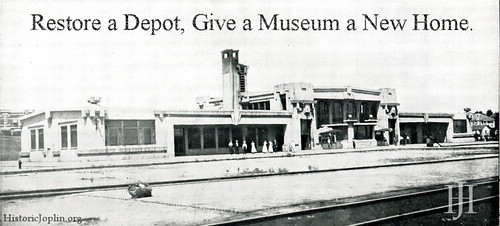
Be Bold, Joplin!
