A Town Called Joplin

Although it is now considered a ghost town, Joplin, Virginia, was named after Joplin, Missouri. William Crow, a native of Jasper County, Missouri, and brother to former Missouri Attorney General E.C. Crow, settled in Virginia. He became a justice of the peace, notary public, and postmaster. As postmaster, he had the privilege of naming the small hamlet in Virginia. He chose the name Joplin. When asked why, Crow replied, “Because the postal department wanted a name with as few letters as possible, and one that would be easy to remember. When [I was] a boy, I made many visits to Joplin, Missouri, as I was reared at Carthage.”

Crow returned to Joplin, Missouri, in 1931, and recalled, “I remember when there was no Joplin, no Webb City, no Galena, Kansas. And as a boy I knew that country when it was all open and wild. Baxter Springs was an Indian trading post.” Upon finding out that Joplin had grown in the years since he had left, Crow remarked, “I can only say that anyone who leaves the boyhood home and remains away for 20 to 40 years should never visit that place; he is sure up for a great disappointment.”

When asked about the origins of Joplin, Montana, residents had no clue why the town was named Joplin. George L. Brennan, the agent for the Great Northern Railway, recalled that before 1909, Joplin, Montana, “was a blind-siding on the main line of the Great Northern Railway.” The area, he said, was used for sheep and cattle ranches until the federal government opened it up for settlement just before 1909, and an influx of settlers quickly snapped up all the available land. Some of these settlers may have been from the Joplin, Missouri, area. Today Joplin, Montana, has an estimated population of 210 residents.

If anyone is aware of any other hamlets, villages, towns, or cities named Joplin, let us know.

Source: Joplin Globe

Joplin’s Own Kit Carson

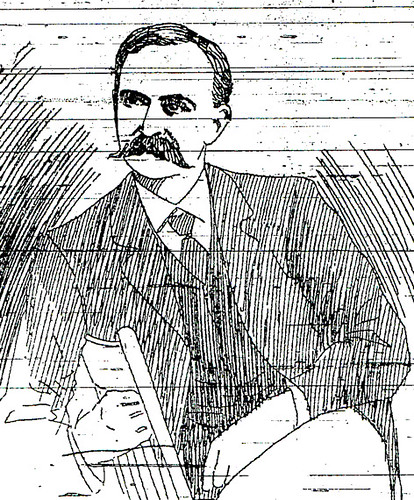
A.W. "Kit" Carson

A sketch of Carson from a 1890 photograph.

Local newspaper baron Alexander Washington “Kit” Carson was one of the most influential individuals in the early development of Joplin. While he was not a capitalist like Thomas Connor, Carson left his own indelible mark on the city he called home.

The red-headed Carson was born near Cadis, Ohio, in 1842. During the Civil War, he served with Company C of the Forty-Third Ohio Volunteer Infantry. After the war ended, he headed west, and taught school at Marshfield, Missouri. Carson left Marshfield a few years later and arrived in Joplin where he began publishing the Joplin News-Herald in February, 1877. Years later Carson, a lifelong bachelor, was still living in his apartment located in the News-Herald building located on Fourth Street. He could often be seen sitting outside the building in a chair reading his old paper. Carson’s friend John Power was an early resident of Joplin and recalled both Carson and the glory days of Joplin’s journalism community in a newspaper article.
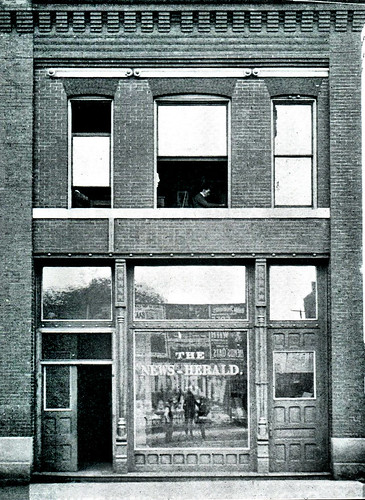
The Joplin Daily News Herald Office, circa 1902.

Together with Columbus “Lum” Farrar, Carson founded the Joplin News-Herald, and soon became sole owner after Farrar found journalism to be hard work. Carson bought out Farrar’s interest in the paper and remained sole proprietor. He put in long hours as the News-Herald was the morning paper. Carson stayed up all night furnishing the copy, proof-reading, making up forms, and then printing the paper on an old Washington hand-crank printing press. By the time he sold the paper in 1888, the News-Herald had become “hard to kill” with a first rate printing press and loyal readership. After he sold the paper, he became known for his eccentric, yet gentle personality.

Power related one story in which Carson had a number of young calves in his lot. A man passing by happened to see the calves and asked Carson if they were for sale. Carson replied that they were. The man offered $7 for each calf and Carson agreed to sale them. The buyer then told Carson he had to go uptown to get cash and would return shortly to pay for the calves. Upon the man’s return, he began to feel the calves. Carson, suspecting the man was a butcher, asked if he was indeed a butcher. The man replied that he was. Carson replied, “You haven’t money enough to buy those calves…I would about as soon allow children to be killed.”

On another occasion, Carson sold some pedigreed hens worth $2-$5 apiece to a woman for only 25 cents apiece, thinking that she would use them for eggs. He stopped by the woman’s house a few days later only to discover that she had eaten all of the chickens. Carson, in tears, remarked that had he known she was going to eat them he would have kept them, as he had hand-raised the chicks after they were orphaned.

He also had a soft heart when it came to his friends. Power recalled on one occasion when the two were out in Carson’s buggy and stopped to visit one of Carson’s old friends. The men talked briefly and then Carson pulled away, remarking that his friend’s coal bin was empty. Carson’s next act was to order a ton of coal and have it delivered to his friend’s residence.

Upon Carson’s death, Peter Schnur (who would die the next year) remarked, “Although we were business competitors, he was one of the closest personal friends I had. The squarest man in business, honest, trustworthy, companionable, fearless but gentled, the heat of campaign nor the struggles of business competition never affected the strong friendship between us.” He ended by observing, “Mr. Carson was a man of peculiarities.”

And peculiar he was. In his will, A.W. Carson specified that $1,000 of his money be spent on the dissemination of Mark Twain’s “How to Be a Gentleman.” The only problem was is that no such work existed.
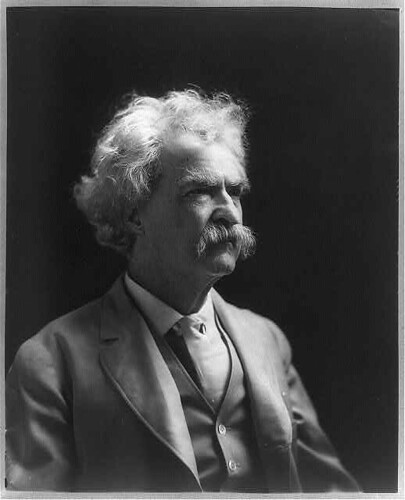
Mark Twain

Mark Twain, whose non-existing idea of a gentleman was the focus of Carson's will. Library of Congress.

A few days after Carson’s will was read, Twain was asked about his advice for the young after he finished a speaking engagement at the Majestic theater in New York City. He remarked how the subject often came up, “Here is such a request,” Twain said, “It is a telegram from Joplin, Mo., and it reads: ‘In what one of your works can be found the definition of a gentleman among the young.”

Twain declared he had never attempted to define a gentleman, but added, “I might say that a gentleman was — well, a biped who is not a lady. That might take it all in, but it seems to me that there was a verse read here from the Bible about justice, mercy — what was that third one? yes, kindness, Oh, yes, kindness.”

He then concluded by offering a few remarks about his former servant Patrick McAleer who had recently passed away. Twain concluded, “In all the long years Patrick never made a mistake. He never needed an order; he never received a command. He knew. I have been asked for my idea of an ideal gentleman, and I give it to you — Patrick McAleer.”

As for A.W. Carson, he left behind many friends who were faced with one last peculiar act of an eccentric man who did much to contribute to the success of Joplin.

Sources: Joplin Globe, Joplin News-Herald
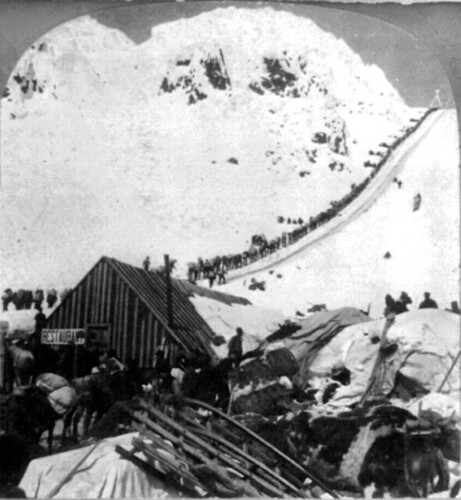
A Joplin Man Writes From the Klondike

Hopeful Gold Miners Begin the Journey into the Klondike

A former Joplin resident headed to Alaska during the great Klondike Rush of the 1890s. He wrote to relatives in Fairfield, Missouri, who shared the letter with the Joplin Globe:

“I will try to write you a few lines in answer to your letter I received this morning. I will have to ask you to excuse this dirty paper, for it is all I have, and paper is hard to get in this country. My partner and I landed in Dawson City yesterday in the best of health, but we are immediately worn out.

We had an awful trip, a trip that tried one both in strength and heart. First, it required one to have a strong constitution. To give you some idea of what we went through with, I will relate a part of our trip from Glenora to Dawson City via Teslin lake. First, it cost us $400 to get 500 pounds of provisions carried from Glenora to Teslin lake, a distance of 200 miles. We had to walk, for it was impossible to get a ride.

Even women tried to walk over but failed. We had to wade streams and mud up to our knees and sleep in wet blankets at night. It took us 21 days to make the trip to Teslin lake. There we had to build a row boat and start down the river and many times my partner wanted to turn back, but I told him no, that I was determined to go through or die in the attempt, for I had long ago learned that a faint heart could conquer nothing.

Now I will give you some idea of the suffering on that trail. There were 2400 persons left Glenora and only 230 out of that number ever reached Dawson City. Many turned back broken-hearted while many lost their lives. I don’t think I am very faint-hearted but I would not come in over that trail again for all the money in Alaska.

I have seen men sit down and cry like a child when they saw that they could not stand the trip and would have to turn back.

The scenery was the grandest I have ever seen but a man could not enjoy it.

I live to get home again. I will tell you more than I can write in a month, for I know I have taken the greatest trip of my life or at least I never want to take another one like it.

We thought we were picking the best trail but instead of that we got the worst one and had to make the best of it we could.

The ground here is covered with a coat of moss about a foot thick. Under that is ice and frozen dirt. There is no level ground here. It is all mountains. It is very rich in gold and we still think we will make our fortunes before next August.  My partner is an expert miner but I rely on my own judgment. We are on a [word obscured] now for a lay in the mines. I have come here to make a stake and intend to make it. The output of the mines this spring was $22,000,000, the richest output in the history of the world.

Dawson City is a city of 20,000 people. Many are homesick and will go home, while many have no money or provisions and cannot get away, and it seems that starvation awaits them. To walk the streets of Dawson reminds one of being at a funeral. You never see a smile on anyone’s face. There are too many men here that were never away from home and they don’t know how to meet disappointments and hardships. There are lots of provisions in Dawson, but they are very high priced.

We have money and provisions enough to winter us nicely. Wages are $10 a day and board yourself. If a man is a good rustler he can make lots of money here. As this will probably be the first letter from Dawson this summer to reach your part of the outside world., I would like for you [to] tell the boys to think before they start, especially those who have never been away from home. I would not advise anyone to come to Alaska, neither would I advise them not to come. Everyone must come on his own responsibility.

I do not need nice clothes here now, for I look like the breaking up of a hard winter. Tell the young people of Fairfield that I wish them a pleasant autumn and happy winter.

I will try to get another letter out to you before the freeze comes. I send my love to you and all inquiring friends. I remain,

Yours, as ever,

Ed Ferguson.

Source: Joplin Globe

S.B. Corn Returns to Joplin

After having left Joplin 35 years earlier, S.B. Corn returned to the city in 1910, amazed by the city that had replaced the small hamlet he once knew. Upon his arrival, he inquired after several old-timers, including attorneys Clark Claycroft and Leonidas “Lon” P. Cunningham. Corn was saddened to find that both men had passed away. The only men still alive in Joplin that he knew from the 1870s were D.K. Wenrich and E.B. McCollum.
 
Corn was also disappointed to find that the spot where his smelting plant once stood in East Joplin could not longer be ascertained. He did, however, find the old building that once housed the Senate saloon. Unfortunately, the reporter accompanying Corn failed to report its location.
 
At one time, Corn allegedly owned several hundreds, if not thousands of acres in the Joplin area that extended south into Newton County. Over the years he sold the land off, most of it purchased by Joplin capitalist John H. Taylor. He built his first lead smelting plant in 1870 near the village of Cornwall (now called Saginaw). He built his next smelter closer to Joplin. It used air furnance fueled by wood. As Corn described it, “Hot blast, rushing over the ore, converted it into a molten mass which drained off into kettles. From these kettles it was ladeled out into moulds, and pigs, ranging in weight from 8/0 to 100 pounds, were formed. The metal was hauled over land to Baxter [Springs], Kansas, and shipped by railroad to St. Louis.”
 
According to the reporter, “Much of the ore smelted was produced from Mr. Corn’s land in the Kansas City Bottoms and was purchased from the lessees. The story is told that the smelting company sometimes paid for one load of lead five or six times, the operators being clever enough to have the same product weighed any number of times.” When this was discovered, duplicate sales were “abolished.” Corn eventually left Joplin and headed east to Pennsylvania where he engaged in the gas and coal business, but on a return trip west felt the urge to see Joplin once more.
 
He exclaimed, “When I was in there the seventies, there was no west Joplin. This part of the city was nothing but prairie. I feel like Rip Van Winkle, and can ahrdly realize that a city could have  grown so rapidly as this one.”

Source: Joplin News Herald, 1910.

The Newberry Law

In 1889, a law commonly known as the “Newberry Law” was passed by the Missouri General Assembly and was signed into law by Governor David Francis. The man behind the law, Dr. Frank R. Newberry, was a physician and Democratic legislator from Fredericktown, Missouri. Concerned by the “moral status” of the liquor trade, Newberry came up with a law that he felt would clean up the saloons of Missouri.
 
The text of the law is as follows:
 
An ACT to prevent any dramshop-keeper from keeping or permitting to be kept in or about his dramshop certain musical instruments, any billiard, pool, or other gaming table, bowling or ten-pin alley, cards, dice, or other device for gaming or amusement.
 
A dramshop-keeper shall not keep, exhibit, use, or suffer to be kept, exhibited, or used, in his dramshop, any piano, organ or other musical instrument whatever, for the purpose of performing upon or having the same performed upon in such dramshop, nor shall he permit any sparring, boxing, wrestling or other exhibition or contest or cock fight in his dram shop; and it shall be unlawful for any dramshop-keeper to set up, keep, use, or permit to be kept or used in or about the premises of his dramshop by any other person, or run or to be run in connection with such dramshop, in any manner, or form whatever, any billiard table, pool table or other gaming table, bowling or ten-pin aley, cards, dice, or other device for gaming or playing any game of chance;

and the keeper of such dramshop shall not permit any person in or about his dramshop to play upon any such table or alley, or with cards, dice, or any gaming device of any kind. Every person violating the provisions of this act shall be guilty of a misdemeanor, and, upon conviction, shall be punished by a fine not less than ten nor more than fifty dollars, and in addition to such fine shall forfeit his license, and shall not again be allowed to obtain a license to keep a dramshop for the term of two years next thereafter.
 
Approved June 17, 1889.

 
Legal jargon aside, the Newberry Law prohibited saloon keepers from operating pool and billiard tables, card and dice games, or any other device that might be used to gamble. Even musical instruments were prohibited and the only furniture a dram shop could have were “bar fixtures and chairs.”
 
Joplin, like many cities during this time period, had more than its fair share of saloons. A bold News-Herald reporter set off to interview some of the bar owners and saloon keepers about their opinion of the new law (and no doubt imbibe a few drinks).
 
At Chester Parker’s saloon, the reporter found that Chester was out, but his employee was of the opinion that the law “would not cut any great figure” of business. Ol Boucher, who was standing outside his saloon at 518 Main Street when the reporter ambled up, felt that “the enforcement of the law would make no material difference to the saloon difference.”
 
Major John D. Mefford of the Mefford and Klotz Saloon, however, was fighting mad. He declared the law “was a gross disregard of the rights of property.” Mefford allegedly had a $1,000 invested in new billiard tables and moaned that they would be a “total loss.” To him, the law was “unjust and a further prosecution of saloon keepers.” John Ferguson of the J. Ferguson & Co. Saloon agreed he would lose money on billard tables, but was happy to see craps and other dice games go, as they “did not belong to the saloon business.” William Teets, of Teets and Company Saloon at 318 Main Street, proclaimed he had always obeyed the law and would not grumble, but noted he would have replace many of the fixtures and furniture in his business in order to be in compliance.
 
Henry Sapp, whose business was located at 214 Main Street, was furious at Newberry and the new law. The reporter had to use multiple dashes to indicate the numerous expletives that Sapp hurled at Newberry. Sapp then said of Missouri Govenor David Francis, “Dave, he promised he wouldn’t sign that —— —— bill. He slaughters the rest of us to get revenge on the —– —– —— St. Louis saloon men. Dave is trying to cater to the —- —– country element. He wants to be United States Senator, but he is a dead rabbit now, henceforth and forever.” Sapp continued on his tirade, but the reporter must have felt it unnecessary to record the rest of his statement, due to the numer of unprintable words Sapp used.
 
Incidentally, Governor Francis became the US Secretary of the Interior shortly after he left office as governor, and then later served as US Ambassador to Russia, but he never served as a U.S. Senator.
 
Sources: p. 104 Laws of Missouri, passed at the Session of the 35th General Assembly, 1889; History of Southeast Missouri by Douglass; Joplin News Herald; 1889-1890 Missouri State Gazeteer.
 
For more on Sapp, see our blog article on Honest John McCloskey.

The Murphy Mansion

In 1889, a reporter with the Joplin News Herald met with P. Monneron, architect of Patrick Murphy’s new mansion. According to Leslie Simpson’s From Lincoln Logs to To Lego Blocks: How Joplin Was Built, the house was a prime example of the Romanesque Revival style of architecture. Located at 402 Wall, the Herald reporter described the house as follows:
 
“The building will comprise cellar and two stories. The ground plan somewhat irregular in outline to conform with the artist’s design of the superstructure, is about 40×60 feet. The basement will be constructed of a 24 inch stone wall, rising above the surface sufficiently to afford ample light and ventilation to the cellar. The portion above ground will be constructed of cut stone. In the cellar will be located the furnace and boiler for heating the entire structure by steam. It will in addition furnish ample room for all other purposes.”
 
The reporter remarked that the location of the house was “the handsomest building site in the vincinity of Joplin, lying directly south of the cemetery. The tract contains forty a cres, a greater part of which is already set in trees.” The land had a small rise on which Murphy planned to build the house so that it sat a reported 21 feet above a nearby reservoir.
 
The house itself was situated so that it faced east with a carriage drive “with walks on either side and lines of shade trees flanking both.” There was a second entrance located at the north end of the property. It too would be lined with trees and passed behind the house and on to the barn. The house itself had a “wide veranda with receding angles below; a short stretch of balcony in front of the upper story and a tower reaching a height of fifty feet rising from the southeast corner.” With a total of 17 rooms, the house cost an estimated $8,000. In today’s money, with inflation taken into consideration, the house would probably cost around $200,000 to build today.

Sources: Joplin News Herald, Leslie Simpson’s From Lincoln Logs to To Lego Blocks: How Joplin Was Built.

The Joplin American

Joplin is home to Thomas Hart Benton’s gorgeous mural, “Joplin at the Turn of the Century.” It’s rare to find someone in Joplin, or even the Tri-State region, who does not know of Benton’s affiliation with Joplin. Born April 15, 1889 in Neosho, Missouri, he spent his youth in Southwest Missouri. As a young man in his late teens, he arrived in Joplin and soon found work as a cartoonist at the Joplin American newspaper. Unfortunately for Benton, the Joplin American was a short lived enterprise. Financed by A.H. Rogers, the founder of the Southwest Missouri Railway, the paper folded. It later moved to Ft. Smith, Arkansas, where it continued on under a different name.

 Although his motives are unclear, Rogers, a Republican, most likely wanted to create a paper to counter his Democratic rival, Gilbert Barbee, who controlled the Joplin Globe. The two were political and business foes until Rogers quietly purchased the Joplin Globe out from under Barbee’s in 1910, silencing his rival for a short time. Barbee, never one to rest on his laurels, tried to launch a second paper after he lost the Globe. His second paper, the Joplin Morning Tribune, ran from 1911-1913, and often made sharp jabs at Rogers and the Globe.

However, the heyday of Barbee’s political and journalistic power was over. The Morning Tribune was shut down and Barbee went into retirement, spending time at health resorts across the country, and only periodically returning to Joplin. Upon his death in 1924, he left a generous bequest to the citizens of Joplin.

Today the name Gilbert Barbee is little remembered, save for his time as owner of both the Joplin Globe and the House of Lords, but he may have helped spark the birth of a short-lived newspaper that employed an aspiring artist who went on to become one of Missouri’s most famous sons. Ironically, no issues of the Joplin American newspaper are known to exist, but should you know of one — let us know.

Dutch Pete

Peter R. “Dutch Pete” Ensminger was one of the many colorful figures who walked the streets of Joplin. He roamed the mining district between Joplin and the Kansas state line during the early 1870s until 1890. One person recalled, “His feats of strength were proverbial, and not to know of ‘Dutch Pete’ was to expose one’s ignorance of the traditions of the locality.” Unfortunately, like many of the individuals who called the Tri-State mining district home, Dutch Pete left little in the historical record, save for one account left by someone who apparently witnessed his exploits.
 
He was described as, “not a large man, weight about 175 pounds and being about five feet eight or nine inches in height. In his street clothes he would only attract attention by his breadth of shoulder, but no one would suspect his strength. He was very heavy boned, had long arms and unusually large and shapely hands and feet. His features were pleasing and intelligent…sparkling black eyes, dark hair, and complexion.”
 
It was only when he was at work at a smelter that one realized just how powerful Pete was. It was recalled that “The sinews then reminded one of the tendons in the leg of a horse, and muscles played about under the skin like live things.”
 
Among the feats of strength Pete could perform were taking a pig of lead in each hand, (each pig of lead reportedly weighed 90 pounds), holding them out, and then bring them together over his head; lift a 500 pound barrel of white lead into a wagon; and once “wheeled 24 pigs of lead 18 feet in an iron wheelbarrow on a dirt floor.”
 
About every six months, it was said, Pete would “drink enough to submerge his natural good nature and consideration for the proprieties.” Given his strength and size, he presented a challenge to local law enforcement, and it “was as entertaining as a circus to see the ‘law’ perspire in landing Pete in the lock-up, and the task was never finished without the force being badly ‘messed up.’”
 
Apparently the only way that Joplin’s police force could get Pete to jail was to tie him up and drag him, but it often took officers an hour to exhaust Pete, and only then could he be bound and hauled off. Given that Pete was a good natured fellow, officers seemingly chose not to billy club him into submission, as “there was not a man on the force who would strike him with a mace or see him struck.” Pete, for his part, was never known to hit or strike an officer.
 
Pete put the Joplin police force to the test one summer day in the 1870s “between Second and Third on the west side of the street.” Joplin’s beloved L.C. “Cass” Hamilton was city marshal. Together Hamilton and two of his deputies, one of whom was Joe Reeder, went after Pete for a minor offense. Hamilton and his men were described as “large men” with Hamilton roughly 250 pounds and the deputies roughly 200 pounds each. The three officers tackled Pete and the fight was on, but not for long.
 
“Before the dust had a chance to settle, it was seen that Hamilton was down, Reeder down beside him, and the other deputy lying across the two. Someone in the crowd yelled, ‘Dogfall! Try it over!’ and the fun continued until justice was vindicated.”
 
Pete was also known for the odd habit of “taking the conceit out of bulldogs barehanded.” He would “aggravate such an animal until it attacked him, when he would slap the dog and spin him around until he was exhausted or quit.” On one occasion, he tormented a bulldog until he grew tired, then viciously struck the animal, knocking it back against a wagon axle where it lay, unable to get up. Joplin attorney W.B. McAntire remembered that on at least one occasion Pete had suffered a few dog bites during one such occasion.
 
It was said that Pete eventually married, bought a farm, and moved to a Kansas county on the state line. He was reportedly killed in a train wreck between Joplin and Springfield.

Joplin Fire Department Mea Culpa!

Thanks to the sharp eye of Jim Perkins of the Joplin Fire Department, we discovered that our post from a few weeks ago of a photo of the 1907 Joplin Fire Department was in fact the 1902 Joplin Fire Department.  Not only are we thankful to Jim for spotting this error, but he was kind enough to share with us a copy of the actual photo.  Thanks, Jim!

1902 Joplin Fire Department - from and by permission of Jim Perkins, Joplin Fire Department

A.J. Blackwell Strikes Again!

Drawing of A.J. "Bear Fighting" Blackwell

Drawing of A.J. "Bear Fighting" Blackwell in his later years.

In one of our previous posts, A.J. “Bear Fighting” Blackwell was mentioned. Blackwell, one of the earliest residents of Joplin, built the first opera house in Joplin. After serving a sentence for counterfeiting in the Missouri State Penitentiary, he left Missouri and founded the town of Blackwell, Oklahoma. He became a wealthy and well known figure who lived an interesting life.

According to an article from a Blackwell newspaper, Blackwell was accused of “periodical insanity and one of these spells is upon him.” For the last few days “he has been terrorizing the entire city and community with his threats, and being heavily armed continuously, it is a question as to what he might do.” Prior to his illness, he had Miss Effie Widick, a Blackwell school teacher, arrested for punishing one of his children. She was acquitted, but Blackwell was not satisfied. He traveled to Wichita, Kansas, in an attempt to have her indicted in U.S. federal court.

The news report claimed, “He once stood off a mob of negro haters with a Winchester and incurred the enmity of nearly the entire citizenship, which finally succeeded in ridding the town of the black race.”

Blackwell proclaimed that he was a member of every church in town and “has been dead twice and returned to life to warn the people to join as many churches as possible.” In the meantime, “he drives up and down the streets, hooting and yelling like an Indian, waving firearms and even defying the officers.”

Despite his insanity, Blackwell had somehow managed to invest in a coal company and direct coal to be shipped from Chelsea, Indian Territory to Blackwell.

When he died in 1903, his obituary failed to mention his bouts of “insanity.”

Source: Joplin News Herald