What the Train Brings In

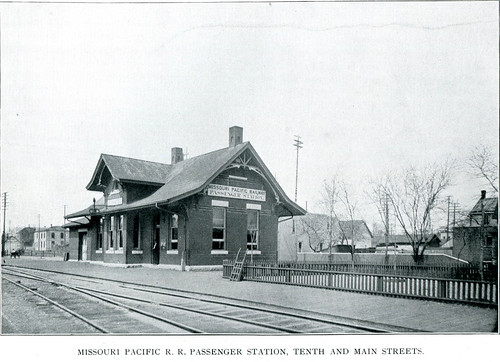
Any town with a railroad was bound to have its share of characters. Joplin certainly had its share. In 1897, Arthur Harrold, an eighteen year old tramp, arrived in town with a curious collection of artifacts. Harrold told a Globe reporter that he hailed from New York City and had left the Big Apple eight years and ten months earlier to see the country. With him he carried a sack full of relics that rivaled the collection of the Smithsonian: fragments of rope used to hang Cherokee Bill; a petrified potato; spectacles given to him by the first settler of Texas; the bullet that killed General James McPherson; cartridges owned by Cherokee Bill and one of the Dalton boys; saws used by Noble Shepherd when he cut his way out of the St. Louis city jail; and letters from officials from all over the country certifying his presence in their cities.

Harrold’s journey was sparked by a wager that he could not travel 65,000 miles in a ten year period and save up $6,000. At the time of his arrival in Joplin, he had reportedly saved $5,382 that was deposited in a New York bank. As part of the wager, he was not allowed to beg, steal, or borrow on his journey. Should he fulfill his mission, Harrold was to receive $5,000 from the Police Gazette magazine plus $5,000 from New York World and Associated Press.

At around the same time, another character drifted into Joplin, but not one that the police wanted to see. “Kansas City Jack” was described as a “bum” who was not “meek.” Upon arriving in Joplin, Jack immediately raised a disturbance at one of the train depots. Officer Jack Winters was called and quickly collared Kansas City Jack. But the bum was not one to go quietly as it was a “continual fight all the way from the depot to the station house.” In the course of their journey, the officer knocked Jack down “about twenty times and was about tuckered out when he reached the jail.” His neat, clean police uniform was reduced to shreds as the officer arrived at the police station wearing “only a pair of shoes and a tired looking countenance.” This, according to the Globe, was “the sort of struggle every officer is reported to have who arrests Kansas City Jack.”

After he was processed and released, Jack did not stay out of trouble. At two o’clock in the afternoon, Deputy Marshal Fones discovered some bums were passing liquor through the jail window to prisoners inside the jail. Upon going outside, Fones found that Kansas City Jack was one of the main culprits. After a struggle, and Deputy Marshal Fone’s pants being destroyed in the process, Jack was back in jail.

If Fones expected the rest of the day to go smoothly, he was wrong. At five o’clock that afternoon, while Fones was talking to a friend on Main Street between Second and Third streets, a little boy named Ira Chubb ran up and told him that prisoners were escaping from the city jail. Fones, together with Officer Winters and Deputy Constable Hopkins, took off in hot pursuit. Their chase was made all the easier by a group of young boys who were following the escapees. The prisoners were captured at Third and Byers. Upon inspecting the jail, it was discovered that one of the prisoners was a “mechanical genius” who had managed to unlock the jail door using only a simple wire.

There was never a dull moment in early Joplin!
The Lawyers

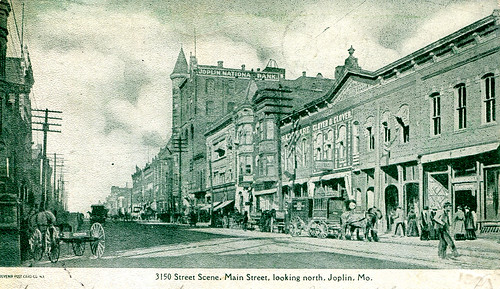
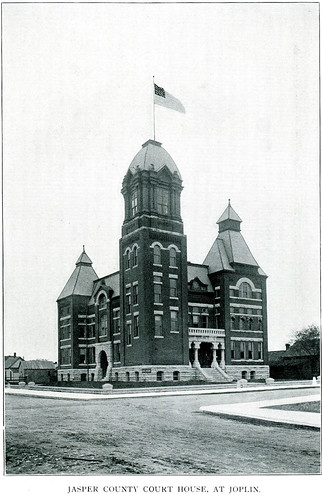
The scene of undoubtedly many a colorful exchange between Joplin's lawyers. It later burned to the ground.

We have covered desperados, sinful sirens, and other ne’er do wells in the past. We have yet, however, to discuss the lawyers who were called upon to defend their clients over the years. There are biographical sketches of many judges and lawyers in the various Jasper County histories, but nothing quite brings the local bar to life like the address the Honorable John H. Flanigan delivered before the Jasper County Bar Association on March 1, 1941, the one hundredth anniversary of the Jasper County Circuit Court. Although we cannot reprint the entire speech in its entirety, we can share some of the more colorful stories he related to his audience.

One of the most vivid tales Flanigan shared was one that he had heard from the venerable Samuel McReynolds:

“One of the old time lawyers in Carthage was Bill Green. He died in the State Hospital [Insane Asylum] at Nevada. For years before his confinement there his mind had been failing, but the failure was so gradual that many were unaware of his condition. Samuel McReynolds told me that on one occasion his firm had been requested by a law book concern to make collection of an account against Bill Green. The firm was unable to make the collection and thus the matter stood until one day a salesman from the law book concern called at the office of McReynolds & Halliburton on a sales trip. Learning that the Green account had not been paid, he asked Judge McReynolds if there was any objection to his undertaking to collect. McReynolds agreed that the salesman might try it.

In a few minutes, the salesman came back white as a sheet and quivering like an aspen leaf. He said:

‘Mr. McReynolds, I have had a perfectly horrible experience. I went up the stairs, found Mr. Green’s door, walked in, and found a very large man lying full-length on the floor. The floor was covered with papers and documents. The man had a large past pot on the floor and a paste brush in his hand. Without preliminary, the man said, “This is my filing system. For years I have been unable to find lost papers. Now I take a paper, put paste on it with this brush, slap it on the wall and there it is until the end of time. I am going to patent this invention.”

He then rose to his full height and asked me to state my business. I told him I had come to collect the account. Green had a peculiar glitter in his eye. He said, “Sir, I am possessed of supa’ powers. You see this long knife with its keen blade. With this knife I am able, sir, to separate your head from your body, remove your head, place it on the floor, and replace it on your shoulders without injury to you, and sir, I am going to perform that miracle on you right now.” I don’t care if we never collect that account.’

According to Flanigan, “Tom Connor [of Connor Hotel fame] disliked Judge Malcolm G. McGregor, but said he was willing to trust McGregor to decide any case because, ‘Even though he is a damned Scotchman, he is absolutely honest.’”  He added that when McGregor arrived in Jasper County, he had walked from Ft. Scott, Kansas, to Lamar. After taking a brief rest, he walked the rest of the way from Lamar to Carthage.

Judge John C. Price, it was recalled, had a fondness for alcohol and tobacco. Flanigan said of Price, “When he was riding the circuit he would retire at night in the primitive hotels of the period, a giant ‘chaw’ of tobacco clamped in his jaw. When seized with the desire to expectorate he would spit a steam of tobacco juice straight in the air above his head and would then quickly draw the covers over his head so that they might catch the fall, thus ‘saving his face.’”

Once Al Thomas was participating in a trial at Carthage and, as usual, “shouted his argument in penetrating tones that carried far beyond the court house square.” His opponent in the courtroom that day, Lon Cunningham, stood up and replied:

“Gentlemen of the jury, I read an article in the encyclopedia which interested me very much. It stated that some scientists had gone to the upper reaches of the Amazon far into the jungles of South America to find out what sort of animal was capable of making a tremendous noise described to them by the natives who reported that when this noise was heard the cockatoos and the wild bird would fly from their perch and flit from tree to tree, hyenas would take to the deep undergrowth, and panthers would retreat to their dens. After weeks of search[ing], the source of this noise was found. It was a harmless beetle which made the noise by the tremendous beating of its wings. This noise was the beetle’s only defense against attack. Al Thomas reminds me of that beetle. He is all noise and noise is his only defense.”

Cunningham was also known for winning a court case over water pressure. One of the parties in the case was required to provide enough water pressure that a stream of water would reach the fourth floor of the Keystone Hotel. Cunningham argued that the contract was invalid because of the required water pressure was not provided. In closing arguments, Cunningham recalled that growing up on the family farm, he remembered boys would “usually gather around a large apple tree behind the barn and each in turn would attempt with Nature’s own water pressure to throw a stream to reach the big limb of the apple tree.” According to Cunningham, he knew from experience “there were boys in the family who could furnish more pressure than the defendant had furnished under its contract.”

Perhaps in 2041, we’ll be greeted with just as colorful recollections of today’s lawyers.

Joplin’s Mining Queen

“All Joplinites who remember the palmy days of ’90, ’91, and ’92 will call to mind the exciting scenes and incidents of those times, and the prominent actors then upon the stage, which made this city the talk of the country,” the Globe recalled in 1897, upon learning that Mrs. M.C. Allen was to be committed to the state insane asylum in Nevada, Missouri.

Mrs. M.C. Allen, Joplin’s “Mining Queen,” was a conspicuous figure in local society. In 1889, after divorcing her husband, she arrived in Joplin from Indiana. As part of her alimony agreement she received a one hundred acre tract of land near Blendville. In a short time, she leased the land to Frank, Harry, and John Snyder. Together, the Snyder brothers developed the land into a profitable mining operation. It was reported that in 1890, 1891, and 1892 the Snyders paid Mrs. Allen $42,000 in royalties.

Allen, however, was ambitious. In 1893, she earned the sobriquet “Mining Queen” when she “took possession of the tract herself and operated it successfully for a period of fifteen months, during which time her income from her operations was from $500 to $600 per month.” Allen bore her new nickname with “such regal extravagance as to excite both natives and visitors alike.”

Mrs. Allen began to indulge in the purchase of “blooded horses” and “imported dogs.” She paid for $50 photographic portraits of her dogs, reserved the finest lodgings at local hotels, and began dabbling in wheat speculation with Frank Snyder. But the good times came to an end when the bottom fell out of the wheat market and both Allen and Snyder were financially ruined. Her one hundred acre tract of land was mortgaged in Kansas City for $5,500 and mortgaged a second time in Crawfordsville, Indiana, for an additional $1,800. The mining land was gobbled by investors from Minnesota for a mere pittance. When the dust cleared, Mrs. Allen was left with $1,000.

Dissolute, Allen moved first to Kansas City, then later to St. Louis where she opened a boarding house. But she could not forget her glory days in Joplin and returned, determined to rebuild her fortune. “Sickness and mental troubles” took their toll on Allen, however, brought upon by “the constant brooding over her losses.” Her despair caused her to hallucinate and lash out violently, despite being cared for with “a kindness and sympathy which her unfortunate situation fully justifies.”

It was determined that she should be sent to the state insane asylum at Nevada. When she arrived in Nevada, the Nevada Mail reported the following story:

“A pathetic incident occurred when Mrs. Allen of Joplin was brought to the asylum to be confided. She had been a woman of wealth, which had been dissipated with a lavish hand. Among her acquisitions was an imported dog which had been procured and trained at great expense…When the unfortunate was brought by her friends and an officer to this house of refuge for the mentally afflicted, her faithful dog accompanied the party.

She did not want to depart from her canine companion, and the mute appeal of the dumb animal to be permitted to stay with her was touching. [Asylum] Superintendent Robinson’s kind heart was moved…he permitted the little fellow to become an inmate and it occupies the room with its mistress, as faithful in companionship, loyal in love, and devoted to his friend as in the days of her luxury and social prominence…”

Thus was the end of Joplin’s first “Mining Queen.”

Check Out Views of the Asylum here.

Creepy book of drawings by an asylum inmate here.

A Man From the Lead Diggin’s – A letter from Boston

The Joplin that Martin Left Behind for Cultured Boston

In the spring of 1908, a Joplinite ventured far from home and landed in “cultured Boston.” The gentleman, E.F. Martin, sent a letter back to his friend, John P. Frank in Joplin, and offered in colorful terms his feelings on visiting the historic town. In the process, we’re offered a glimpse not only in the words Joplinites chose to represent their feelings, but also what they felt was proper from low heel shoes on women to modern day Yankees.

“Boston, Mass, April 28, 1908.

I have had so little to do today that I am awfully lonesome and thought possibly I might work some of it off on you. Boston is an older town than Joplin. You can tell that by the dates on the head-stones at the burying grounds.

I went in to the ‘Arm and Bella,’ an old hold-out and had a drink of real musty ale sitting in the same place where Nathaniel Hawthorne used to sit and tell stories. Sunday I visited the Old South Burying Ground and while walking about in there found the grave of Paul Revere. You remember Paul. He became excited one night when he saw a light in the old South meeting house and got on his horse and rode out into the country giving the alarm that the Britishers were about to get them. If the average Yankee was then as he is now it is a durned pity that the Britishers didn’t get them all.

Boston is a real nice place, though, for a day or two — not for a whole month. I would much rather be down in Stone county, Missouri, catching speckled bass. Talk about fish, they sure have it here in plenty. I have sampled everything in the fish line since coming, except an octopus. I think I shall order planked octopus net. I spend some of my leisure time on the Commons. This is the place spoken of in Saint Matthew where the British soldiers broke the ice in the ponds and the school boys went and told on them for it. Served them right, eh? I was in New Haven, Conn., the first of the month and tried to buy some wooden nutmegs, but could find none. I will try and get you some postals showing pieces of interest — ancient interest. The old state house is still here and is used for a depot for the subway. Faneuil Hall — the Cradle of Liberty — is here down on State street. Armour Packing company have the first floor rented and there is a large sign out telling the people that Armour’s dressed lambs are the best. I think that is simply awful.

I wish I had someone with me to walk around with and kill time. I am stopping at the “Tavern.” Tolerably good place. There are no large department stores, but many shops. There are no Jews here here that I have seen and but very few negroes.

I was down on the wharf last week and saw an ocean vessel come in from the South loaded with bananas. I was there again this morning and they are still unloading bananas. The vessel will carry about 100 car loads.

From things here in general I don’t wonder that our forefathers wanted to go west. I have that same feeling, and it makes me glad to think that I can start Saturday noon. Doggone me if I hadn’t rather live in Carl Junction, Saginaw or Carthage, than in cultured Boston. The ladies here all wear low heel shoes like a man. The men all smoke pipes. I wonder why until I tried some of their cigars.

Of course there are plenty of places of interest, but one grows tired of looking at sights highly valuable because of their age and historic surroundings.

Well I will be down this summer when bass are ripe and we will make up for all this tomfoolery. By the way, I saw a sturgeon brought in that weighed more than 300 pounds. It was caught in a net far out at sea.”

Joplin Celebrates St. Patrick’s Day


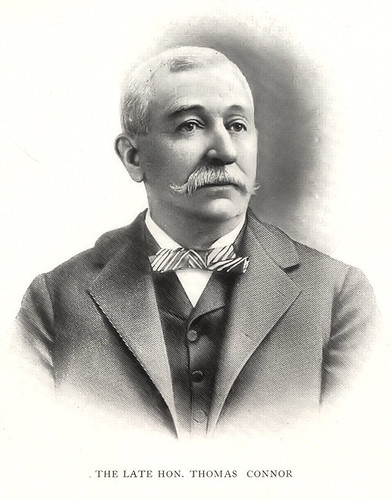
Thomas Connor, an immigrant from Ireland, was one of Joplin's wealthiest citizens.

With sons and daughters of Ireland calling Joplin home from its earliest days, it’s not surprising to know that the celebration of St. Patrick’s Day is more than a hundred years old in Joplin.  The Joplin News Herald noted the events held on March 17, 1908 and claimed that the day began with a “typical Irish fog enwrapping the city,” with every flag pole decorated with the Irish flag.  Thousands of green shamrocks decorated the lapels of Joplinites across the city, the paper declared.

In describing the events, the News Herald noted, “The Irishman lives everywhere, and everywhere has he well-wishers who long with him for the time when oppression and wrong in his native soil will cease to be and the Emerald Isle return to the control of the native son.”  I

Beyond political discourse, the paper reported that the Irish and those who intended to celebrate the day with them, were to attend an observance at a “little old church that was the religious home of Joplin Catholics for so many years.”  The program consisted of a boys’ choir singing “God Save Ireland,” the Catholic priest, Father Clinton singing “The Wearing of the Green,” and a instrumental selection from Miss Margaret Williams, Masters William and John Joseph Hennessey.

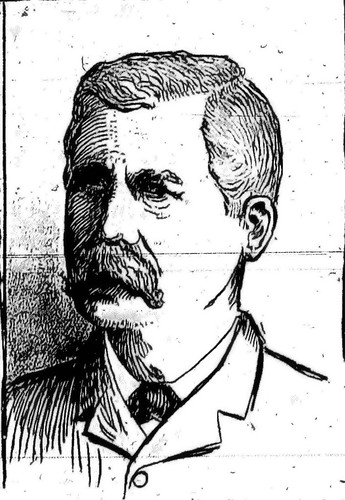
Patrick Murphy, also an Irish immigrant, was the benefactor and namesake of Murphy Park.

The instrumental was then followed by a recitation by a Father Lyona, another song, “Then You’ll remember Me” by Miss Anna Toohey, a selection from Mrs. E.F. Cameron, a song from Mrs. Will Moore, another instrumental, “The Irish Dance” again from Ms. Toohey, “The Irish Immigrant” by Mrs. W.F. Maher with another recitation from Father Lyona, “Kathleen Mavourneen” sung by Mrs. Kachelski; a concertino solo and song by D.M. Sayers, and concluded with the boys’ choir singing “My Country Tis of Thee.”


Happy St. Patrick’s Day!


Source: Joplin News Herald

The Love Pirate and the Bandit’s Son by Laura James – Review

The Love Pirate and the Bandit’s Son: Murder, Sin, and Scandal in the Shadow of Jesse James by attorney Laura James was published in 2009, but we thought we would mention it because the book contains a detailed look at one of Joplin’s lesser known scandals involving one of the most influential men in early Joplin history.

Zeo Zoe Wilkins was a charming osteopath who also a cunning opportunist. Her prediliction for marrying men, taking their money, and then divorcing them led some to call her a “vampire.”

After meeting 72 year old banker and former Joplin mayor Thomas W. Cunningham, Zeo Zoe sought to marry him and, in the process, seize his assets for herself. There was only one problem: Thomas had a common-law wife, Tabitha Carr Taylor Cunningham. Zeo, however, pushed ahead with her plans and married Cunningham. She kept him sequestered away from his friends, took over half a million dollars in cash, sold his bank to a rival, and disposed of his real estate holdings. Cunningham launched a divorce suit, claiming he was Zeo’s slave. In the end, the marriage was anulled. Zeo Zoe received a generous settlement while Cunningham returned to Joplin and to Tabitha. But Zeo Zoe’s story did not end in Joplin. She continued her scandalous ways until she met a brutal end in Kansas City. Her murder was never solved, but among those suspected of killing her was her one-time lover, Jesse James, Jr.

Despite the campy title, Laura James has produced an entertaining and well documented narrative account of Zeo Zoe Wilkin’s sinful life, and in the process has provided an in-depth look into one of Joplin’s lesser scandals that, for a brief moment in time, captured the nation’s attention.

The Estimable Mr. Worth

Jimmy Worth

Joplin’s flamboyant James “Jimmy” H. Worth, who was known to periodically advertise for a wife, announced to the Joplin News-Herald that he was returning to his farm in Franklin County, Indiana, to solve a mystery. Worth, in addition to his property in Indiana, was the eccentric owner of the Worth Block which is now the site of Spiva Park at the northeast corner of Fourth and Main streets.

Worth’s one hundred and fifty acre farm was planted in cherry, apple, peach, and pear trees. Perhaps more notable was the large cave located on the farm which, according to Worth, “ticks, ticks, ticks, just like a monster clock, day after day, year after year.” Previous attempts to explore the cave beyond three hundred yards ended prematurely due to bad air which Worth said made “one’s breath come in painful gasps.” But the bad air was not enough to stop at least one brave creature from calling the cave home.

Worth claimed “a big bear that escaped from a wrecked train ten miles from my farm once took refuge in the cavern and for weeks the natives of Franklin County enjoyed daily bear hunts that netted them nothing, for the big brute was successfully concealed in the far corners of the cave, the ominous clock-like ticking, apparently, holding no horrors for his bearship.” It was later discovered and removed from the cave.

Jimmy asserted his belief that the ticking noise was not the result of dripping water as the cave was reportedly dry. Instead, he claimed that the cave was the artificial construction of “cave-dwellers centuries ago” based on broken flint projectiles, bones of animals, and what Jimmy thought was a “deformed human skull.” He declared he would find out what types of bones were in the cave and discover the source of constant ticking.

If Jimmy did find out what caused the ticking noise, the News-Herald must have found his explanation dull, as it failed to report Worth’s findings.


Source: Joplin News Herald

A Joplinite Takes a Bath

Americans have always loved a good excursion and they love health fads even more. Men as varied as Robert E. Lee and Franklin Delano Roosevelt enjoyed a good soak in hot springs. E.R. Moffet, Jr., son of one of the most significant men in Joplin’s history, engaged in a soak at Hot Springs, Arkansas at the turn of the century. As his descriptive letter indicates, not everyone enjoyed their experience at the baths.

“Editor of the Joplin Daily Globe:

Hot Springs Ark. Nov. 20 —

I arrived here yesterday and thought I would give you my views of the place and express my opinion of the first bath.

I took my choice of some 15 bathhouses situated upon the U.S. reserve and, fortifying myself against surprise, I boldly opened the door and there I met a man behind a counter with a 55 cent smile and a bunch of keys with a rubber band to each key. Upon making my wants known, he returned to a row of boxes like the boxes in the safety deposit department of a bank, and drawing out a box, he pushed it toward me.

I told him I did not want it — I came for a bath. He explained that I was to put all my earthly belongings into the box, so, having had to pay for my bath in advance, I had only three coppers and a nickel left, but in they went, and he put the box back and as it locked there I thought I was fleeced. He took one of the keys corresponding to the number of the box and slipped it onto my wrist telling me to let it remain there.

Well, as I had broken the ice, I was open for everything. As each 55 cent bath is entitled to a 15 cent attention I was put in the hands of a son of Africa who knows his business. He assigned me to a certain room to disrobe and gave me a robe to don, and I shortly went forth. Going to the bath, we went through the cooling rooms where some eight or ten men were cooling off. Passing through a door, we come to the finest place I ever saw: marble floors, marble partitions between baths, tubs, all supported with brass and porcelain as clean as could be.

My attendant being a man built on the Jeffries order, I soon saw after getting into the bath I was in for it. I remonstrated, but he said I wanted my money’s worth. After rubbing about all the skin off, he took me to a wire cot, laying me out, wrapped me up, and handed me a cup of hot water saying, “Have one on me.” The water was as hot as coffee and could only be supped, the degree of heat being something near 175 degrees.

While lying there I saw a sign saying, “Ladies in the cave.” I called my attendant and said, “Let’s go to the cave,” but he made me lie still. I kept watching that sign and presently it flopped over and it was the word, “empty.” Then my attendant said, “You can now go to the cave.” I said I was not particular now, but I went.

I found a cave some five feet wide, six feet high, and about thirty feet long, and as hot as hell or hotter. This cave is used for bad cases of heart trouble — love, for instance. The heat in the cave is natural, coming from the rocks, and is a most wonderful thing. It is lighted up and one is not allowed to stay in it over eight minutes.

After returning to the bath room, I was asked if I wanted to take a sweat. As I had sweated only about 5 gallons I thought I could stand a little more so he opened an iron door and invited me to step in. I went and out I came — I thought I was done for. The water in the room was it comes from the ground and steam rises from it all the time. But I managed to get in again and stay. Talk about a Turkish bath! They are not in it. I could only stay a few minutes and then called to be released. Getting out of the sweater, as the cloister is called, I asked what next.

I was led to the shower room where I believe ten thousand small streams of water about the size of a knitting needle shot at you with about 40 pounds of pressure. They came from every conceivable direction and in striking you they sting very sharp. I concluded the thing had gone far enough and I begged for quarter, but my attendant said, “You isn’t near through yet.” I had enough, however, and after having a pound or so more skin rubbed off, I was allowed to go into the first cooling room and presently to my place of starting.

After dressing I went to the office. There the key was removed from my wrist, the box unlocked, and my money turned over to me with the remark, “Call again.” I guess not — I know when I get enough.

E.R. Moffet, Jr.”


Source:  Joplin Daily Globe

A Soiled Dove Returns

Florence Woodson was hailed as one of “the most notorious denizens of the north end.” She had spent “many long and tedious hours behind the bars” and “years in dives of ill fame” when her mother appeared in Joplin and forced her to return home. Florence, it was said, had left her home in Springfield years before and journeyed to Joplin’s tough North End where she found work as a soiled dove. She soon gained the reputation as one of the “toughest of the tough.”

When her mother arrived, she found her daughter in jail, held on a charge of prostitution. Their meeting was “a heart rending scene” as Florence’s mother told her that Florence’s father had died from grief after she left home. Florence promised to leave her life on the streets and return home to Springfield. She was released from jail and left Joplin. It was rumored that she had indeed returned to the straight and narrow, but she eventually returned to Joplin, hoping to visit the “scenes of her dissipation” while on an excursion to nearby Carthage.

Florence, however, found that Joplin’s North End had changed. Many of the “resorts” were deserted; some even partially destroyed. Once the scene of “music, dancing, and wrong-doing galore,” reform-minded middle-class women had led a somewhat effort to drive the prostitutes, gamblers, and criminals from the North End, many of whom were African-American.

The police, alerted to Florence’s return, arrested her in a rooming house on Main Street. She begged that if released she would never return to Joplin. The judge fined her $5 and costs before releasing her. Florence reportedly caught a train back to Springfield. One more soiled dove had come and gone, but there would always be more to fill the bars and boarding houses of Joplin.

Source: Joplin News-Herald

No. 52

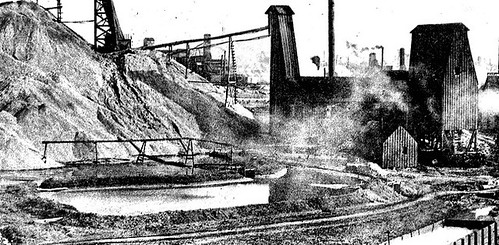
No. 52 often visited his friends who worked in the mines.

“No other Chinaman in Joplin has ever enjoyed the distinction of being the mixer that No. 52 was,” the Joplin News Herald remarked, recalling the life of one of the city’s few Chinese residents.

Little is known about “No. 52.” According to an article in the News-Herald, “No. 52” was the nickname of a Chinese immigrant named “Sam Wung, or something of a similar sound.” He was born the son of a fish vendor in Hong Kong. After he fell in love with the daughter of a well-to-do Hong Kong merchant, Sam sought to prove himself worthy of her love. Despite his best efforts, Sam failed to acquire the wealth he sought. So he boarded a ship for the United States, arriving in Louisiana, and found work at a cotton plantation.

Sam found himself working in cotton fields alongside African-Americans. It was also in Louisiana there that he obtained the nickname “No. 52.” “When payday came he received his envelope marked 52. And the title stuck with him.” A man named C.B. Oats met Sam in Louisiana and brought him to Joplin to find work in the mines. When a miner asked, “What’s the Chink’s name?” Oats replied, “They call him No. 52.” The name stuck.

Sam spoke wistfully of the girl he left behind in Hong Kong, but declared he could not return because a group of white men had cut off his queue while in Louisiana. Chinese men were required to wear their hair in a queue [pigtail] in deference to the emperor. If a Chinese citizen disobeyed this order, it was considered treason, and the penalty for disobedience was death. Fearful he would be executed if he returned to Hong Kong, Sam hoped to save up enough money to send for his beloved.

He found work in the mine of Monroe Clark and John F. Wise located on West Third Street just south of the Joplin Overall Factory near Byers Avenue. According to the News-Herald, Sam was the only Chinese immigrant to work in Joplin’s mines. It was explained that “Unlike his fellow yellow skinned brethren who contented themselves with cleaning dirty clothes and eating rice three times a day, No. 52 sought employment with white men, and despite his nationality he became a favorite.”

For “a number of years he labored with white men. Industrious, good natured, and honest, he won for himself an esteem that is seldom granted to Chinamen.” Impressed with Sam and his rapport with miners, John F. Wise offered him a position as a clerk in his grocery store, which Sam accepted. But even though he worked behind a counter, Sam would leave work in the evening to go to the mine and “spend many hours with the boys underground, chatting and telling stories.”

It was on one of these occasions that Sam stepped onto a tub to be lowered into the mine when tragedy struck. As the tub descended, the “can dropped suddenly a distance of fifteen feet, then stopped.” A cable had slipped on the whim [a whim was a large windlass]. Sam was jerked out of the tub and was “dashed to death” on the floor of the mine one hundred and thirty feet below. His broken body was retrieved and laid to rest in Fairview Cemetery. Sam’s grave was marked with a simple stone that read, “No. 52.”

His death brought sorrow to “hundreds of hearts for No. 52 was a popular Chinaman and he numbered his friends by his acquaintances.”

Source: Joplin News Herald