The Architectural Legacy of Garstang & Rea: Arthur E. Spencer House of Joplin

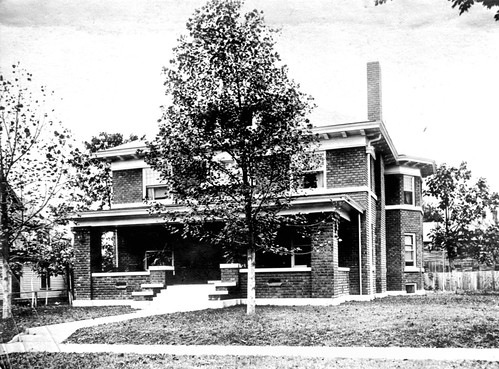
The Arthur Spencer House as photographed by Rea a hundred years ago.

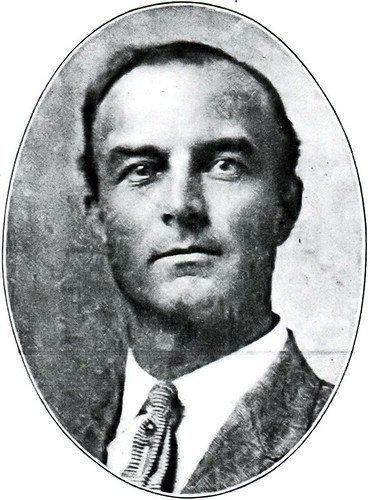
The next item in the portfolio of Garstang & Rea is the Arthur Spencer House in Joplin, located today at 217 N. Pearl Ave. The Centennial History of Missouri by Walter Barlow Stevens, has this short biography of Mr. Spencer:

Among the list of distinguished lawyers who have graced the bar of Missouri in general and of Joplin, Jasper county, in particular, the name of A. E. Spencer deserves a prominent place, not alone because of his legal ability but for his probity of character and his worth as a citizen. Mr. Spencer was born in Newburg, Indiana, October 3, 1868, a son of Galen and Mary M. (Bates) Spencer, the former a native of Illinois and the latter of Indiana. They were married in Boonville, Indiana, and continued to reside there up to 1873 when they moved to Joplin, Missouri. Galen Spencer, while yet a young man, applied himself to the study of the law, and some time later was admitted to the Indiana state bar, continuing to practice in that state up to the time of his removal to Joplin.

Here he resumed his legal practice and in due course came to be recognized as one of Joplin’s foremost attorneys, at the same time earning a reputation throughout Missouri as one of the state’s ablest barristers and most forceful advocates. His death, which occurred December 30, 1904, was the occasion for deep felt sorrow among his legal brethren and the citizens at large, to whom he had endeared himself by his upright character and conduct during the many years of his residence in this city. His widow is still living in the old home in Joplin, where she is spending the evening of her life among a large circle of friends who regard her with affection.

A. E. Spencer, the subject of this sketch, was educated in the St. Louis Law School, a department of the Washington University, from which institution he received his degree of LL. B., graduating with the class of 1888. Following his graduation he associated himself with his father in the practice of his profession at Joplin, and this mutually agreeable partnership continued up to the time of the death of his father in December, 1904. Since then his brother, C. C. Spencer, has been associated with him in his legal practice, the firm enjoying an extensive and influential clientele, Mr. Spencer’s standing in legal circles making his services much in demand. Mr. Spencer is a director of the Joplin National Bank, to the duties of which office he brings sound and thoughtful judgment.

On November 13, 1898, Mr. Spencer was united in marriage to Miss Lou Ann Howard, of Webb City, Missouri, and to this union two children have been born, one son, Arthur E., Jr.. surviving. Mr. and Mrs. Spencer are members of the Congregational church and interested in its good works, as they are in all social and cultural activities, and in all movements having for their object the wellbeing of the community. During the participation of this country in the great World war Mr. Spencer was called upon to serve as a member of the legal advisory board, carrying out the duties imposed on him with zeal and fidelity. In fraternal circles he is a life member of Joplin Lodge, No. 501, Benevolent and Protective Order of Elks.

Additionally, Spencer was the legal counsel for the Joplin National Bank, Empire District Electric Company, Eagle-Picher Lead Co., Empire Zinc Co., and the Missouri Pacific Railroad Company. When not dazzling his peers in the courtroom, Spencer was one of a group of Joplinites who decided to bicycle across a number of states in 1896, which we wrote about earlier (click here for a photograph of Mr. Spencer with his comrades in cycling).

In last good news, Spencer’s home as it remains since the last Google Maps car passed through:
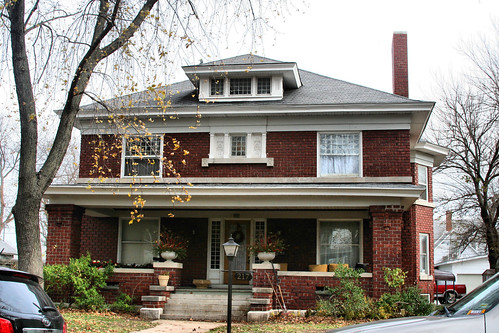
The Spencer House in present day Joplin.
The Architectural Legacy of Garstang & Rea: Amos Armstrong Cass House, Carterville, Missouri

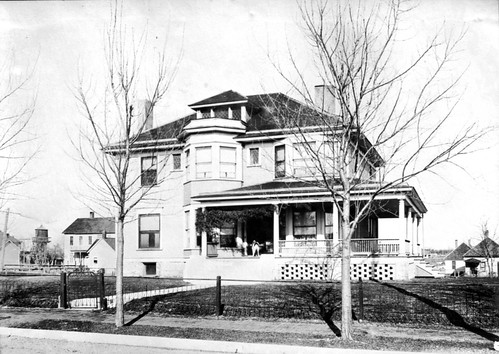
Amos Armstrong Cass House, Carterville, Missouri

We are happy to present the first of many photographs from the portfolio of architect Alfred W. Rea of Garstang & Rea. The featured photo is of the Amos Armstrong Cass House in Carterville, Missouri. Many thanks to Rea’s relatives for preserving and sharing Garstang & Rea’s architectural legacy.

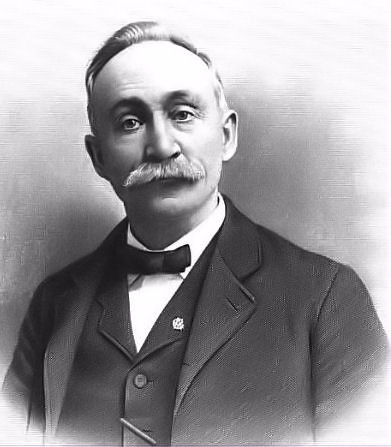
Amos Armstrong Cass

The Biographical Record of Jasper County, Missouri, by Malcom G. McGregor, had this to say about Mr. Cass:

“One of the most conspicuous exponents of that sturdy spirit of American progressiveness which enables men to win success in any field of labor to which they may be called, that could be pointed out among the many successful miners and business men of Jasper county, Missouri, is Amos A. Cass, of Carterville. He is a native of Georgia, but was taken to east Tennessee while yet a mere child, and was there reared to manhood. James M. Cass, his grandfather, was a cousin of General Lewis Cass. His father, James M. Cass, died in Tennessee. His mother, who prior to her marriage was Miss Martha Jane Ryan, was a native of Georgia, and she died in Carterville, Missouri.

Mr. Cass, a contractor and builder, came to Jasper county in 1886 and engaged in the milling business, but soon began to give attention to mining. During the last five years he has devoted himself exclusively to mining, and is now interested in seven good plants, having three on the Cornfield land, at Carterville, one on the Perry lease, one on the McKinley lease and one on Judge McGregor’s lands, besides one other at Oronogo, all productive mines, well equipped with good machinery, and he has come to be known as one of the most extensive miners in the district. He is a partner and director in the Weeks Hardware Company at Carterville, and is a director in the Carterville Investment Company, of which corporation he is secretary.

A man of much public spirit, he has the best interests of Carterville at heart and he is one of its most active and progressive citizens and one of theleading Democrats of Jasper county. He was for eight years a member of the school board of Carterville and was influential in increasing the number of school rooms of the public schools of the town from four to fourteen and in securing the erection of two new brick school buildings. In 1867 he was received as an Entered Apprentice, passing the Fellow Craft degree and was raised to the Sublime degree of Master Mason. Later he took the degrees of capitular Masonry, became in turn a Mark Master, a Past Master and a Most Excellent Master and was exalted to the august degree of Royal Arch Mason; the degrees of Chivalric Masonry were conferred upon him and he was constituted, dubbed and created a Knight Templar, and still later he acquired the Royal degrees of the Secret Ineffable degrees of the Scottish Rite.

Mr. Cass married Miss Sarah Hunt, a native of east Tennessee. His son, Walter W. Cass, owns a good interest in four good producing mines and is connected with his father in the management of the Bell C. and L. C. mines, of which he is superintendent and his son, Carl C. Cass, is assistant superintendent. He had four daughters: Ollie, the eldest, the deceased wife of M. V. James, of Carterville; Lillie A., wife of O. H. Schoenherr; Belle B., at home; and Beulah Jene, a student in St. Charles College, at St. Louis, Missouri.”

According to his death certificate, Cass enjoyed his home by Garstang & Rea up until his death in 1915 from heart disease.

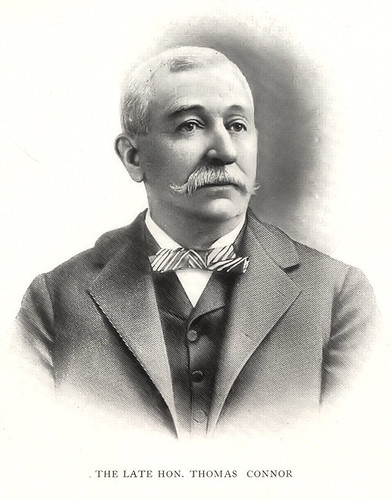
Thomas Connor: Philanthropist, Mine Owner, and Prankster?

Thomas Connor, a son of Ireland and immigrant to America, made his fortune in Joplin in zinc and lead mining.  He oversaw the construction of the New Joplin Hotel, which after his death, became known as the Connor Hotel and was a Joplin landmark until its demolition and collapse in 1978.  Connor Avenue, the site of the Extreme Makeover build, is named for him.  Known for being one of Joplin’s wealthiest citizens at the turn of the 20th Century, as well a philanthropist, Connor was also a bit of a prankster.  Below is an account of one of Connor’s more elaborate jokes:

“Though nearly a month has gone by and Tom Connor is far away out west, he’s still chuckling to himself out there over about the best April fool joke of the season, and the biggest practical prank ever pulled off in Joplin.

Elaborate paraphernalia was necessary to stage this idea, but Tom Connor had the resources at his command and was ready when the opportunity of his life offered.  The occasion came with the arrest of an elderly female employee of the Joplin Hotel Company, which is comprised of Tom Connor, Tom Jones and E. Z. Wallower.  The woman was at work about the hotel as a maid when eleven silver spoons disappeared one day and she was promptly arrested on suspicion.  The case seemed to be a pretty good one, and Frank Lee, whom she retained as counsel, went to the benevolent Tom Connor to get the prosecution stopped.

Connor magnanimously assented and passed the tip to Manager Moats, who had instituted the proceedings.

The Old Joplin Hotel was the site of the prank. The Joplin Public Library is now located where it once stood.

At the same time that he caused the prosecution to be stopped, the big-hearted Connor bethought himself of the chance of a lifetime for a practical joke on his partner, Tom Jones.  Attorney Richard N. Graham was employed to draw up the petition for a fake $20,000 damage suit, alleged to have been instituted by the elderly chambermaid for false imprisonment.

The sheriff’s office was the next piece of paraphernalia employed by the practical joker, and Deputy Clarence Rier responded nobly by awaiting an opportunity to catch Connor and Jones together.  He found them in the Joplin Hotel barber shop and cold-heartedly announced that duty compelled him to serve a copy of the petition of this $20,000 damage suit on them as the two resident members of the defendant hotel company.

“What’s that – a $20,000 damage suit!” fairly gasped Jones.  Connor looked astounded – but his funny-bone was paralyzing him.

“What is it?” demanded Connor, feigning, then the deputy sheriff’s heart failed him – at least risibility threatened him and he walked on away, leaving the victimized Jones pouring over the bogus typewritten petition, which the attorney had purposefully made very, very lengthy, padding it with all the whereases, wherefores and other legal verbiage to be found in the revised statutes.

“Thunderation!” boomed Jones.

“Consternation!” echoed Connor, with a look of blank dismay, but with that ecstatic feeling creeping up his sleeve.

And the best of the joke is that Connor went away on his western trip and Jones don’t know till this day that the chambermaid’s $20,000 damage suit was a “pipe.”

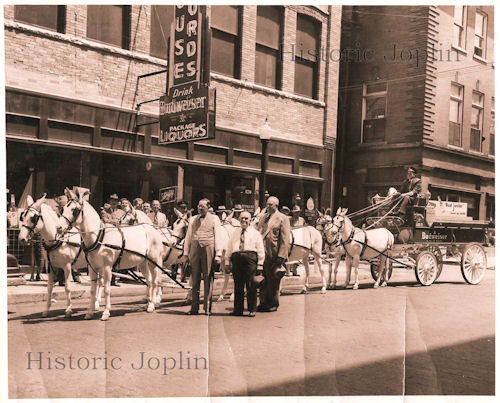
House of Lords

This photograph comes to Historic Joplin courtesy the great-grandson of Joseph “Joe” Dorizzi. Dorizzi is the man standing in the center of the photo flanked by two unknown men. He was one of the last to own the famed House of Lords. Notice the large, vertical House of Lords Budweiser sign – it replaced a smaller sign that hung outside the establishment years earlier. Although we’ve come to know the Budweiser Clydesdales and even the Budweiser frogs, you’ll see that in this case it’s a Budweiser mule team in front of the House of Lords. Perhaps it was a tip of the hat to the noble Missouri mule. We thank the owner of the photo for sharing this incredible treasure.

The Early Mayors of Joplin

The city of Joplin came into existence in 1873.  Since that time period, there have been a number of mayors.  Below is our attempt to slowly build up a convenient list of Joplin’s early leaders.  Eventually, each mayor will also have their own post which will offer more detailed information about these early leaders and the roles they played in the city’s development.

1873

Elliot R.  Moffett

1874

.

Lee Taylor

+

J.H. McCoy (finished Taylor’s Term)

1875

Patrick Murphy


1876


F.J. Thompson


1877 – 1878

Frank E. Williams


1879


F.M. Roberts


1880 – 1881

W.E. Maynard

1882 – 1883

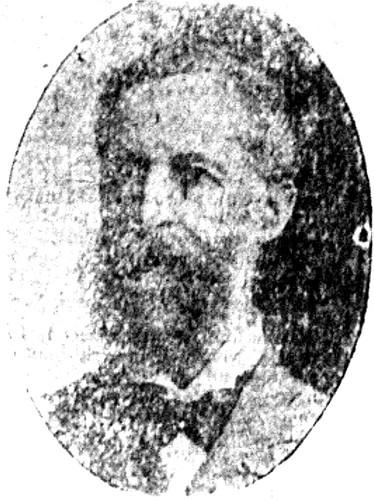
Galen Spencer


1884

W.B. Halyard


1885 – 1886

A.B. McCarty


1887


J.L. Briggs


1888


C. Livingston


1889 – 1892


R.B. Tyler

R.B. Tyler


1893 – 1894

W.B. Halyard


1895 – 1896

E.D. Porter


1897 – 1898

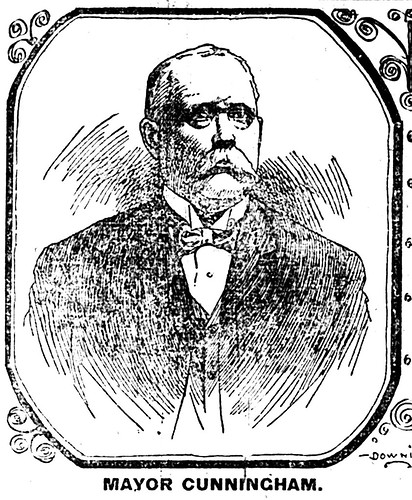
T.W. Cunningham

1899 – 1900

J.H. Spencer

J.H. Spencer


1901 – 1902

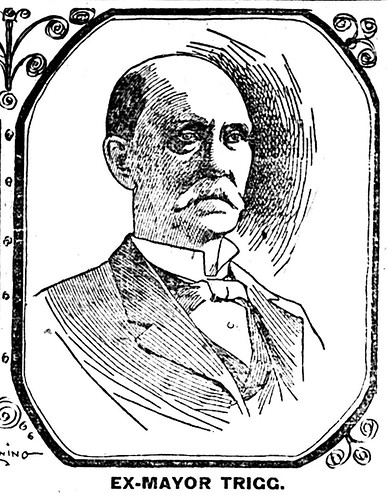
J.C. Trigg


1903 – 1904

T.W. Cunningham


1905 – 1906


C.W.  Lyon


1907 – 1908

Jesse F. Osborne


1909 – 1910

Guy Humes

Guy T. Humes


1911 – 1914 (to April 20)

Jesse F. Osborne


If you have photographs of the above listed men or documents connected to them, we’d love to share them here on Historic Joplin.

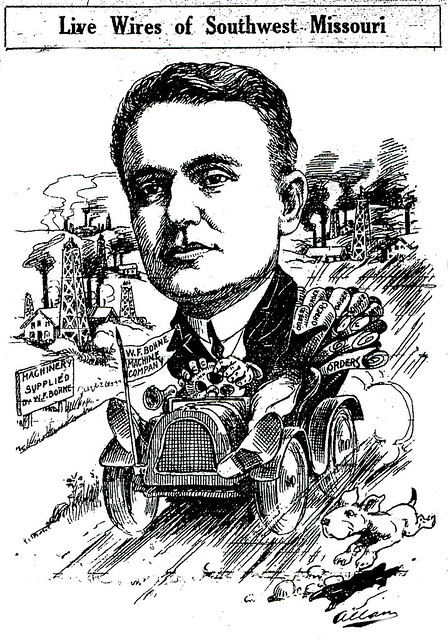
Southwest Missouri Live Wire: William F. Bohne

W.F. Bohne

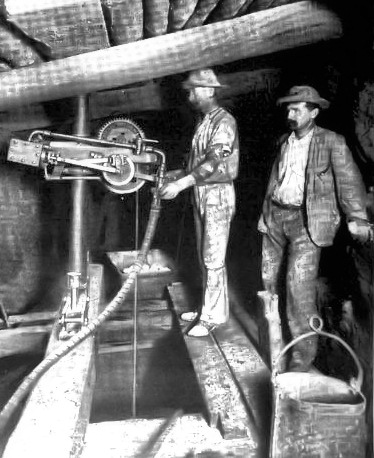
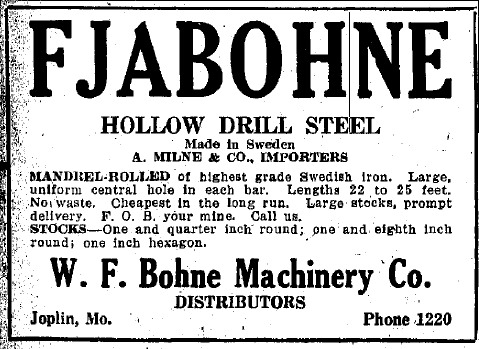
The next “live wire” in the Live Wire series is William F. Bohne. A native of New Orleans, Bohne attended Cornell University, and arrived in Joplin in 1905. His primary business was pumps, a required apparatus of any zinc or lead mine in the Tri-State Mining District due to the ever present desire of the water table to flood the mines. Because of such, his company, W.F. Bohne Machinery Company, was considered one of the more successful enterprises of the district. The company also sold other machinery needed in mines, such as hoists (like the one pictured below). The company was located at 503 Virginia avenue.


By 1930, Bohne still called Joplin home and referred to himself in the 1930 census as a proprietor of machinery.

An ad from the W.F. Bohne Machinery Company from 1927

A Prince Among Men: Oliver S. Picher

The following story is taken from Bud Belden’s memoir “Pioneering Days.” His father, Charles Belden, founded Belden Electric Company and wired many Joplin homes for electricity.

“When engaged in wiring the residence of O.S. Picher the boys discovered a case of Scotch Whiskey. Being alone in the house they placed a bottle on the kitchen table where all could wet their whistle as they passed by. Unexpectedly Mr. Picher returned about 4 P.M. and immediately work centered in the basement and in the attic. But when any of the malcreants did appear, Mr. Picher no doubt noticed their unusually bright and shining eyes as they peered at him from dirty faces. Being an observant man, Mr. Picher noticed this condition was general among all members of the crew.

Then his suspicions were confirmed for some of the boys started talking and removed all doubt. As the boys were preparing to get away hastily, Mr. Picher must have had an idea, for he stopped them and said, “You fellows look tired, you’ve been working hard all day. How about taking a little drink with me before you go?”

Now there was a regular fellow. Sure, the day was finished, they would be glad to. O.S. then assembled them not in the kitchen but in the dining room and served them in manner grand. Iced ginger ale in tall gold rimmed glasses with White Horse Scotch Whiskey. They were a sorry lot weaving around in dirty overalls but they sang the praises of Mr. Picher loud and long.

He was to them a Prince among men and so remained until one day Dad received his check for the work done. From the bill [Picher] had deducted fifty dollars with the notation in large letters, For WHITE HORSE.”

Hi-Ki, Joplin’s “Wild Man”

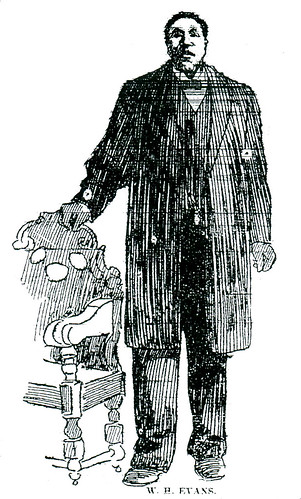
W.H. Evans

Over the years Joplin saw its share of curiosities. In her book, Tales from Joplin, Evelyn Milligan Jones recounted the story of the “Man Horse.” According to Jones, the Man Horse was an individual who believed he was a horse and could often be seen “charging down the street pulling his own buggy. He had his boots shod with horseshoes, and sometimes ate hay from the back of his wagon, or grass at the roadside.”

Just as a real horse would, the Man Horse would “shy at a blowing piece of paper and run wild for a few blocks.” Regrettably, Jones has little else to say about Man Horse, nor did she divulge his real name. Man Horse was only one of a handful of characters to roam the streets of Joplin.

Another colorful character that Jones recounted was “Nigger” Evans. Joplin composer Percy Weinrich remembered him as the “big man who used to roam the alleys and byways of Joplin in his trash wagon.” Mothers would tell their children, “If you don’t behave, Nigger Evans will get you!” Evans inspired such fear that the Joplin Elks “dressed him up in a leopard suit, and provided him with a whole haunch of meat which he flourished like a club, pausing only to gnaw at the raw meat now and then as he marched along. Children who saw this had wilder nightmares than TV can inspire.”

But there was more to “Nigger” Evans than just a crude racial caricature. His real name was W.H. Evans and he made his living in Joplin as a “city scavenger.” As he made his way through the streets of Joplin, Evans stood out due to his extreme size: He was six feet eight inches tall, weighed 350 pounds, and wore a size 15 shoe.

A native of Cairo, Illinois, Evans was born to slave parents. According to Evans, his father “stole his mother from Alabama and then ran off to sea.” As soon as he was grown, Evans joined the Ninth United States Cavalry, where he served for five years. He later worked as a railroad brakeman in Texas. It was during this time in his life that he killed a fellow African American with his fists, ending his ambition to become a prizefighter. Despite his past, Evans found employment with the Barnum and Wallace circuses as “Hi-Ki the Wild Man.”

Barnum circus barkers would cry out to curious crowds:

“Hi-Ki, the flesh-eating wild man. Species of Cuban negro. Captured forty-two miles south of Manila by a group of American soldiers. Cannot understand a word of English. The only one in captivity.” For those brave enough to view “Hi-Ki” they entered a tent and saw Evans seated in a cage chewing on a piece of raw beefsteak handed to him through the bars with a pitchfork.

When asked about his days in the circus, Evans opined, “Barnum was a little off when he said the American people like to be humbugged. It is not because they want to be humbugged that makes them pay out their money, but it is their desire to learn and see something they never saw before. The American people ain’t afraid to invest in anything if it’s new.”

After he left the circus, Evans settled in Joplin where he owned “several thousand dollars’ worth of property besides a farm of 120 acres in Texas and town lots in Palestine and Bremond.” In Joplin he was known as a “wonder of the people of his home town and the ‘bogy-man’ of the little children.”

Evans was enough of a local fixture in Joplin that in 1896, his name was put before the Republican county convention as candidate for coroner, but his name was withdrawn from voting, and he left the convention hall in disgust.

Evans claimed, “They hadn’t more’n got half way through voting when some Republican gets up and says that if they elect me as coroner and the sheriff dies, they’d have a nigger sheriff. Then he went on and talked about what he called ‘wisdom.’ and then they quit voting. Then I told them what I thought about the Republicans. There wasn’t no money in the job then anyway, just empty honors.” Evans later joined the Democratic Party.

He explained to a reporter, “If old Abraham Lincoln could come back to this country again he would say the same thing about the Republicans and would run them all out. The Republicans just use the negro as a tool to be held up and hammered and they are doing the negroes in the south more harm now than anybody else by arraying them against the best friends they’ve got down there. No, sir, I’m a Democrat, and I expect to help fight for the Democrats, even if I did go down to defeat twice with [William Jennings] Bryan.”

Evans believed “everybody ought to take part in politics. If a man is honest and his character unimpeached, he should have consideration. But it’s all a manipulating scheme, and the feller that gets elected goes off with the cream.”

At the time Evans made his statement, Democrats were considered the party of “wets,” which is to say those who were against prohibition. Curiously he declared:

“But some of these white folks around here ain’t much fitting to govern themselves. I has always been an anti-prohibitionist, though I never drank nor used tobacco, except I drank a little whisky for medicinal purposes but that don’t do much good. But I’m going to vote for the prohibitionists this time. The other night I saw thirty-six men with buckets over their shoulders drinking beer in a saloon at one time. Then they do something and blame the other feller for it. Whisky in, wit out. I wouldn’t say a word if they was the only ones hurt, but more of them fellers had wives and children at home. Yes, I’m going to vote for the prohibitionists this year.”

For a man who wore a leopard suit, Evans viewed the world with a far more serious perspective than many whites may have assumed and refused to acquiesce to the image of a mere wild man.

Joplin Live Wire: Richard Fedeli, Joplin’s Paper and Paint Man

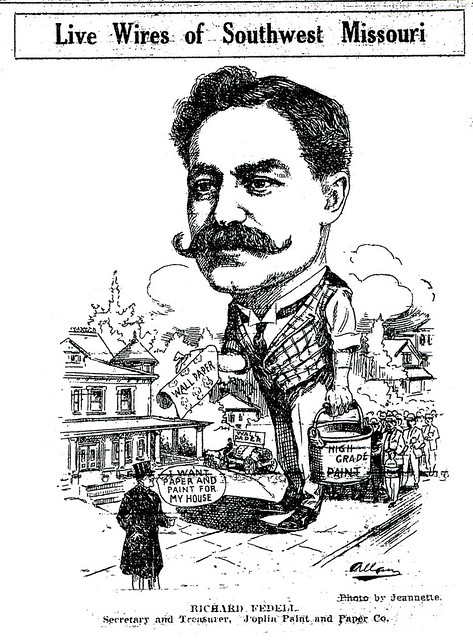
Our next installment of the Joplin Live Wire series is Richard Fedeli. Fedeli, the son of an Italian Immigrant, was born in Indiana around 1877. He arrived in Joplin in 1909, previously from Kansas City, where he had connections with the business of Devoe and Reynolds (a paint company still in existence). In Joplin, Fedeli rose to the rank of treasurer and secretary at the Joplin Paint and Paper Company. Concerning painting, itself, Fedeli told a reporter from the Joplin Daily Globe, “We shall sell paint and let the other fellow do the painting.”

Richard Fedeli Joplin Paper and Paint Company
Although Fedeli was recognized as a rising star of Joplin’s community, he returned to Kansas City by 1920. He remained there until at least 1930, where the former corporate officer had fallen to the position of a salesman of brushes, perhaps paint brushes. The Joplin Paint and Paper Company also disappeared, but once was found at 418 Joplin Ave.

Meet John C. Cox

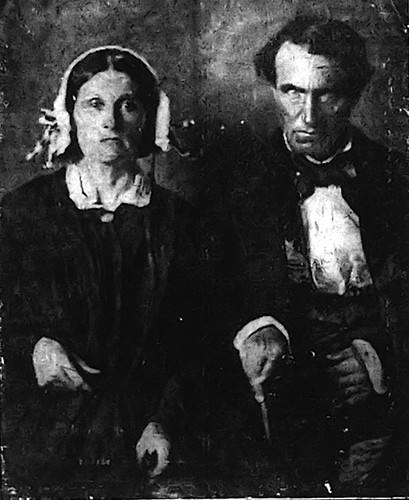
Considered a “father” of Joplin, and one of its earliest settlers, John Cox, a North Carolina native, made his way to Missouri and settled near Turkey Creek around 1838. He never left and the rest is history. Below is Cox and his wife, Sarah Ann Mercer.

John Cox and wife, Sarah Mercer.