A Hold Up at the Silver Moon Saloon

Joplin had the atmosphere of the roughest mining towns in the American West. On the evening of December 8, 1903, the Silver Moon Saloon was the scene of a “bold hold-up.” Located at the northeast corner of Fifteenth and Main Streets, the Silver Moon Saloon may not have been as refined as Joplin’s famed House of Lords, but it served the needs of the countless men who crossed its threshold.
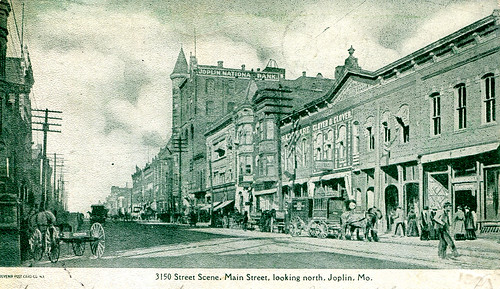
Main Street Joplin circa 1906 or earlier.

Main Street Joplin circa 1906 or earlier.

It was 10:40 in the evening. The saloon was empty, save for Einhart, the proprietor, and an old man who was passed out from a bout of heavy drinking. Einhart was cleaning glasses when two men strode into the saloon. As Einhart later told a Globe reporter, “They were strangers to me and I did not pay any particular attention to them when they started to the rear. I did not take my eyes off of my work. They certainly did not appear to be robbers. Neither of them looked vicious.”

The two men silently approached Einhart with their Colt .45 revolvers pointed at him. The saloon owner confessed, “Without saying a word they induced me to throw up my hands for I could see then that they meant business.” One of the men came around the bar and riffled through Einhart’s pockets. He pulled out Einhart’s watch, but the bar owner protested, saying it was a present from a “very good friend.” The robber laughed and told him he could keep it. Einhart then pointed his assailant to the cash register, secretly pleased he had already taken out most the night’s take earlier in the evening.

At this, the old man who had been passed out suddenly revived, looked at the two robbers, and “ran out the side door and headed down Fifteenth Street as hard as he could, screaming meantime as loud as possible.” Frightened, the two men grabbed money from cash register, dashed out the door, and ran east down Fifteenth Street. For their efforts, the two men pocketed $32.10 out of the cash register, a couple of dollars out of Einhart’s pockets, and some checks.

Joplin Police Officer Snow and Night Watchman Heady began tracking down leads in the case within the hour. By the end of the night, they arrested two suspects, Oscar Orman and C. Ownes, both of whom had come to Joplin from Galena, Kansas, earlier in the evening. Both men were locked up and charges followed the next day.

Source: Joplin Globe

The 1903 Joplin Fire Department Thanksgiving Dinner

The young men and women of Joplin may have not caught a possum on their evening foray in the winter of 1905, but Joplin’s firemen feasted on one in 1903 for Thanksgiving.

The Globe reported, “While the populace of Joplin was enjoying turkey with sage dressing in their dining rooms, the members of the central department were feasting on ‘possum and sweet potatoes.”

Photo of Possum

Some possums may object to the content of this post. Via Wikimedia Commons.

Source: Joplin Globe 1903

Celebrate St. Patrick’s Day at the Connor Hotel Restaurant

…only requirement is a time machine.

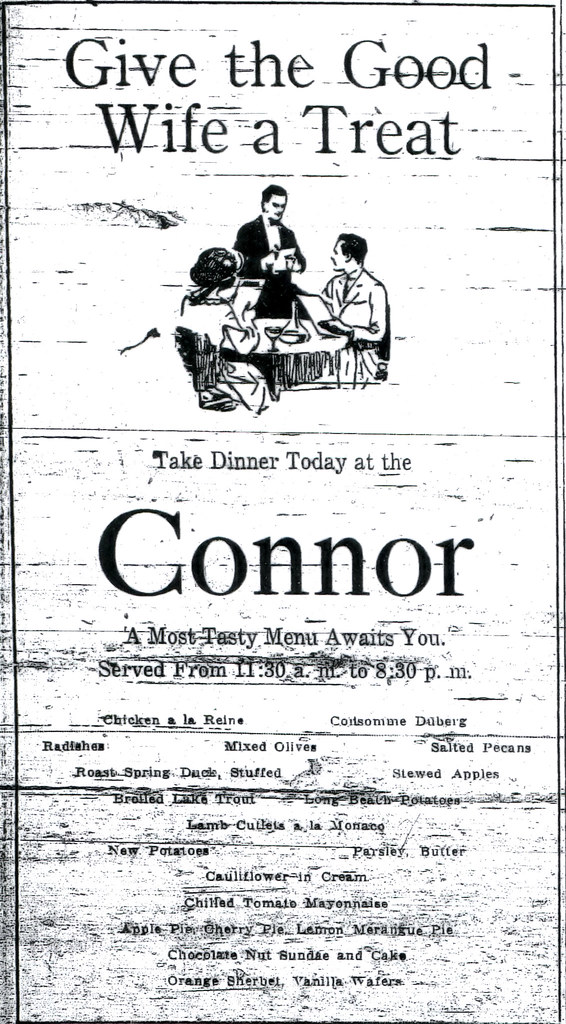
Of those who lived in Joplin, the city claimed not a few number of sons of Ireland.  Some of the city’s wealthiest citizens, such as Patrick Murphy and Thomas Connor, were the children of Irish immigrants or born in Ireland.  In a tip o’ the hat to Joplin’s Irish, presented below is a menu ad for the Connor Hotel’s restaurant.  The Connor, named after Thomas Connor, was once the architectural centerpiece of Joplin’s downtown.  Not bad for a true son of Ireland.

An ad for the restaurant at the Connor Hotel

A 1923 ad for the restaurant at the Connor Hotel

Source:  Joplin Globe

Review of Now and Then and Again by Leslie Simpson

Historic preservation in Joplin cannot be discussed without mentioning Leslie Simpson.  The director of the Post Memorial Art Reference Library, Simpson is a long established expert of Joplin’s architecture and historic past.  She is credited with initiating the push to preserve Joplin’s remaining historic buildings and homes. Simpson has played an instrumental role in the creation of the Joplin Historic Preservation Commission and Main Street Joplin.  She has produced numerous slide shows on the city’s past and published a pamphlet titled, From Lincoln Logs to Lego Blocks: How Joplin Was Built.  Such is her impact that the city proclaimed a day in her name and the Missouri General Assembly honored her achievements.

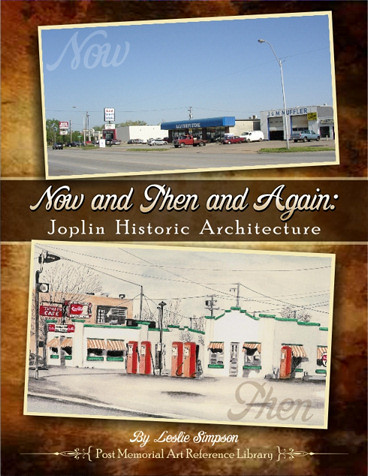
One of Ms. Simpson’s most well known works was a fascinating slide show presentation entitled, “Extreme Makeover: Joplin Edition,” that compared historic photographs of Joplin buildings and homes to present day photographs of the same locations.  In December, 2009, she published her latest book, Now and Then and Again: Joplin Historic Architecture Now and Then and Again is the published version of her popular lecture on Joplin’s architectural past.

Any fan of American architecture from the late 19th Century to the early 20th Century will both adore and loathe reading Ms. Simpson’s latest work.  Readers will love it for the photographs of grand old buildings and majestic finely cut stone homes that once populated Joplin.  It will, however, make the reader grimace at the lack of foresight and vision that cost Joplin some of its finest architectural masterpieces.

Now and Then and Again is written somewhat categorically, beginning with photographs of many of its former homes and buildings that represented the first several decades of the city’s prosperous growth.  This may well be the most painful part for those who mourn the loss of Joplin’s finest buildings. as it reveals the devastation of the period of Urban Renewal.  During the 1960s and 1970s, Urban Renewal oversaw the destruction of many of American’s turn of the century architecture under the belief that their replacements would spark economic growth and development. Sadly, such was not the case with Joplin. Downtown Joplin became a vast wasteland of empty parking lots and neglected store fronts.

Despite her passion for Joplin’s lost history, Ms. Simpson maintains a neutral tone, letting the devastation of Urban Renewal speak for itself. Buildings such as the Connor and Keystone hotels, the Worth Block, and other crown jewels of Joplin’s past were lost to the wrecking ball.  By the time the reader finishes with this first part of the book, he or she can begin to dry their tears with the knowledge that some buildings survived, though are now hidden behind more modern facades.   One example is the home of the Joplin Globe whose gaudy outdated facade belies the fact that it still has the bones of a century old brick building underneath.

Now and Then and Again opts for an ending on a happier note.  The last two sections of the book are devoted to those structures still standing decades after their construction, and in a somewhat smaller part, those buildings which have recently been renovated.  Now and Then and Again is not entirely made up photographs.  Each photographic subject is accompanied with a paragraph or two of information which generally consists of the history of the building or house, the architectural style, and the individuals who owned them.  Conveniently, Ms. Simpson provides two indexes, one by name and the other by address.

In the unfortunately limited pantheon of resources for those seeking to learn more about the history of Joplin, Ms. Simpson’s Now and Then and Again is a welcome addition.  It serves as a wonderful reference for both the trained and untrained to a past built by stone, brick, and beam.  Any collection is better for its inclusion, and knowledge of its contents most certainly help to bring alive the Joplin of the past, and to discover its wonder in the present.

The cover of Leslie Simpson's work, "Now and Then and Again: Joplin Historic Architecture."

The cover of Leslie Simpson's work, "Now and Then and Again: Joplin Historic Architecture."

For information about purchasing a copy of Ms. Simpson’s work, follow this link to the Post Memorial Art Reference Library websiteNow and Then and Again consists of 95 pages, sells for $17.95 and is published by the Winfred L. and Elizabeth C. Post Foundation, Joplin, Missouri.

Globe Coverage of the Joplin Supply Company

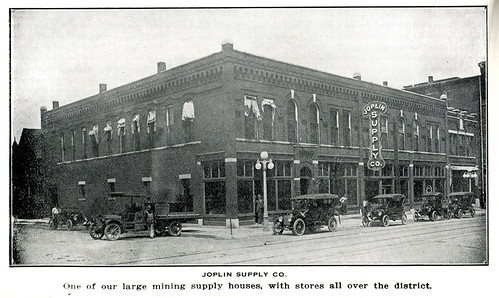
On Saturday, the Joplin Globe ran an article about the Joplin Supply Company.  The one time location where later on Ford Model Ts were built within and moved within the building by large elevators.  That building is now one of the historic locales receiving the renovation treatment.

The article here.

Below is a photograph of one of the earlier locations for the company on Fourth Street.  The parking lot adjacent to the former Federal building and located behind the library is all one will see if they attempt to hunt down this building today.

The Joplin Supply Company building at Fourth and Wall Streets.

The Joplin Supply Company building at Fourth and Wall Streets.

Source: Historic Joplin

Failure, I call thee Possum.

Back in the winter of 1905, a group of twenty-six young possum hunters flooded the Shoal Creek bottoms in search of the “savory little sweet potato seasoner.” Despite their best efforts to catch a possum, the group came home empty handed. The young men blamed their bad luck on the girls; the girls proclaimed if they were the young men, they’d be ashamed at their failure to catch a possum. Their hound was so ashamed that he reportedly slunk back into town with his tail between his legs.

But the group’s disappointment, if any, was short-lived. They built a bonfire, made hot coffee, and had dinner under the clear, starry skies of winter. It wasn’t until after one o’clock in the morning that the exhausted group made their way back into the city limits.

For those who may be interested, a list of the group’s names were provided: Mr. and Mrs. T.A. Wisdom; Mr. and Mrs. Jas. C. Daugherty; Mrs. James McCool; Misses Nell Cummings, Goldie Mason, Maude Smothers, Margaret Cummings, Belva Looker, Mary Carrithers, Margaret McCarthy, Inez Looker, Jennie Harding, Kate Cummings, Mable Looker; Messrs. Albert Webb of Carl Junction, Thomas Beatois of St. Louis, H.D. Watrous, J.H. Gwathney, Will Malone, Max Paul, Earl Doherty, W.P. Keller, Fred Degraff, and Louis Jones.

Source: Joplin Globe

Growth of A City – Fourth Street Looking East

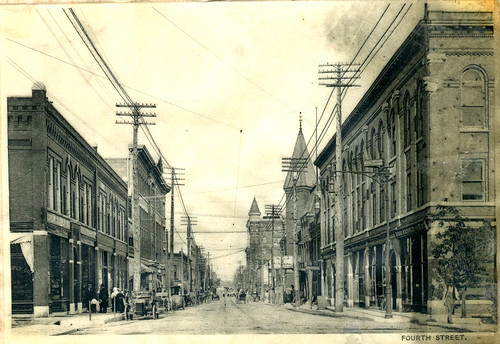
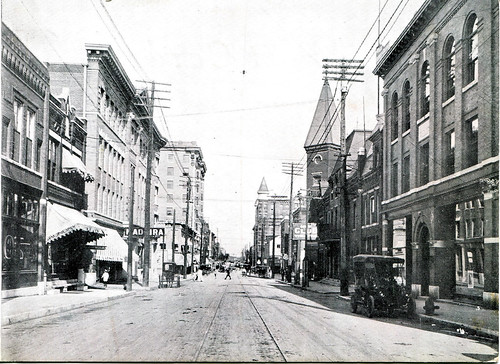
At the height of Joplin’s boom days, the intersection of Fourth and Main streets was the beating heart of the city’s commercial district.  It was no coincidence that the city’s two greatest hotels, the Connor and Keystone, faced one another from opposite corners, or that Democratic party boss, Gilbert Barbee owned the House of Lords on another corner.  Along Fourth Street, particularly that west of Main, was prime real estate.  One venturing down west Fourth Street found themselves passing the Club Theater, as well the Elks Club lodge and the home of the Miners Bank.  In the next few photos, we’ll examine the change to the street over just a few years.  In addition, with a nod to Leslie Simpson’s latest book, Now and Then and Again: Joplin Historic Architecture, a present day view of the street.

A view of Fourth Street looking east - sometime before 1906.

A view of Fourth Street looking east - sometime before 1906.

In this first view there are several clues to time the photograph was shot.  First, visible to the right is the steeple roof of the Club Theater.  The Club Theater was completed in 1891.  The conical roof further down the street marks not only the Keystone Hotel, built in 1891 and completed a year later, marks the intersection of Fourth and Main.  On the left side of the street, a block down and hardly noticeable is the old Joplin Hotel.  What is not in this photograph is the Connor Hotel, an eight story building that was built where our squat Joplin Hotel now stands.  The Joplin Hotel was razed in 1906.  As such, we know this photograph dates from before that time.  Speculatively, sometime from 1891 to 1906.

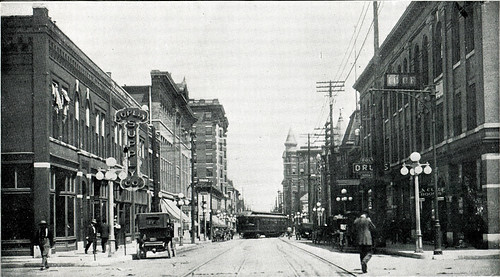
View of Fourth Street looking east sometime after 1908.

View of Fourth Street looking east sometime after 1908.

In this view we have some familiar faces.  The Club Theater on the right, the Keystone down the block, and on the immediate right, the once Elks Lodge and offices of the Joplin Water Works.  The main difference is now the reverse of our previous photograph.  Where the old Joplin Hotel stood, now stands the Connor.  Its presence lets us know that this photograph was taken after its completion in 1908.  Note the change in design of the automobiles on the street and the lack of horse drawn wagons or carriages that were present in the previous view.

Fourth Street looking east - sometime before 1913.

Fourth Street looking east - sometime before 1913.

Our third view of Fourth Street.  The Connor and the Keystone are both present.  The steeple roof of the Club Theater is conspicuously absent, though you can see the roof line of the club’s western side.  Incidentally, by this time, the Club Theater, despite a renovation in 1905, had lost its status as the finest theater in town to the Shubert Theater which was located several blocks down to the south.  The vehicles are a little more modern and a subtle aspect is the switch from one set of trolley tracts to two.  Also different, which allows us to place this photograph as more recent, is the addition of electric signs to the facades of the buildings.  Now, we state that this photograph is dated as having been taken before 1913.  How did we come to that number?  In this case, its simply knowing your source.  This photograph came from a booklet published in 1913 to publicize the city, which allows us to place that hard date.

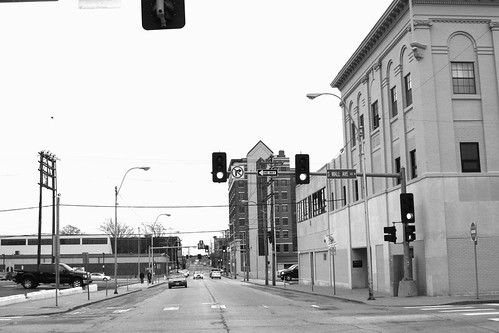
Fourth Street looking east - present day.

Fourth Street looking east - present day.

This photograph, taken on March 13, 2010, is not for the faint of heart for those who love the architecture of bygone days.  All that remains from the previous photographs is our friend the one time host of the Elks and Joplin Water Works building on the immediate right.  The row of buildings on the left are gone, though a few halfway down the block disappeared in the 1920’s when the Connor built an annex further down the block from its Fourth and Main location.  The Club Theater is gone, the front of a car, marks the parking lot that now remains in its place.  On the left down the block is the Joplin Public Library, situated where the Connor Hotel stood until 1978.  The Keystone, destroyed several years before the Connor, is gone.  The building visible beyond the library is the Joplin Globe office, visible only because the Worth Block was demolished (taking with it the House of Lords).  On a bright note is the tall building at the end of the block on the right side.  It was built around 1923 and managed to survive the devastation that was “Urban Renewal.”

If any comfort can be taken from this view of modern day Fourth Street it is that the City of Joplin has embarked on a mission to restore and recognize the city’s remaining historic buildings.  A drive down Main Street reinforces the belief that while a lot has been lost, that which remains will be saved.

Sources: Historic Joplin collection, Missouri Digital Heritage.

The Bloomer Girls Come to Joplin

In turn-of-the-century America, teams of “Bloomer Girls” traveled across the country challenging men’s amateur, semi-pro, and professional baseball teams to exhibition games. Despite being nicknamed for the loose-fitting trousers that they wore on the diamond, Bloomer Girls were tough competitors. One such “Bloomer Girls” team arrived in Joplin in June 1898, to play a series of seven baseball games against McCloskey’s Giants at Cycle Park. Interest was so intense that promoters added additional seats in anticipation of large crowds of spectators.

Maud Nelson, star pitcher for the team, was hailed as “a twirler of exceptional speed, and it is a common occurrence for her to strike out the strongest batters on the opposing team.” Nelson, a native of Chicago whose real name was Clementina Brida, grew up playing baseball with her brother. As a pitcher, she was reportedly paid $250 a month.

Although the Bloomer Girls engaged in athletic competition with men at a time when women were still governed by stifling Victorian mores, their manager assured the Globe’s reporter that the Bloomers were “refined ladies, most of whom learned the art of ball playing on account of it being a health giving exercise, and only adopted it as a profession after becoming experts and receiving flattering offers to play in exhibition games.”

McCloskey, manager of the opposing team, asserted that the Bloomer Girls came “highly recommended, both as to their excellent playing and conduct on the diamond.” Potential spectators were assured that “the management guarantees that nothing will be said or done but what the most refined lady in the audience will approve.”

In one of their games prior to coming to Joplin, the Bloomer Girls played the Eurekas, a local men’s team in Richmond, Virginia. The Eurekas were warned that the Bloomer Girls “asked no favors, and wanted the game played on its merits.” Captain Boyne, manager of the Eureka team, instructed his players, “to knock the Bloomers silly.”

Whatever preconceived notions the men of the Eureka baseball team may have had about women baseball players were quickly overturned when it was found that it “would be no easy matter” to beat the Bloomer Girls. By the end of the ninth inning the Bloomer Girls led the Eurekas 11 to 5. Maud Nelson was hailed as “a peach, her work in the box alone is worth the price of admission to the game.” She “handles herself like a professional pitcher, throws well, gives the catcher curve signs, and can stop or catch a ball with either hand.”

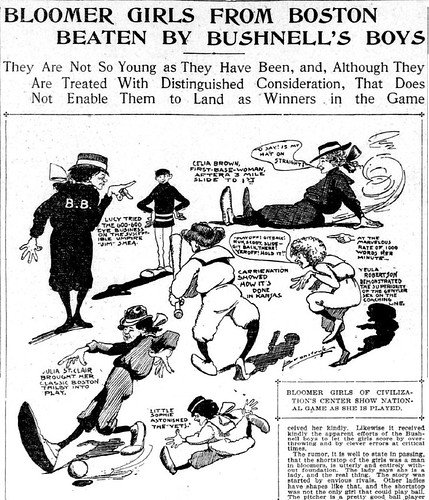
A 1901 cartoon of the Bloomer Girls from the San Francisco Call.

A 1901 cartoon of the Bloomer Girls from the San Francisco Call.

When the Bloomer Girls played McCloskey’s Giants at Cycle Park, they faced fierce competition from the Giants, who played as if “they had reputations to lose.” Managers McCloskey and Menefee livened up the game by having their men run between bases with the Bloomer Girls in hot pursuit. Unfortunately for the Bloomer Girls, they lost the first game 14 to 1.

Maud Nelson, who was “justly” billed as the “star of the team,” continued to be involved in baseball for years to come as a manager and team owner, anticipating the time when the women of the All-American Girls Professional Baseball League.

Sources: The Joplin Globe, the Library of Congress, www.Exploratorium.edu, Wikipedia: Maud Nelson.

Proof that Joplin needs a Police Matron

While the Joplin city council had by 1904 agreed to the necessity of a police matron due to popular demand, a year later, no matron had yet been appointed.  As a response, the Joplin Globe ran an article offering proof to the need of the city to hire a matron.  The headline read, “PROOF THAT JOPLIN NEEDS A POLICE MATRON,” and the paper argued the following:

“The police records show the arrest of eighty women during the month of May.  Eighty women are supposed to have been locked up in the Joplin city jail in the last month without the care of counsel of a police matron.  There was none but the regular police force to listen to the appeals of, or to advise these erring women charges of the city.  True, most of them were doubtless hardened and seemingly deserving of little better than they got, but who can say?

Who can say to what depths each separate individual has fallen to what extent any one was irreclaimable?  The charges as a result were in the cat-purse of blanket charges, if the term may be so used.  Twenty-nine of these eighty women were charged with prostitution, twenty-one with lewd conduct, thirteen with street walking, thirteen with disturbing the peace, and one each with drunkenness, petty larceny, interfering with an officer, and being suspected of robbery.  Hard charges, those, yet many cried when locked up.  Some were not really bad.  Surely one or two, at least, might be prevailed upon to repent and change her ways.  Certainly enough soul remained to cry out through the tears of those eighty bad women to justify the attention of a good and worthy police matron.

The records prove that one, anyhow, might have been saved from death, if not also from deeper depths of sin, for one of these eighty was Lucy Scott, the young, fair, but wayward girl who took her own life as she confessed, because nobody would come and talk to her about going to a reform school.  A police matron could have saved one life last month.  Who knows, how many wrecks could have been averted?”

A year later, the position was finally assumed by Ellen Ayers.  See our earlier post on Mrs. Ayers concerning her appointment and reaction to the job.

Sources: The Joplin Globe

The Pawn Shop on the Corner

The Joplin of today has numerous pawn shops dotting its streets and thoroughfares. Perhaps the most iconic pawnshop is that of Ben Milgram on Main Street. Pawn shops, however, were in downtown Joplin long before Milgram set up shop.

According to one turn-of-the-century account of Joplin pawn shops, people pawned the coats off of their backs for twenty-five to fifty cents. One pawn shop owner reported that a man had come into his store and asked to speak to the owner in the back. Embarrassed, the man asked the pawn shop proprietor if he “could get a loan on a good pair of shoes.”

Another Joplin pawn broker told the story of one of his repeat customers, an elderly African-American woman who often pawned her solid gold dental crown for money. According to the broker, she would enter his shop, take off her dental crown, wrap it up in a piece of paper, and then get her money. She reportedly had done this so often that the store owner rarely ever checked the paper to see if the crown was in it or not. One pawn shop operator on Third Street related the story of a man who burst into his store, pulled out his dentures, and asked “Say, mister, what’ll give me for these?”

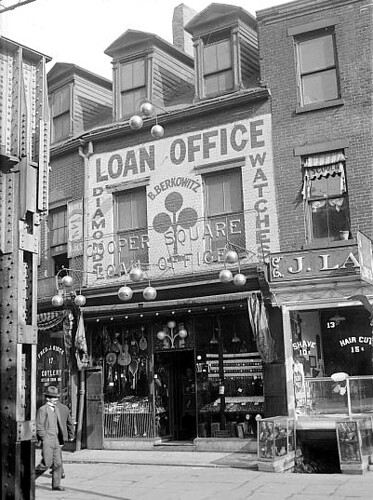
A representative view of a pawn shop from the time period.

A representative view of a pawn shop from the time period, though not a Joplin pawn shop.

Men were not the only ones to patronize the pawn shops of Joplin. Women were known to “buy diamonds one day and come back to the same place and pawn them the next.” One woman reportedly pawned her wedding rings in order to pay for the cost of a divorce. Another woman pawned her expensive silk dress to get enough money to pay her brother’s rent after he fell ill and was unable to work. Fortunately she was able to reclaim her dress within a few days. One pawn broker remarked, “Yes, I’ve all sorts of things offered me; shoes, shirts, coats, and hats to diamonds and false teeth, and I wouldn’t be surprised to have a woman come in and want to borrow money on her false hair.”

Thus, a drive down Joplin’s Main street with pawnshops on the corner isn’t a recent phenomenon, but an experience shared with residents of Joplin that stretches back a century.

Sources: Library of Congress and the Joplin Globe.