Renovated Union Depot Proposed Home For Museum

At last night’s City Council meeting, City Manager Mark Rohr proposed that the Union Depot be renovated to be used as a new home for the Joplin Museum Complex. As covered by the Joplin Globe, Rohr believes that existing sources of funding exist and as a result, no new taxes would be required for the project.

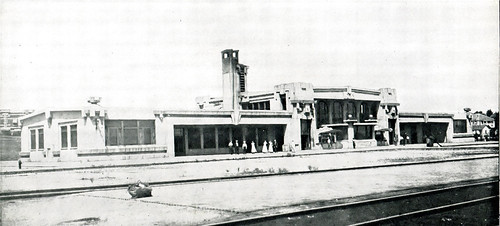
Joplin Union Depot

The Joplin Union Depot not long after it was opened. A great future home for the Joplin Museum Complex.

We, here at Historic Joplin, strongly support this proposal.  We hope that it becomes reality and that someday in the near future, we can walk in and enjoy a beautifully restored depot.  Even though the Carnegie Library appears not to have been part of the new plan, we hope it too has a bright future.

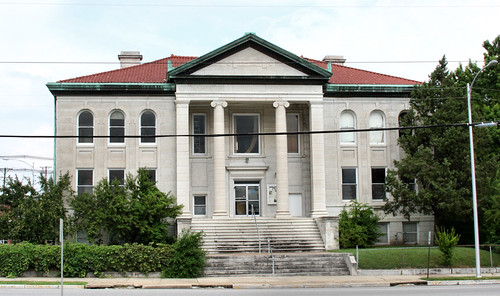
Joplin Carnegie Library

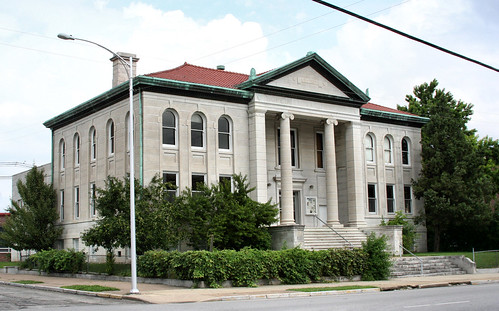
The Joplin Carnegie Library as it appears in 2010.

Joplin Carnegie Library – Then and Now

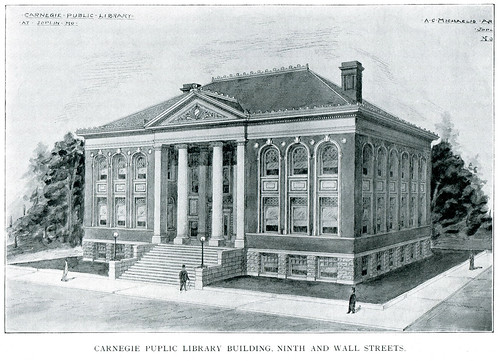
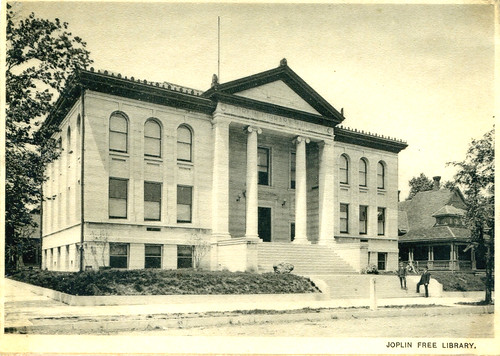
The Joplin Carnegie Library may come up in a city plan to be discussed tonight, July 6, 2010, by City Manager Mark Rohr, as part of the redevelopment plan for the city. As such, we figured to show a series of photographs (and one drawing) of the Joplin Carnegie Library.

First, we have the award winning sketch of the library by August Michaelis, a distinguished Joplin architect of the time.

August Michaelis' winning design for Joplin's Carnegie Library

August Michaelis' winning design for Joplin's Carnegie Library

Next we have a photograph not long after it was built:

The Joplin Carnegie Library

The Joplin Carnegie Library not long after completion.

Now we have the library as it appears today. It is privately owned, but in need of restoration. It is easily one of the most beautiful buildings in Joplin.

Joplin Carnegie Library

The Joplin Carnegie Library as it appears today.

Source: Historic Joplin Collection

Whistles for the Police

In April, 1911, it was announced that the Joplin Police Department had adopted a “metropolitan police” scheme of equipping the police officers with whistles.  Viewed as one more step toward imitating the police departments of large cities, the whistles were thought useful:

“Although it is seldom that an occasion arises in this city when an officer cannot take care of himself, it is thought best to be on the safe side.  When an officer hears one of these whistles, which are of a peculiar tone, he is to hasten at once to the scene of conflict, or wherever the sound comes from.”

It was thought at the time that the presence of a mere whistle may have prevented some of the deaths of Joplin’s police officers up to that point.  It’s unknown if the whistle dramatically changed the safety of the police in a city with the rowdy reputation of a mining town.

Source: Joplin News Herald

Joplin Celebrates the Fourth

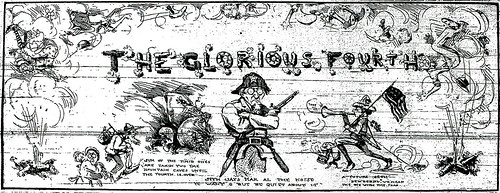
Bingville Bugler 4th of July

Bingville Bugler, insert of Joplin News Herald, 4th of July banner.

The celebration of America’s Independence Day was no less important a hundred years ago in Joplin than it is today.  A principal slogan of the city of Joplin in 1910 was to have a “Safe,  Saner Fourth of July for Joplin.”  In June of that year, the city council had passed the Kelso ordinance which oversaw the sale, display and use of fireworks.  Proponents of the safer and saner Fourth were women groups and the Ministers Alliance.   Both Mayor Guy Hume and Chief of Police John McManamy supported the measure and the idea of a “quieter Fourth.”   Further support was also sought by the local school systems.  Unsurprisingly, the motivation for the ordinance had been to reduce the injuries from the celebratory play with explosives.  If injuries could be reduced it was hoped the city could proceed with more support for the holiday.  The “Sane” Fourth motto was also raised the next year in 1911 and reinforced by a city ordinance that prevented the sale of firecrackers more than 2 inches in length, as well “exploding canes and blank pistols”.

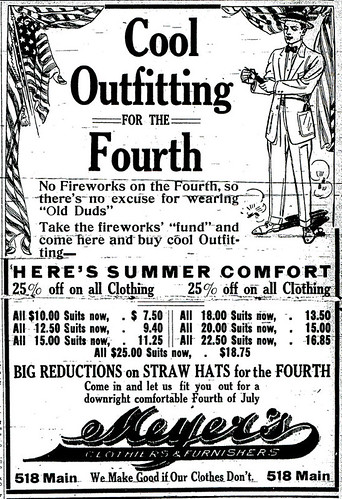
If people were not buying fireworks, Joplin shopkeepers likely hoped they would do some holiday shopping.  One such business was Meyers, which paid for a patriotic Fourth of July ad three years later (when the same belief in a “quieter Fourth” prevailed):

A patriotic ad from Meyers in 1913.

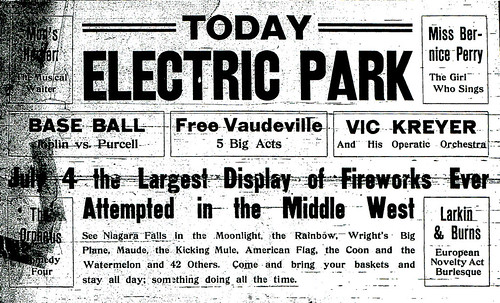
Many in Joplin opted instead of celebrating in town to travel to two of the popular recreational parks in the area, “Since early morning wagons, buggies, autos and street cars have been busy carrying people from the city.  Contrary to the usual custom, there seem few people from the country coming to town to spend the day.  Both Electric and Lakeside parks are the scenes of great activity.”  The bill of events in 1911 for the Electric Park in, located within Schifferdecker Park, advertised a fun and entertaining day:

Electric Park Fourth of July ad from 1911.

An advertisement for the Electric Park in 1911.

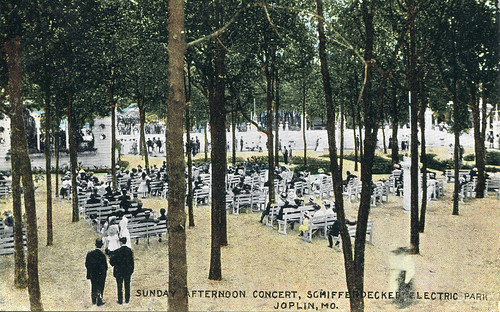
An entertaining area of the Electric Park of Joplin, Mo.

One area of the Electric Park where visitors enjoyed the nearby stage.

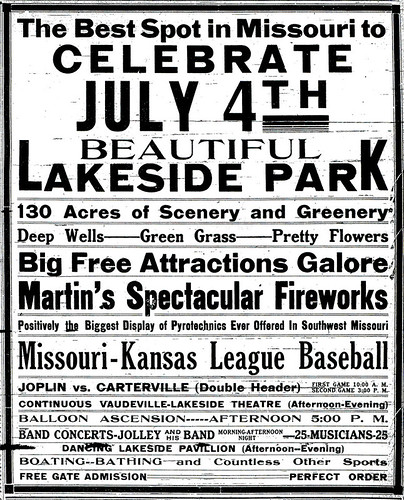
Not mentioned in the ad above was an inviting swimming pool, an escape from the hot July heat.  Likewise, as the name reveals, Lakeside Park also offered a cool, aquatic retreat.  The attractions at Lakeside in 1911 were several.  The Trolley League, a local baseball league of four teams, was scheduled to present a doubleheader.  A standard at Lakeside was boating, in addition to swimming, and a band had been secured for a patriotic performance.  For those in the mood for dancing, a ballroom was also available.

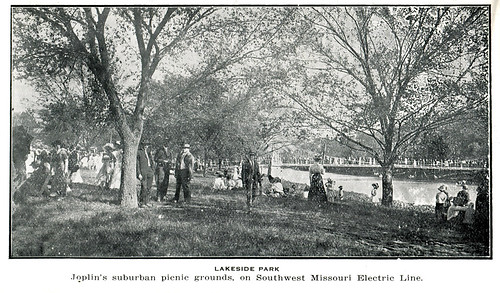
Lakeside Park, Joplin, Missouri

By accounts, the there was far less room to stroll, as presented here in the photograph of Lakeside Park

Lakeside Park 4th of July ad from 1913

A 1913 Fourth of July ad for Lakeside Park

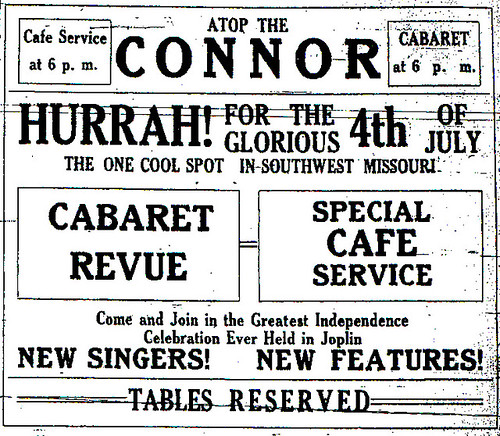
For those in Joplin who opted to celebrate without visiting the parks, one option was to enjoy a meal and music atop the Connor Hotel.  48 booths were made available in “The One Cool Spot in Southwest Missouri,” each designated with a separate flag which represented one of the 48 states of the United States.  “A telephone message to the Connor Hotel will be all that is necessary to have a state held.”  For those who opted to reserve “a state,” the rooftop garden was decorated with lanterns, flags, and festoonings, and the evening was filled with cabaret singers such as, “Ward Perry, Ned LaRose, Nell Scott and Grace Perry.”  Of course, fireworks of some sort were to be expected and for the Connor Hotel diners, a “grand illuminated display of pyrotechnics” among other novelties was offered.

Connor Fourth of July ad from 1913

Ad for the 4th of July entertainment atop the Connor Hotel

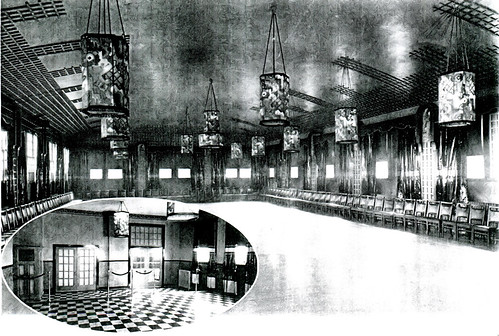
The Connor Hotel's rooftop garden.

A view of the renovated Connor's rooftop area where the 4th of July celebration was held.

From we at Historic Joplin, have a great Fourth of July!

Sources: The Joplin Globe, Joplin News-Herald

For more on the Connor Hotel, click here!

No Rest for the Weary Willie

Today many Americans, unless they live in an urban metropolitan center, have little interaction with the country’s rail system.  Once in a while, one might find themselves stopped at a railroad crossing watching a train roll past, but gone are the days when the train would stop at the town depot to take on coal, passengers, mail, and freight before heading to its next destination.  Peruse an old Joplin newspaper and ads from the St.  Louis and San Francisco “Frisco” Railway touting summer excursions to Eureka Springs, St.  Louis, and Chicago spring from the pages.  Joplin was fortunate that it not only had an extensive interurban trolley system, but was home to a handful of rail lines that carried lead and zinc to industrial centers in the east.

With the trains came hoboes and tramps.  Just a few years after the turn of the century, the Joplin Daily Globe reported that local train crews were having problems with hoboes.  “According to trainmen,” the Globe recounted, “they are having more trouble with tramps this winter than for a great many years.  They are of the worst class and are exceedingly dangerous customers.  They are traveling around stealing rides when they can and endeavoring to find the most favorable places for looting stores or cracking safes.”

The trainmen claimed that the “harmless hoboes who would go out of their way rather than harm a human being are very much in the minority.” Instead, many trainmen told the Globe reporter that they had engaged in “hand to hand fights in an effort to rid the train of them.” Many of the fights broke out during the night when hoboes boldly roamed the rail yards in groups of four to six men.

Later that year, the Globe reported that the, “rail road yards have been especially infested with the merry willies of late.” Nels Milligan, a Joplin police officer detailed to keep an eye on the hoboes told a Globe reporter, “All up along the Kansas City Southern embankment from Broadway to Turkey Creek, you could see the bums lying stretched out in the warm afternoon air sunning themselves like alligators or mud turtles on a chilly afternoon, and here and there was a camp.”  According to Milligan, a hobo’s camp consisted of a “small fire that you could spit on and put out, between two or three blackened rocks, and a blackened old tin can, and an improvised pan or skillet made out of another tin can melted apart and flattened out.”
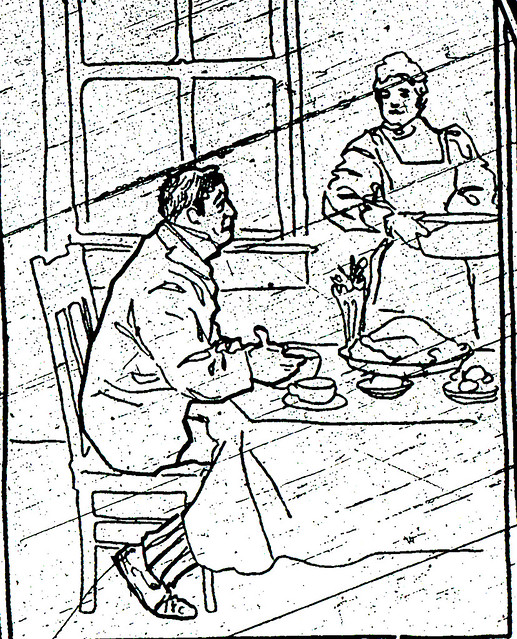
Hobo getting a free meal

Sometimes a hobo succeeded in getting a free meal.

The officer admitted there were too many hoboes and not enough room in the jail to house them.  He worried they would be “working the residence district for grub, hand-outs, punk, pie, panhandle, pellets, and any old thing they can get together.” Once they had food, Milligan claimed, the hoboes would “feed and gorge and lie around there like fat bears dormant in the winter time” until a bout of bad weather would send them on their way.

Five years later, the Joplin News Herald interviewed a railroad employee about the tramps who traveled through Joplin.  Watching a couple of hoboes jump off of a freight train in the Joplin rail yards, the railroad employee remarked, “See those fellows getting off up there? Now there is no telling where they got on, nor where they rode.” He shook his head.  “There’s another thing connected with this hauling of tramps.  Some of the most notorious criminals of the country have occupied places on the train and eluded the crew for hundreds of miles.”  According to the man, rail workers made every effort to assist law enforcement officers in locating wanted criminals who might be catching a ride on the trains.

Joplin was still struggling with hoboes eleven years later when Chief of Police Joseph Myers directed his officers to sweep the town for any weary willies.  Six men were arrested on charges of vagrancy, jailed, and then told to move on.  But as long as there were trains rolling into Joplin, there were always tramps and hoboes to contend with.
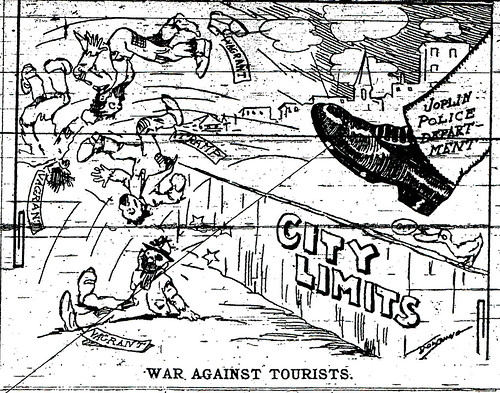
Hobos kicked out of Joplin

Joplin Police kicking out bums and hobos

Hoboes were sometimes looked at in a humorous light.  A hobo celebration was held at the “hobo cave one mile and a half north of the union depot in the hills of Turkey Creek.  Twenty of the Ancient Sons of Leisure gathered there in the cool cave.” One of the hoboes stood up to deliver an impromptu address about the significance of the Fourth of July and said, “Fellow brothers, you all realize what this day means.  It was on this day in 1776 that George Washington crossed the Delaware, whipped fifty thousand Redcoats and whacked out the Declaration of Independence.  Since that time we have been independent.  We do not have to work.  I now propose a committee of three raid a [chicken] coop so we can have an elaborate dinner as befitting Washington’s birthday.”

By 1918, the day of the hobo in Joplin had begun to wane.  Despite Joplin remaining an “oasis  in the great American desert created by prohibition” it was no longer “possible for police to spread a drag net in the railroad yards and gather in anywhere from a dozen to fifty ‘Knights of the Open Road.’”
Tim Graney, a former Joplin police officer and station master at Union Depot, declared he had not seen more than half a dozen hoboes in the last year and not one in the past six months.  The camps where the tramps and hoboes once gathered were empty.  The Globe, unable to explain their absence, mused, “Maybe they have all gone to work…At any rate, they’re gone! The genus Hobo is no more!”

Sources: Joplin Globe, Joplin News Herald
A Changing of the Police Guard

An early ritual of the Joplin Police Department concerned the changing of the guard between new officers and old upon the assumption of a new police chief into office.  One of the powers of the chief was the appointment of selected officers, a relic of the days of political patronage.  In April, 1911, such a changing of the guard occurred and was described in a city paper.

“At midnight tonight the forces of the police will change from the present “bulls” to the new assignment which Chief Myers has selected.  At that time every prisoner in the city jail that is not held on a state warrant will be released so that the new force may enter with a clean slate.”

The preparation involved in this change concerned snipping brass buttons from coats and polishing the stars that the policemen wore to mark their station.  These two things, plus revolvers, were to be handed over by the old guard to the new upon the stroke of midnight.  The newspaper noted that most of the police force was to be dismissed with only a few experienced veterans retained.  Those who were about to lose their jobs were expected to go into mining, many of which who claimed they intended to prospect rather than go into the earth for others.

The dramatic signal to bring all the police to the station was to turn on every red traffic light across the city.  After the policemen had returned to the headquarters for the exchange of stars, buttons, and pistols, it was estimated 30 prisoners would be released.  The recently freed criminals would not have long to play upon the streets of Joplin without oversight, as beats were already assigned to the new officers who would immediately take them up as soon as they assumed their new duties.

Source: Joplin News Herald

A Pioneer Aviatrix Visits Joplin

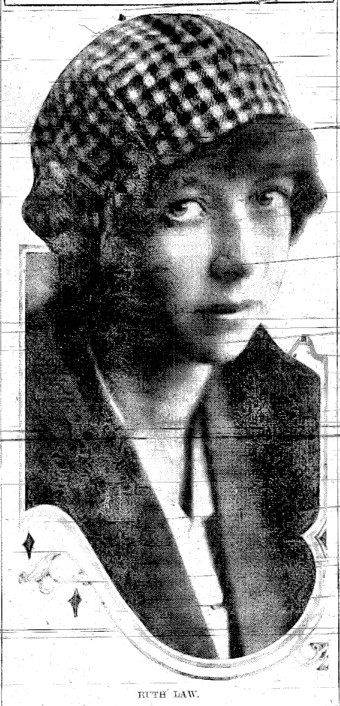
The usual bustling noise of Joplin was interrupted one June morning by the unfamiliar buzzing of an eight cylinder airplane engine from several thousand feet above.  It was not the first time that Joplin had been visited by an airplane, but neither was it a common occurrence, particularly due to the aviatrix at the plane’s helm.  The pilot was the famous Ruth Bancroft Law and had been challenging both stereotypes and flying records for the past several years.

Ruth Bancroft Law

Aviatrix, Ruth Bancroft Law

Her arrival in June, 1917, was intended to be promotional flight to drop “liberty bond bombs” over the city.  All had begun well with a take off from Bartlesville approximately 110 miles away earlier that morning, but somewhere along the way, as she cruised in her modified Curtis airplane, one of the cylinders of her engine began to misfire.  Concerned about the engine, Law opted to pass over the city once and then head for the landing strip setup for her on one of the links of the Oak Hill golf course.  A crowd awaited her arrival, and she swooped down over their heads before she agilely set her plane down without incident around 11 am.

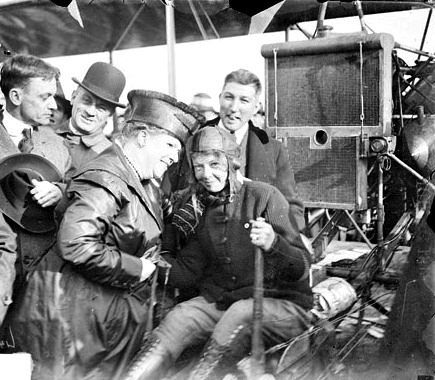
Immediately, the aviatrix was mobbed by fans who began an incessant volley of questions at the new arrival to Joplin.  Law was described as dressed in “regulation army aviation uniform,” an outfit she later exchanged for a divided skirt, leather boots, and leather jacket.  It was of particular note that she wore the uniform, as the United States began its venture into the war in Europe, Law had argued on the national level that women be allowed to join the military as aviators, a position that the government refused to adopt.  She voiced her aspiration to the assembled crowd, “I have offered my services to the war department to be used in any way it thinks best.”

Ruth Bancroft Law in her cockpit

Ruth Bancroft Law in her cockpit surrounded by fans. Via the Chicago History Museum

The Joplin Globe reporter on the scene wrote, “She talks distinctly, biting off her words with flashes of white teeth in a rather square little jaw.  Her pronunciation is that of an easterner, or perhaps an Englishwoman.  She talks fast, as she moves and does everything else.”   Law continued on her aspiration to go across the pond to Europe, “I should like to go to France, but I don’t believe I would care for personal encounters in the air where the object would be to send one’s opponent hurtling to the ground in a mass of debris, mangled and perhaps killed.”  She noted that the French had fine flying machines and her desire to fly one someday.

Law had planned to fly from Joplin to St. Louis, but the problem with her 100 horsepower engine effectively grounded the pioneer aviatrix.  Instead, a special train car upon which her plane would be loaded, would be attached to the next Frisco train and hauled to St. Louis for maintenance.  Law was not alone, but supported by one mechanic, two others, and a trusty French fighting dog.  The plane, itself, was a bi-plane, but with the engine mounted behind an exposed cockpit.  “The propeller blade is at the rear of the two main planes [wings] and is a monster thing compared with the rest of the machine.  Made in one piece, it is nearly twelve feet from tip to tip.”  The plane was a dirty yellow, streaked and smeared with oil from the engine.  It was also a famous plane, as the pilot acknowledged it was the same that had flown the record breaking flight from Chicago to New York, a distance of nearly 600 miles.

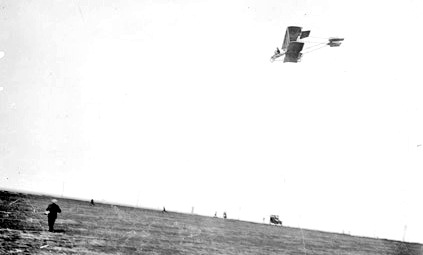
Ruth Bancroft Law flying over St. Louis

Ruth Bancroft Law flying over St. Louis after leaving Joplin, via the Chicago History Museum

The journalist described Law as possessing baby blue eyes, tawny yellow hair that often was kept under tight fitting headgear, and a satisfied smile that twisted the corners of her small mouth into delightful curves.  From St. Louis, Law stated, she intended to fly to Chicago.  When asked why she flew, the bold aviatrix stated, “I fly because I like to.  I like the feel of the air and I like to do things that other girls can’t.”

Source: Joplin Globe, Chicago History Museum, Library of Congress

The Unfortunate Life of Jung Ling

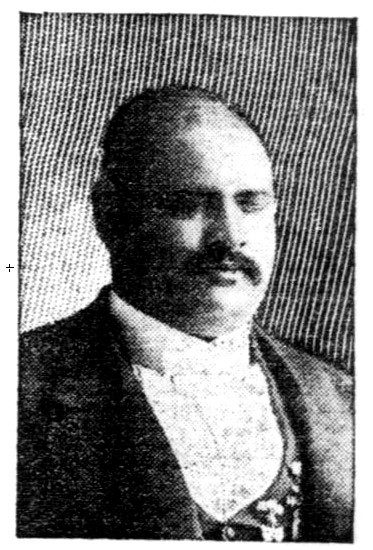
Life was not easy in Joplin for a Chinese immigrant. The Chinese community was minuscule in the midst of a city whose population was overwhelming white.  In previous posts, we covered the lives and affairs of Joplin’s immigrant community, and found that their lives were fraught with hardship and hostility. Jung Ling, sometimes referred to Lo Jung Sing or just Jung Sing, was one of those immigrants. During his time in Joplin he had to deal with his American wife absconding with his life savings and was forced to defend his business with a pistol.

In June of 1907, Jung attempted to gain legal entry for his son into America. During an interview with a government investigator, Jung claimed his son was born in the United States. When the boy was four, Jung took him to China to live with Jung’s Chinese wife. Now that his son was older, Jung wanted the boy to return to the United States to pursue an education. The government investigator, identified only as Mr. Tape, was a Chinese-American reportedly renowned for his ability to uncover and expose illegal Chinese immigrants. Mr. Tape rarely ventured into Southwest Missouri as few Chinese immigrants made the area their home. Reportedly at this time Joplin was home to only five Chinese residents and Carthage had only one Chinese resident. We do not know whether or not Jung was successful in his attempt to bring his son to the United States, but we do know that he was living alone four years later.

The same year, Jung, who owned both the Troy Laundry (located at 109 West Fifth Street) and a restaurant (in a 1909 Joplin city directory it is simply called “Chinese Restaurant” located at 117 East Fifth and 624 ½ Main Streets — Google Maps indicates the laundry was located roughly where Columbia Traders is today and that both businesses were across the street from each other) found himself in trouble once again. Jung was working late at his restaurant on a Wednesday evening when four strange men entered. The men sat down as if they were going to order a meal. Jung walked over to take their order. Without warning, the men jumped to their feet and attacked Jung with a blackjack. Frantically, Jung tried to escape out the back door, only to be beaten and choked into unconsciousness by his attackers.

Twenty-one hours passed before friends of Jung aroused him with loud knocks on his door.  The thieves had locked him inside, perhaps to create the illusion that the restaurant was closed for business and to prevent a sooner discovery of their victim. Jung managed to unlock the door before he fell back into unconsciousness. A broken blackjack club, the metal shot used to give the weapon its heft spilled across the floor, illustrated the brutality of the attack. Once again, Jung’s savings had been stolen.

It was not until two weeks later, when the Joplin police had arrested a notorious robber, Arlie Smith, that Jung had the chance to identify one of his attackers.  The Chinese immigrant still bore the wounds inflicted upon him from a fortnight before, but was by no means fearful when he spied Smith in a cell.  The Joplin News-Herald reported that Jung leapt forward, prepared to attack Smith.  Smith, meanwhile, dismissed Jung with a slur, and laughed.  It’s unknown if Smith was tried for his robbery and assault of Jung, but already accused of other such thefts, it’s likely he was sent off to the penitentiary for one crime or another.

Sources: Joplin Globe, Joplin News Herald
Blind Boone comes to Joplin

Blind Boone

Blind Boone, famed Ragtime piano player.

In June, 1907, a crowd in the large auditorium of the First Methodist church sat enraptured before the musical genius of John William Boone, better known as “Blind Boone.”  Boone had lost his eyesight at the age of six due to illness, but the handicap had not prevented him from finding a career as a piano player.  Managed by John Lange, Boone toured Missouri and the nation performing a mix between the classic and the popular.  His visit to Joplin coincided with his 26th season on the road with Lange.  Considered a Ragtime player, Boone entertained the Joplin crowd with songs from Chopin, Sidney Smith, Liszt, Gottschalk, and Wollenhaust.  Additionally, Boone performed songs of his composition.

The Daily Globe reporter who covered the event described Boone’s playing and its effect as, “He plays in perfect time and interprets the most difficult selections with ease.  He is very enthusiastic when about to begin a selection and his laughs at the end of his songs made a decided hit.”  The reporter continued on the laugh, noting that it, “enraptured his audience.” Furthermore, “Boone has a constant motion of the body backward and forward as he plays and sings which affects him only in appearance.”

Boone was not the sole performer, but was joined by a Miss Emma Smith who sang several songs, and then was called back by the crowd to sing several more.  Among the songs that Boone performed was the famed “Marshfield Tornado.”  Composed after a disastrous tornado swept through Marshfield, Missouri, the reporter stated of it, “so realistic a portrayal of the wind and storm that several small children in the audience cried out in alarm.”  Boone also exhibited imitations of various instruments on his piano, such as a violin, drum, and a fife.  The black performer closed with “The Mocking Bird” and “Home, Sweet, Home.”  For those Joplin residents who missed this performance, the article noted that Boone would be playing again a second night at Joplin’s First Christian church in South Joplin.

Source: Joplin Globe

An Annual Amount of Mail

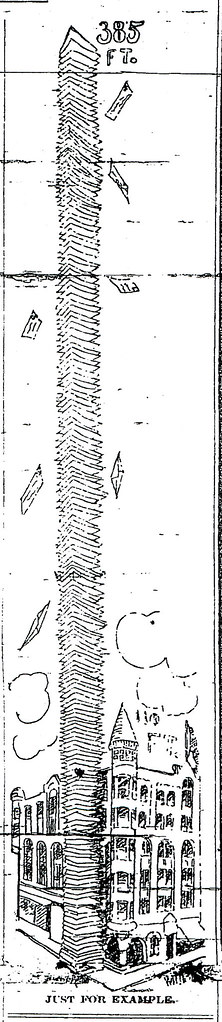
In Joplin’s first few years in the 20th Century, its ever growing population sent an ever growing amount of mail.  A newspaper sketch decided to illustrate that amount of mail by showing how high it would stack in a single column.  As noted, it would go well over the roof of the Keystone Hotel, the tallest building in town at that time (until eclipsed by the Connor Hotel).

All the Mail in Joplin Stacked in A Column

The Keystone Hotel, once the tallest building in Joplin.

Source: Joplin Globe