Joplin By Gaslight

On a rainy spring night in 1878, Marshal L.C. Hamilton turned to a reporter from the Joplin Daily Herald and proclaimed, “If you want to see Joplin by gaslight, take a trip with me.” Not one to pass up a promising story, the reporter stepped under the officer’s umbrella, and together the two men set out into the darkness. “I’m going to raid the brothels,” Marshal Hamilton declared, “Many of the inmates are behind with fines and complaints are being made.” Together the two men visited several brothels over the course of the night, most of them “so filthy” that the Marshal and the reporter chose to stand outside on the steps, rather than go inside.

Despite the efforts of the “city dads” and the police, Joplin’s streets and sidewalks remained populated by prostitutes for years to come. In 1902, Josie Seber was arrested by Office Meanor for streetwalking. She pled not guilty to no avail. Judge Walden fined Josie ten dollars for streetwalking, but the jury decided the fine was too low and pushed the fine up to fifty dollars. Her counterpart, Etta Pitts, was fortunate in that she was only fined ten dollars, but because she was unable to pay the fine, was returned to her jail cell.
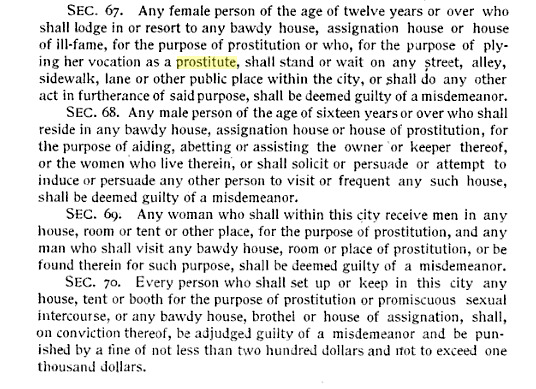
Section of Joplin's 1893 ordinance against prostitution

Joplin's 1893 ordinance against prostitution

As Joplin Police Matron Ellen Ayers would find out, many of Joplin’s prostitutes were addicted to cocaine, morphine, and alcohol. Flo Banks reportedly had a “police record as long as any woman in the city” but in 1902 she declared, “her intention of being good henceforth and forever.” A Globe reporter noted Flo was a longtime “cocaine fiend” but that soiled dove had sworn she had given up her addiction once and for all.

Prostitution was also a family affair for Flo Banks. She and her sister, Pearl Banks, ran a brothel at 629 and 631 Pearl Streets in Joplin. Although it was repeatedly raided by the Joplin police, Flo and Pearl continued their life of crime.  The rewards were simply greater than the risks.

Not all scarlet women came from impoverished backgrounds. Gertrude Rhodes, who was arrested by Officer Theodore Leslie and Officer Ben May for “beastly intoxication” claimed she was from a well-to-do Kalamazoo, Michigan, family. She had married a man whose “weakness was poverty.” They moved to Pittsburg, Kansas, and although her husband idolized her, she grew restless and angry at their poverty. Seeking an escape from her husband and young child, Gertrude Rhodes left her family and headed to Joplin, and within a few days “became scarlet.” After spending time in the Joplin city jail, Gertrude announced her intentions to return to her parents in Kalamazoo.  If she returned to Kalamazoo, only her parents know.

Other girls were more fortunate. Pearl Bobbett left home to travel to Pittsburg, Kansas, after she was promised a job. Upon her arrival, she found that the job required her to dance in a “hooche-kooche” show. Pearl told a Globe reporter, “I had no money or I should have come home at once. I only had $2 when I started. Afterwards they wouldn’t let me leave.” Joplin Police Officer Cy Chapman, who was dispatched to Pittsburg to escort the girl back home, “had to resort to force to get her away from” the show’s managers but not before she had been hit by the showmen with a stick on her neck, arms, and back.
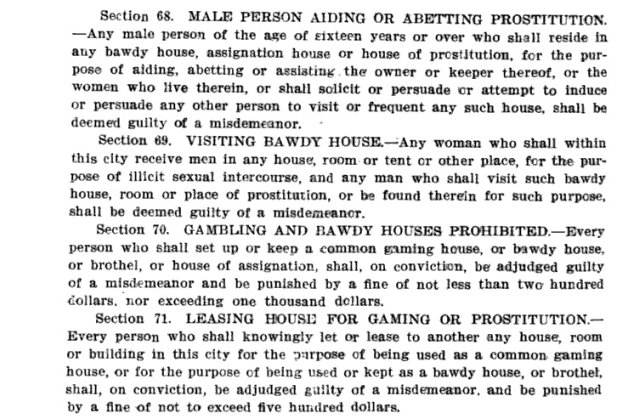
Joplin's 1903 ordinance against prostitution

Joplin's 1903 ordinance against prostitution.

But many ended up like Annie “Black Annie” Stonewalk, an African-American prostitute in neighboring Galena, Kansas. Annie, who was arrested in early 1902 for disturbing the peace after a fight with fellow white prostitute Jose McClure, died a few years later in 1904. It was at the home of Mrs. James Burton, where the former street walker succumbed to a slow and painful death from consumption. The Joplin News Herald remarked, “She has been giving the officers much trouble since she arrived in Cherokee County four years ago from Alabama. Her life would have been shortened months sooner if it had not been for Mrs. Burton’s kindness.”

By no means sanctioned, prostitution existed outside the law but for occasional attempts to reign in its excesses.  Of the women who by intent or by desperation were drawn into the trade, little is known except when apprehended by the police or sought out by reporters who sought shocking or pitiful stories to draw in readers.  Never the less, any history of Joplin is incomplete without acknowledging their presence and their impact upon the city that Jack built.

Sources: Joplin News Herald, Joplin Globe, Joplin ordinances.
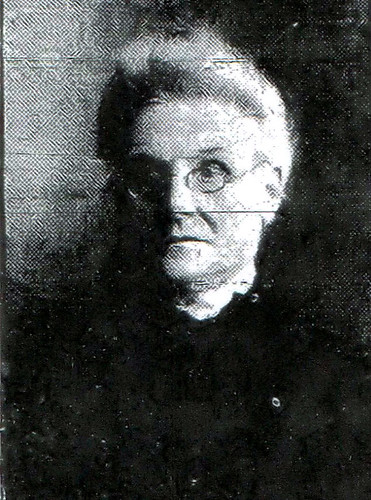
Joplin’s First Police Matron: Ellen Ayers

In the immediate years following 1900, Joplin continued to aggressively expand with more mines, more buildings, more wealth, and more vice. Back alley crap shoots, billiard halls, saloons, bars, and brothels were common sights. Just like mining towns in the American West, Joplin had its share of soiled doves. In 1904, a mix of Victorian morals, a steady number of prostitutes, and petty crime led to the public to demand that the Joplin Police Department hire a police matron.  A police matron, often an older woman, was placed in charge of female prisoners in the city jail.  The Joplin city council responded to the growing problem in the spring of 1904 when it unanimously passed an ordinance that required the city to hire a police matron.  The only hitch was that the hiring would have to wait until the next fiscal year as there was no money in the then city budget to pay the matron’s salary.

It was not until two years later, in 1906, that the city hired a police matron.  Over forty eager women applied for the position, but many were quickly turned aside for lack of skills, deportment, and experience deemed necessary for a qualified police matron. The field of candidates was narrowed down to three women: Mrs. Dona Daniels, matron of the city’s children’s home; Mrs. Agnes Keir, who oversaw Joplin’s chapter of the Young Women’s Christian Association (YWCA); and Mrs. Ellen Ayers.  Mrs. Daniels refused the offered position.  Mrs. Keir had her admirers and fans amongst the members of the YWCA, who all threatened trouble to the city council should they attempt to steal her away.  Through the process of elimination, Mrs. Ellen Ayers was selected as the successful applicant.

Joplin's first police matron, Ellen Ayers

Pictured here, Ellen Ayers took on the role of police matron at the age of 64.

Described by both a local Joplin paper and the city council as highly qualified and trained for the position, Ellen Ayers’ appointment was closely followed by the newspapers.  She was described as a “kindly faced, white haired woman of 64 years,” originally from near Portsmouth, Ohio, and moved as a young child several times, first to Trenton, Missouri, and then to Pleasant Hill, and finally to Paola, Kansas.  The uncertainty of safety found in the border counties between Kansas and Missouri prior to the outbreak of the Civil War may have been the reason her family moved temporarily to Kansas City, only to return after the war ended.  During the war, Ellen Fields, as she had been christened by her parents, met Felix M. Ayers, whom she married in 1864.  A farmer and Union veteran from Kentucky, Felix was gave up his plow for the miner’s pick and moved his family to Joplin in search of a more prosperous life.  He worked as miner until his health failed him, which may have prompted his wife to take on the candidacy of a police matron.

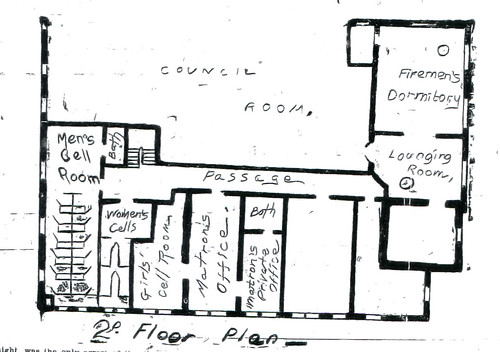
Although she was selected sometime around the end of 1906, she had to wait several weeks due to the fact that the city, despite the passage of the ordinance two years earlier, was still not ready for its new police matron to assume her duties.  On November 27th, Mayor C.W. Lyon formally recommended that she begin her duties, which some hoped would allow the Joplin police to “much better work” at in “exercising influence to restrain wayward feet.” It was not until December 1, 1906, that Mrs. Ayers officially began her job looking after the female prisoners of Joplin’s city jail.  While she had a residence at 1922 Pearl Street, an office and private apartment were prepared for her on the second floor of the city building, which was shared by both the city’s police and fire department. Described as inexpensive but “substantial” the paper promised a certain amount of coziness for its inhabitant.  Adjoining her living area was a wooden door, built to conceal a barred one behind it which had a cement floored cell for female prisoners.

Floor plan for the second floor of the Joplin Police Station

Floor plan for the second floor of the Joplin Police station, which also served as the fire station and city hall.

Mrs. Ayers approached her job nervously, admitting that the work was new to her, but professed her resolute determination to do a good job.  While unaware of what was entirely expected of her, she told a reporter that she thought that “firmness and kindness” were the most essential elements of her job.  Likewise, it was thought that the new police matron would provide motherly reassurance to the wayward women of Joplin.  Mrs. Ayers was the mother of four children; the only surviving child, a daughter, was Mrs. Myrtle Gobar.  One of the duties assigned to the police matron was inspection of the food served to the women, and on her first go Ayers quickly rejected a breakfast for her first charge, Nettie Waters.  Declaring the meal inedible, the police matron demanded a new one.  Nettie may have appreciated the care, but unfortunately did not get to experience much more of it as she was ordered off to the State Industrial School for Girls in Chillicothe for a year.

One week and twenty-four women later, a reporter caught up with Mrs. Ayers to obtain her reaction to her new job.  It was a job, Mrs. Ayers said, that demanded constant attention and required her presence nearly twenty-four hours out of the day at the city jail.  With the exception of when she left on business or for meals, the police matron found herself always in the city building.  The most striking and shocking revelation for Mrs. Ayers, was the “depravity” of the women she encountered.  While ages varied, many of the women were jailed for prostitution and street walking.  Of their vices, the police matron complained that many were addicted to cigarettes and “coke.”  Coke in this sense was the local term for morphine and cocaine.  She estimated two-thirds of the women were addicted to either morphine, cocaine, or both.  The police matron experienced the needs of an addict in one of her first days when a new arrival grew terribly sick and demanded a physician.

“She awakened me with the most painful screams.  I went to the door, and she was crying loudly, and complained that she was very sick.  I immediately went down stairs to see about getting a physician but the officers informed me that it wasn’t a physician she wanted, but rather some morphine.”

Beyond the dark and depressing side of Joplin’s prostitution problem, she also encountered women who arrived at the jail for other reasons.  One was a young girl, perhaps 16 or 17, who to Mrs. Ayers dismay constantly smoked during her conversations with the police matron.  Another girl was Alma Richards.  Described as appearing to be 14 years old, despite being much older, and possessing “dark eyes,” the girl had been to the Missouri State School for the Deaf and Dumb in Fulton, and despite being ascribed those qualities, communicated to Ayers through writing.  By this communication, the matron explained, she learned that the girl refused to go home due to the presence of an abusive father, who reportedly brutally beat her after she broke a window.  Alma’s presence at the jail caused its own news, as the city did not want to release her, and the Industrial School at Chillicothe refused to take her as she was older than 18 and reportedly, “unmanageable.”  Alma Richards’ fate is unknown.

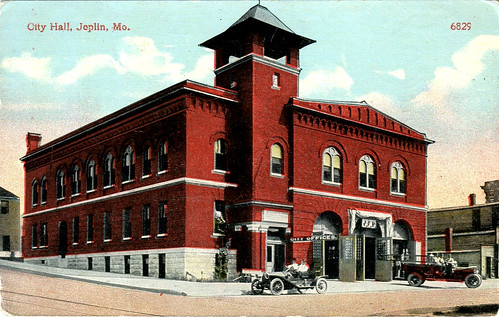
Joplin's city hall, police and fire station

This building served as Joplin's city hall, fire station and police station. Mrs. Ayers' office was likely along the left side of the building pictured here.

For three more years, Ellen Ayers performed the role of matron for the Joplin Police Department before leaving the position in 1909.  After a period of time, she was replaced two years later in 1911 by Vernie Goff who worked the job until 1914.

As for Ellen Ayers, at some point before 1920, her husband Felix passed away.  In 1920, she lived a widow with either a nephew or niece, but by 1930 had her own room in a boarding house at age 87.  Despite the trials and undoubted stresses of the position as Joplin’s first police matron, Ellen Ayers did not let the job overwhelm her and hopefully lived the next 20 years of her life knowing she made a valuable contribution to her community as the city’s first police matron.

Sources: 1880, 1920, 1930 United States Censuses, Joplin Daily Herald, 1918 History of the Joplin Police Department.

Death in the Mines

Lead and zinc mining was the heart and soul of early Joplin. Men toiled in the mines to earn their living or, in many cases, meet their end. There were a variety of ways that death came to those who worked in the mines, often sudden and very violent.

On June 13, 1901, the Carterville Record reported that T. Hibler, a mining engineer working in nearby Galena, fell into a mine shaft over one hundred feet deep while walking to work at 5:30 a.m.  Perhaps it was simply luck, or maybe the manner in which the unfortunate engineer tumbled downward into the darkness, but Hibler survived the fall. Not only did Lady Luck spare his life, but shortly after, a passerby came to his rescue.  Amazingly, Hibler suffered only a few cuts, bruises, and a sprained ankle. He was one of the fortunate as others were not so lucky.

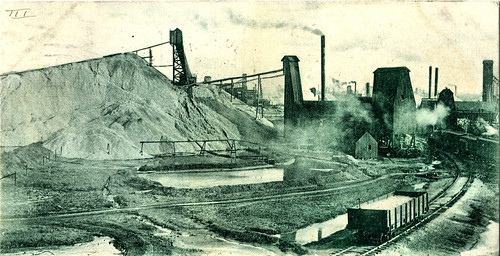
A typical mine in Southwest Missouri

A mine with chat pile looming beside it.

In James Norris’ “AZn: A History of the American Zinc Company” he noted that “In 1897 soaring prices and continued active demand produced large profits for miners in the Joplin zinc-ore district, and the following year was one of the most prosperous in the history of zinc mining.” This boom in lead and zinc mining attracted the attention of wealthy Eastern investors. In 1899, a group of Boston capitalists formed a corporation they called American Zinc, Lead, and Smelting Company. American Zinc, as it was commonly known, became one of the major players in the Tri-State Mining District.

In 1902, Harry S. Kimball was sent to Joplin to evaluate the company’s prospects in Joplin. He later recalled that Joplin was a, “bleak prospect for a tenderfoot to see as his first contact with a mining camp.” Hugh chat and slag piles littered the landscape. Miners were using “relatively simple and inefficient” mining methods.  Thus men who were on the cusp of a century that heralded rapid technological and industrial innovations were operating as if they were still in the Dark Ages.

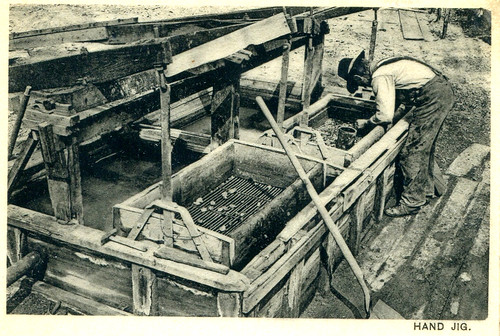
A primitive hand jig

An example of the primitive technology at play in the mining fields. Here a hand-powered jig.

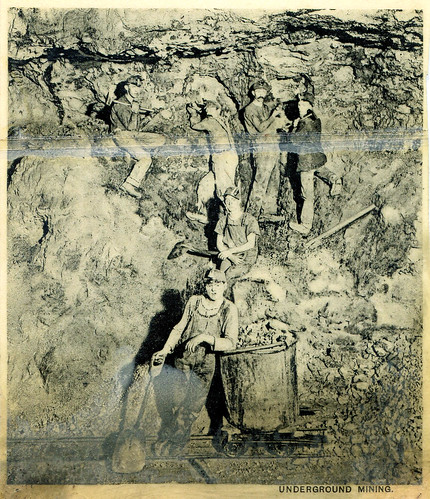
Historian Arrell M. Gibson describes the various mining techniques used in the Joplin area in his book, “Wilderness Bonanza.” Shafting, which required miners to create a vertical access shaft into the earth, was dangerous work. Miners drilled openings into the rock face and then inserted sticks of dynamite into the holes in order to break up solid rock. Dynamite, if handled incorrectly, was deadly. Miners sometimes had to tamp sticks into place.  This involved tapping the explosive material into a firmer or deeper position. If they neglected to use a wooden stick to tamp in the dynamite, often using a metal bar instead, it could create sparks and cause a premature explosion with devastating effect.

Adding to the danger, miners also used giant powder, which was more powerful than regular black powder, to break up solid rock surfaces. Gibson states that many miners complained that giant powder caused headaches and nausea. But if a miner was fortunate enough not to die in a mine collapse, premature explosion, or suffocate, there was a good chance he would die early from silicosis. Silicosis is a condition caused by breathing in crystalline silica dust.  After a controlled explosion, miners often failed to wet down the rock and as a result, inhaled minute particles of rock dust, which damaged their lungs like invisible razorblades piercing through their lung tissue. Miners who suffered from silicosis experienced shortness of breath, coughing, fever, and even a changing of the color of their skin. Of the many miners who eventually succumbed to the manufactured disease, one was Oscar C. Rosebrough. The thirty-six-year-old miner died of “miner’s consumption” in the summer of 1917.

A photograph of likely zinc or lead miners

Miners posing for a photograph within the dangerous confines of the mine.

Other deaths came suddenly and mercifully for some.  The Carl Junction Standard reported on September 12, 1903, Walter McMahan was telling jokes and laughing with his coworkers at the Edith Mine near Joplin when a large boulder fell from the mine roof and crushed him. Meanwhile, The Carthage Evening Press recounted the death of Riley Marley, who was killed when he and his partner set off two shots of blast in a mine shaft. When one of the shots failed to go off, the two men reentered the mine to re-tamp the shot. As Marley tamped the shot back into place it exploded and drove the tamping rod through his head.  He died instantly. His partner was blinded by the blast but survived.

Much of the danger came from simply entering the mines or processing areas.  In 1905, Nathan Rice was struck on the top of his head by a falling timber. He later died of his injuries. In 1916, John Campbell was killed when he got caught in a drill rig. In 1882, Johnie Craig died when he went into a mine contaminated by bad air. In 1920, Kenneth Everett, a five year old child, died from bad air in an abandoned mine shaft.

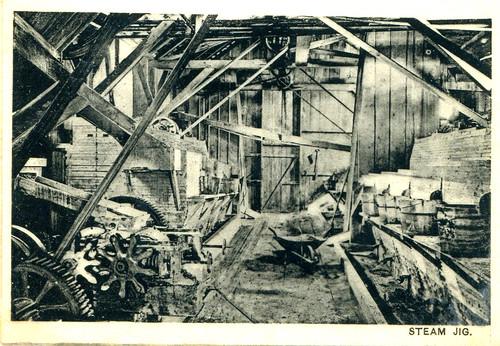
Photograph of Joplin steam jig for zinc and lead mining

Far more complex than the hand jig, it's not hard to understand the danger of working around this steam powered jig.

Close calls were common and sometimes bizarre.  In 1902, William Morgan was injured while working in the Big Six Mine when an icicle fell from the top of a mine shaft and hit him in the back. The icicle was heavy enough that it fractured his shoulder blade, but the physician who tended Morgan expected his patient to recover.

The zinc and lead of Joplin brought great wealth to some, work to many, and danger to all who entered the mines to retrieve it.

Sources: “Mine Accidents and Deaths In the Southwestern Area of Jasper County, Missouri, 1868-1906,” Volume I. Compiled by Webb City Area Genealogical Society.  “Mine Accidents and Deaths In the Southwestern Area of Jasper County, Missouri, 1907-1923,” Volume II, “Accidents, Deaths, and Other Events.” Compiled by Webb City Area Genealogical Society. “Wilderness Bonanza” by Arrell M. Gibson

The Chinese Immigrants of Joplin

Walter Williams, founder of the University of Missouri’s Journalism School, once wrote “Joplin is a city of self-made men, nearly every one of the moneyed citizens having made his fortune there. They are largely American born and American educated.” As Williams observed, Joplin was primarily populated by American citizens, but there were many immigrants who called Joplin home.  Few, however, were Chinese.

Chinese immigrants arrived on America’s shores beginning in the late 1840s during the California Gold Rush. Two decades later, even larger numbers of Chinese laborers were recruited to work on the Transcontinental Railroad. The influx of cheap labor and threat of economic competition sparked racial animosity. Violent anti-Chinese riots broke out in several American cities, including Denver, Seattle, and Rock Springs, Wyoming.  In 1882, in response to growing outrage over Chinese competition, President Chester A. Arthur signed the Chinese Exclusion Act. The act suspended Chinese immigration to America for a period of ten years. Only those Chinese immigrants who arrived prior to the act’s passage were permitted to stay.

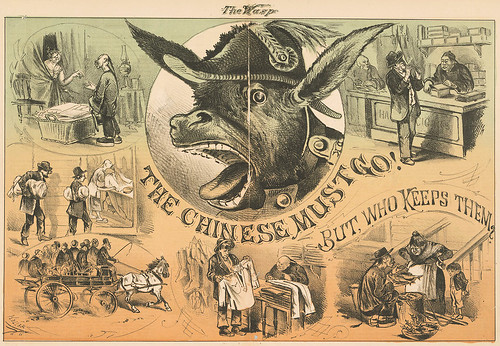
An anti-Chinese immigration illustration from the virulent Wasp magazine of San Francisco

An illustration from "The Wasp" a magazine of San Francisco often noted for its virulent depictions of Chinese Immigrants. Available from the Library of Congress

At the turn of the century, both St. Louis and Kansas City were home to sizable Chinese communities but the Chinese presence in Joplin was less substantial.  Historians can be stymied by gaps in the historical record. The earliest Joplin city directory to have survived the ravages of time dates to 1899, leaving a gap in the city’s history that ranges decades. Meanwhile, county histories often overlooked and ignored the presence and contributions of minorities. Although the state of Missouri attempted to collect birth and death records beginning in 1883, the effort failed until 1910, when the Missouri General Assembly passed a law making it mandatory for counties to record birth and death information.  Few archival collections can boast of letters, diaries, and manuscripts from early Joplin, much less one kept by Chinese resident. Thus, it is often difficult to piece together the history of an immigrant group at the local level, especially if it was a particularly small immigrant group.

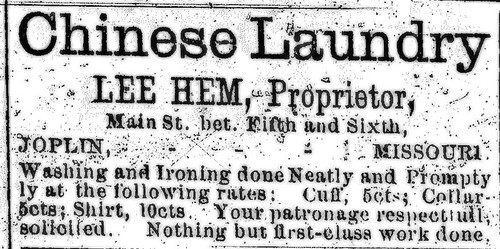
According to the 1870 U.S. Federal Census, there were no Chinese immigrants living in Joplin. By 1880, however, at least one Chinese immigrant called Joplin home. Lum Wong, a single twenty-seven year old native of China, listed his occupation as “servant — clerk in store.” He could not read or write English. Wong lived with sixty-four year old Jacob Wise, a retired merchant. A few years later, in1883, an advertisement appeared in the Joplin Daily Herald for a “Chinese Laundry” run by Lee Hem.

Ad for Chinese Laundry

An advertisement for Hem's Chinese Laundry in Joplin

Although Lum Wong did not appear in the 1900 U.S. Federal Census, five other Chinese immigrants are listed as residents of Joplin. Most, if not all, worked in the laundry business. G. Goro, a thirty-six-year-old immigrant, lived on Main Street. According to the census, his neighbors described themselves gamblers, blacksmiths, day laborers, miners, and traveling salesmen. Sing See, Jung Jin, and Low Chung described themselves as “partners” in a laundry. See and Chung listed the year of their immigration as 1877 while Jin arrived in American in 1879. Thirty-four-year-old A. King, who roomed in a boarding house on Main Street, listed his occupation as “Chinese laundryman.” Unable to work in the mines, Chinese immigrants were forced to eke out their living in whatever industry was accessible, and often greatly restricted along racial lines.

Albert Cahn, a German-born clothing salesman who spoke at the opening of the Joplin Club in 1891 echoed the words of many American politicians when he declared, “This is the best apple country to be found and had Adam and Eve been placed here that Garden of Eden story would never have been told. We have vineyards here for the German, railroads for the sons of the Emerald Isle, commerce for the English, but no use for the Chinese.”

By 1910, only two Chinese immigrants lived in Joplin. One, Jung Low, gave his occupation as “Chinese laundry.” The other, John Jungyong, ran a restaurant.

Within ten years, the Chinese population in Joplin grew when Toy Jung, an immigrant to America since 1890, opened a Chinese restaurant. Toy, the proprietor, was assisted in his business by a partner, Ling Kwong, who had reached the states five years after Toy. Additionally, five cousins of Toy worked as cooks and waiters. Only two of Toy’s cousins were born in California; Toy, his partner, and his three other cousins were all born in Canton, China.  Another Chinese run business listed in 1920 was a laundry run by a Chinese-American named Charlie Hoplong.

The 1930 Census revealed the presence of another Chinese restaurant run by Shang Hai Lo, a sixty-year old restaurateur from Canton, China who had arrived from China the same year as Toy Jung.  It also noted the absence of Charlie Hoplong and his laundry business.  Four years later, Toy Jung, who had spent at least fourteen years in Joplin, passed away leaving only his wife Quong Jung to mourn his death.

Today there are a small number of Chinese residents in Joplin. If you want to sample some of the finest Chinese in the Midwest, stop by Empress Lion. This small, unassuming restaurant located in a strip mall at the corner of 32nd Street and Connecticut, offers some of the finest Chinese to be had.  (We hope you’re well, Tiger and Lily!)

Sources: United States Census, “History of Jasper County and Its People” by Joel Livingston, and the Joplin Daily Herald, “The State of Missouri” by Walter Williams, and the Library of Congress.

Before the Joplin Miners

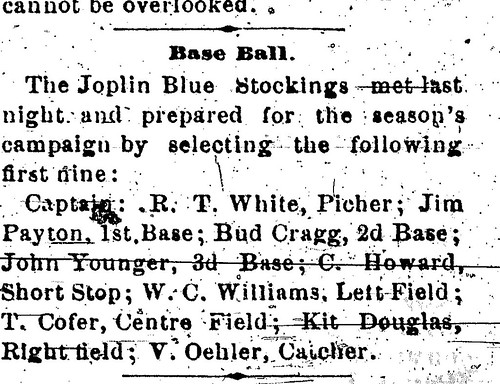
While Joplin no longer has a professional or semi-professional baseball team, perhaps its best known team was the Joplin Miners, where Mickey Mantle began his baseball career.  Perhaps the city’s least known team may have also been its first.  One of the first mentions of a team, and a brief one at that, appeared in 1880:

A reference to the Joplin Blue Stockings

The Joplin Blue Stockings, perhaps one of Joplin's earliest baseball teams.

Source: Joplin Daily Herald