The Joplin Carnegie Library and the Origins of Joplin Public Library: Part Two

Under a bright October afternoon sun, a crowd of ten thousand gathered to watch a parade snake its way from Fourth and Joplin streets to Main Street.  It turned under the watchful gaze of the Keystone Hotel and then proceed south to Ninth, where it turned again to the right and came to a stop at Ninth and Wall.  It was October 8th, and the people of Joplin had come to celebrate the laying of the cornerstone of the new Carnegie Library.

The parade had formed at 2:30 pm and consisted of a number of different groups.  In the vanguard was Police Chief Jake Cofer with a platoon of police officers.  Behind the police, the South Joplin band played and stomped in celebration, and were followed by 66 members of the Knights Templar from Joplin and the surrounding area.  The contingent of Knights Templar was outnumbered by the 151 members of the Masonic Blue Lodge.  Behind the Masons came 2,386 excited school children, headed by 29 high school students and teachers, walked four abreast down the city streets.
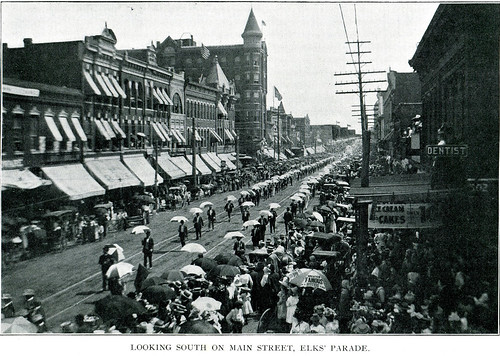
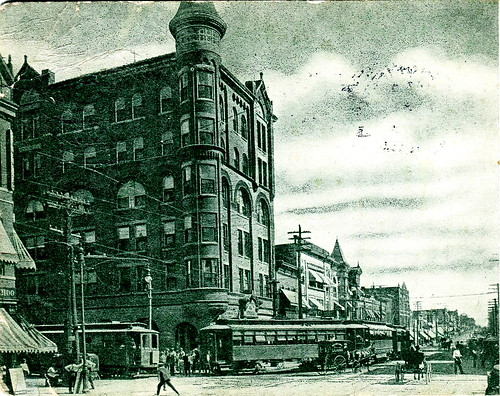
An Elks Parade on Joplin's Main Street

A different parade, but an example of a parade down Main Street and how the Elks might have marched that October afternoon.

Behind the flood of children came 24 grey headed members of the Grand Army of the Republic from  Joplin’s O.P. Morton Post. As in 1865, the veterans marched proudly behind a cherished battle flag.  Approximately 60 individuals of the Elks and Eagles followed the veterans and then bringing up the rear were thirty members of the Knights of Pythias commanded by Joplin attorney Joel T. Livingston.

Thousands surrounded the construction site of the library.  The limestone walls soared over the crowd, such was the progress that had been made since Augustus C. Michaelis was selected as the architect in February.  A platform rested against the side of the building next to where the cornerstone was to be laid.  Children, anxious to see the ceremony, climbed the surrounding trees and hung perilously from branches.

A band took up position beside the platform while the mayor of Joplin, John C. Trigg, climbed onto the platform to address the crowd.  His speech, the lengthiest of the day, began with the origin of the movement for the library.  The mayor boasted that the tax revenue from property valued at $4,000,000 was more than sufficient to support the library, but also noted that it had not been enough for the construction of the building.  For this, Mayor Trigg credited industrialist Andrew Carnegie who, “came to the rescue and dissipated all doubts and disquieting fears.”  Trigg continued:

“No event in the history of the city of Joplin will perhaps stand out in bolder or more prominent relief in the future than the laying of the corner stone of the Carnegie public library building…It should be accentuated as a distinct epoch in the annals of the city, from which to date as from the dawn of the new century, an augmented zeal in the material, moral and intellectual improvement of our people of all classes and conditions…”

After the mayor established the effect of the library on the city, he then described the benefit of books, “The inestimable value of books is no longer a vexed or mooted question.  The wise, the good and the great of all ages and nations, divines, poets, philosophers and statesmen, have contributed the most cogent and convincing testimony in support of the premise.”  Trigg went on, reading excerpts from such authors as Joseph Addison, Richard DeBury, and Louisa May Alcott.  Finally, and perhaps to the relief of some in the crowd, the mayor concluded his speech.  This was followed by a brief rendition of the song, “Remember Now Thy Creator,” that setup the next speaker, Reverend Paul Brown.  Brown was a substitute for Judge Picher, who had been unable to attend the ceremonies that day.

Reverend Brown reflected on the origin of free libraries and then spoke of libraries as essential to democracy:

“What is the end of democracy?  I answer the end of democracy is a natural aristocracy.  There is an aristocracy of nature which no contract or statute can ever abolish….Here in the district, our chief industry, mining, weeds out weaklings and cowards, and creates a natural aristocracy of physical courage and vision in the depths of the earth.  Now what does democracy guard against?  Not natural aristocracy, but artificial, the aristocracy of mere birth or place or force or accident.  Democracy means that equality of opportunity which will give the natural aristocracy a chance.”

It was books, Brown argued, that provided the opportunity for men to overcome the privileged aristocracy who were born to fame, title, or fortune.  Brown, after noting famous authors of history, praised the city’s superintendent, J.D. Elliff, whom Brown stated, had played the crucial role in seeing the library created.  Brown soon concluded his remarks, followed by a song from the band, and again, when the time finally came for the actual laying of the cornerstone.
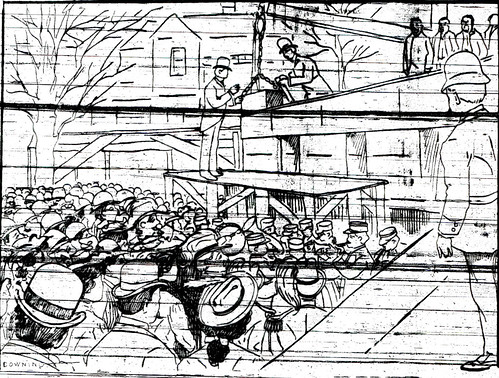
Laying of the Joplin Carnegie Library cornerstone

The laying of the cornerstone of the Joplin Carnegie Library.

This august moment was overseen by the Most Worshipful Grand Master of the Masons, John C. Yocum.  The Grand Master announced the placement of the cornerstone, as it was guided by a small crane and lowered carefully into place.  An invocation was given by the Mason’s Grand Chaplain, who was accompanied by the Masonic ceremonies of deposit and consecration.  One last speaker arose, Dr. W.P. Kuhn, a senior grand warden of the Masons from Kansas City.  Dr. Kuhn opted to win the crowd through praise of the children present, as well a quick joke about Methodist and Presbyterian preachers:

“ The Methodist preacher never prepared a sermon or at any rate never had any reference notes, but his services were largely attended, while the Presbyterian divine labored conscientiously over his discourses, wrote them painstakingly out and read them with painstaking fidelity.  But, his flock was few, and in a spirit of discouragement he came to the Methodist preacher and asked him why it was that the people crowded to hear him who never prepared a sermon while his own church was all but empty.  And the Methodist replied, “My good friend, you write out your sermons and the devil is right there behind you.  He knows every word that you’re going to say and he is able to circumvent every effort you make, no matter how praiseworthy.  Now I don’t know what I’m going to say and I know the devil don’t know what I’m going to say either, and that’s the difference between us.”

Dr. Kuhn concluded by stressing the importance of free libraries, as they were part of the “three planks that the structure of every American community is founded.”  The other two planks were free thought and free speech.  Immediately after the crowd sang, “America,” and the cornerstone laying ceremony ended with a benediction offered by the Rev. Charles A. Wood.

With the cornerstone laid, construction on the library resumed.  The building incomplete, the actual Joplin library, which was already in existence was housed at the Joplin high school and overseen by Lucile Baker, the first librarian.  Ms. Baker was a writer for the Joplin News-Herald and used the byline of “Becky Sharp” in a nod to Missouri’s own Mark Twain.

The library was finally completed a year later.  The city received its first check from Andrew Carnegie at a sum of $5,000.  Twelve years later, the city sought and received another $20,000 from the generous benefactor for an addition to the west side of the library.  In charge of the library, now at home in its new building, was Mary B. Swanwick, who was joined by assistant librarians Blanche Trigg, Mary Scott, and Hattie Ruddy Rice.
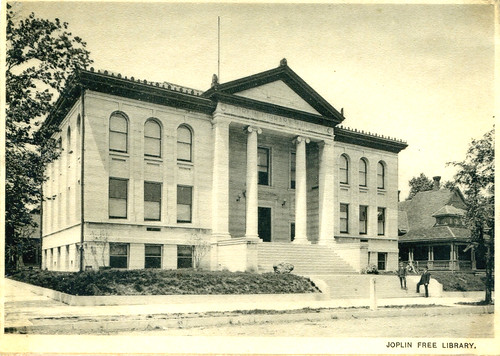
The Joplin Carnegie Library

The Joplin Carnegie Library not long after completion.

As of 1911, the library had 15,737 books as well as 2,643 magazines and periodicals.  Over the year, over ten thousand people used the library, around 1/4th of the city’s population, and almost 65,000 books were circulated.  Active card holders numbered almost 7,000.  Ten years later, the head librarian, Swanwick, passed away and was eventually replaced by Blanche Trigg, daughter of Joplin Mayor John Trigg. She oversaw the institution until 1949.  It was under the oversight of Trigg’s successor, Margaret Hager, who helped lead the movement in the 1970s to purchase the Connor Hotel and the rest of the 300 Block as the site of a new library building.  That building, the present home of the Joplin Public Library, opened in April, 1981.

Sources: Joplin News Herald, Joplin Globe, “A History of Jasper County, Missouri and its People,” by Joel Livingston, and Missouri Digital History.
Hell Hath No Fury Like a Miner’s Wife Scorned

Saloons were not the only places that jealous lovers sought revenge.

On a sunny afternoon in 1899, a dozen miners sat at the entrance to the Boston mine just east of Joplin.  After spending their morning below ground, the sunshine must have provided a welcome relief, but their boisterous talk was soon interrupted when a well dressed woman stormed up to them.  She demanded to know if her husband, Ralph Market, was at the mine.  The miners replied that he was not and that they did not know him.

Mrs.  Market, however, was no fool.  She insisted her husband worked at the mine and demanded to see him.  Once again the miners replied they had never heard of Ralph Market.  Mrs.  Market, frustrated, demanded to be hoisted down into the mine because she knew he must be hiding somewhere in the mine shaft.  The miners tried to tell her that it would be awhile before they descended back into the mine, but Mrs.  Market replied she, “did not care for company on the way down,” assured the men she was not afraid of mine, and wanted to be the first one down so her husband could not escape.

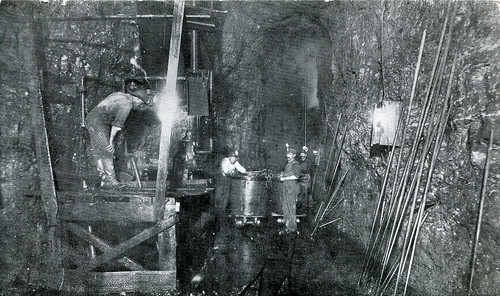
Interior of a Joplin Mine

The interior of a Joplin mine, which might have looked like the mine where Mrs. Market unsuccessfully searched for her husband.

The hoisterman finished his lunch and told Mrs.  Market to step into the tub.  It was probably best that he did.  When she gathered her skirts about her as she prepared to enter the tub, the miners spotted a loaded six-shooter strapped to her waist.  It was then that the “boys then believed that she meant business and they respected her wishes.” Mrs.  Market went down into the shaft without a light, but one was sent down when requested.  She searched the mine but failed to find her husband.  She asked to be returned to the surface and asked for the superintendent’s office to find out if her husband was employed at the mine.  The miners speculated the woman’s actions were the result of jealousy.  Ralph certainly must have had a heck of a welcome when and if he returned home to his wife.

Source: Joplin Globe

The 1902 Collapse of Easth Seventh Street

In the spring of 1902, just before noon, East Seventh Street collapsed.  The debris from the street plunged downward into the gaping maw of an old mine drift from the defunct Zola mine.  The dark chasm sprawled 50 feet.  The Joplin News-Herald remarked that the street was “the main thoroughfare east and there is scarcely a moment that if it is not traveled at every point along the route.” Fortunately no one was on the street when it collapsed.  Traffic was diverted onto Fifth and Fourteenth Streets until the vast hole could be filled in.

As we have noted before, there are numerous mine shafts all over the Joplin metro area.  For now, it seems that most shafts are filled up with water, and are holding steady.  In the future, though, with some speculating that the water table in the Four State area could drop, it seems plausible that shafts may open up as the water disappears.  While we here at Historic Joplin are not hydrologists, geologists, or any other type of “-ologist,” we find the idea of the underground honeycombs of mining shafts and drifts in and around Joplin intriguing.

Source: Joplin Daily News Herald, 1902

In the spring of 1902, just before noon, East Seventh Street collapsed. The debris from the street plunged downward into the gaping maw of an old mine drift from the defunct Zola mine. The chasm sprawled 50 feet. The Joplin News-Herald remarked that the street was “the main thoroughfare east and there is scarcely a moment that if it is not traveled at every point along the route.” Fortunately no one was on the street when it collapsed. Traffic was diverted onto Fifth and Fourteenth Streets.

As we have noted before, there are numerous mine shafts all over the Joplin metro area. For now, it seems that most shafts are filled up with water, and are holding steady. In the future, though, with some speculating that the water table in the Four State area could drop, it seems plausible that shafts may open up as the water disappears. While we here at Historic Joplin are not hydrologists, geologists, or any other type of “-ologist,” we find the idea of the underground honeycombs of mining shafts and drifts in and around Joplin intriguing.

Source: Joplin Daily News Herald, 1902

General Coxey Comes to Joplin

In 1899, General Jacob S. Coxey rolled into Joplin to try his luck in the mines. General Coxey was not a hero of the Civil War; instead, he was a hero of the working class who twice led a rabble of unemployed workers dubbed “Coxey’s Army” on quixotic marches on Washington, D.C.

Coxey, a native of Pennsylvania, who despite his status as a prosperous businessman, believed that business monopolies brutally crushed the common man. One year after the nation descended into financial panic during the economic crisis of 1893, Coxey led a ragtag group of unemployed workers to Washington, D.C. to protest unemployment and to ask the federal government to create public works projects to provide jobs for the unemployed. His plan anticipated the economic recovery programs of Franklin Roosevelt’s administration, such as the Works Progress Administration (WPA) and the Civilian Conservation Corps (CCC). Although unsuccessful, Coxey and his followers captured the country’s attention. He would later launch a second march in 1914 that also failed to achieve lasting results.

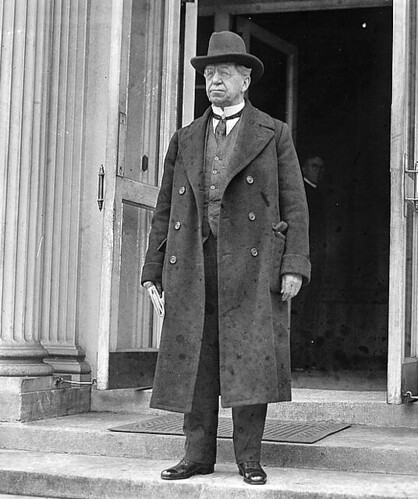
General Jacob S. Coxey

General Jacob S. Coxey, leader of "Coxey's Army" in his later years via Library of Congress

In between marches Coxey continued his successful business pursuits, but remained open to new ventures. The year 1899 found Coxey in Joplin, Missouri. He brought with him a sixty foot long railroad car that had once been outfitted for traveling in luxury, including his personal office on wheels, but had since been converted into a car that carried machinery. On board was a boiler and engine, mining timbers, mine cars, and other equipment brought from an Ohio coal mine.

Coxey announced his intent to mine according to his style, but the Joplin Daily News remarked, “what use he has for a dozen coal cars experienced miners here cannot explain.” Coxey’s mine was made up of two lots on the Shoal Creek Company’s lease located at Redding’s Mill south of Joplin. Coxey’s railroad car and its contents attracted “unusual attention” among onlookers at the Frisco Depot.

One week after his arrival Coxey departed Joplin to return home to Massillon, Ohio, and announced his intent to return in the following weeks to check on his mining operations. He was described as a “business like man and has plenty of ready cash” who “merely smiles and says but little when politics is broached. He is a good storyteller and never fails to tell jokes on himself.” In looks he was a “plain business appearing man, middle aged and wears the latest style tailor made clothes and tan shoes.”

While in Joplin, he reportedly became good friends with Thomas Connor, who would later build the New Joplin/Connor Hotel, and expressed his interest in “the story of Mr. Connor’s success.”

It is unknown just how much money Coxey made from his mines, but he certainly livened up Joplin for at least one week in 1899.

Source: Joplin Daily News, Library of Congress

He Pulled A Gun

Downtown Joplin is fairly quiet compared to what it was like on a Saturday night one hundred years ago.   At that time the Worth Block sat at the corner of Fourth and Main where a small park, once famous more for its vagrant population than the namesake statue of a miner, now sits. The Worth Block was owned by the eccentric James “Jimmy” H. Worth, a native of Indiana who married well, and lived life fast.   In the future we’ll write about “Colonel” Worth, but for now will focus on yet another scrap on the streets of Joplin.

Busy corner of Fourth and Main

A daylight view of the busy intersection of Fourth and Main

“Last night about 11 o’clock a little excitement was created at the corner of Fourth and Main streets by a hair brained individual with a gun who made a public exhibition of himself and then gun in hand fled before the righteous wrath of an unarmed man.  This spectacle also created much amusement.  Chas. Allen is a driver of carriage No. 5, of Finch Bros. line.  At the hour named last night his carriage stood at the southwest corner of Fourth and Main streets.  He was about to drive to the Gulf depot when Richard Risdon, formerly a driver of Watson’s line, but now of Webb City, came along and asked Allen if he was going to the depot.  Allen answered in the affirmative and Risdon swung himself up to a seat on the box.  With an oath Allen jumped to the pavement pulling from his pocket a revolver as he jumped.

He presented his gun at Risdon as though he intended to fire, but Risdon had nerve and alighting from the box advanced upon the warlike Allen, asking him why he didn’t shoot.  Allen weakened, and turning in the face of his unarmed adversary fled across the street, pocketing his revolver as he flew, ran through Kinsella’s saloon and disappeared.  Risdon is well known in Joplin as a gentlemanly young man and a man of nerve and by his action last night bore out his reputation.

It seems that the driver, Allen, had a private grudge against Risdon and that they had had some trouble before. Risdon returned to his home in Webb City last night, but up to the present writing Allen has not been apprehended.”

Source: Joplin Morning Herald, 1892

The Boxer McCormick

Over the years, Joplin saw its share of characters.   Alvin Clarence Thomas, the pool shark better known as “Titanic” Slim Thompson; Bonnie and Clyde; and Jim McCormick were just a few of the colorful folks who stopped but never stayed.

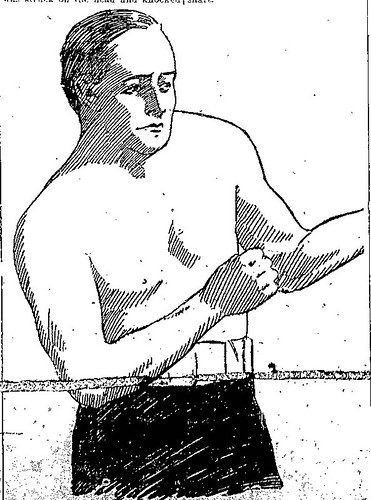
Boxer Jim McCormick

Boxer Jim McCormick

You may not recognize the name Jim McCormick unless you are a hardcore boxing fan.  McCormick, a native of Galveston, Texas, was at one time a notable boxer.  During his career he fought both John L.  Sullivan (Sullivan’s last match) and Jack Johnson (twice).

McCormick ran into trouble when he came to Joplin with business on the mind.  After meeting with a man named Dunham about opening a boxing school in Joplin, an altercation ensued, and McCormick was picked up for assault and robbery.

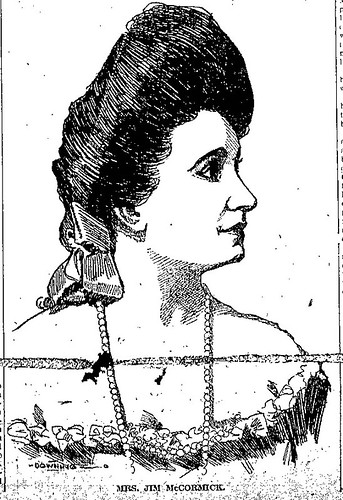
His wife, Lucretia Vincent McCormick, hired the Joplin law firm of Clay and Shepherd to defend her husband.  The two reportedly met when McCormick worked as Sullivan’s sparring partner and Vincent, a vaudeville singer, was part of Sullivan’s entourage while in Seattle, Washington.  They married in March, 1905, and had lived previously in Topeka, Kansas.  Interestingly, Lucretia noted that her husband’s real surname was Heiman, but used his mother’s surname of McCormick as his ring name.

Mrs. McCormick

Mrs. Jim McCormick

Although the details of McCormick’s life are incomplete, it can be assumed that after he and Lucretia hit the road in search of better luck.

Source: Joplin Globe

A Hotel Pool at 4th and Main

Several youngsters who rode past the place on bicycles deliberately rode down the long board incline that leads into the pit and plunged, wheel, clothes, and all, into the murky pool.

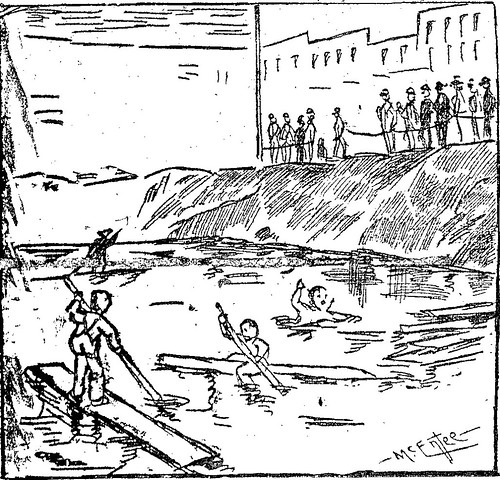
No trace of the old Joplin Hotel remained by late July, 1906.  Excavation was well underway for the new hotel when a summer torrential downpour occurred on July 20.  Over the hours as the rain fell the great pit, from which the Connor Hotel would eventually rise, filled with water.  When the sun rose the next day, to the delight of Joplin’s urchins, a veritable swimming hole at the corner of the city’s economic district reflected the morning light.  Encouraged by the July heat, boys quickly took advantage of the “hotel pool.”

A Joplin Globe article described the enthusiasm of the boys to partake in its cool, wet relief, “The youngsters did not disrobe before entering; such a move would have brought down upon them the wrath of the law.  They simply plunged in, clothes and all, a very few of them removing their outer shirts before the plunge.”  In addition to the swimming and diving, the boys soon discovered wooden boards that were quickly plied into use as rafts.  Envious youthful onlookers, who had failed to secure such craft when the opportunity allowed, willingly paid several cents, upward to a dime, to purchase either a ride on a raft or a raft itself.

Swimming pool at the old Joplin Hotel

A quick sketch of the swimming festivities at 4th and Main

The fun and games did not last forever, at least for a boy named Robert.  His aquatic fun ended upon the discovery of his mother of finding her son, fully clothed, splashing about the rain-filled pit.  The last that was seen of poor Robert was his mother leading him away with a firm grip on his ear.

Source: Joplin Globe

Matt Miller’s Treasure

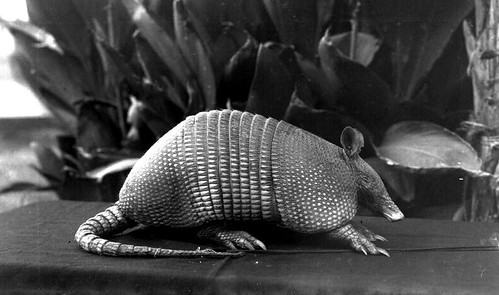
In the early spring of 1897, Matt Miller of Joplin was the recipient of what may have been the first armadillo in Southwest Missouri.  Miller’s friend F.D.  Bancroft of Von Ormy, Texas, sent Miller the armadillo as a gift.

Armadillo

Image of an armadillo via the Library of Congress

The Globe reported that the armadillo was, “eighteen inches long and a foot tall.  It is covered with a shell something like a turtle, has four legs long enough to reach to the ground, at the bottom of which are four feet that look something like a cross between a hoof and a cat’s paw.”

Miller described it as a, “land bird, strictly omnivorous and carnivorous.  It eats mice, snakes, lizards, ants, and other beasts and vermin.” He added, “The ladies are invited to call at my office and see it.  Sleeps by day and runs around hunting something to eat at night.” Miller, already proud of his gift, boasted, “It will dig into the ground faster than a man can with a spade, and when he gets in he spreads his armor out against the sides of the hole s o that a team of mules can’t haul him out.  All are urged to come and see him and it won’t cost anyone a cent.”

Source: Joplin Globe, Library of Congress

A Plunge Down a Sixty-Foot Shaft

Every day hundreds, if not thousands, of automobiles rumble through downtown Joplin.  Most drivers  go about their business without a thought that there may be empty mine shafts below their wheels.  We here at Historic Joplin do — which is not to say we’re afraid of our vehicle plunging into a gaping chasm on Main Street, but in an area riddled with mine shafts, tunnels, and sinkholes, the ground giving way does happen from time to time.  Mine shafts even presented a threat to folks, who despite having a familiarity with the dangers of working in the mines, had the misfortune to make a misstep.  Or, in the case of James “Jim” T.  Bodine, the wrong way home.

In the summer of 1904, Jim Bodine was on horseback herding the family cow home for the night.  As he passed south of Twenty-Sixth Street, he had to ride through some brush when he and his horse unexpectedly encountered an abandoned mine shaft.  Bodine, who was a, “well known and very popular mine superintendent and operator,” undoubtedly knew about mine safety, but riding your horse into a mine shaft in the middle of the night was something he had thought little about up to this point.  Bodine’s horse pitched forward into the shaft.  It managed to dig its forelegs into the mine shaft so that it seemed as if it would be able to get both itself and Bodine out of the shaft.  Unfortunately, its legs buckled and the two plunged sixty feet into a water-filled mine shaft.

An abandoned mine shaft via Bureau of Land Management

Abandoned mines poise significant danger risk in any mining area, such as this one located in California.

Both man and horse surfaced with Bodine still in the saddle.  The horse struggled to keep its nose above the water.  Bodine tried to sit in the saddle as long as he could, but realized the horse could throw him at any time, so he slipped into the water.  His head throbbing from a bump to his head, Bodine managed to climb two or three feet onto the walls of the mine shaft.  As the strength began to leave his arms, he began to cry for help.  There he remained for over an hour yelling for help.  In the water below Bodine, his horse was “plunging and striking his feet right and left.” Gritting his teeth, he sank his fingers “into the sides of the shaft as far as possible.”

Fortunately for Bodine, a Mrs.  Carter was passing by when she heard his cries for help.  She “ran to the shaft, shouted a word of encouragement to Mr.  Bodine, and then ran for help.” Mrs.  Carter brought James Ingram, D.E.  Krokroski, and H.  Dillon back to the mine shaft.  There the three men lowered a rope to Bodine which he tied around his waist.  Together the men pulled Bodine up to the surface where he was rushed home.  Four doctors were summoned, but found that Bodine was in good shape despite his harrowing ordeal.

Bodine later told a Globe reporter, “There was a time when I thought I would have to give up and fall into the water.  After Mrs.  Carter looked into the shaft and then ran for assistance it seemed hours before assistance came.  I felt my strength gradually giving away, and it seemed that every minute would be my last.” Even as the rope was being lowered to him, Bodine confessed, “I thought I would not e able to keep my position until I could get it tied, but it is remarkable how a man’s strength will stay by him when his life is at stake.” As for his horse, several men tried to extricate it, but as of the newspaper’s deadline, they had not been able to pull it out of the shaft.

Source: The Joplin Globe

Easter in the Joplin Globe

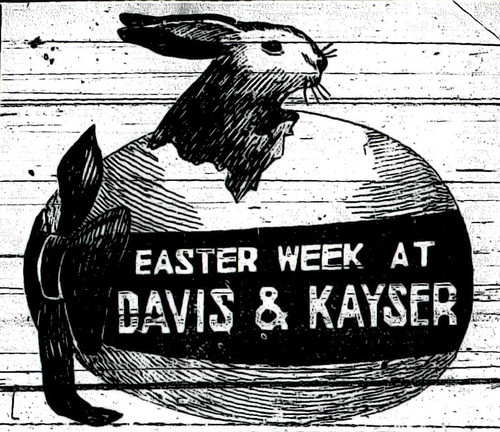
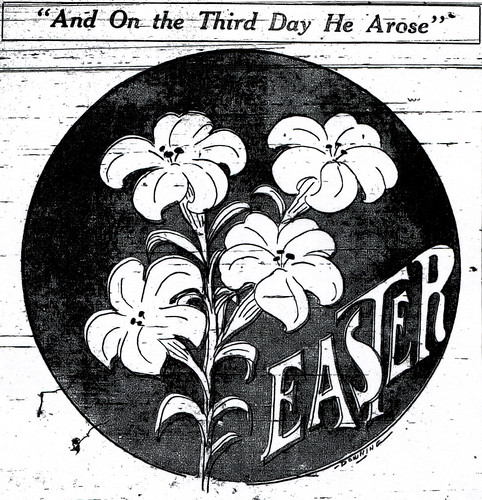
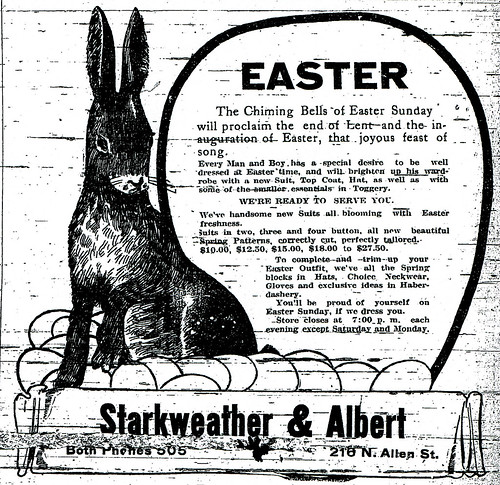
The majority of Joplin’s residents were Christian and as a result, as Easter neared, ads reflecting the holy day appeared in the Joplin Globe.   Here are three examples for your viewing pleasure:

Easter Advertisement in the Joplin Globe

Easter Advertisement in the Joplin Globe utilizing the Easter Bunny and an Easter egg.

An illustration for Easter Services in the Joplin Globe

An illustration for Easter Services in the Joplin Globe

An Easter advertisement in the Joplin Globe

Easter Bunny with Easter eggs in advertisement.

Sources:  The Joplin Globe