The Stars and Stripes

Englishman B.E. Dover and Irishman Harry Flynn began talking during a Salvation Army service held at the corner of Fourth and Main streets when Dover gestured to the American flag and remarked, “That’s a damned pretty flag but it’s a dirty rag and represents a dirty class of people.”

Flynn, who had met Dover for the first time during the service, was enraged. Flynn asked Dover to walk up the street with him, rather than disturb the Salvation Army service, and the two men began walking toward Fifth Street. Flynn asked, “What did you say back there?” Dover repeated what he had said, then fell to the street as Flynn punched him in the face.

“Take that, and that, you dog!” Flynn shouted, striking the Englishman as a crowd gathered to watch, cheering the miner on. After he decided Dover had taken enough punishment, Flynn walked off, but not before he declared, “You may be able to talk about the American flag as you please in England, but begorrah, when you come to the United States of America, you will have to be guarded in your speech.”

Dover picked himself up off the street in search of a police officer. By the time he found one, Flynn could not be found, and the newspaper remarked, “even if he had been on the spot, the crowd of spectators would never have allowed him to be taken to jail.”

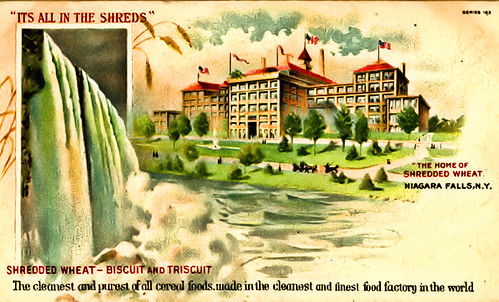
Shredded Wheat

An early advertisement for Shredded Wheat from the Library of Congress

Joplin was a stopping point for many hoboes and railroad tramps and one can only assume that they hoped to find a square meal as they roamed its streets and alleys. On one occasion, hoboes were able to secure themselves a free meal, but probably not the feast they had hoped for.

Early one morning, young boys roamed the streets of Joplin with free samples of shredded wheat biscuits. At every doorstep the boys visited, they left a small box that contained two shredded wheat biscuits. It was not long, however, before a tramp caught on and began to trail behind the boys collecting the boxes of shredded wheat. Before noon “over two dozen tramps had been told the joyful tidings” and soon each tramp had at least “half a dozen boxes.”

Armed with plenty of shredded wheat, the tramps and hoboes fled to the safety of the Kansas City Bottoms, where “cans, old buckets, cups, and in fact anything that would hold liquid were pressed into use.” A nearby farmer was talked out of a “gallon or so of milk.”

The newspaper, which often frowned upon weary willies, declared that perhaps the boxes of shredded wheat “did more good to mankind” that day than if it had remained on the doorsteps of its intended recipients. One has to wonder if hoboes reminisced years later about the time they feasted on shredded wheat in Joplin.

Joplin’s Managers of Baseball

Recently, Joplin Museum Director Brad Belk chose to write briefly about Harry Francis Craft for the Joplin Globe. Craft was not the first nor last baseball manager to pass through Joplin either on the way to the Major Leagues or on their way after. Perhaps one of the earliest baseball managers was “Honest John” McCloskey.

McCloskey rolled into Joplin in 1887. 1887 was the year that the News Herald declared that Joplin finally decided to become serious about baseball. This resolve was put into effort by the construction of a baseball field at the end of a mule drawn trolley line on west 9th Street. The city advertised for players, apparently finding none at home who met their own criteria, and ended up hiring a number of players from the “Kerry Patch” area of St. Louis. At the same time, the paper noted, a boom in some eastern Kansas towns had led John McCloskey to managing in Arkansas City.

Successfully defeating the Kansas towns, McCloskey brought his team to Joplin and thrashed the hometown heroes. Henry Sapp, who had made money mining lead and later zinc, and had been a driving force behind the St. Louis hiring, quickly fired the team and promptly bought out McCloskey and his Arkansas City team. Victory followed for Joplin until summer came to an end and fall grew closer to winter. Eager to keep playing, McCloskey raised enough support among Joplin businessmen to fund a tour of Texas. Purportedly, the Joplin players may have been among the first to assume the title of “Joplin Miners” with the team name stitched on the front of their uniforms. In the process, the Joplin team defeated two national league teams traveling through the state, one from New York and the other from Cincinnati, and may have also contributed to the establishment of a Texas baseball league.

In the late 1890’s, McCloskey returned several times to Joplin to field a team. One team, the Giants, competed against the Bloomer Girls in 1898. A few years later, McCloskey found himself the manager of the St. Louis Cardinals from 1906 to 1908. By his later years, the manager found himself without the success that had brought him a job in Joplin. Friends helped out McCloskey by contributing money to purchase the on and off again Joplin manager a home in Louisville, Kentucky.

Perhaps Joplin’s most successful baseball manager was Charles “Gabby” Street. Street was a son of Alabama and had a baseball career cut short by what Joplin newspaper man, Robert Hutchison called, “overindulgence in the bottled stuff.” Hutchison counted Street a friend and met with him and others every weekday morning during the off season to share their passion for the sport. One of the other regulars was Joe Becker, namesake of Joplin’s Joe Becker Stadium. Hutchison noted that Street earned the most fame as a player for catching a ball “thrown” from the top of the Washington Monument and as the catcher for Walter Johnson, a fellow teammate on the Washington Senators.

Street managed the Joplin Miners from 1922 to 1923, the former season being the one where the Miners won the Western Association championship. The success in Joplin lead him away from the city, but he later returned to make a home and to invest in real estate. He kept this home, according to Hutchison, before his major league appointment as manager of the St. Louis Cardinals. At the Cards, Street managed from 1929 to 1933, taking the team to the World Series twice. Hutchison aptly described the two trips, “His Redbirds lost the 1930 World Series to Sly Connie Mack’s Philadelphia Athletics, four games to two. They met again the next year and the famed Gas House Gang ripped up the basepaths for a victory in seven hard fought contests.”

The World Series pennant was the highlight of Street’s career. Soon after he was let go from the Cardinals and only returned to the show one last time to manage a losing St. Louis Browns. As Hutchison then recalls, “Gabby came home to stay.” Later on, Street did return to St. Louis, but to provide color commentary for the Cardinals instead of coaching. At this time, a future radio commentator worked with him, Harry Caray. When Street passed away, he was buried in Mount Hope cemetery along with many of the other notable names in Joplin’s past. West 26th Street is named after the baseball coach, who likely will be remembered as the most successful of the baseball managers to find their way to Joplin.

Sources: Joplin News Herald, Robert L. Hutchison’s “Deadlines, Doxies & Demagogues,” and Baseball-reference.com.

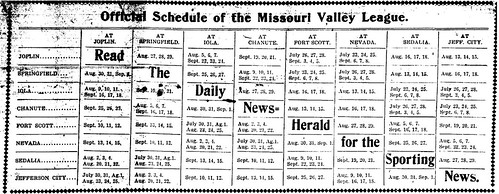
The Schedule of the 1902 Joplin Colts / Miners

We previously discussed the emergence of Joplin’s first professional baseball team, the Colts who soon after became the Miners.  After some research, we uncovered what appears to be the schedule for the team that season in the Missouri Valley League.

1902 Joplin Miners' Missouri Valley League schedule

For a larger version click on the photograph

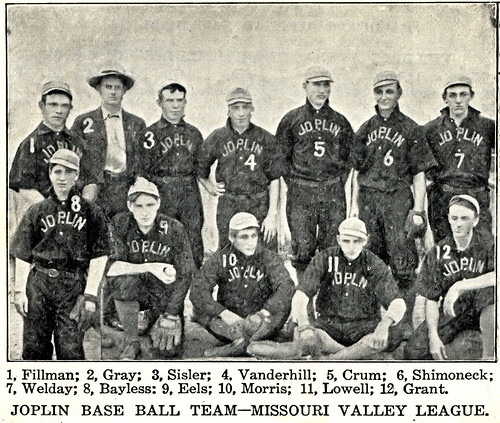
In the earlier post, we offered a team photo from that year.  To keep things fresh, we’ve added a photograph of the 1904 team.  A glance between the supplied rosters for the teams reveals some old faces and some new.

1904 Joplin Miners

1904 Joplin Miners

Sources: Joplin News Herald, Historic Joplin Collection

Hell Hath No Fury Again

Shrill screams pierced the air. Residents who lived in the vicinity of Sergeant and Fourth Streets emerged from their homes at two o’clock in the afternoon to investigate the horrific screams. Two women were struggling in the street. Upon closer inspection, it was clear that one woman had the upper hand as she “had seized the other by the hair was applying a whip vigorously over her head and shoulders. Hence the screams.”

Spectators intervened and the two women were separated. The woman who wielded the whip, Mrs. John Essry, turned herself in to Officer Robinson. She explained that her husband had been courting Miss Anna Rosser, a young woman who still lived at home with her parents on Sergeant Avenue. After she discovered that her husband had taken Miss Rosser on a Sunday buggy ride the preceding week, Mrs. Essry decided that revenge was the best course of action.

She drove to the Rosser home and pretended to be looking for a young woman to work for her selling samples. While in the street, Mrs. Essry drew her whip and began beating Miss Rosser.

But the beating was not enough. The following week, Mrs. Essry once again unleashed her fury against Miss Rosser. This time she returned to the Rosser home armed with rocks. She began to bombard the house with rocks, breaking windows. The Rossers escaped out the back door and ran to a neighbor’s home as Mrs. Essry continued to assault the Rosser home until she managed to break down the door. Finding no one inside, she went to the neighbor’s home, but was given an evasive answer.

Mrs. Essry was not finished. She returned to the Rosser home, picked up a hatchet, and smashed what she could. “Doors, windows, furniture, stove and household fixtures” were destroyed. Spectators watched her frenzied hatchet attack but did not intervene. Joplin police officers arrived and took Mrs. Essry into custody.

She quickly bonded out of jail “as public sympathy is strong in her behalf. Her neighbors speak highly of her in her struggle to maintain five small children almost wholly without aid from her profligate husband.” Her husband’s advances towards Miss Rosser had driven her “wild.”

The girl’s mother had attempted to keep the two apart, but the girl “is at that giddy, gosling period when a waxed mustache, soft talk, and a musk befogged handkerchief would turn her head more in a minute than maternal precept could right in a day.” It was said that Miss Rosser had left town.

Joplin’s First Speeding Ticket

Just after the turn of the century, Joplin attorney Fred Basom received the first speeding ticket issued in Joplin. He was “hailed by an officer of the law while out for a spin,” after the mayor’s recent instructions to the police department to arrest drivers who violated Joplin’s city ordinance that set the speed limit at six miles an hour. The news item did not explain how fast Mr. Basom was going when he was ticketed or what the fine was for breaking the speed limit, but it can be expected that attorney Basom was able to secure adequate representation for his police court appearance.

Source: Joplin News Herald

Reflections on Circus Life

In the not too distant past we published a post about Hardy Hardella and his dog Moxie.  Hardy and Moxie are among our favorite Joplin residents, so when we found an article about Hardy and his days with the circus, we knew it would end up as a post.  A more specific post on Hardy himself is in the works for later.

Hardy Hardella

A distinguished Hardy Hardella, courtesy of the private collection of Judy Hurdle.

Hardy Hardella moved to Joplin in 1905.  A few years later, one of Hardella’s old circus cronies arrived in town. The two had not seen each other in twenty-five years, but Hardy and William Underwood (his stage name was William Lucifer) took up where they left off the last time they had seen one another. Underwood, still working the vaudeville circuit, arrived in Joplin for a performance and decided to call upon his old friend.

The two men first met when they worked together in the Charles Hunter Circus which traveled through Nebraska, Kansas, and Missouri. Hunter, the former circus owner, still lived in the area, but instead of wrangling animals and acrobats, now proprietor of the Crescent Hotel in Pittsburg, Kansas. The two men said the circus consisted of one car, a camel, two ponies, six or seven mules, and two or three horses. Altogether there were twenty five men employed by the circus.

The circus car, an old condemned Pullman, had a secret compartment underneath it. When times were hard, half of the employees would hide in it when the conductor came around to collect train fares. One day, however, Hunter’s adopted son poked his head up out of the trap door when the conductor came through. Hunter’s circus “had hard luck on that road ever after.”

Underwood recalled the time he came to Joplin with the De Haven Circus and a fight broke out between circus employees and local miners. Angry miners cut up and destroyed the circus tents and half of the outfit was “broken up.”

After things seemed to have cooled down, another fight broke out after miners and circus workers got into a brawl at one of Joplin’s saloons. Underwood remembered “billiard cues and bottles were freely used” in the fight. Circus workers were arrested and thrown in Joplin’s city jail for a few days before they were released. Underwood remarked, “I have never forgotten that incident in Joplin. I have been all over the world since then and in every civilized nation, but I nearly always sign my residence as Joplin, MO., because of that fight and subsequent stay in jail.”

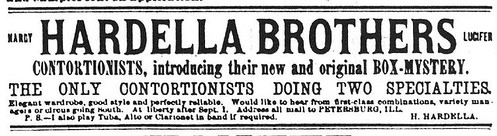
That same week, Hardy Hardella and William Underwood met old friend William McCall, who performed with Hardella as the “Hardella Brothers,” to discuss old times. The men recalled when Hardy was known as, “Hardella, the wonderful contortionist.”

Hardella Brothers ad

An advertisement for the Hardella Brothers, courtesy of Judy Hurdle.

Underwood remembered how the “old time circuses sure used to clean out a town. There was always a bunch of ‘fakirs’ that went along with the show and paid big concessions. The games they used to devise were many and varied. Yankee ingenuity being a mild term to apply to it. What money wasn’t taken in at the gates or by the shell games was usually cleaned up the ‘gooseberry crowd’ that followed the circus and while the people were watching the performance, raided the houses. Sometimes the ‘gooseberry’ bunch was in cahoots with the show and sometimes they were not, but they usually made a cleaning. Some small towns were literally wiped clean by the circus bunch.”

Locals, however, often lashed out after discovering their town had been “wiped clean.” Underwood recalled, “When they got a chance to get their breath and compare notes, they usually came down on the circus with blood in their eyes. The ‘fakirs’ had moved on to greener pastures by this time and were ready to work the next town. The circus hands had to bear the brunt of the storm. One experienced stake driver with the heavy, banded circus stake, could usually clean twelve or fifteen ‘rubes’ but just the same there was much bloodshed and cracked heads.”

He also somberly told the story of a young Kansan who had just sold a load of corn for a large sum of money, possibly as much as $200, and decided to bet it all on a shell game. He lost. The shell game operator, scared the crowd was going to attack him, fled. The young farmer chased him into a tent where the man cracked the rube over the head with a club. Underwood claimed, “It was one of the most cruel sights I have ever witnessed, but those were hard days in the circus business.”

Circuses are few and far between these days, but undoubtedly the big top once thrilled crowds all across the country, and Joplin was no exception.

Sources: Joplin Globe, Joplin News Herald, Livingston’s History of Jasper County, Bale Milling Odyssey by Judy Hurdle, Missouri Death Certificate Database 1910-1959, Judy Hurdle private collection

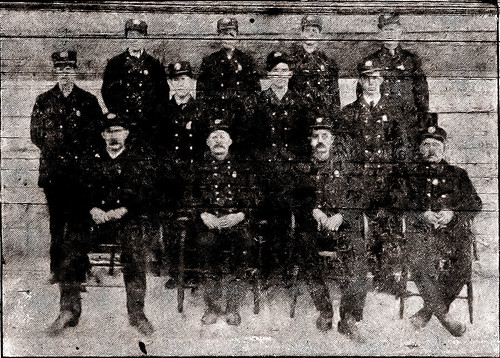
Joplin Police Department 1907 (Correction: 1902)

Another in our “We Wish We Had the Originals” series of photographs, this time with the 1907 Joplin Police Department.  If you missed yesterday’s post, here’s the link to the 1907 Joplin Fire Department.

Joplin Police Department 1907

Click on the image for a larger version.

From left to right – Top Line:  N.H. Milligan, John Ginsler, C.H. Cole, Henry Burns, Nathan Swift, Perry Snow, J.E. Gilmore.  Middle Line:  Grant Davis, C.E. Chapman, Fred Sellars, Charles Moore, Joseph Reubart, J.H. Holmes, J.H. McCoy, J.H. Johnson.  Bottom Line:  Night Captain Thomas Lawson, Day Captain T.F. Ogburn, Marshal Joseph H. Myers, Police Matron Ellen Ayers, Deputy Marshall J.J. Cofer, Joseph Giles, James A. Rose

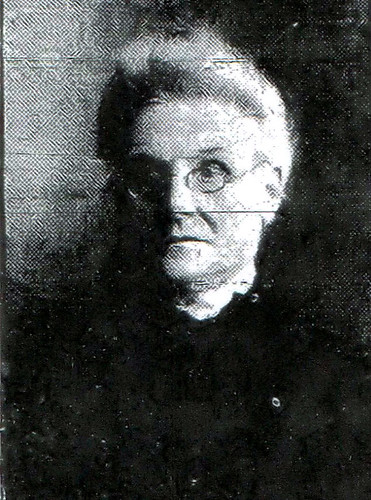
Of note:  See here for more information on the police matron, Ellen Ayers,  (who’s seated in the front row).

Joplin's first police matron, Ellen Ayers

Pictured here, Ellen Ayers took on the role of police matron at the age of 64.

Joplin Fire Department 1907 (Correction: 1902)

Following yesterday’s post about the Southwest Firemen’s Association Tournament in Joplin, here’s a somewhat clear photograph of the men who fought the fires of Joplin in 1907 (1902).  This would be the last year before the transition from fire horse to fire automobile.

Joplin Fire Department 1907

Joplin Fire Department 1907

The Top Line from Left to Right:  George Hays, Hiram Franks, Bert Davis, Albert J. Foster.  Middle line from Left to Right: John Hinds, Henry Staab, T.E. Fowler, A.L. Moore.  Bottom line from Left to Right: R.S. Pierson, Fire Chief Frank Zellers, and William Griffith.

An Accident Spurs the Creation of Joplin’s First Motorcycle Cop

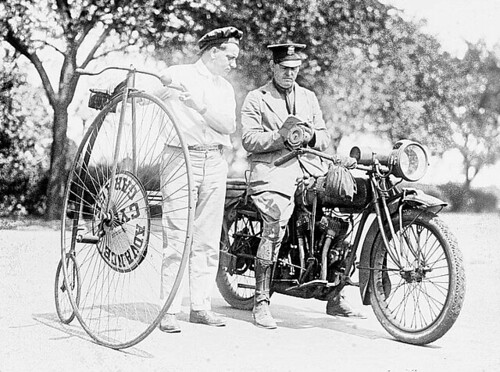
An example of a motorcycle patrolman from around 1922 via Library of Congress

At approximately 5:45 pm on a Monday in June, Roscoe Barbee, son of the wealthy and influential Gilbert Barbee, drove quickly north on Joplin Street in his Speedwell touring car.  His speed reportedly between 30 and 45 miles per hour, Barbee passed over 6th Street and headed for 5th under the late afternoon sun.  At the same time, a horse drawn buggy slowly made its way west along 5th Street.  Its occupants were four young women, Mary Delaney, 19 years of age and a stenographer at the Rudd Insurance company, was accompanied by her guest, Minnie Sanford from nearby Jasper, and the 20 year old twin Shigley sisters, Ruth and Blanche.  Ruth worked as a bookkeeper for the Thomas Fruit Company and her sister, a stenographer like Delaney, worked at the Walker Insurance Company.

The collision occurred as the four women turned their buggy into a right hand turn to proceed north up Joplin and as Barbee turned left to go east on 5th Street.  The touring car clipped the wheel of the buggy, which sent its occupants into the air, while Barbee skidded to a stop some distance down 5th Street.  The witnesses were many, one being deputy constable Fred Gault, who raced down 5th Street to arrest Barbee.  A city prosecutor, W.N. Andrews, volunteered himself as a witness.

The women were found lying on the street paved with bricks.  Blanche Shigley and Minnie Sanford, though stunned, suffered only bruises.  Ruth Shigley and Mary Delaney, however, were seriously injured.  Witnesses quickly reached the women and carried them in out of the summer heat and into nearby homes and buildings.  Mary, described as having sustained a skull fracture and “her face disfigured,” was carried into the home of J.M. Ryall, at 420 Joplin Street, where Mrs. Ryall, who knew Delaney, failed to recognize due to the extent of her injuries.  Such were the severity, that Delaney’s identity was at first hard to establish.

Ruth Shigley, was also horribly mangled, having sustained injuries to her head and internally.  Unconscious, she was carried into the lobby of the Lyric Theater, where her less seriously injured sister Blanche had previously been taken.  From there, an ambulance from the J.M. Myall Undertaking Company transported her to St. John’s Hospital.  The News Herald reported, “her clothing was bespattered with blood and her features were not recognizable by those who crowded about her.”

Roscoe Barbee was unhurt and by 7pm, just under an hour and a half later, had been arraigned for one charge of feloniously maiming to Mary Delaney, and then an hour later, received a second charge for gross negligence and causing the injuries to the Shigley sisters.  A preliminary hearing was set for Saturday, and Barbee was quickly bonded out of jail for $7,500 courtesy Dan F. Dugan.

By Wednesday, doctors at St. John’s, believed that both women had a fair chance at recovery despite the fact that neither of them had regained consciousness.  Further details were offered toward the women’s injuries, with doctors unable to discern if Mary Delaney had suffered any skull fractures, but had sustained a crushed cheek bone.  Ruth Shigley, had suffered several fractures of the skull and doctors were forced to act to relieve the pressure that built behind the injuries.  That morning, Ruth had emerged from unconsciousness only briefly, before she had slipped back out.  Of the other two women, Ruth’s sister, Blanche, and Minnie Sanford, they were described as suffering from a nervous shock, but were otherwise unharmed. Barbee, meanwhile, refused to offer comment about the accident.

The talk not dedicated to the state of the girls on Wednesday was devoted to the pressing need for a motorcycle for the Joplin Police Department.  Motorcycles were not yet commonly found in police departments at the time, but a great amount of frustration revolved around the failure of motorist to abide by the city’s speed limits and the police department’s ability to capture and punish those violators.  The speed limit in Joplin at the time was eight miles per hour.  As previously noted, witnesses believed that Barbee had been traveling at a rate between 30 to 45 miles per hour.

Assistant Police Chief Ed Portley was eager to comment on the need of a motorcycle for the department, “The police need a motorcycle.”  Portley continued, “We are doing our utmost to arrest all person who are guilty of violating the speed law, but when there is no evidence obtained except that furnished by pedestrians or others who have no means of rapid riding, it is hard to convict the guilty.”  Portley pointed out that with a motorcycle, “whenever a machine was seen speeding the patrolman could follow, gain all the evidence necessary and a conviction would follow, in all probability.”  The assistant police chief went on to note that the presence of the motorcycle patrolman would likely greatly decrease the number of speeding vehicles and if the city council would not pay for a motorcycle, the department would find a way to procure one.

Future Mayor Taylor Snapp also weighed in on the issue through his position as president of the Joplin Automobile club.  Snapp quickly noted that speeders would not be defended by the club, more so, that the club would do everything it could to assist the police.  Snapp offered, “If necessary the club will furnish a special automobile for the purpose.”  Though, Snapp agreed, “I think the city should employ a motorcycle policeman to look after unruly auto drivers.”  The president of the auto club also raised the issue of speed limits and pointed out that the state’s speed law conflicted with the Joplin speed law in residential areas, with Joplin’s law being a lower speed.  Furthermore, most automobiles had a hard time keeping to such low speeds in their high gear and that existing conditions should dictate the speed that a car might go, regardless of the neighborhood.  He added, “a great speed should not be attained within the city limits, no matter how clear the streets may be…”

While the debate continued, the condition of Ruth Shigley finally began to improve, while Mary Delaney not nearly as much.  While Roscoe Barbee’s lawyer argued that none of the charges were applicable to his client with the exception of possibly a misdemeanor charge of fast driving, Mary Delaney continued to slip in and out of consciousness.

At this point, the newspaper coverage of the affairs of Roscoe Barbee and the condition of Ruth Shigley and Mary Delaney falls from the front page coverage it had enjoyed.  The conclusion to their stories remain to be discovered and reported.  One result can be reported.  In the first week of June, 1911, Mayor Osborne offered a commission to Joplin’s first motorcycle patrolman, J.C. Haus.  While the make and model of the patrolman’s motorcycle was not provided other than it being “the best and fastest” available, it was boasted that the machine could reach 60 miles per hour and possibly faster.  Two more machines were to be ordered for the constabulary force.

The procedure for enforcing the speed limit was simply for the patrolman to catch up to the speeding vehicle, note his speed, as it would be the same as the violator’s, and write down the motor vehicle’s number, and then report the matter to “proper officers.” A register existed which cross-referenced the vehicle number and the owner, and by checking against this register, the owner could be summoned to court to pay for his or her speeding crime.  As a tangent matter, efforts were to be made to insure that all cars displayed their numbers properly and had lights.

Thus, from an accident at the intersection of 5th and Joplin Streets, Joplin came to acquire its first motorcycle for the police force.  The force still retains motorcycles today, as late as 2007, when the department received two Harley Davidson motorcycles as a gift from a local Harley Davidson dealer.  From 1911 to today, the Joplin Police Department has been employing motorcycle patrolmen for nearly a century.

Sources: Joplin News Herald