The Missing History of Fourth and Main Street

The four buildings of Fourth and Main Street

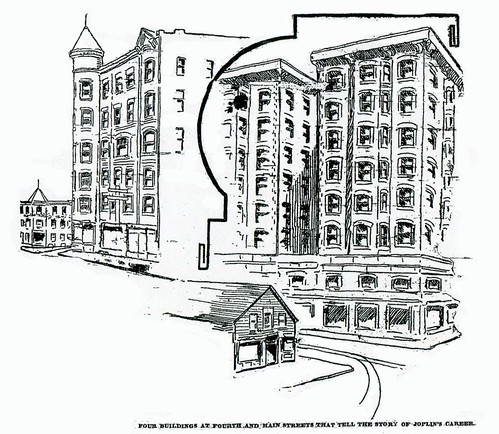
More than a century ago, a visitor to the bustling growing city of Joplin could have stood on any of the four corners of the intersection of Fourth and Main and viewed the history of the former mining camp writ large in the buildings about him or her. The ability to taken in the “epochs” of Joplin’s history with a glance was not missed by Joplinites of the era, and one reporter of a city papers wrote,

“The noonday shadow of the old frame landmark of the early seventies almost brushes the base of the half million dollar edifice that represents the highest achievements in building construction of the twentieth century. The monument to the days of Joplin’s earliest settlement seems to crouch lower and more insignificant than ever, now that a colossal hotel has been erected within less than a stone’s throw of it.”

The “old frame landmark” was the Club Saloon owned by John Ferguson until his death on the Lusitania (learn more about that here) and the “half million dollar edifice” was none other than the Connor Hotel, completed in 1908 and considered by many the finest hotel of the Southwest. Unmentioned above were the Worth Block and the Keystone Hotel. A visit to the intersection today, however, would find none of these buildings remaining.

A step back in time, when these four buildings still stood, would let the visitor see Joplin’s history as built by man. For reference by today’s geography, imagine that you are standing on the northwest corner of Fourth and Main Street with the Joplin Public Library at your back. Behind you in the past would be the towering eight story Connor, across the street to your right was the two story, wood-framed Club Saloon, where the current Liberty Building stands, to your left was the three story Worth Block, now home to Spiva Park, and directly diagonal from you would be the six story red-bricked Keystone Hotel, gone for the one story brick building today. The same reporter from above offered descriptions of how each of these four buildings revealed the chapters of Joplin’s past. The history that the Club Saloon represented was one of a camp fighting to become a city.

“When the frame structure at the southwest corner was the leading structure of the city, the site of the present Connor Hotel was a frog pond and the deep booming of the inhabitants of the swampy places echoed over the sweeping stretch of open prairie land.”
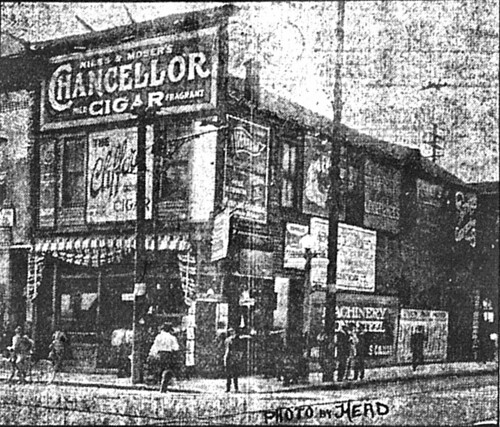
The Club Saloon shortly before it was razed.

At the same time, the land where the Keystone Hotel eventually grew, was a mining operation owned by Louis Peters. The reporter is quick to allay fears of sink holes and noted that the drifts and shaft of the mining were filled before the property was sold. The Club Saloon’s home was bought from its owners in Baxter Springs, Kansas, by Oliver Moffett (E.R. Moffett’s son), Galen Spencer, and L.P. Cunningham, among others, and brought to the young mining camp to become the town’s early center. It was first used as a grocery store and flanked on either side of it were “shacks of disreputable apperance.” In the frame building, reportedly, one of Joplin’s early grocers and councilmen, E.J. Guthrie was killed. It was not the only frame building to be brought to Joplin, but those failed to survive for long. The Club Saloon was immuned perhaps because of the temperament of its owner, the ill-fated John Ferguson. Often, he turned down offers to buy it and once Ferguson allegedly declared, “If you would cover the entire lot with twenty dollar gold pieces, it would not be enough. I think I shall keep it.”

Across the street, so to speak, the old frog pond was shortly developed into a three story brick building, the original Joplin Hotel. Described as a “palace” amongst the other contemporary buildings of Joplin, it was given credit for shifting the center of the new city from East Joplin to the area formerly known as Murphysburg. The presence of the brick building spurred the construction of others, particularly on the east side of Main Street. Among those building was Louis Peters, who continued his mining, but also built a two-story building at a cost of approximately $4,600 on the northeast corner. The new building replaced one that had burned to the ground and was built in less than two months, completed in the December of 1877. Later, a third story was added to what was then called the Peters Building, but became better known as the Worth Block when James “Jimmy” Worth became the owner (precipitated by Worth marrying a co-owner of the property).
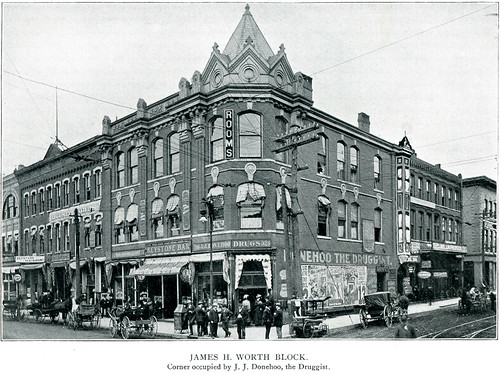
Worth Block - Joplin, Missouri

The Worth Block circa 1902

As slowly a recognizable Fourth and Main Street began to emerge, Joplin was still a young city that had more in common with a mining camp than a growing metropolis. Saloons proliferated, gambling was common, and other vices not spoken of in good company. This period of Joplin’s past was described as so:

A crimson light hung high over Joplin, shedding its rays over a great portion of the town, would have been an appropriate emblem of the nature of the community. Pastimes were entered into with a wantoness that brought to the town a class of citizenship not welcome in the higher circles of society. But if, in those days there was a higher circle, its membership was limited. Society existed but it was in true mining town style. There was in evidence the dance hall, the wine room and the poker table. The merry laugh of carefree women mingled with the clatter of the ivory chips on the tables “upstairs” and the incessant music of the festival places sounded late into the night, every night of the week, and every week of the year. No city ordinance prevented citizens from expectorating tobacco saliva upon the sidewalks; in fact, the sidewalks were almost as limited as was the membership of the exclusive upper circles.

In 1875, a flood swept through Joplin, and washed away homes, flooded mines, and even killed some Joplinites. The damage, in 1875 dollars, was almost $200,000. For all that was lost, the city continued to gain in wealth, growth and citizens. Ordinances and laws were put in place and a more determined citizenship to see their enforcement. The lawlessness that had persisted in the open air withdrew, the “secrets of the underworld of the Joplin…” were not “broadcast as they were…” The surge of mineral wealth saw more bricked buildings rise and the new owner of the southeast corner of Fourth and Main, E.Z. Wallower, saw more to gain in building than in mining. In 1892, construction of the turreted Keystone Hotel began. Not long after, the intersection was just short of the Connor Hotel in its appearance. This was remedied, as noted above, in 1908, just sixteen years later. In that span of time, “many fine edifices were erected.”
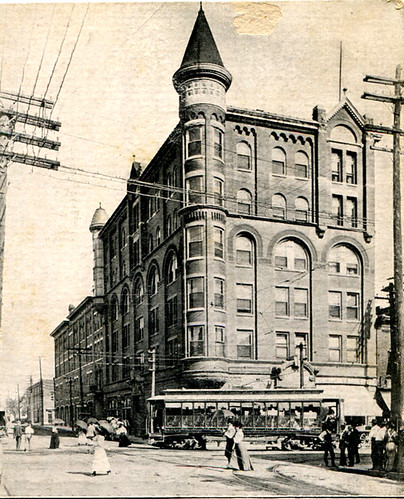
Until the demolition of the Club Saloon, at a glance, one could have seen the history of the city. From the very first days when a wood frame building was a sign of progress, up from shanties and tents; and then the brick constructions of the Peters Building that became the Worth Block, as the first inclinations of wealth from mining began to show progress; and finally, the raising of the Keystone and the Connor, when millionaires brushed elbows as they walked the sidewalks from the House of Lords, and Joplin was in the thick of its first renaissance. A visit to the intersection today leaves nothing of this history to be learned at a glance. The Liberty Building, which now stands where the Club Saloon once stood, is a bridge back however, witness to all of the former inhabitants of Fourth and Main Street but the Club that it eventually replaced. As are all the historic buildings of downtown Joplin, so while some of old Joplin is gone, much thankfully, can still be enjoyed and that history known with a glance.
The Saloon at 402 Main Street

In our last post, we brought you the unfortunate fate of the owner of 402 Main Street, John Ferguson. Today we bring you the unfortunate fate of Ferguson’s Club Saloon located at 402 Main Street.

The Club Saloon shortly before it was razed.

In the years that followed Ferguson’s death, the heirs to his estate, had promised to tear down the old saloon. It was an old saloon indeed, likely one of the oldest commercial buildings that remained in Joplin by 1916. Though considered by locals as the “Joplin Eyesore,” its history went back to the very founding years of the city when it was brought wholesale from nearby Baxter, Kansas, to the fledgling mining town. For over forty years, the saloon was the home to a bar on the first floor and a gambling hall on the second. As one old timer commented, “There’s where I used to play poker, myself, until I learned I didn’t know anything about the game.” The Club Saloon, a relic of the city’s wilder days, was finally razed in January, 1916, at the order of the city. It was, after all, worth thousands of dollars per square foot. The lot thereafter remained empty, but was used as a place to sell Liberty bonds during the First World War. It was this usage that gave the property the nickname, “The Liberty Lot.” Later, the building which was built and still stands today retained the liberty moniker, “The Liberty Building.”

Video Page Added!

Many months back, we created video slideshows from old photography books of Joplin and posted them on Youtube. Now they are accessible on our site without hunting them down elsewhere. Just click on the “Video” tab at the top of the site on the right. Enjoy!

Downtown Joplin

A reader sent us this interesting photograph of downtown Joplin. If you have an interesting photograph of Joplin, please feel free to scan it in and send it our way. We’d love to share it.

Guest Piece: Leslie Simpson – Joplin’s Frank Lloyd Wright Usonian House

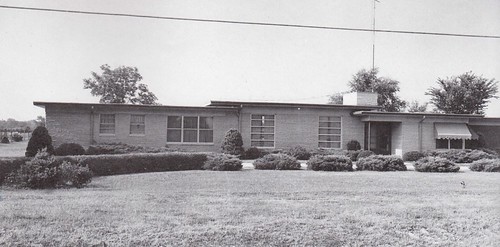
In the mid-20th century, Frank Lloyd Wright invented the concept of “Usonian” houses, which were based on the utopian ideals of simplicity, economy, and convenience. The first step in constructing a Usonian house was to lay down a concrete platform with cast-in heating pipes. Next came a grouping of brick supporting screens, creating a chain of linked boxes. The brick supports were topped by a series of flat concrete roofs, with a higher roof over the living-dining area and lower ones over the bedrooms and bath. The difference in roof heights allowed extra light to come in through clerestory window strips. Light also streamed in through floor to ceiling windows, usually overlooking a garden or pool.

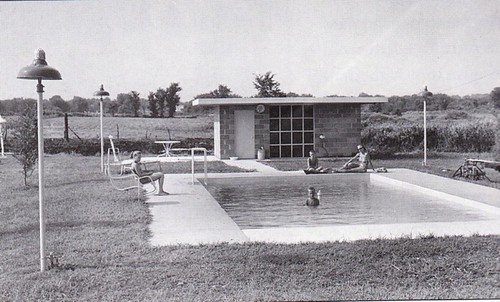
One of these Usonian designs was built on the outskirts of Joplin, ¼ mile west of Stone’s Corner on Highway 171. Joplin architect Robert Braeckel adapted Wright’s plans to construct this ultra-modern dwelling for Stewart and Naomi Ruth Stanley in 1950. All steel construction supported Carthage limestone walls and large expanses of glass. Copper tubing built into the floor provided radiant heat. The ultimate in modern living, the house also featured a pool and bathhouse.

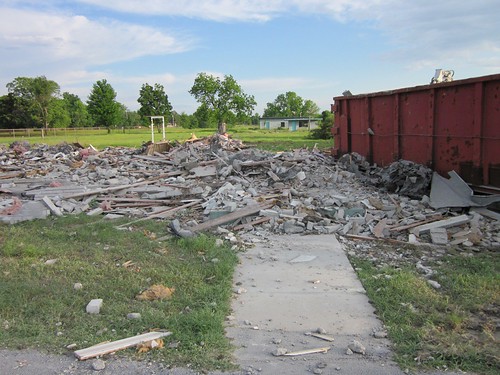
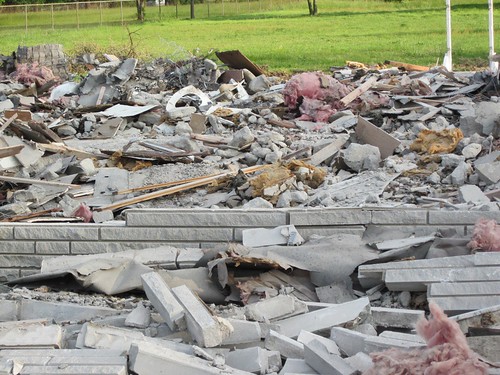
Unfortunately, I had to use past tense in my description; the house was demolished May 3, 2012. It is ironic as well since May is National Historic Preservation Month. This month’s Preservation Magazine devotes the entire issue to Frank Lloyd Wright architecture and the efforts to preserve it.


This piece was adapted from Leslie Simpson’s “Little House on the Prairie” that was published in Joplin Souvenir Album, G. Bradley Publishing, 2001. Photographs courtesy of Leslie Simpson and the Post Memorial Art Reference Library.

Leslie Simpson, an expert on Joplin history and architecture, is the director of the Post Memorial Art Reference Library, located within the Joplin Public Library. She is the author of From Lincoln Logs to Lego Blocks: How Joplin Was Built, Now and Then and Again: Joplin Historic Architecture. and Joplin: A Postcard History.

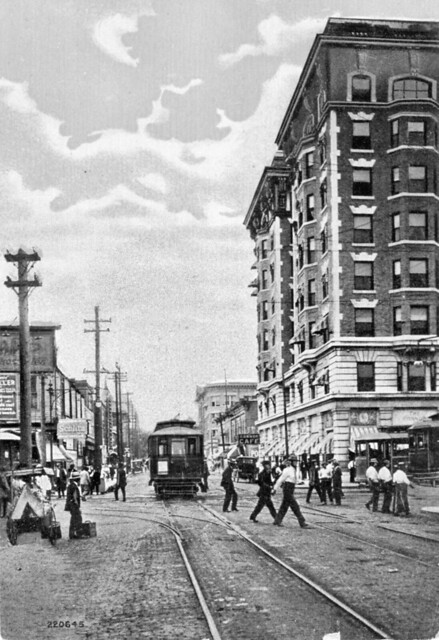
A Photograph’s Story: Fourth and Main Street Joplin Turn of the Century

Here is a fascinating glimpse of a moment in time in Joplin’s history. Time to explore the story of the photograph of looking West on Fourth Street from Main Street:

First, let’s positioned ourselves and stand in the same place as the photographer. In front of us is the intersection of Main Street and Fourth Street. We are looking West in this photograph which tells us that out of sight, but immediately to our left is the Keystone Hotel. On the right, you can see the edge of the curb of the Worth Block, which means the House of Lords is just a quick jaunt around the corner.

Second, the Connor Hotel is across the street from us. The Connor Hotel was completed in 1908, so we now have an estimated time as to when we are standing at the intersection of Fourth and Main. If you look closely, you will recognize some of the stonework that is now outside the Joplin Public Library. When you look down the street from the Connor, you will notice a row of small buildings. These buildings were eventually demolished to make way for the Connor Annex, which was built in the 1920′s. Again, we have now created a time span for when we are looking: 1908 to 1920′s.

Third, beyond the small buildings, you will notice a tall building. Gone now, but only a few years old at the time of this photograph, the Miners Bank Building was home not only to the aforementioned bank, but also to one of Joplin’s premier architects, August Michaelis. If you squint, on the opposite side of the street framed by telephone and power lines, is a steeple. That steeple belongs to another of Joplin’s lost buildings, the Club Theater. It was home to the Joplin Commercial Club, which survives today in the form of the Joplin Area Chamber of Commerce.

Fourth, immediately across from the Connor is a two storm frame building. Until it was destroyed to make way for the Liberty Building (and current resident of the southwest corner of Fourth and Main), this was the oldest remaining building in Joplin at the time having been built in the 1870s.

Fifth, also of note, are of course the the trolleys and if you look close at the street, you can see a textured surface. Reportedly, these were macadam streets, which Joplin boasted of having many and might still exist in some form under her currently paved streets.

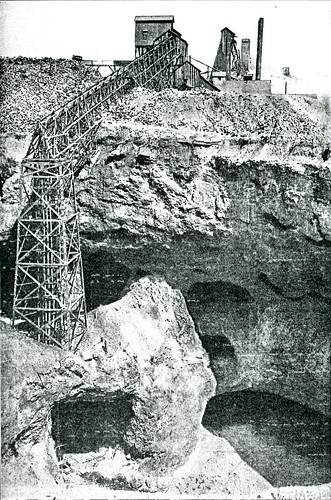
A Daylight Mine

While the majority of Joplin’s lead and zinc mines were below ground, and in fact, much of Joplin is built above those shafts, there were some that were open to daylight. Below is a photograph of one of the best examples, the aptly named Daylight Mine.

History in the News: Historic Home in Joplin In Danger

A historic Joplin home in danger of demolition.

This last weekend, the Joplin Globe published a story on the two story house on Schifferdecker Ave. The handsome house with a stone facade belongs to the late J.T. Goodman and his wife, Yvonne. The historic home, which likely dates to the early years of Joplin, was damaged by the May 2011 tornado. As seen in the above photograph, the home presently has no roof which is accelerating its danger of being declared condemned by the city. Joplin history expert and director of the Post Memorial Art Reference Library, Leslie Simpson, is presently trying to research the history of the home in an effort to help its preservation. So far, Simpson has discovered that it was on the property of Thomas Cunningham, one of Joplin’s wealthiest citizens at the turn of the century. Likewise, a mortgage deed indicates it might have even been built in 1873.

The historic home is currently before Joplin’s Building Board of Appeals. Unfortunately, due to the death of J.T. Goodman and a refusal by the Goodmans’ insurance company, the family has no funds to make the repairs needed to save the home. At the moment, Simpson is seeking to learn more of the home’s history which might translate to convincing the city Board of Appeals to spare the house more time to be repaired.

If you know anything about the house pictured above, located at 2725 S. Schifferdecker Avenue, please contact Leslie Simpson at the Post Memorial Library: (417) 782-7678. This is a piece of Joplin’s history, it needs to be saved!

A Fireman from Joplin’s Past

Today’s post is a glimpse at one of Joplin’s earliest firemen. As previously covered on Historic Joplin, the Joplin Fire Department came into existence in the mid-1870s. Below is an unidentified fireman of the era who helped protect the young city of Joplin from the dangerous threat of fire.

The Number of Joplin’s Historic Buildings Decreased By One: Rains Building Lost to Fire.

The Rains Building circa 1902.

The next time you cruise down Joplin’s Main Street, you may notice that yet another of the city’s historic buildings has been lost. The Rains Building, located at 906-908 South Main Street, burned on Thursday night. The building, attributed to one of Joplin’s most prominent and prolific architects, August C. Michaelis, is a tragic loss.

Built in the Renaissance Revival style at the turn-of-the century for brothers Charles and George Rains, it brought an understated architectural elegance to the block.

Like many buildings along Joplin’s Main Street, it was home to several different businesses including the Miner’s Hardware Company, the Bullard-Bell Company, and the Roosevelt Hotel. By the 1970s, only the first floor was in use as an antiques shop. When the building was nominated for the National Register of Historic Places in 1991, it was noted that little, if any, alterations had marred Rains Brothers Building original design over the years, unlike many other buildings.

Rains Brothers Building Image via Wikipedia.org, Rains Building circa summer 2010.

Here is a link to the Joplin Globe‘s coverage of the fire and here is a link to the National Register of Historic Places, a source for more detailed information on the building.