Death in the Mines

Lead and zinc mining was the heart and soul of early Joplin. Men toiled in the mines to earn their living or, in many cases, meet their end. There were a variety of ways that death came to those who worked in the mines, often sudden and very violent.

On June 13, 1901, the Carterville Record reported that T. Hibler, a mining engineer working in nearby Galena, fell into a mine shaft over one hundred feet deep while walking to work at 5:30 a.m.  Perhaps it was simply luck, or maybe the manner in which the unfortunate engineer tumbled downward into the darkness, but Hibler survived the fall. Not only did Lady Luck spare his life, but shortly after, a passerby came to his rescue.  Amazingly, Hibler suffered only a few cuts, bruises, and a sprained ankle. He was one of the fortunate as others were not so lucky.
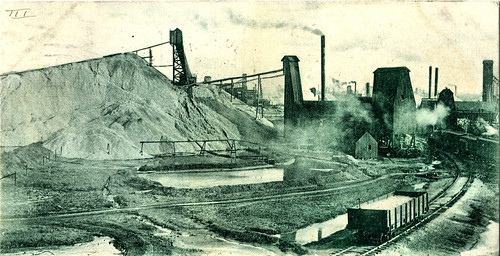
A typical mine in Southwest Missouri

A mine with chat pile looming beside it.

In James Norris’ “AZn: A History of the American Zinc Company” he noted that “In 1897 soaring prices and continued active demand produced large profits for miners in the Joplin zinc-ore district, and the following year was one of the most prosperous in the history of zinc mining.” This boom in lead and zinc mining attracted the attention of wealthy Eastern investors. In 1899, a group of Boston capitalists formed a corporation they called American Zinc, Lead, and Smelting Company. American Zinc, as it was commonly known, became one of the major players in the Tri-State Mining District.

In 1902, Harry S. Kimball was sent to Joplin to evaluate the company’s prospects in Joplin. He later recalled that Joplin was a, “bleak prospect for a tenderfoot to see as his first contact with a mining camp.” Hugh chat and slag piles littered the landscape. Miners were using “relatively simple and inefficient” mining methods.  Thus men who were on the cusp of a century that heralded rapid technological and industrial innovations were operating as if they were still in the Dark Ages.
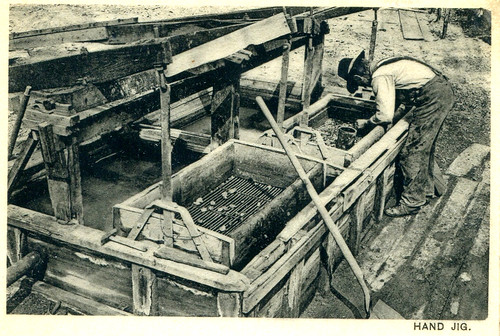
A primitive hand jig

An example of the primitive technology at play in the mining fields. Here a hand-powered jig.

Historian Arrell M. Gibson describes the various mining techniques used in the Joplin area in his book, “Wilderness Bonanza.” Shafting, which required miners to create a vertical access shaft into the earth, was dangerous work. Miners drilled openings into the rock face and then inserted sticks of dynamite into the holes in order to break up solid rock. Dynamite, if handled incorrectly, was deadly. Miners sometimes had to tamp sticks into place.  This involved tapping the explosive material into a firmer or deeper position. If they neglected to use a wooden stick to tamp in the dynamite, often using a metal bar instead, it could create sparks and cause a premature explosion with devastating effect.

Adding to the danger, miners also used giant powder, which was more powerful than regular black powder, to break up solid rock surfaces. Gibson states that many miners complained that giant powder caused headaches and nausea. But if a miner was fortunate enough not to die in a mine collapse, premature explosion, or suffocate, there was a good chance he would die early from silicosis. Silicosis is a condition caused by breathing in crystalline silica dust.  After a controlled explosion, miners often failed to wet down the rock and as a result, inhaled minute particles of rock dust, which damaged their lungs like invisible razorblades piercing through their lung tissue. Miners who suffered from silicosis experienced shortness of breath, coughing, fever, and even a changing of the color of their skin. Of the many miners who eventually succumbed to the manufactured disease, one was Oscar C. Rosebrough. The thirty-six-year-old miner died of “miner’s consumption” in the summer of 1917.
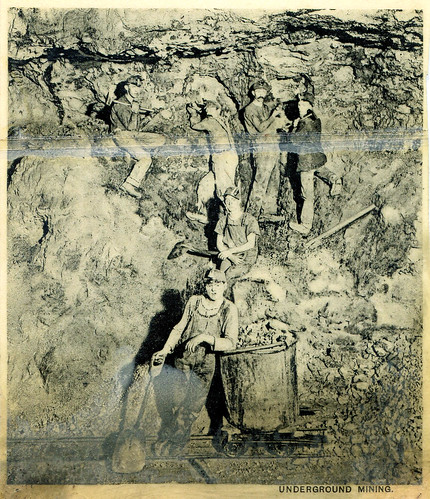
A photograph of likely zinc or lead miners

Miners posing for a photograph within the dangerous confines of the mine.

Other deaths came suddenly and mercifully for some.  The Carl Junction Standard reported on September 12, 1903, Walter McMahan was telling jokes and laughing with his coworkers at the Edith Mine near Joplin when a large boulder fell from the mine roof and crushed him. Meanwhile, The Carthage Evening Press recounted the death of Riley Marley, who was killed when he and his partner set off two shots of blast in a mine shaft. When one of the shots failed to go off, the two men reentered the mine to re-tamp the shot. As Marley tamped the shot back into place it exploded and drove the tamping rod through his head.  He died instantly. His partner was blinded by the blast but survived.

Much of the danger came from simply entering the mines or processing areas.  In 1905, Nathan Rice was struck on the top of his head by a falling timber. He later died of his injuries. In 1916, John Campbell was killed when he got caught in a drill rig. In 1882, Johnie Craig died when he went into a mine contaminated by bad air. In 1920, Kenneth Everett, a five year old child, died from bad air in an abandoned mine shaft.
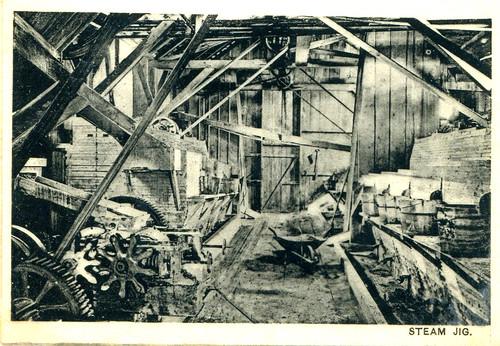
Photograph of Joplin steam jig for zinc and lead mining

Far more complex than the hand jig, it's not hard to understand the danger of working around this steam powered jig.

Close calls were common and sometimes bizarre.  In 1902, William Morgan was injured while working in the Big Six Mine when an icicle fell from the top of a mine shaft and hit him in the back. The icicle was heavy enough that it fractured his shoulder blade, but the physician who tended Morgan expected his patient to recover.

The zinc and lead of Joplin brought great wealth to some, work to many, and danger to all who entered the mines to retrieve it.

Sources: “Mine Accidents and Deaths In the Southwestern Area of Jasper County, Missouri, 1868-1906,” Volume I. Compiled by Webb City Area Genealogical Society.  “Mine Accidents and Deaths In the Southwestern Area of Jasper County, Missouri, 1907-1923,” Volume II, “Accidents, Deaths, and Other Events.” Compiled by Webb City Area Genealogical Society. “Wilderness Bonanza” by Arrell M. Gibson
The Chinese Immigrants of Joplin

Walter Williams, founder of the University of Missouri’s Journalism School, once wrote “Joplin is a city of self-made men, nearly every one of the moneyed citizens having made his fortune there. They are largely American born and American educated.” As Williams observed, Joplin was primarily populated by American citizens, but there were many immigrants who called Joplin home.  Few, however, were Chinese.

Chinese immigrants arrived on America’s shores beginning in the late 1840s during the California Gold Rush. Two decades later, even larger numbers of Chinese laborers were recruited to work on the Transcontinental Railroad. The influx of cheap labor and threat of economic competition sparked racial animosity. Violent anti-Chinese riots broke out in several American cities, including Denver, Seattle, and Rock Springs, Wyoming.  In 1882, in response to growing outrage over Chinese competition, President Chester A. Arthur signed the Chinese Exclusion Act. The act suspended Chinese immigration to America for a period of ten years. Only those Chinese immigrants who arrived prior to the act’s passage were permitted to stay.

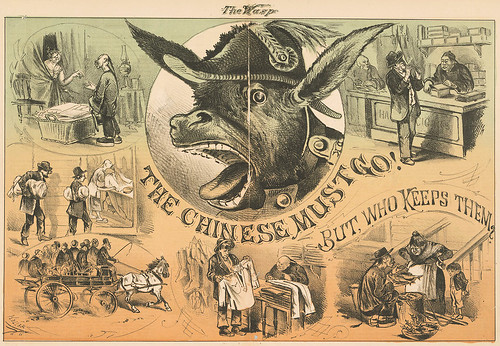
An anti-Chinese immigration illustration from the virulent Wasp magazine of San Francisco

An illustration from "The Wasp" a magazine of San Francisco often noted for its virulent depictions of Chinese Immigrants. Available from the Library of Congress

At the turn of the century, both St. Louis and Kansas City were home to sizable Chinese communities but the Chinese presence in Joplin was less substantial.  Historians can be stymied by gaps in the historical record. The earliest Joplin city directory to have survived the ravages of time dates to 1899, leaving a gap in the city’s history that ranges decades. Meanwhile, county histories often overlooked and ignored the presence and contributions of minorities. Although the state of Missouri attempted to collect birth and death records beginning in 1883, the effort failed until 1910, when the Missouri General Assembly passed a law making it mandatory for counties to record birth and death information.  Few archival collections can boast of letters, diaries, and manuscripts from early Joplin, much less one kept by Chinese resident. Thus, it is often difficult to piece together the history of an immigrant group at the local level, especially if it was a particularly small immigrant group.

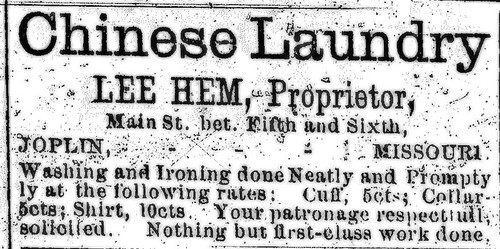
According to the 1870 U.S. Federal Census, there were no Chinese immigrants living in Joplin. By 1880, however, at least one Chinese immigrant called Joplin home. Lum Wong, a single twenty-seven year old native of China, listed his occupation as “servant — clerk in store.” He could not read or write English. Wong lived with sixty-four year old Jacob Wise, a retired merchant. A few years later, in1883, an advertisement appeared in the Joplin Daily Herald for a “Chinese Laundry” run by Lee Hem.

Ad for Chinese Laundry

An advertisement for Hem's Chinese Laundry in Joplin

Although Lum Wong did not appear in the 1900 U.S. Federal Census, five other Chinese immigrants are listed as residents of Joplin. Most, if not all, worked in the laundry business. G. Goro, a thirty-six-year-old immigrant, lived on Main Street. According to the census, his neighbors described themselves gamblers, blacksmiths, day laborers, miners, and traveling salesmen. Sing See, Jung Jin, and Low Chung described themselves as “partners” in a laundry. See and Chung listed the year of their immigration as 1877 while Jin arrived in American in 1879. Thirty-four-year-old A. King, who roomed in a boarding house on Main Street, listed his occupation as “Chinese laundryman.” Unable to work in the mines, Chinese immigrants were forced to eke out their living in whatever industry was accessible, and often greatly restricted along racial lines.

Albert Cahn, a German-born clothing salesman who spoke at the opening of the Joplin Club in 1891 echoed the words of many American politicians when he declared, “This is the best apple country to be found and had Adam and Eve been placed here that Garden of Eden story would never have been told. We have vineyards here for the German, railroads for the sons of the Emerald Isle, commerce for the English, but no use for the Chinese.”

By 1910, only two Chinese immigrants lived in Joplin. One, Jung Low, gave his occupation as “Chinese laundry.” The other, John Jungyong, ran a restaurant.

Within ten years, the Chinese population in Joplin grew when Toy Jung, an immigrant to America since 1890, opened a Chinese restaurant. Toy, the proprietor, was assisted in his business by a partner, Ling Kwong, who had reached the states five years after Toy. Additionally, five cousins of Toy worked as cooks and waiters. Only two of Toy’s cousins were born in California; Toy, his partner, and his three other cousins were all born in Canton, China.  Another Chinese run business listed in 1920 was a laundry run by a Chinese-American named Charlie Hoplong.

The 1930 Census revealed the presence of another Chinese restaurant run by Shang Hai Lo, a sixty-year old restaurateur from Canton, China who had arrived from China the same year as Toy Jung.  It also noted the absence of Charlie Hoplong and his laundry business.  Four years later, Toy Jung, who had spent at least fourteen years in Joplin, passed away leaving only his wife Quong Jung to mourn his death.

Today there are a small number of Chinese residents in Joplin. If you want to sample some of the finest Chinese in the Midwest, stop by Empress Lion. This small, unassuming restaurant located in a strip mall at the corner of 32nd Street and Connecticut, offers some of the finest Chinese to be had.  (We hope you’re well, Tiger and Lily!)

Sources: United States Census, “History of Jasper County and Its People” by Joel Livingston, and the Joplin Daily Herald, “The State of Missouri” by Walter Williams, and the Library of Congress.

Before the Joplin Miners

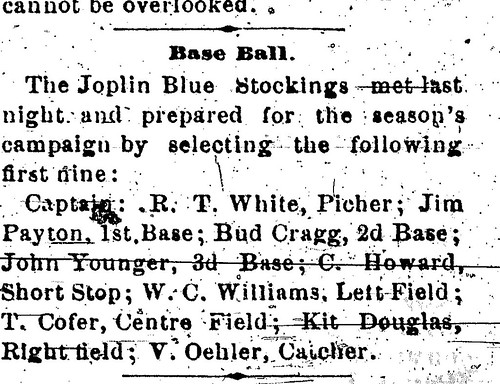
While Joplin no longer has a professional or semi-professional baseball team, perhaps its best known team was the Joplin Miners, where Mickey Mantle began his baseball career.  Perhaps the city’s least known team may have also been its first.  One of the first mentions of a team, and a brief one at that, appeared in 1880:

A reference to the Joplin Blue Stockings

The Joplin Blue Stockings, perhaps one of Joplin's earliest baseball teams.

Source: Joplin Daily Herald