The Joplin Shadies

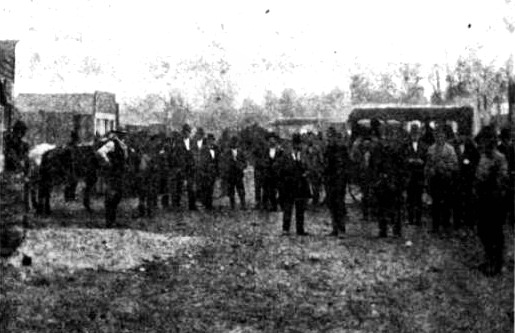
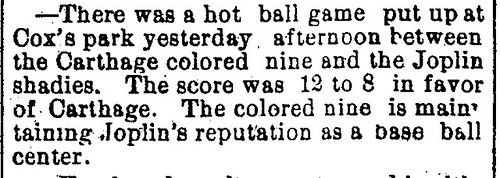
While Joplin did not have a professional baseball team until around 1901 / 1902 in the form of the Joplin Colts (who became the Miners), amateur teams were active and present before then.  Among them was this African American team called the Joplin Shadies.  Unfortunately for the Joplin team, on July 30, 1896, they lost to a Carthage team.

A brief score from an African American baseball team in 1896 Joplin, Missouri

A brief score from Joplin's African American baseball team in 1896.

Source: The Joplin Globe

More Trouble at the Silver Moon Saloon

In the rough and tough world of Joplin’s saloons, it seems excitement was never far away.

Henry Moon, the proprietor of the Silver Moon Saloon in August 1904, did not suffer fools.  Will Sowder was in a bad mood.  It ended, of course, with bloodshed.

Sowder, whose real name was Will Davis, was the stepson of Deputy Marshal Frank Sowder.  Perhaps Sowder felt this relationship gave him special privileges.  He had already faced arson charges earlier in the year, but was acquitted. Or maybe he just didn’t care after a night of heavy drinking with his friend Mike Ryan.  In any event, Sowder got into an argument with Moon.  Heated words were exchanged. Sowder lunged behind the bar and hit Moon.  Moon hit the floor and Sowder jumped on him.  He was in for a surprise, though, because Moon was able to draw his revolver.  With a squeeze of the trigger, Moon shot Sowder in the leg, then hit him over the head with the gun.  Sowder staggered and fell, leaving a pool of blood on the floor.

An ambulance picked Sowder up and took him to his home at the southeast corner of Fourteenth and Wall Streets.  There he received medical attention from Dr. Tyler who felt that Sowder would recover from his wounds without any problems.  Moon, however, was hauled off to the home of Justice Potter who turned Moon over to Constable Arch McDonald.  Moon bonded out after he ponied up $1500.  He refused to talk to a Joplin Globe reporter about the incident.

In the end, it was just another night in Joplin.

Source: The Joplin Globe

The Reminiscences of G.O. Boucher: Part III

Boucher opens Joplin’s first saloon

“The price of town lots in Joplin in those days would hardly compare with the prices of today.  On the northwest corner of Main and Second streets were two vacant lots an through advice of Pat Murphy I bought them for $25.  I built a small building and September 1, 1871, J.C.  McCurdy and myself opened up the first regular saloon in Joplin.  At this time this was the tenth building finished in West Joplin.  It was later moved to the alley where it now fronts the police station.  It was used for some time as the Herald office.  As well as I remember, the saloon had been running about three weeks, business was good, and the miners crowded the place from opening until closing time.  One day a miner wandered in and asked: ‘When do you scrub out here?’ Now I had never given the scrubbing proposition a thought and I said, ‘Well, I expect it does need scrubbing, but where is a fellow to get the water?’ ‘Well,’ said the miner, ‘I will go hitch up old Nell and haul a barrel of water from down on the corner.’  We went to work and this is the way the first saloon in Joplin received its first scrubbing.

1872 Street Scene of Joplin, Missouri

A street scene from Joplin in 1872.

Sources: Joplin Globe, Joel T. Livingston’s “A History of Jasper County, Missouri, and her people.”

Happy Birthday, Joplin!

On March 23, 1873, the Missouri legislature passed a bill presented by T.M. Dorsey and Judge John H. Taylor.  On that day, the City of Joplin was born.  On that day in March, Joplin counted around four thousand citizens, no paved streets or roads, and only seventeen lead furnaces.  All but a few of Joplin’s buildings were built of wood and many homes were simply tents and small box-houses.  By appointment of the governor, E.R. Moffett was made the first mayor of Joplin.  Joel T. Livingston, in his massive History of Jasper County, republished an article from the St. Louis Globe-Democrat which described the people of Joplin as full of “pluck and industry” and who overcame severe disadvantages through sheer, “abundant nerve.”

Today, Joplin turns 137 years old.  Happy Birthday, Joplin!

A Hold Up at the Silver Moon Saloon

Joplin had the atmosphere of the roughest mining towns in the American West. On the evening of December 8, 1903, the Silver Moon Saloon was the scene of a “bold hold-up.” Located at the northeast corner of Fifteenth and Main Streets, the Silver Moon Saloon may not have been as refined as Joplin’s famed House of Lords, but it served the needs of the countless men who crossed its threshold.

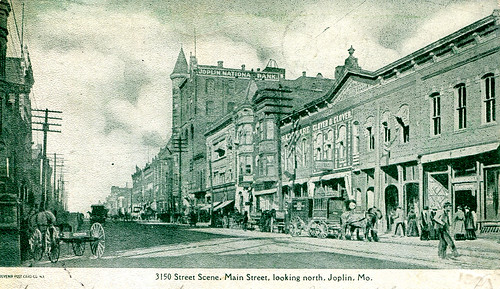
Main Street Joplin circa 1906 or earlier.

Main Street Joplin circa 1906 or earlier.

It was 10:40 in the evening. The saloon was empty, save for Einhart, the proprietor, and an old man who was passed out from a bout of heavy drinking. Einhart was cleaning glasses when two men strode into the saloon. As Einhart later told a Globe reporter, “They were strangers to me and I did not pay any particular attention to them when they started to the rear. I did not take my eyes off of my work. They certainly did not appear to be robbers. Neither of them looked vicious.”

The two men silently approached Einhart with their Colt .45 revolvers pointed at him. The saloon owner confessed, “Without saying a word they induced me to throw up my hands for I could see then that they meant business.” One of the men came around the bar and riffled through Einhart’s pockets. He pulled out Einhart’s watch, but the bar owner protested, saying it was a present from a “very good friend.” The robber laughed and told him he could keep it. Einhart then pointed his assailant to the cash register, secretly pleased he had already taken out most the night’s take earlier in the evening.

At this, the old man who had been passed out suddenly revived, looked at the two robbers, and “ran out the side door and headed down Fifteenth Street as hard as he could, screaming meantime as loud as possible.” Frightened, the two men grabbed money from cash register, dashed out the door, and ran east down Fifteenth Street. For their efforts, the two men pocketed $32.10 out of the cash register, a couple of dollars out of Einhart’s pockets, and some checks.

Joplin Police Officer Snow and Night Watchman Heady began tracking down leads in the case within the hour. By the end of the night, they arrested two suspects, Oscar Orman and C. Ownes, both of whom had come to Joplin from Galena, Kansas, earlier in the evening. Both men were locked up and charges followed the next day.

Source: Joplin Globe

The 1903 Joplin Fire Department Thanksgiving Dinner

The young men and women of Joplin may have not caught a possum on their evening foray in the winter of 1905, but Joplin’s firemen feasted on one in 1903 for Thanksgiving.

The Globe reported, “While the populace of Joplin was enjoying turkey with sage dressing in their dining rooms, the members of the central department were feasting on ‘possum and sweet potatoes.”

Photo of Possum

Some possums may object to the content of this post. Via Wikimedia Commons.

Source: Joplin Globe 1903

Failure, I call thee Possum.

Back in the winter of 1905, a group of twenty-six young possum hunters flooded the Shoal Creek bottoms in search of the “savory little sweet potato seasoner.” Despite their best efforts to catch a possum, the group came home empty handed. The young men blamed their bad luck on the girls; the girls proclaimed if they were the young men, they’d be ashamed at their failure to catch a possum. Their hound was so ashamed that he reportedly slunk back into town with his tail between his legs.

But the group’s disappointment, if any, was short-lived. They built a bonfire, made hot coffee, and had dinner under the clear, starry skies of winter. It wasn’t until after one o’clock in the morning that the exhausted group made their way back into the city limits.

For those who may be interested, a list of the group’s names were provided: Mr. and Mrs. T.A. Wisdom; Mr. and Mrs. Jas. C. Daugherty; Mrs. James McCool; Misses Nell Cummings, Goldie Mason, Maude Smothers, Margaret Cummings, Belva Looker, Mary Carrithers, Margaret McCarthy, Inez Looker, Jennie Harding, Kate Cummings, Mable Looker; Messrs. Albert Webb of Carl Junction, Thomas Beatois of St. Louis, H.D. Watrous, J.H. Gwathney, Will Malone, Max Paul, Earl Doherty, W.P. Keller, Fred Degraff, and Louis Jones.

Source: Joplin Globe

The Bloomer Girls Come to Joplin

In turn-of-the-century America, teams of “Bloomer Girls” traveled across the country challenging men’s amateur, semi-pro, and professional baseball teams to exhibition games. Despite being nicknamed for the loose-fitting trousers that they wore on the diamond, Bloomer Girls were tough competitors. One such “Bloomer Girls” team arrived in Joplin in June 1898, to play a series of seven baseball games against McCloskey’s Giants at Cycle Park. Interest was so intense that promoters added additional seats in anticipation of large crowds of spectators.

Maud Nelson, star pitcher for the team, was hailed as “a twirler of exceptional speed, and it is a common occurrence for her to strike out the strongest batters on the opposing team.” Nelson, a native of Chicago whose real name was Clementina Brida, grew up playing baseball with her brother. As a pitcher, she was reportedly paid $250 a month.

Although the Bloomer Girls engaged in athletic competition with men at a time when women were still governed by stifling Victorian mores, their manager assured the Globe’s reporter that the Bloomers were “refined ladies, most of whom learned the art of ball playing on account of it being a health giving exercise, and only adopted it as a profession after becoming experts and receiving flattering offers to play in exhibition games.”

McCloskey, manager of the opposing team, asserted that the Bloomer Girls came “highly recommended, both as to their excellent playing and conduct on the diamond.” Potential spectators were assured that “the management guarantees that nothing will be said or done but what the most refined lady in the audience will approve.”

In one of their games prior to coming to Joplin, the Bloomer Girls played the Eurekas, a local men’s team in Richmond, Virginia. The Eurekas were warned that the Bloomer Girls “asked no favors, and wanted the game played on its merits.” Captain Boyne, manager of the Eureka team, instructed his players, “to knock the Bloomers silly.”

Whatever preconceived notions the men of the Eureka baseball team may have had about women baseball players were quickly overturned when it was found that it “would be no easy matter” to beat the Bloomer Girls. By the end of the ninth inning the Bloomer Girls led the Eurekas 11 to 5. Maud Nelson was hailed as “a peach, her work in the box alone is worth the price of admission to the game.” She “handles herself like a professional pitcher, throws well, gives the catcher curve signs, and can stop or catch a ball with either hand.”

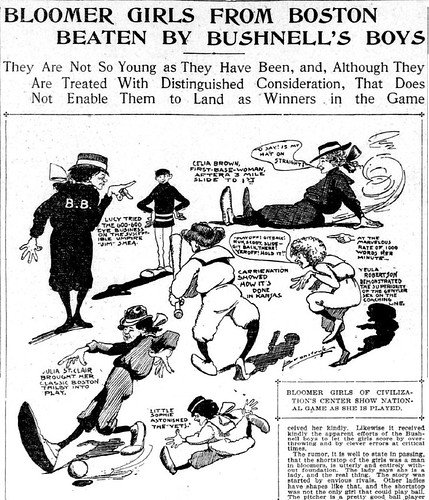
A 1901 cartoon of the Bloomer Girls from the San Francisco Call.

A 1901 cartoon of the Bloomer Girls from the San Francisco Call.

When the Bloomer Girls played McCloskey’s Giants at Cycle Park, they faced fierce competition from the Giants, who played as if “they had reputations to lose.” Managers McCloskey and Menefee livened up the game by having their men run between bases with the Bloomer Girls in hot pursuit. Unfortunately for the Bloomer Girls, they lost the first game 14 to 1.

Maud Nelson, who was “justly” billed as the “star of the team,” continued to be involved in baseball for years to come as a manager and team owner, anticipating the time when the women of the All-American Girls Professional Baseball League.

Sources: The Joplin Globe, the Library of Congress, www.Exploratorium.edu, Wikipedia: Maud Nelson.

An Outlaw Killed in Joplin

The end of an era came to a close when, on August 16, 1924, Joplin Police Detective Lee Van Deventer shot and killed Roy Daugherty.  Daugherty, a member of the fabled Wild Bunch, met his end when Van Deventer shot him just above his heart as a young child clung to his leg. The mortally wounded bandit staggered, then collapsed onto a nearby bed, and died. With his death ended a saga of the Wild West that began in 1870 in nearby Barry County, Missouri, where Daugherty was born.

At the age of 14, Roy Daugherty ran away from home to Oklahoma.  It was there that he adopted the nickname “Arkansas Tom Jones” and fell in with Bill Doolin of the famed Doolin Gang.  A string of subsequent robberies ended with the “Battle of Ingalls,” in a saloon in Ingalls, Oklahoma, when United States Marshals under the command of E.D. Nix sought to capture the Wild Bunch.  It was a bloody gunfight that ultimately left three marshals and four outlaws dead.  Daugherty was captured when James Masterson, brother of legendary lawman, Bat Masterson, hurled a stick of dynamite at the outlaws and managed to stun Daugherty long enough to arrest him.
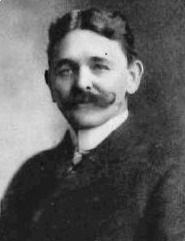
United States Marshal E.D. Nix

Legendary United States Marshal E.D. Nix who oversaw Daugherty's capture at the Battle of Ingalls.

Daugherty was sentenced to prison for 50 years, but was released early. It wasn’t long before he returned to a life of crime. It was approximately 1901, after an arrest, when Daugherty’s first recorded visit to Joplin may have happened, purportedly as an unwilling participant in a traveling exhibit of the Wild West.  It is entirely possible this event never happened, but the lifelong outlaw did find his way to Joplin in 1917.

While much of Daugherty’s criminal career happened in neighboring Oklahoma, by 1917, it was rumored he had played a role in a series of robberies in Missouri, including a bank job in the small town of Fairview, in neighboring Newton County.  In 1917, Joplin police detectives William F. Gibson and Charles McManamy sought him for robberies in Oronogo and Wheaton, Missouri.  Their investigation led them to a farmer who, after an hour of intense interrogation, finally confessed the location of Daugherty’s safe house.  The hesitation had not been out of loyalty, but for fear that the outlaw would seek vengeance for the betrayal of his location.

Possibly out of doubt of their informant’s confession, or perhaps for lack of a better plan, the Joplin detectives simply knocked on the door of the house in which Daugherty was reportedly inside.  It may have come as shock when the outlaw opened the door himself, but if the men were surprised, the moment quickly passed as both lawmen charged into the house to arrest Daugherty.  Daugherty stumbled back into the house, while McManamy and Gibson rushed after him, and the three found themselves caught in a moment of hesitation focused around a revolver that lay on a nearby table.  All three men lunged for the weapon, and had Daugherty been the quicker, the stories of Detective Gibson and McManamy might have ended that day.

Gibson reached the pistol first.  Daugherty, who seemed to have known the detective, reportedly said, ” I’m glad you got it, Billy.  If I had beat you to it, I would have had to kill you.”  And so, the Barry County native was returned to prison courtesy of the Joplin Police Department and sentenced to 8 years.  Daugherty, despite being a former member of the Wild Bunch with a string of robberies to his name, was released early on good behavior.  If Daugherty had served his entire prison term, it is entirely possible that the events of August 16, 1924, might have never happened.
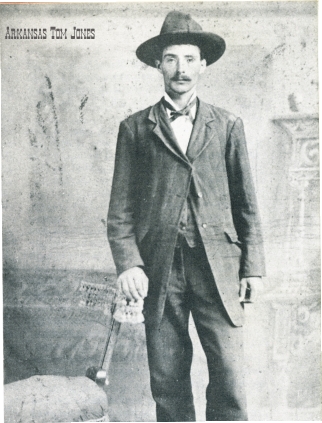
Roy Daugherty in the prime of his life.     Roy Daugherty in the prime of his life. Via Wikipedia.

Roy Daugherty in the prime of his life. Via Wikipedia.

Some things had changed since 1917.  Joplin detective, William Gibson, had been promoted to Chief of the Joplin Detectives.  Likewise, some things had not changed, such as Roy Daugherty’s penchant for robberies.  This time it was a bank in Asbury, a town on the Kansas — Missouri line, just northwest of Joplin.  The Joplin police sought out the 54 year old outlaw, and were tipped off to his location on a hot Saturday afternoon.  Once more, William Gibson set out to arrest Daugherty, accompanied by fellow detectives Len Van Deventer, Tom DeGraff, and Jess Laster.  Chief of Police Verna P. Hine also joined the detectives.

Word was that Daugherty was in the home of a Joplin local known as “Red” Snow at 1420 W. Ninth Street.  The plan was simple.  Two cars, one with Gibson and Van Deventer, the other with DeGraff, Laster, and Hine, would speed to a stop in front of the home and the men would rush the house.  Afterward, Detective Chief Gibson reflected on his thoughts as the lawmen left to capture Daugherty:

“I knew there would be trouble when we left the station to get Daugherty.  I knew we were after a man who had shot first in eighteen fatal encounters and I expected no surrender.  Daugherty would die with his boots on and I believed that someone else would unlace them tonight.”

As the police neared their destination, the car in which Police Chief Hine was riding in veered off a block early.  At that point, Gibson believed that Hine had elected to stay out of the capture, a claim that Hine later denied.  When Gibson arrived, he headed for the rear of the house, convinced that Daugherty would try to escape out the back.  Gibson described what happened next to a reporter:

“I saw him [Daugherty] through a window as I ran toward the back door to cut off his escape, and I knew then he knew that it was to a finish.  He ran crouched, to present as small a target as possible, his gun clutched in both hands before him.  I reached the porch in the rear of the house and met him at the door.”

At that point, Daugherty opened fire point-blank on Gibson.  Gibson later was at a loss as to how he was not hit by the outlaw’s fire, especially after he discovered a bullet hole in his hat. Gibson sought cover behind a nearby bush and returned fire.  Three of his bullets hit their intended target. Daugherty was hit in his left wrist, his right side above the kidney, and was grazed on the side of his head above an ear.  Sufficiently discouraged from escape out the back door, Daugherty headed for the front.

As Daugherty did so, Red Snow’s wife, caught in the middle of the gunfight, screamed loudly.  He did not get far.  In the time in which Daugherty and Gibson had exchanged shots, Detective Van Deventer entered the house through the front door.  The two found themselves in a face off and the younger Van Deventer fired first.  The large .44 caliber slug from Van Deventer’s revolver struck Daugherty in the chest and the man who had rode with the Wild Bunch fell dead onto a nearby bed.  At his feet, the young child of Red Snow bawled, confused and frightened.

After confirming that Daugherty was dead, Van Deventer and Gibson helped themselves to two cigarettes from the dead man’s shirt pocket. His body was sent to the Hurlbut Undertaking Company and reportedly attracted the attention of thousands who came out to view the corpse of the famed bandit.  Later it was discovered that Daugherty’s .38 revolver had jammed after he had fired only two shots at Gibson, which might have been a reason that both Gibson and Van Deventer had emerged unscathed in the ordeal.
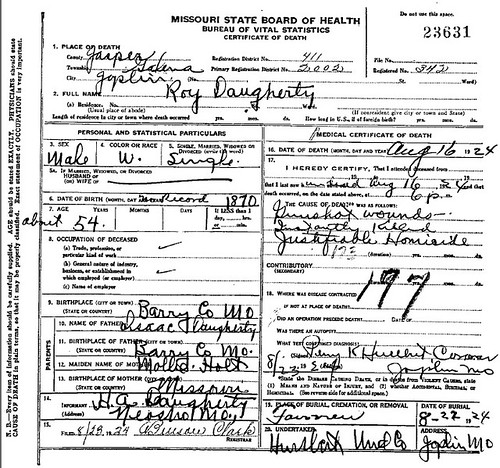
Roy Daugherty's death certificate.

Roy Daugherty's death certificate.

Daugherty’s death brought about the resignation of the Joplin Police Chief Hine.  When the police had set out to capture, Hine’s car had turned away a block too early.  Hine later stated that he thought he was supposed to go to the rear of the house to cut off escape.  Hine was later accused of cowering behind a barn while Gibson shot it out with Daugherty.  The police chief claimed he had thought Gibson had been shot dead, when the detective had only crouched for cover, and thus had paused in his approach toward the house.  Hine also argued that he had never even paused, but the entire time had been on a slow approach to the house; slow only because of high grass that had grown up in the rear of the property.  His explanations were not enough.  Joplin Mayor F. Taylor Snapp publicly called the police chief a yellow coward and demanded his resignation.

Ironically, Hine, a former barber, had been appointed by Mayor Snapp two years before, his only experience was having served as a special park policeman in Schifferdecker Park and six years on the Joplin police force.  His inglorious end as Joplin Police Chief came only two days after the gun battle when Hine handed in his badge..

Roy Daugherty was not the first notorious gunslinger to visit Joplin, nor was he the last infamous outlaw to come to the city.  In less than ten years, a modern successor to the Wild Bunch rolled into town, headed by two outlaw lovers commonly known as Bonnie and Clyde.  Unlike Daugherty, the Barrow Gang escaped fate in a hurried departure from Joplin, but that is a story for another post.

Sources: U.S. Marshals website, the Joplin Globe, and Digital Missouri.
A Stench-filled Journey Through Joplin

One of the major concerns for a growing city is sanitation.  Poor sanitation can lead to the outbreak of deadly diseases like dysentery, but can also simply create an eyesores and horrible smells.  In order to combat this issue, three city councilmen, one member of the city’s health committee, a city marshal, and a reporter set off to uncover the worse sanitation practices they could find.   To the detriment of at least one of these men’s health, they were quite successful.

Joplin article on sanitation in 1881

An article from the Joplin News Herald in 1881 about the city's sanitation.

Sources: Joplin Daily Herald