A Quick History In The News Round Up

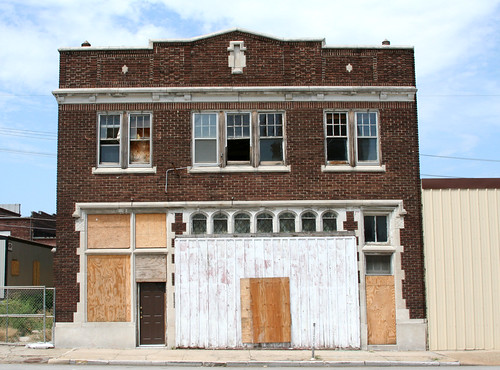
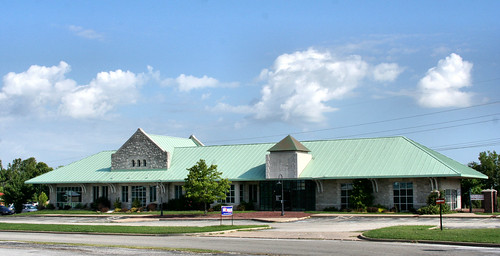
Joplin's Missouri Pacific Depot as of July, 2010

Joplin's Missouri Pacific Depot as of July, 2010

A couple things have popped up in the Joplin Globe over the last few days.  In good news, the old Missouri Pacific Depot that was saved and moved to its present location by David Glenn has found new owners.  Glenn bought the depot when it was scheduled to be destroyed and carefully relocated it to its spot off of Rangeline where it opened up as Timberline restaurant.  In the future, we’ll provide a little more history on this smaller depot of Joplin’s past.   The new owners are Raymond and Amy Yen, who will re-open it later this year as a far eastern restaurant.  Let’s hope when it comes to decoration that they don’t alter anything original!

The other news item has to do with the arrival in Joplin of general American history, a restored B-17 Flying Fortress, the Liberty Belle. Just like another restored B-17, Aluminum Overcast, the Liberty Belle, never saw combat due to being produced at the end of the war.  However, that doesn’t make her any less grand a lady.  It’s highly recommended to go visit the Liberty Belle when she arrives on August 29 at the Joplin airport.  For those of you in Springfield, she’ll visit Springfield’s airport a day earlier on August 28.   Check here for her schedule and more information about the Liberty Belle.

Music Video Joplin

For those of you who just want to sit back and look at photographs of historic Joplin and listen to good music in the process, we present to you Patrick McPheron’s work, Presenting Joplin (click here!).  McPheron is a free lance designer in Los Angeles with Joplin roots and crafted this music video using photographs and images from Digital Postcard Collection at the Joplin Public Library’s website.

For a look at the rest of McPheron’s work, including photographs, other videos, and music, just follow this link to Interiorstate.com.

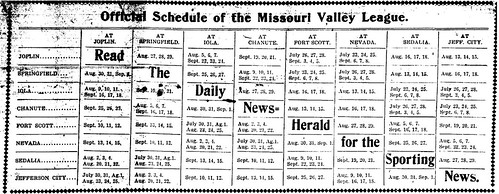
The Schedule of the 1902 Joplin Colts / Miners

We previously discussed the emergence of Joplin’s first professional baseball team, the Colts who soon after became the Miners.  After some research, we uncovered what appears to be the schedule for the team that season in the Missouri Valley League.

1902 Joplin Miners' Missouri Valley League schedule

For a larger version click on the photograph

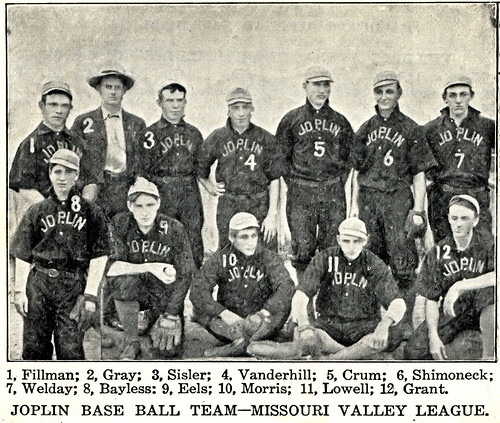
In the earlier post, we offered a team photo from that year.  To keep things fresh, we’ve added a photograph of the 1904 team.  A glance between the supplied rosters for the teams reveals some old faces and some new.

1904 Joplin Miners

1904 Joplin Miners

Sources: Joplin News Herald, Historic Joplin Collection

Tepidness Reigns Supreme at Museum Board Meeting

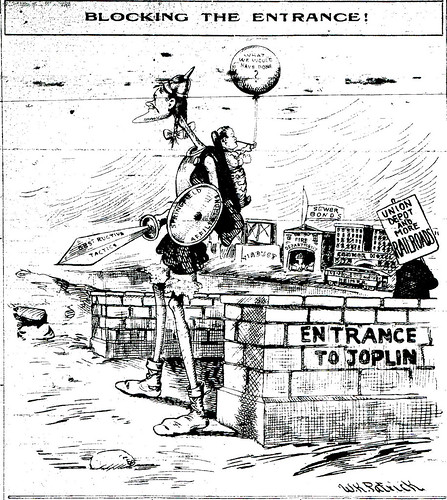
Joplin newspaper cartoon

Don't Let the Obstructionist Win!

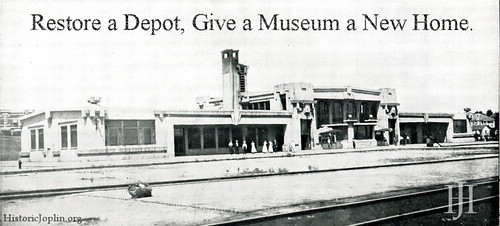
This last week’s meeting of the Joplin Museum board was a showcase in tepid response to bold planning for the future.  The topic of the meeting, covered by the local news station KODE, was the possible relocation of the museum to the Union Depot.  The news segment featured interviews with board member Allen Shirley and City Councilman Benjamin Rosenberg.

Shirley continued what is now becoming a two month long hem haw of expressing a cautious disapproval for the idea of moving to the Union Depot.  The main point expressed by Shirley in his interview was the lack of exhibit space, a point raised by Museum Director Brad Belk previously.  The matter of sufficient space appears to be growing into the banner to be waved by the Joplin Museum Board, we expect to hear it raised again and again as their argument against the move.

From even before City Manager Mark Rohr’s presentation, the Joplin Museum Board has not wanted to move to the Union Depot, and since the presentation, have protested as much as possible without appearing reactionary.  It is clear that if the Joplin Museum Complex is to be moved to the Union Depot, the board will have to be dragged kicking and screaming.  The angry child who did not get its prized relocation and taxes to take over Memorial Hall now just want to take their ball and go home, rather than settle for something less than they desired.

Disconcertingly, the meeting was attended by three city council members, which as the news report explained were there in support of the museum board.  Of the three, only Benjamin Rosenberg opted to speak with a reporter and offered a fascinating rebuttal against Mark Rohr’s well grounded plans for Joplin’s growth over the next five years.  Rosenberg, when asked about the plan declared, “I had no part in the city manager’s vision.  I had no pre-warning. I had no consultation with the city manager.”  By all appearances, it seems Mr. Rosenberg does not like or agree with Rohr’s plan that was presented earlier this summer.

Rosenberger also told the reporter that he strongly believed the fate of the museum should be left in the hands of the museum board and not forced by the hand of the city.  This would be a rational position to take were the museum lead by forward thinking, competent and experienced individuals, but that is not the case.  The only imaginative thinking the museum has displayed in recent years has been to spring an idea that was overwhelmingly disapproved of by 75% of the city’s voting residents.  Meanwhile, the popularly supported plan of moving the museum to the Union Depot languishes because neither the museum board nor apparently some of the city council are willing to take bold steps for Joplin’s future.

Is Joplin anymore the city of Thomas Connor, Charles Schifferdecker, or Thomas Cunningham?

We say nay!

Where is the vision?  Why the desire for mediocrity?  Where is the leadership that has helped to restore downtown?  Joplin became the city that is resplendent with beautiful buildings and good people because its leaders in the past were unwilling to quietly abide.  It would do the museum board well to remember this, a lesson they should learn if they are at all familiar with the history they have sworn to safe keep.

HJ Union Depot image

It Is Time To Be Bold!

Lee & Grant Traveling Exhibit Arrives at Powers Museum

Wikipedia image of Robert E. Lee painting

A portait of Lee via Wikipedia.

The much talked about Lee & Grant traveling exhibit will be opening September 1st at the Powers Museum in Carthage. The exhibit features,”a major reassessment of the lives, careers, and historical impact of Civil War generals Robert E. Lee and Ulysses S. Grant.”  Furthermore, the exhibit, “encourages audiences to move beyond the traditional mythology of both men and rediscover them within the context of their own time – based on their own words and those of their contemporaries.” To do this, the exhibit uses a great variety of items, such as photographs, paintings, accouterments, coins, prints, and reproduction clothing.  Also used are documents written by each of the famous generals.

Unknown to many, Julia Grant, Ulysses’ wife, had relatives who lived in Carthage, which created a connection to the Jasper County city and the Grants.  Lee also has a connection to Missouri, where while in service with the Corps of Engineers, he helped to prevent the Mississippi from flowing away from the bustling city of St. Louis.

For a sneak peak of the exhibit, check out this link on the exhibit from the National Endowment For the Humanities.

Of course, available all year round is the Powers Museum, a great place for local history.

Hell Hath No Fury Again

Shrill screams pierced the air. Residents who lived in the vicinity of Sergeant and Fourth Streets emerged from their homes at two o’clock in the afternoon to investigate the horrific screams. Two women were struggling in the street. Upon closer inspection, it was clear that one woman had the upper hand as she “had seized the other by the hair was applying a whip vigorously over her head and shoulders. Hence the screams.”

Spectators intervened and the two women were separated. The woman who wielded the whip, Mrs. John Essry, turned herself in to Officer Robinson. She explained that her husband had been courting Miss Anna Rosser, a young woman who still lived at home with her parents on Sergeant Avenue. After she discovered that her husband had taken Miss Rosser on a Sunday buggy ride the preceding week, Mrs. Essry decided that revenge was the best course of action.

She drove to the Rosser home and pretended to be looking for a young woman to work for her selling samples. While in the street, Mrs. Essry drew her whip and began beating Miss Rosser.

But the beating was not enough. The following week, Mrs. Essry once again unleashed her fury against Miss Rosser. This time she returned to the Rosser home armed with rocks. She began to bombard the house with rocks, breaking windows. The Rossers escaped out the back door and ran to a neighbor’s home as Mrs. Essry continued to assault the Rosser home until she managed to break down the door. Finding no one inside, she went to the neighbor’s home, but was given an evasive answer.

Mrs. Essry was not finished. She returned to the Rosser home, picked up a hatchet, and smashed what she could. “Doors, windows, furniture, stove and household fixtures” were destroyed. Spectators watched her frenzied hatchet attack but did not intervene. Joplin police officers arrived and took Mrs. Essry into custody.

She quickly bonded out of jail “as public sympathy is strong in her behalf. Her neighbors speak highly of her in her struggle to maintain five small children almost wholly without aid from her profligate husband.” Her husband’s advances towards Miss Rosser had driven her “wild.”

The girl’s mother had attempted to keep the two apart, but the girl “is at that giddy, gosling period when a waxed mustache, soft talk, and a musk befogged handkerchief would turn her head more in a minute than maternal precept could right in a day.” It was said that Miss Rosser had left town.

Joplin’s First Speeding Ticket

Just after the turn of the century, Joplin attorney Fred Basom received the first speeding ticket issued in Joplin. He was “hailed by an officer of the law while out for a spin,” after the mayor’s recent instructions to the police department to arrest drivers who violated Joplin’s city ordinance that set the speed limit at six miles an hour. The news item did not explain how fast Mr. Basom was going when he was ticketed or what the fine was for breaking the speed limit, but it can be expected that attorney Basom was able to secure adequate representation for his police court appearance.

Source: Joplin News Herald

Update on Nominated Historic Districts

Becky Brill, of the city of Joplin, was kind enough to drop by and leave us an update on the status of the nominations that went before the Missouri Advisory Council on Historic Preservation on Friday.  For those of you following the status of the Joplin and Wall Historic District and the South Main Street Historic District, Becky had some good news!  Both districts were approved by the council and were recommended to be placed upon the Federal Register of Historic Places as commercial districts (which bring important tax benefits).  That final decision will be made by the Federal government in Washington, D.C.   Becky’s comment noted that that decision will probably come in October.  Let’s hope for good news in the fall!

For those of you who missed our initial coverage of the nomination of the districts, here’s the post with all the details.

Reflections on Circus Life

In the not too distant past we published a post about Hardy Hardella and his dog Moxie.  Hardy and Moxie are among our favorite Joplin residents, so when we found an article about Hardy and his days with the circus, we knew it would end up as a post.  A more specific post on Hardy himself is in the works for later.
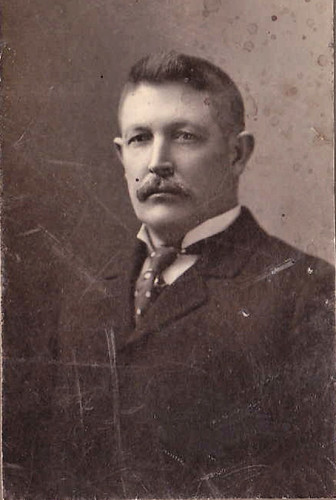
Hardy Hardella

A distinguished Hardy Hardella, courtesy of the private collection of Judy Hurdle.

Hardy Hardella moved to Joplin in 1905.  A few years later, one of Hardella’s old circus cronies arrived in town. The two had not seen each other in twenty-five years, but Hardy and William Underwood (his stage name was William Lucifer) took up where they left off the last time they had seen one another. Underwood, still working the vaudeville circuit, arrived in Joplin for a performance and decided to call upon his old friend.

The two men first met when they worked together in the Charles Hunter Circus which traveled through Nebraska, Kansas, and Missouri. Hunter, the former circus owner, still lived in the area, but instead of wrangling animals and acrobats, now proprietor of the Crescent Hotel in Pittsburg, Kansas. The two men said the circus consisted of one car, a camel, two ponies, six or seven mules, and two or three horses. Altogether there were twenty five men employed by the circus.

The circus car, an old condemned Pullman, had a secret compartment underneath it. When times were hard, half of the employees would hide in it when the conductor came around to collect train fares. One day, however, Hunter’s adopted son poked his head up out of the trap door when the conductor came through. Hunter’s circus “had hard luck on that road ever after.”

Underwood recalled the time he came to Joplin with the De Haven Circus and a fight broke out between circus employees and local miners. Angry miners cut up and destroyed the circus tents and half of the outfit was “broken up.”

After things seemed to have cooled down, another fight broke out after miners and circus workers got into a brawl at one of Joplin’s saloons. Underwood remembered “billiard cues and bottles were freely used” in the fight. Circus workers were arrested and thrown in Joplin’s city jail for a few days before they were released. Underwood remarked, “I have never forgotten that incident in Joplin. I have been all over the world since then and in every civilized nation, but I nearly always sign my residence as Joplin, MO., because of that fight and subsequent stay in jail.”

That same week, Hardy Hardella and William Underwood met old friend William McCall, who performed with Hardella as the “Hardella Brothers,” to discuss old times. The men recalled when Hardy was known as, “Hardella, the wonderful contortionist.”
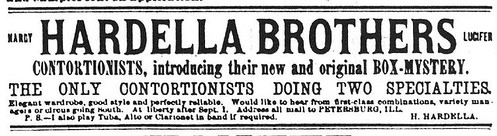
Hardella Brothers ad

An advertisement for the Hardella Brothers, courtesy of Judy Hurdle.

Underwood remembered how the “old time circuses sure used to clean out a town. There was always a bunch of ‘fakirs’ that went along with the show and paid big concessions. The games they used to devise were many and varied. Yankee ingenuity being a mild term to apply to it. What money wasn’t taken in at the gates or by the shell games was usually cleaned up the ‘gooseberry crowd’ that followed the circus and while the people were watching the performance, raided the houses. Sometimes the ‘gooseberry’ bunch was in cahoots with the show and sometimes they were not, but they usually made a cleaning. Some small towns were literally wiped clean by the circus bunch.”

Locals, however, often lashed out after discovering their town had been “wiped clean.” Underwood recalled, “When they got a chance to get their breath and compare notes, they usually came down on the circus with blood in their eyes. The ‘fakirs’ had moved on to greener pastures by this time and were ready to work the next town. The circus hands had to bear the brunt of the storm. One experienced stake driver with the heavy, banded circus stake, could usually clean twelve or fifteen ‘rubes’ but just the same there was much bloodshed and cracked heads.”

He also somberly told the story of a young Kansan who had just sold a load of corn for a large sum of money, possibly as much as $200, and decided to bet it all on a shell game. He lost. The shell game operator, scared the crowd was going to attack him, fled. The young farmer chased him into a tent where the man cracked the rube over the head with a club. Underwood claimed, “It was one of the most cruel sights I have ever witnessed, but those were hard days in the circus business.”

Circuses are few and far between these days, but undoubtedly the big top once thrilled crowds all across the country, and Joplin was no exception.

Sources: Joplin Globe, Joplin News Herald, Livingston’s History of Jasper County, Bale Milling Odyssey by Judy Hurdle, Missouri Death Certificate Database 1910-1959, Judy Hurdle private collection
Downtown Areas Up For Historic Designation

Today’s Joplin Globe features an article on the Missouri Advisory Council on Historic Preservation and its consideration of several areas in downtown Joplin for historic district status.   The two areas that the city wants to join the Sunshine Lamp District include an area located between Joplin and Wall and 1st and 3rd streets and would be known as the Joplin and Wall Historic District, the other would be the South Main Street Historic District, an area on the west side of Main Street between 1st and 2nd Streets.   If the Missouri Advisory Council on Historic Preservation signs off on these nominations, they would then be forwarded to the Federal Register of Historic Places.  If placed on the register, buildings in the districts could qualify for Federal and state tax credits.

Here’s a link to a draft of the Joplin and Wall Historic District nomination.

The draft describes the historic area:

“”The Joplin and Wall Avenues Historic District (Photos 1‐11) consists of an approximately three square‐block 5‐acre area in the northern reaches of the central business district of Joplin, which is in Jasper County, in southwestern Missouri. The district is topographically flat and contains a total of 13 buildings dating from c. 1900 through the 1930s, all of load‐bearing masonry construction, flat‐roofed, and ranging in height from one story to five stories; no residential buildings are in the district. (continued below…)

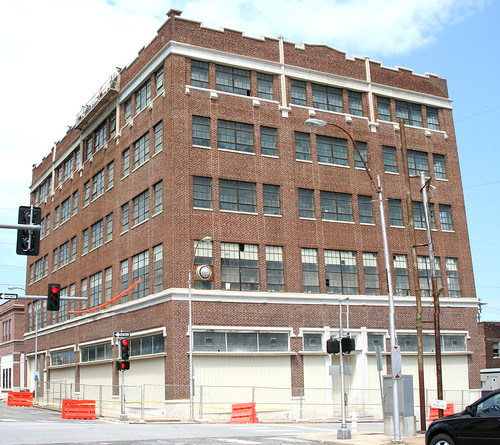
Joplin Supply Company building

Joplin Supply Company building is included in the Joplin and Wall Historic District

“(continued…) The nominated area is located along a grid of three blocks of Joplin and Wall Streets which run north‐to south and are intersected by West First, West Second, and West Third Streets and unnamed alleys running both north‐south and east‐west. Of the 13 buildings in the district one, the Joplin Supply Company (Resource No. 13; Photos 3, 6), was previously listed in the National Register (NR 2007). Of the remaining 12 unlisted buildings, 11 contribute to the character of the district and one is a noncontributing element with reference to the district as a whole. The overall appearance of the district is entirely commercial, lacking landscaping and characterized by a grid of paved streets and alleys, concrete sidewalks, with most buildings built flush with one another. Some buildings have associated surface parking; the largest vacant parcel is associated with a 1936 former bus depot (Resource No. 5); this parcel was used historically for bus parking.”

Hulbert Chapel 2010

Hulbert Chapel, next door to the Joplin Supply Company building is also part of the nominated Joplin and Wall District

The draft provides a list of the properties, a brief description of each, as well some history.  Such recognizable buildings are the Joplin Supply Company building, the Greyhound Bus Depot across from the library, and the old court house post office building.

Here’s the link to the draft for the nomination of the South Main Historic District.

The draft describes the area as:

“The South Main Street Historic District (Photos 1‐8; Figs. 1‐4) is located in the City of Joplin, Jasper County, in southwestern Missouri. This one‐block long linear district encompasses less than one acre and occupies all of the west side of South Main Street between West First and West Second Streets and consists entirely of commercial architecture dating from the turn of the twentieth century through c. 1910. The district is located at the northern periphery of the central business district and contains ten buildings of one and two stories in height, all of load‐bearing masonry construction. Two buildings are non‐contributing elements within the context of the district as a whole and the remaining eight are contributing.

The district retains the characteristic dense concentration of development which typifies most downtown areas, with all buildings constructed without front‐lot setback. Rear‐lot setbacks vary
from building to building, and surface parking is provided behind most properties. All but two of the district’s buildings are built flush with one another; two adjacent buildings are separated by a narrow walkway. The district fronts on South Main Street, West First and Second Streets form the district’s north and south boundary, respectively, and an unnamed alley establishes the district’s western boundary. New construction and vacant lots are immediately adjacent to the nominated district, and the Joplin and Wall Avenues Historic District, nominated concomitant with this district but distinct in its own right, is to the west.”

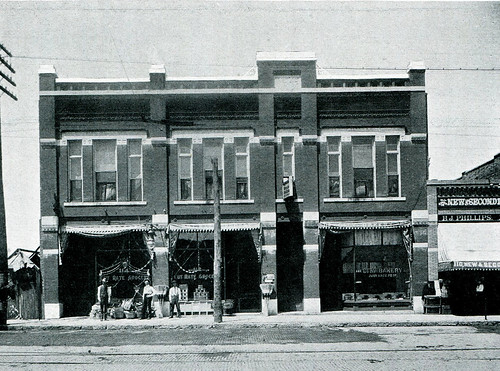
Miles Block circa 1902

The Miles Block as it appeared around 1902.

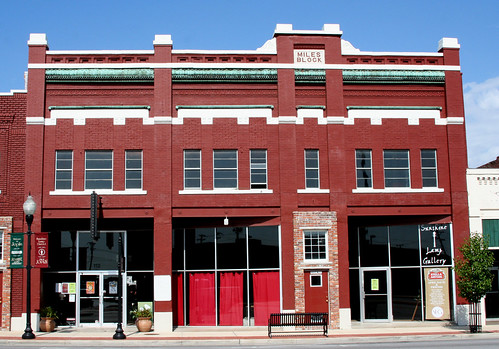
The district primarily concerns the strip of beautiful buildings on the west side of Main Street from 2nd street up that include the striking Miles Block.

Miles Block 2010

The Miles Block, as it appears today, is included in the South Main Street District nomination

For those of you interested in learning more about the architecture used in the construction of these buildings, as well as for some brief histories, we encourage you to read the drafts in greater detail.  The Council will meet this Friday to discuss the nominations.