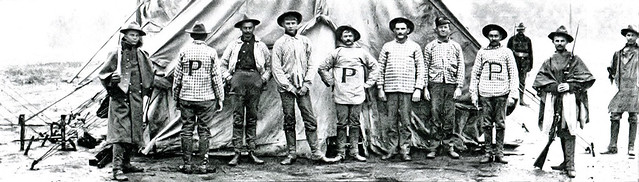
The Five Cyclists of Joplin

Cycling was all the rage in the 1890s. Cycle tracks were built, races were held, and cycling associations were formed all across America. Cycling became an accepted form of transportation, rather than just a passing fancy. Today we might think of Mongooses, Schwinns, or Bianchis – brands that allow cyclists to ride across the country, over mountains, and commute to work on city streets. Bicycles in the 1890s, however, had heavy frames, cumbersome rubber tires, and uncomfortable seats. That did not deter a group of five friends from Joplin who hopped on their bicycles in the summer of 1896 and pedaled to Louisville, Kentucky.
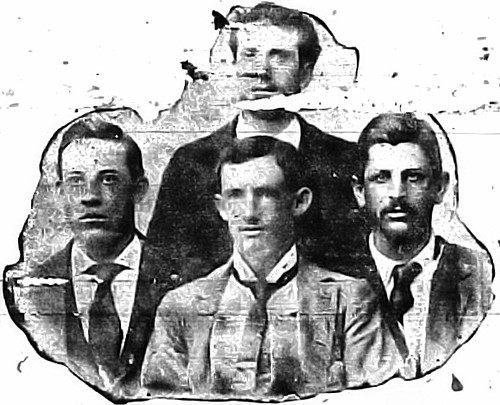
The Intrepid Joplin Cyclists

Businessman Fred Lawder, attorney Arthur E. Spencer, Boone Jenkins, Captain Marion Staples, and “Ike” Simon left Joplin in August. Although they planned to pedal from Joplin to Louisville, they decided to ship their bicycles to St. Louis and then pedal to Louisville. They made the trip in four days with stops at Vincennes, Indiana, and Cincinnati, Ohio. They spent a considerable amount of time in Louisville before heading west on their bicycles, passing through much of Illinois, Indiana, Kentucky, and Ohio. They returned to St. Louis where Simon and Spencer, citing pressing business concerns, caught a train back to Joplin. The remaining three men made the trip back to Joplin by bicycle.

They became somewhat of a media sensation. It was recalled that “at every city in which stops were made the party was besieged by reporters, and newspapers published column after column regarding the tour, together with photographs of the tourists and their bicycles.”

The remaining three men returned to Joplin in September, but not before Captain Marion Staples appointed himself a missionary for presidential candidate William Jennings Bryan, and preached the gospel of free silver to curious onlookers during the trip. Staples was a surprisingly spry fifty years of age when he made the trek. It was reported that while the other riders were young men, Staples “stood the trip as well if not better than his companions and reached home in better physical condition than he was when he left.” He lived to the ripe old age of 78.

Source: Joplin Daily Globe
Joplin City Marshal Explains Suicides in Joplin

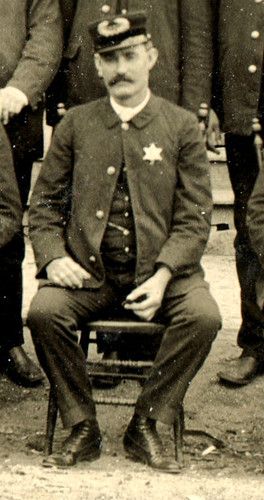
McManamy

In 1904, Joplin City Marshal John A. McManamy gave an interview regarding suicide cases in Joplin. In it, one can observe strains of gender, class, race, and economics that provides insight into the suicidal trends of the city.

McManamy claimed that the majority of would-be suicides in Joplin were women, often “women who have fallen from the highest plane of moral standing. As a rule they are not successful.  But as a rule also, this class of women, if they fail the first time, they try it again.” Very few African-Americans in Joplin attempted suicide, McManamy claimed, as “it is the rarest sort of thing that a negro ever wishes to end his own life and it is more rare still that they ever attempt to end it. Negro men are not the least prone to commit suicide and negro women seldom bother us in this manner.

According to the marshal, most suicide cases involved the use of carbolic acid, which caused an individual to “suffer the greatest of agonies before they finally shuffle. In the event they do not take enough of the poison to produce death, the suffering they undergo while recovering is fearful.”

Others chose to use morphine and cocaine. If the police found a morphine user before death claimed them, the officers would treat them for morphine poisoning by “pounding the party with wet towels, by rapping him hard knocks on the body, by rubbing the legs until they almost blister and in fact indulge in almost every kind of heroic treatment that will keep the would-be suicide awake, until the antidotes have time to neutralize the morphine.” McManamy noted that cocaine and arsenic suicide attempts also required “heroic treatment” as the would-be victim would often go into spasms while yelling, groaning, or crying. He disapproved of what he called “gun play,” but unhelpfully pointed out that cutting one’s wrists was the most effective way to end one’s life.

When asked what caused many of the would-be suicides in Joplin, McManamy declared, “Suicides usually follow debauches, or financial reverses. Debauches with the women and financial reverses with the men. These debauches may be brought about by many causes, disappointments in love being the most frequent.”

For the benefit of the paper’s readers, the marshal sternly pointed out “An attempt at suicide is poor business. Not over ten per cent of the attempts that are made are successful. The agonies, the sufferings, the tortures of the period following the attempt, with those who are not successful, make the game not worth the candle. Life may not hold out any hope to the would-be suicide, but there is seldom a life so devoid of hope, or so without light, that it is not better than the life of one who is frustrated in an effort to end all with one fell swoop.”

Source: Joplin News Herald

If you ever find yourself in need of help or in a time of crisis and need someone to talk to:

http://www.suicidepreventionlifeline.org/
http://www.save.org/
http://www.afsp.org/

Joplinites in Kansas City

Joplinites, as residents of Joplin were referred to at the turn of the century, were a restless bunch. Throughout the last half of the nineteenth century, Joplin miners were not afraid to work as scabs in the copper and silver mines of the west, while others left in the hopes of striking it rich in the Klondike Gold Rush. Some, however, sought wealth in the metropolisies of the Midwest. Kansas City was among the burgeoning cities that beckoned to Joplinites.

One article from the News-Herald discussed a number of former Joplin residents who had since made Kansas City their home. James A. “Jim” Bolen, an early Joplin resident who served as a Jasper County deputy sheriff and as county recorder, owned the Bolen Lead and Zinc Company. He also served as president of the Zenith Mining Company. In 1879, he moved to Kansas City and founded the Bolen Coal Company. He made a large fortune and was once mentioned as a candidate for mayor.

Another former Joplinite in Kansas City was Thomas A. McClelland, who, like Jim Bolen, was an early resident. He served as Joplin’s city collector. After becoming wealthy from investing in land and mines, he moved to Kansas City. He did not forget Joplin, as he gave the city the land for what is now known as McClelland Park.

M.D. Darnall, who was associated with the white lead works in Joplin, moved to Kansas City where he became involved in the real estate business. B.T. Webb, who was once Joplin’s city clerk, also moved to Kansas City. He, too, went into the real estate business. W.F. Snyder, who once worked for the News-Herald, owned a cigar stand on West Ninth Street. John Cotton was working as a dentist. Harry Brundidge, a sign-painter, was kept constantly busy as a sign-painter for the numerous businesses in Kansas City. Pat and Tom Clifford, who struck it rich from diggings on Parr Hill, were considered to be long time residents of Kansas City. Numerous others, including musicians, porters, train conductors, and lawyers had since moved from Joplin to Kansas City, but clearly they were fondly remembered and not forgotten, despite having left the city that gave them their start.

Sources: Encyclopedia of the History of Missouri, Joplin News-Herald, Joplin City Code of 1917

The Dissolution of Company G

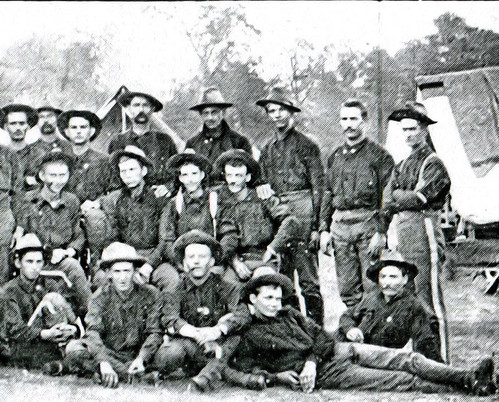
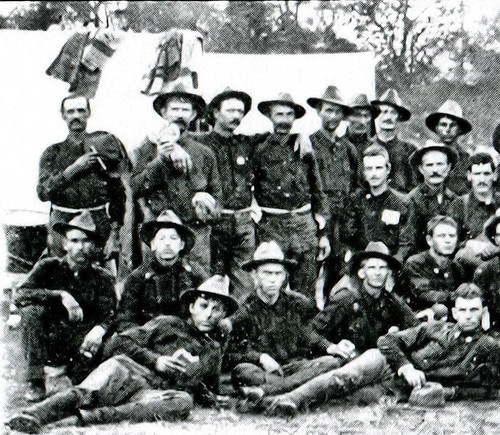
Men of Company G

Last week we brought you the story of Company G of the 2nd Missouri Volunteer Infantry, the Joplin men who went off to fight in the Spanish-American War. Unfortunately for Company G, the end came for the unit in November, 1902. Colonel Henry Mitchell of the National Guard of Missouri came to Joplin specially to see it formally mustered out. The colonel offered the reasons for the end of the 20 year old unit, “Lack of interest seems to be among the main causes which has contributed to the final ending of the organization. The company has no funds and no armory and these things in connection with other factors has at last made it necessary to take the final step.” The end came despite what the Joplin Daily News Herald claimed, “Many of Joplin’s finest and bravest boys strove hard to keep life in the organization but it seemed that the fates decreed it otherwise.”

Source: Joplin Daily News Herald

In Anticipation of Thanksgiving

In 1902, the eighteen newsboys of the Joplin News-Herald arrived at Turner’s Café at noon in anticipation of a free Thanksgiving Day meal. Mr. I.S. Vaughn, head of city circulation, his assistant, William S. Moss, and Mrs. Moss, escorted the boys from the News-Herald office to Turner’s Café where they found a lavish spread set for them. The boys dined on the following fare:
 
Cream of Fowl soup
Oyster soup
Roast sirloin of beef with brown gravy
Leg of mutton
Stuffed young turkey
Cranberry sauce
Baked lake trout au gratin
Black bass fried
Hollandaise potatoes
French peas in cream
Baked sweet potatoes
Hot corn bread
Steamed fruit pudding
Hot mine and pumpkin pie
Tea, coffee, sweet milk, or buttermilk
 
If that doesn’t get you in the Thanksgiving mood, then nothing will.

Source: Joplin News Herald

Joplin Goes to War: 1898 – Letters Home III

The Post Office for the camp.

Previously, we told you about the men of Joplin who marched off to war as Company G of the 2nd Missouri Volunteer Infantry. Today we bring you the third of three letters from those men. The third comes from Robert E. Jones (Jones’ other letter was a previous post here), who wrote from Camp Thomas, Chickamauga, Georgia, dated around June 20, 1898 to the Joplin News Herald:

“The regular drill, drill, drill is the only thing that disturbs the monotony of our camp life now.  The boys are all in good health, and hardly any of them are absent from drill now on account of sickness.  Lieut. Shepard, on account of his health, has been forced to sever his connections with the commissary department, but is rapidly improving under the rest and quiet of outdoor life which is granted him by the activity of Lieut. Duckett, who although not very large in stature, is full of energy and takes the drilling of the company entirely in his own hands.

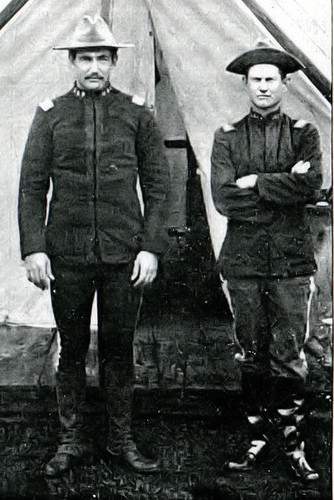
Lieutenants Shepard (left) & Duckett (right)

The boys never report on the sick list on Sunday morning unless feeling very bad, for there are no drills to dodge on that day by so doing, and they want to have liberty to go where they please, as they are expected to stay in their quarters when ill and excused from drills.

The Second today received about 600 Springfield rifles to go towards arming the regiment.  It is understood that the remainder of the new guns apportioned to us will be received in a day or two.  They are of the 1898 model, almost like those we have now, only brand new.  Companies I and M, the newly organized, unequipped companies will be fitted out first and the older companies will receive what is coming to them later.

New recruits for the regiment have arrived to the number of nearly 100.  Thirty-two came in Sunday morning, of whom eight were Joplin boys.  The new victims have to undergo a great deal of good natured chanting when they first arrive, but all take it in good humor and they are a willing lot of fellows.  Co. G has received seven new recruits so far.  they are being drilled as rapidly as possible by non-coms, and seem to “catch on” readily.

The Y.M.C.A. is doing a rushing business in every way.  Sunday morning and afternoon services were held in the big tent and were attended by good-sized audiences of young men from the neighboring camps.

The boys of Co. G are going in for solid comfort in the way of sleeping accommodations.  Some of them have snug little cots made from the canes that grow here along the creek, to which several have added the luxury of ticks full of straw or twigs from pine cedar or willow trees.

Sergeant Means has received his wheel from Joplin and now pedals his way to and from the points of interest instead of walking as heretofore.

Lieut. Duckett was heard to remark this afternoon that photo buttons were getting to be quite the thing in Co. G now.  He was doubtless referring to Fred Hinkley’s “Coon” Riseling, and several others who were wearing their sweetheart’s pictures pinned onto their uniforms.

Girls are few and far between here and are made much of when they do visit or even stop at our camp.  Yesterday morning a party of young ladies from Chattanooga, in a large carriage, stopped for some information at our camp, and had quite a time getting away from the gallant boys of the Second, who insisted on their stopping awhile with a result that it was an hour before they could proceed on their way.  They took the situation in good humor and promised to come again, but whether they will or not we do not know.  But come on, girls, you’ll always be welcome at the Second Missouri’s camp.

Men of Company G

We are looking for the return of Capt. Spears in a week or two, and are endeavoring  to keep up our good record while he is away.

Robt. E. Jones ”

Sources: History of the Second Regiment, Joplin News Herald

Joplin Goes to War: 1898 – Letters Home II

The Post Office for the camp.

Previously, we told you about the men of Joplin who marched off to war as Company G of the 2nd Missouri Volunteer Infantry. Today we bring you the second of three letters from those men. The second comes from Robert E. Jones, who wrote from Camp Thomas, Chickamauga, Georgia, dated around June 21, 1898 to the Joplin News Herald:

“Editor Herald – Co. G. has just come in from company and battalion drill, and the boys are lying around cleaning up guns for inspection tomorrow, washing clothes, and doing other necessary camp work.  Some of the Joplin people would smile at the sight of their sons bending over tubs full of hot water, scrubbing away like regular “Bridgets,” but the boys are getting “onto the hang of it” pretty well, and take to washing almost as kindly as they did at first to drilling.

We are happy over the prospect of receiving new guns, for at inspection Monday a number of the guns of the company were condemned and new ones will be issued to us, although it is thought hardly probable that the entire company will get new ones.

We are enjoying very good mail facilities now.  Mail comes twice a day now, at noon and 6 o’clock in the evening.  The boys rush for it as eagerly, however, as when we received it once a day.  When the trumpeter at headquarters blows his call for first sergeants at mail hours, the boys congregate at the head of the company street, and when sergeant Tschappler comes with the precious packages he is surrounded by a crowd of boys anxious to know “if there is one for me.”  The papers usually come at noon, and the boys thus have a chance to read them before afternoon drill, which comes at 3:30.

The work of the recruiting officers at home is already evident, for 24 men from Springfield and vicinity arrived this morning and were distributed two to each company in the regiment.  They are all healthy, strong looking fellows, and will be valuable additions to the companies.  The two apportioned company G are from Springfield, and seem to be very nice fellows.

The sick list of Company G is gratifyingly small just now.  there was only one man in the company excused from drill yesterday because of illness.  A good many of the boys have very sore arms, but they drill all the same.

The Y.M.C.A. is a hustling success in every way.  Bible classes are held every day at 1 o’clock and are usually very well attended.  The song services at night are also very much enjoyed by the boys, and every night religious and patriotic hymns may be heard at the tent.  “Home, Sweet Home” for some reason is very popular.

Men of Company G

Lient. Duckett handles the company on battalion drills and regimental drills like an old veteran.  Lient. Shepard’s duties at the commissary department, preventing him from very much drilling.

The boys are excellently settled in camp now, and should we be compelled to stay here all summer, they are fixed for it.  Nearly all of them have made beds out of timer from along the creek, and covered with hay, straw, boughs, etc.  In some of the tents there are huge beds big enough for six or eight men.

Robt. E. Jones ”

Source: History of the Second Regiment

Joplin Goes to War: 1898 – Letters Home

The Post Office for the camp.

Previously, we told you about the men of Joplin who marched off to war as Company G of the 2nd Missouri Volunteer Infantry.  Today we bring you the first of three letters from those men.  The first comes from Fred Hinkley, who wrote from Camp Thomas, Chickamauga, Georgia, dated June 19, 1898 to the Joplin News Herald:

“As this is Sunday and all drills are dispensed with I will inform the Joplin people of the doings of the Second Missouri, at Chickamauga.  We had the most rigid inspection by Major-General Slocum Monday that the Second has undergone.  It was for the purpose of determining if the Second should go to the front or stay here; also to condemn guns.  We will receive our new guns tomorrow and our ordinance supplies in a few days.

The Major in conversation with Col. Caffee said that out of nine regiments inspected there were two very good, the Second being one of them, and further, that if his word went for anything, the Second should be the first regiment out after the South Carolina men which will go first as Gen. Lee asked the War Department to have that regiment assigned to his command.

The new recruits are arriving now in squads of twenty-five, the first to reach here being the detail from Springfield which arrived Friday morning.  The next detail to arrive was from Sedalia with 22 men, and the Joplin recruits arrived this morning 32 in number.

The men are distributed among the companies.  Company G now having seven recruits, but none from Joplin.  The recruits are taken charge of by the First Sergeant, shown the rules and regulations of a regular, then turned over to the cooks who have them carry a little water and wood just to get used to it.

One of the new men assigned to Company G fell in for mess call and when the cooks gave him black coffee and bread without butter he turned to the boys and said, “Boys, I wasn’t raised in a castle, but I cannot drink coffee without milk or eat bread without butter,” and he handed his dinner to one of the men, but this morning he was noticed going back the second time for more “bare-footed” coffee.

The health of the regiment and especially of Company G, is fine, they not having a man for the hospital this morning.

Men of Company G

NOTES.

Sergeant Watson and Kid got leave of absence this morning for six hours, and went blackberrying.  About 2 hours later they returned with a tomato can about half full and said they would take an oath that they had to walk 10 miles for them, but later the boys found out that they had got lost and gave a farmer 20 cents to haul them back to camp.

Sergeant Tschappler is one of the busiest men in camp and when not on duty he is very busy writing a book.  He writes about 40  pages, puts it in an envelope, sends it to Carthage, and it doesn’t go to the book bindery either.

The Joplin recruits brought Private McCullough’s pet coon with them.  It has been in camp about 9 hours and has bitten only 9 of the boys.

On account of the fracas at Lytle last Sunday no one is allowed to go to Lytle without a written permit signed by the colonel.

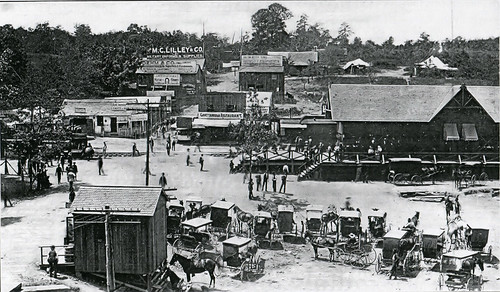
Lytle Depot

Sergeant Sansom has been on the sick list for several days but is a great deal better tday.

The boys were all pleased to see “Cholly” Burnham but were greatly disappointed when he was assigned to Company A of Carthage.

Private Dunwoody and Eckhart are two of the sickest (love-sick) men we have in camp.

Corporal Kelley is now one of the proudest men in camp.  He has a beard of the strawberry variety that would make a New York policeman leave his beat in disgust.

One of the men in our company concluded that it was too warm to drill Saturday morning so he hied himself to the Y.M.C.A. tent about drill time but Sergeant Tschappler happened to call the roll and he was hunted up and given 12 hours in the guard house and six day’s extra duty.

A Chicago corporal got himself in the guard house by getting gay when Gen. Brooke approached.  The corporal had a vague idea that when so distinguished an officer approached he should be complimented by a general salutation of the guard.  His order should have been, “Turn out the guard for the commanding officer,” but he became disconcerted and just as the general reached his tent, the corporal bawled out, “Turn out de push and duck: here comes de main guy.”

You can tell the Joplin people to look out for soldier’s letters, as everyone is broke and stamps are at a premium.

Fred T. Hinckley”

Source: History of the Second Regiment, Joplin News Herald

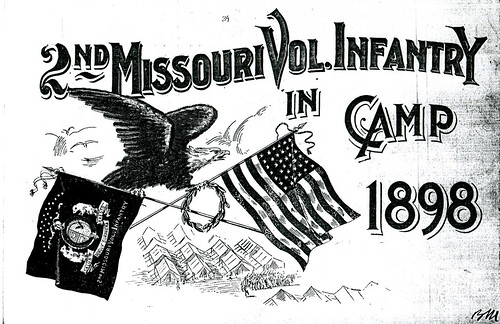
Joplin Off to War: 1898

In 1898, the U.S. engaged in what U.S. Secretary of State John Hay described as a, “splendid little war.” Thousands of men from across the country volunteered for military service. Only a few actually engaged in combat in Cuba, the rest were stuck state-side in camps across the South.

The Second Regiment of Misssouri Infantry was comprised of companies from Pierce City, Lamar, Nevada, Clinton, Carthage, Joplin, Butler, Sedalia, Springfield, and Jefferson City, Missouri. The regimental headquarters were located in Carthage where it was designated, “Second Regiment of the Missouri National Guard.” The regiment then mobilized at Jefferson Barracks in St. Louis on May 6, 1898, and were mustered into service a few days later. The total strength of the regiment when mobilized was 1,031 officers and men.

Shortly thereafter, the regiment was sent to Chickamuaga, Georgia, and was brigaded with the Ninth Pennsylvania and the First New Hampshire in the Third Brigade, Third Division, First Army Corps. At this time the regiment’s strength increased to 1, 337 officers and men.

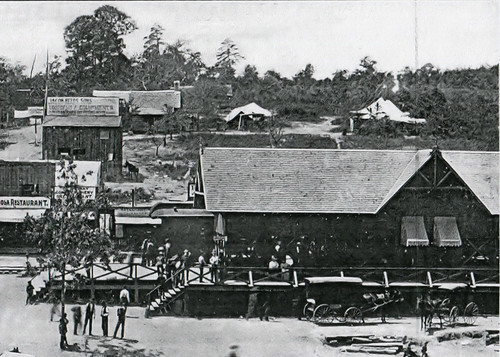
Lytle Depot near Chickamauga, Georgia, where Company G was located.

Company G was from Joplin and was made up of the following officers and men:

Captain — Robert A. Spears.

First Lt. — E.L. “Lee” Shepherd

Second Lt. — E.E. Duckett

Captain Spears, Leiutenant Shepherd, and Lieutenant Ducket.

First Sgt. — A.S. Tschappler

Sgts. — C.W. Calvin., A.M. Kidd, F.W. Sansom, D.D. Watson, H.D. Mears

Cpls. — E.J. Boggs, Wm. Jones, Jas. Kelly, A.S. Owen, C.A. Warren, L.M. Ingraham, R.G. Boreing, David  Garrison, Frank Smith, F.T. Hinckley, T.F. Clary, Wm. St. Clair

Musicians — W. Axton, Ben Ebling

Wagoner — Charles Monson

Artificer — C.W. Sloan

Privates: Jesse Axton, J.N. Baily, J.T. Bean, Chas. Bierman, Wm. Botkin, R.E. Barnett, E.E. Brubaker, Jerry Butts, Jas. Clary, Will Clary, C.M. Chenoworth, E.E. Colier, Ben Cory, E.J. Crampton, Jay Dunwoody, Chas. E. Dewitt, Claude Flemming, Jason Fellows, M.P. Fox, G.K. Freeman, Roy Greer, Chas. Gould, Jas. Gilmore, Y.A. Hays, Wyle Hodshier, H.H. Hoback, Clyde Hites,  Logan Horner, J.T. Howard, Henry Helm, A.J. Halterman, Wm. Johnson, R.E. Jones, C.D. Johnson, Jos. Jirauch, S.H. Jones, Fred Kinner, Fred Kerr, Lester Loy, Walter Laud, A.O. Lanyan, H.H. Lewis, Jeff D. Long, Dennis Landon, Harley McCullough, Percy Mylius, L.R. Nugent, J.E. Nischwitz, H.W. Neff, Otto Nickoleson, Norton Oliver, Harry Plimmer, J.D. Penrose, Frank Reha, C.J. Rhoads, Wm. F. Rice, Chas. E. Rice, Thomas Rogers, E.S. Riseling, H.W. Ryan, J.E. Smith, Chas. Shafer, Henry Saulesbury, C.V. Spyres, H.S. Shyrock, C.H. Smith, Nick Spore, Patrick Spore, Newel Short, Frank Treganza, G.A. Thompson, Thos. Thomason, A. Woodward, Melvin Walls, Walter Wilkes, Louie Watzdorf, and Geo. Zietler.

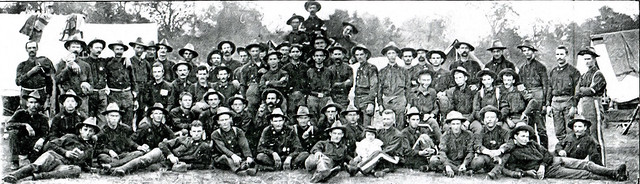
Company G - click to access larger version.

The regiment suffered one fatality: Private E.E. Brubeker died September 20, 1898 of typhoid fever.

C.W. Hudson and George M. Eckhart were transferred to the Hospital Corps and Walter Ladd was discharged for disability.

Below are more photographs of life in the camp where Company G was located:

The Mule Corral

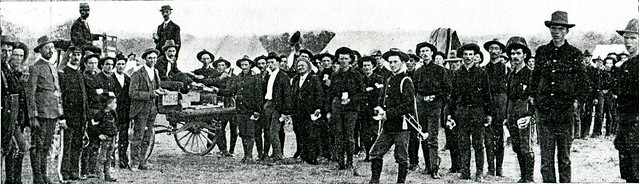
The American Tobacco Company arrived in camp to offer "the boys" some "Battle Ax" and "Dukes Mixture" tobacco.

Sunday Morning Inspection

The Guard House with the men entrusted with guarding the encampment.

Some prisoners at the Guardhouse, hopefully none from Company G.

Source: History of the Second Regiment

The Cult Leader Who Called Joplin Home

James Sharp, commonly known as cult leader “Adam God,” once called Joplin home.
 
Born in Lebanon, Missouri, in 1857, Sharp styled himself as a “traveling evangelist.” He was never very successful, however, and in 1908 was living in Kansas City, Missouri, on a houseboat with less than thirty followers. The group, which included several children, was out proselytizing on the streets of Kansas City when a police officer (some accounts say probation officer) questioned one of the adults why the children were not in school. James Sharp, angered by the officer’s questions, bellowed “I am Adam God, father of Jesus Christ,” demanded the officer to leave, then struck him on the head with the butt of a revolver. The officer, sensing trouble and outnumbered, went to a nearby police station.

Sharp, enraged by the altercation, marched his band of followers to the police station where they sang. Crowds began to gather and watch the curious proceedings. Sharp waved a revolver and a knife while yelling, “We’ll show these sheep thieves. We’ll sing in front of the station. Let them dare to stop the father of Jesus Christ.”
 
A police officer, Albert Dalbow, was sent out to quieten the unruly group. He ordered Sharp in to the station to meet with a police sergeant. When ordered to drop his knife and revolver, Sharp went nuts. The street fight that ensued would become known as the “Adam God Riot.” Officer Dalbow, Officer Michael Mullane, two of Sharp’s followers, and an innocent bystander paying his utility bill were killed when Sharp’s group opened fire.
 
Sharp and his remaining followers fled. One woman was killed as she and others tried to escape in a rowboat on the half-frozen Missouri River. Sharp was found a few days later hiding in a haystack by a farmer who called the police. Sharp’s hands had been pierced by bullets. Disturbingly, one of the children, when questioned by police remarked, “When a policeman tried to stop us our religion teaches us that we have the right to shoot and kill.”
 
Sharp was arrested, tried, and convicted of second degree murder with a 25 year sentence. Sharp was paroled 14 years and 7 months later in 1924 and it was at that time that he and his wife, Melissa, moved to Joplin.
 
A few years later, in 1926, he was arrested in Joplin for “chasing and frightening children at the Alcott School.” Sharp was described as 70 years old, with a long flowing white beard. He claimed he chased the children because they called him “Santa Claus.”
 
James Sharp lived in Joplin until 1946, when he died from dancing a vigorous jig at the corner of Seventh and Main streets, despite his constant claim that he would “live forever.” He would jig in an attempt to draw a crowd to listen to his street preaching. He lived at 2430 Adele Street in Joplin, and referred to himself as “Reverend” although the paper noted that he did not have following.
 
When he died in 1946, Melissa Sharp told the Globe that “We’ll just quietly put him away.” Which she did. He was buried “without a prayer or religious service and without music or flowers” in Osborne Memorial Cemetery. A small group of 18 friends of the Sharps witnessed the burial and then Mrs. Sharp was driven home. Thus came the end to James Sharp.

Source: Joplin Globe