Joplin Miners: 1910 Western Association Champs

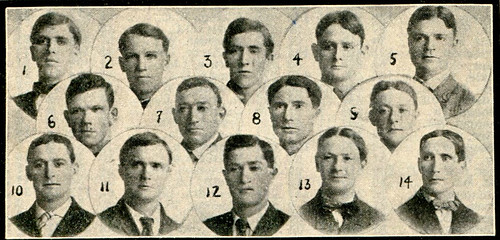
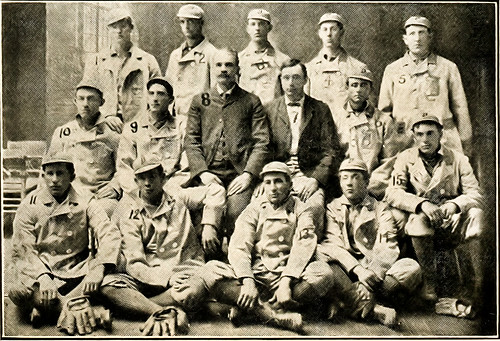
Our next photograph in the Joplin Miners series is the 1910 Joplin Miners.

1910 Joplin Miners: 1) Richard Rohn, 2) Marc Hall, 3) Ralph Bell, 4) George Watson, 5) Bruce Ross, 6) Harry Ellis, 7) Howie Gregory, 8 ) Ed Hawk, 9) W. Burton, 10) Earl Hamilton, 11) Thomas Harlow, 12) Lowthers, 13)Joe Kelly, 14) Bert Lamb.

In 1910, the Joplin Miners finished first in the Western Association and played their games at Cox Baseball Park. Richard Rohn, aka, Dick Rohn, was a hold over from the 1907 team. Ed Hawk, from Exeter, Missouri, made it to the St. Louis Browns in the Majors. While Joe Kelly went on to play for the Pittsburgh Pirates, Chicago Cubs, and the Boston Braves.

Joplin Miners: 1907

Baseball was an ever present pastime in Joplin, be it amateur or professional. Of the latter, the Miners held Joplin’s attention. In addition to our current series from the portfolio of Alfred W. Rea, we are going to present a short series of four team photographs of the Joplin Miners. Our first is the team from 1907:

1907 Joplin Miners

The 1907 Joplin Miners: 1) Owens, 2) Sylvester Oleson, 3) Charles Flemming, 4) Roy Gill, 5) Dick Rohn, 6) Jack Fillman, 7) Tony Vanderhill, 8 ) Manager Louis Armstrong, 9) Guy Harrington, 10) Abner Persch, 11) Conrad Welsch, 12) William George, 13) John Root, 14) Cecil Bankhead.

The 1907 Joplin Miners played at Cox Baseball Park in the Western Association League. Both Vanderhill and Fillman were “veteran” players who had played on previous Miners teams.

Be Like The Mick

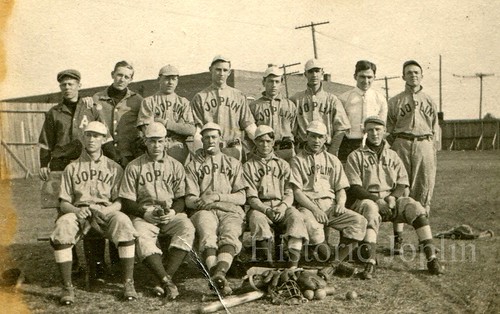
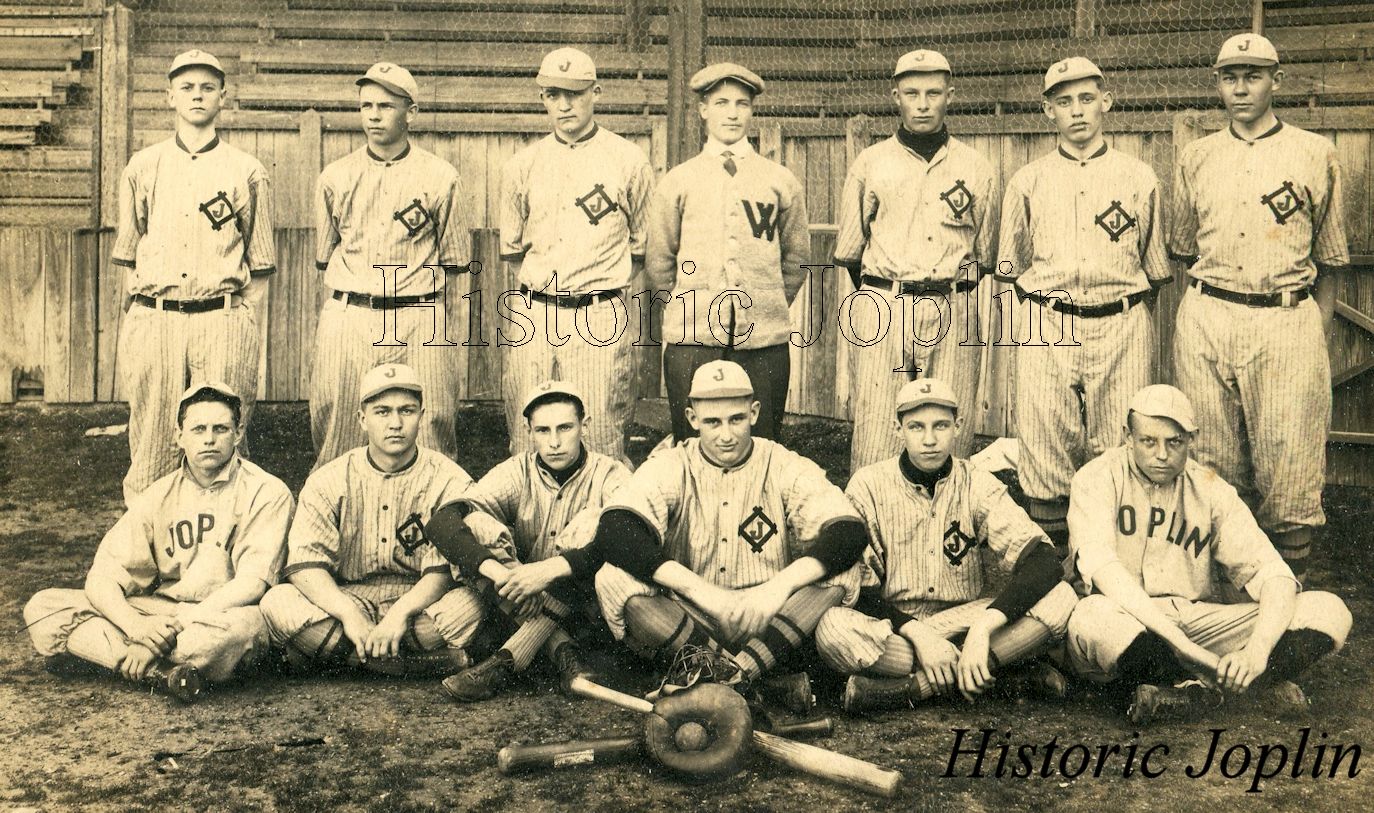
A photo of the Miners from some time around 1910, possibly at Cox Field.

Long an institution of Joplin, the Miners baseball team entertained Joplin crowds for more than half a century. Among one of their greatest, if not greatest, players to wear the name Joplin emblazoned across the chest, was Mickey Mantle. For the low price of nearly $200 (okay, not that low), you can own a replica of the 1950 jersey that the Mick wore courtesy of Ebbets.com.  It’s a bit of flannel history.


Twisters, Cyclones, and Tornadoes of Joplin’s Past: Part I

The tornado of May 22 was the worst to strike Joplin, but it was not the first.

In May, 1883, a tornado swept through Joplin and the news accounts of the event appear to echo recent events. Just this past week, a story about Laverne the cat, who was rescued after being trapped in the rubble after sixteen days aired on local news stations. In 1883, Charley Elliott’s dog was “in his store building when it fell. He was dug out next morning pretty badly bruised, but after a few hours he was alright. There were acts of generosity. E.R. Moffett, who would later die impoverished, walked up to an “old friend who he had worked with before he became a millionaire. ‘Crit, I’m damned sorry, I’m sorry $500,” and then gave a five hundred dollar check to the relief fund. Citizens scrambled to help each other. Judge Byers was “constantly busy distributing supplies to the needy who lost their all by the wild winds.” Doctors Fannie Williams and Mrs. Creech did “good work for the suffering ladies who were injured” during the storm. Miss Fannie Hall of Carthage gave her all to assist the suffering at the hospital. Oronogo, also hard hit by the storm, was the focus of a relief committee made up of some of Joplin’s leading socialites: Mrs. L.P. Cunningham, Mrs. J.B. Sergeant, Mrs. J.C. Gaston, and Mrs. Thomas Heathwood. Together these women sought to collect food, clothing, and bedding for those effected by the storm.

For others, the tornado brought excitement and curiosity. The Daily Herald remarked, “Some of the visitors Monday night seemed to regard the occasion in the light of a picnic. Frivolities and flirtations were engaged in that would have been regarded impudent at a circus. No apparent sympathy was exhibited for the crippled, bereaved, and homeless, while silly children took the place of sober sense.” Sightseers came to stare at a “bushel basket that lodged in the top of a large tree near the railroad track.” Telegraph poles at the train depot reportedly looked like “they had passed through a storm of musketry.”

And then there were those that lost their lives. Preliminary reports reported that the bodies of a Mr. Goodwin and his daughter were killed by the tornado. It is unknown how many others lost their lives.

The next significant tornado to hit Joplin was in April, 1902. The News-Herald proclaimed it was, “[The] Worst That Joplin Has Known.” A wind, hail, and rain storm converged upon Joplin around 4:25 p.m. in the afternoon in an area described as covering “Seventh Street on the north and as far as Seventeenth Street on the south” with the worst areas at Moffett and Bird streets from Thirteenth to Sixteenth streets and at Moonshine Hill. Property along Main and Ninth streets received substantial damage.

The News-Herald reporter must have not known about the Tornado of 1883 as they declared, “As Joplin has never experienced a real tornado, the people were unprepared and as it came upon them so unexpectedly, it as a wonder that more fatalities are not recorded.” Telephone and trolley poles were twisted beyond recognition making communication with neighboring communities impossible. Streetcars were unable to run due to the lack of electricity and piles of debris covering the tracks. One car caught at Twelfth and Main, Car Number 41, was struck by a telephone pole. Passengers inside were “thoroughly frightened and several actually said their prayers.” Strong wind was not the only threat to human lives. The pole was described as having fifteen double cross arms with three large cables and several hundred telephone wires. Workers roped off the street to prevent traffic and pedestrians from going near the car. Passengers shakily disembarked and walked home on foot.
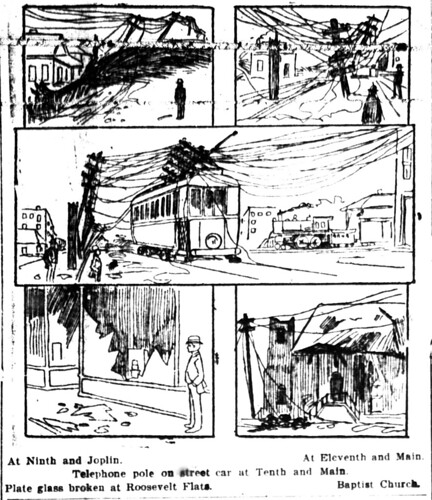
Illustration of the damage from the tornado.

A “solid sheet of water, besides some hail” fell, causing people to hide inside their homes. Willow Branch, the Tenth Street branch, and other small streams in and around Joplin began to flood, leaving many to seek dry ground as the streams became “turbulent torrent[s] of water, mud, and wreckage.”

The storm indiscriminately took human lives and property. It was reported that the two room house of William Hunter, who lived on the east side of Moonshine Hill, was carried for a long distance before it shattered. Mrs. Hunter, holding her baby Esther in her arms, was about to flee the house when the storm hit. A plank of wood flew past and hit her child in the head, mortally wounding it, while Mrs. Hunter sustained serious injuries. Her husband, a miner, was at work at the Dividend Mine when the storm rolled through Joplin. A neighbor, Charley Whitehead, came to Mrs. Hunter’s rescue. Other residents of Moonshine Hill suffered the same fate. Will Douglass’ home was obliterated. Lee Whitehead [perhaps related to Charley] and family also lost their home. The Methodist church on Moonshine Hill was a complete loss.

Arthur Cox, owner of Cox Baseball Park, was one of the “heaviest losers.” The storm destroyed the baseball park’s fence, the grand stand’s roof ripped off, and sustained overall heavy damage. The losses were estimated at $1,000. Cox, however, was not one to stand idly by. Within a day, W.J. Wagy was hired to rebuild the park in time for a game just a day after the tornado struck.
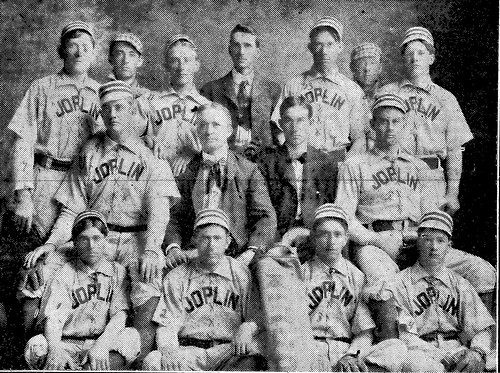
The Joplin Miners

The Joplin Miners of 1902 who temporarily lost their home.

At the corner of West Ninth and Tenth streets, several homes were damaged, if not utterly ruined. An African-American family named Smith lost their house and P.B. Moser’s home was demolished. A.J. Stockton was fortunate – he only lost his kitchen.

For the impoverished residents who lived in “shanties” north of the Missouri Pacific roundhouse between Grand Avenue and the Frisco and Kansas City Southern tracks, their impermanent residences were blown away.

White and black churches were not left untouched. The First Baptist Church was “badly wrecked.” The Methodist Episcopal Church’s South Mission location at Tenth and Grand was “completely wiped away.” The African Methodist Episcopal Church on East Seventh street was also destroyed. Despite being a substantial frame structure, the roof was torn off and the walls subsequently caved in.
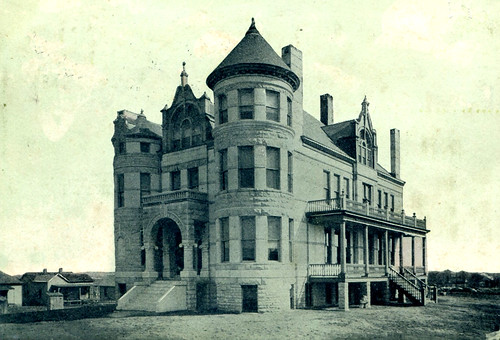
St. John's Hospital

The nuns at St. John’s Hospital were “buffeted and blown about by the wind as they strove in vain to keep out the sheets of water thrown against the west end south of the building which stands high and unprotected.”

Property damage was estimated at $50,000 and an estimated fifty to sixty houses destroyed. As soon as the storm passed, “ambulances and relief crews found work to do for many hours.” Mayor John C. Trigg released a proclamation that read:

“To the Citizens of Joplin – Authentic information having been received that the cyclone which visited the city of Joplin on yesterday, caused incalculable damage to many of our citizens and has been especially destructive to the poorer classes of our citizens in many instances to the extent of destroying everything they owned, leaving them destitute, houseless and homeless.

Therefore, for the purpose of alleviating the distress which prevails in the city and vicinity and to devise ways and means by the organization of relief corps, or by such practicable methods as may be suggested and agreed upon at a meeting of the citizens is hereby called to be held at the Commercial Club rooms, on the 25 inst., at the hour of 3 o’clock p.m. to consider the premises and take such appropriate action as may be deemed necessary therein.”

Mayor John C. Trigg

Joplin has always taken care of its own in times of need. When the committee met, it was agreed that many of those effected by the storm were impoverished miners who were in badly need of assistance, and a relief fund was created. Thomas W. Cunningham reported that when he checked on his rental properties in the damaged section of town he found that one of the families renting from him had been forced to cut their way out of the house. He decided that they “deserved the house” and “made them a deed for it.” His act of kindness was heartily applauded. It was thought that the family was that of I.W. Reynolds who lived at Thirteenth and Ivy. Mr. Wolfarth of Junge Baking Company pledged free bread to those in need. Arthur Cox and Don Stuart pledged the proceeds of the next baseball game to the relief fund. The Wilbur-Kirwin Opera Company decided to give a benefit performance for Joplin’s tornado victims.

Joplin rebuilt only to face another tornado six years later in 1908. That story and more in our next installment.

[Conclusion of Part I]
Joplin Miners, 1902 – 1904 Team Photos

For today’s post, we thought we’d toss in something new with a couple things previously seen just for the fun of having a comparison.  That comparison is the Joplin Miners, from 1902 to 1904, in team photographs.  In chronological order, three years worth of the Joplin Miners baseball team.

A March 21, 1902 article, accompanied by a not very flattering sketch of pitcher Arthur Ragan, reported of some of the men pictured below:

“The local management received contracts yesterday from Andrew Brophy, one of last year’s most popular players and who will again be behind the bat for Joplin, from C.W. Wickizer, a heavy hitter with Nevada last year, and who is considered one of the best utility men in the southwest, from Arthur Ragan of Cherokee, Kas., a pitcher whose work will interest the fans for, while his engagement with Joplin will be his first professional ball, competent judges who have seen the young man work, declare that he is a comer. “

The Joplin Miners

The Joplin Miners of 1902

Top Row – Wright Wickizer, catcher; an unnamed pitcher; Bert Dunn, pitcher; Claud Marcum, manager; Arthur “Rip” Reagan, pitcher; Peck Harrington, catcher and outfielder; and Lefty Greer, pitcher.  Middle Row – Earl Taylor, pitcher, Don Stewart, secretary of the club; Arthur “Art” Cox, treasurer of the club; and William “Dolly” Gray, first baseman.  Bottom Row – Bert “Monk” Senter, shortstop; Jimmie Underwood, outfielder; Fred Tullar, third base; and Dick Bayless, outfielder.

1903 Joplin Miners

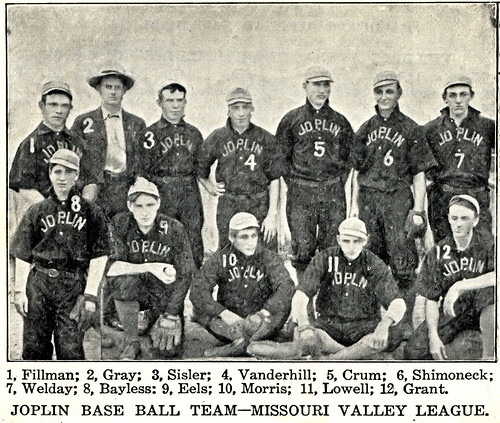
The 1903 Joplin Miners

The 1903 Miners: 1. Morton; 2. Lowell; 3. Adam; 4. Stoner; 5. Wickheiser; 6. Woliver; 7. McCullough; 8. Evans; 9. Allen, Captain; 10. Weldy; 11. Jones; 12. Fillman; 13. Driscoll; 14. Herrington; 15. Roedell.

1904 Joplin Miners

1904 Joplin Miners

Sources: Historic Joplin Collection, Joplin Daily Globe

The Schedule of the 1902 Joplin Colts / Miners

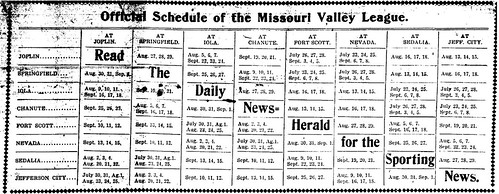
We previously discussed the emergence of Joplin’s first professional baseball team, the Colts who soon after became the Miners.  After some research, we uncovered what appears to be the schedule for the team that season in the Missouri Valley League.

1902 Joplin Miners' Missouri Valley League schedule

For a larger version click on the photograph

In the earlier post, we offered a team photo from that year.  To keep things fresh, we’ve added a photograph of the 1904 team.  A glance between the supplied rosters for the teams reveals some old faces and some new.

1904 Joplin Miners

1904 Joplin Miners

Sources: Joplin News Herald, Historic Joplin Collection

Vada Corbus – Joplin Miners catcher

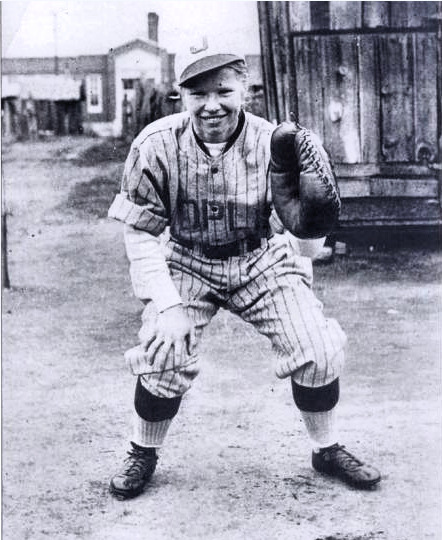
We recently covered Vada Corbus, a woman ballplayer who sought to play for the Joplin Miners.  By the permission of John Kovach, college archivist at St. Mary’s College, we secured a much better photograph of the near trailblazer.  The photograph comes from Mr. Kovach’s book, Women’s Baseball, (Images of Baseball).   For more on women in baseball, check and see if the traveling exhibit, “Linedrives and Lipstick: The Untold Story of Women’s Baseball,” is coming near you (or arrange to have it visit your local museum or history institution!).

Vada Corbus - Joplin Miners

Vada Corbus - Joplin Miners - personal collection of John Kovach.

Source: John Kovach’s “Women’s Baseball.”

Joplin’s First Organized Baseball Team – The Colts Who Became the Miners

By the turn of the century, baseball had an established presence in Joplin in the form of amateur teams, both black and white.  However, what Joplin did not have was a professional team and the Joplin Base Ball Association was created to change this fact and to “promote the great national game in this city.”  The lead men behind the club was Arthur C. Cox, treasurer, Don W. Stuart, secretary and a manager of the Club Theater, and John A. Campbell, president.  Joplin was to play in a six team league called the Missouri Valley League, the other teams involved were from Jefferson City, Springfield, Sedalia, Coffeyville, and Iola.

The Joplin Miners

The Joplin Miners of 1902

The Colts, as they were initially named, had their first home at Cox Park and were watched by cheering fans in a brand new grandstand that seated 1,500.  The grandstand featured special boxes for the scorekeeper and the press, plus 12 private boxes for those willing to pay for the privilege of a good seat.  A good seat was needed as apparently for the first time in Joplin baseball history, only the players and umpires were allowed on the field.  Under the grandstand, locker rooms complete with showers awaited the teams before and after the games.

The team was managed by Claud A. Marcum, considered locally as a seasoned baseball veteran who oversaw a “galaxy of stars.”  Outfitted in uniforms ordered from Rawlings Sporting Goods of St. Louis, the team won their season opener against Springfield at Springfield, 11 to 6.  Unfortunately, the Colts promptly loss their home opener against Springfield a few days later.  By the end of the season, two notable events had happened.  Joplin had failed to win the league pennant or even place in the upper half of the league and the Colts had changed their name to the Miners.  From the end of 1902 and for many decades to come, the Miners provided Joplin with a team to cheer for and a pastime to enjoy.

Featured left to right in the photograph above are: Top Row – Wright Wickizer, catcher; an unnamed pitcher; Bert Dunn, pitcher; Claud Marcum, manager; Arthur “Rip” Reagan, pitcher; Peck Harrington, catcher and outfielder; and Lefty Greer, pitcher.  Middle Row – Earl Taylor, pitcher, Don Stewart, secretary of the club; Arthur “Art” Cox, treasurer of the club; and William “Dolly” Gray, first baseman.  Bottom Row – Bert “Monk” Senter, shortstop; Jimmie Underwood, outfielder; Fred Tullar, third base; and Dick Bayless, outfielder.

Sources: The Joplin Globe, “Angling in the Archives” by Charles Gibbons.

Vada Corbus, Almost a Trailblazer

When it comes to women in baseball, many are likely familiar with the hit movie, A League of Their Own, which focused on the brief life of the All American Girl’s Professional Baseball League from the Second World War into the early 1950’s.   Few, however, may know about Vada Corbus.
In the spring of 1931, Vada Corbus lived with her widowed mother, brother Luke (or Lewis), and two sisters.   The family was supported by Luke’s work at a lead smelter and Vada’s two sisters employment at a pasta factory.   Luke was a catcher for the Joplin Miners, and in April, 1931, was moved to play right field.   This opened up competition for the catcher position and Vada Corbus tried out for the position.

Not much is known about Vada, the newspapers were surprisingly reticent on the subject of a girl playing for the city’s minor league team.   There were a few articles, a photo of Vada in uniform, but little else about her.  Prior to an exhibition game against the nearby Pierce City team, Vada served as a warm-up catcher.   Word was that Vada was going to be signed or was signed with the team to vie for the catcher position and was expected to play in the Miners’ season opener against Springfield.

The game was held on the evening of April 30, 1931.   The bright electric lights of Childress Field illuminated the Joplin skyline.   The bleachers were full with fans filled with hope for a winning start to the season.  Vendors walked the aisles hawking refreshments.  Yet when the time came for the home team to take the field for the first inning, Vada was not among them.  Her absence was explained by an article that appeared in the New York Times.

On April 18th, the New York Times picked up the story and the news of Vada’s hopeful experiment in the Western Association League.   This in turn alerted league officials who stubbornly insisted that there was no place for women in men’s minor league ball.   It seems that Vada Corbus fell from the attention of the newspapers and was forced to bid farewell to a dream of playing ball.   Her brother never made it out of Joplin.  Instead of playing in the big leagues, he remained in his hometown where he worked as welder for Eagle-Picher, before he died in 1952 at the age of 48 from kidney failure.

Vada Corbus, female baseball player.

Vada Corbus in her Joplin Miners uniform.

If anything can be said of Vada, it is that she was courageous for attempting to break into minor league baseball, following in the footsteps of the Bloomer baseball girls that barnstormed the country.   She had certainly proven she could play at their level, if unfortunately denied the chance to do it before a grandstand full of cheering fans, men, women, and little girls.   While the Joplin Miners may be best remembered for fielding a young Mickey Mantle on his way to the Yankees, Vada Corbus deserves a spot in the limelight of the club’s and city’s history as a pioneer of women’s baseball.

If you have any information on Vada, let us know.  We’d love to hear from you.

Sources: The Joplin Globe, Missouri Digital History, 1930 Federal Census, “Baseball: The People’s Game” by Harold Seymour, “Women Players in Organized Baseball” by Society for American Baseball Research.