Progress

From the city’s founding in 1873, a spirit of progress seemed to buoy Joplin.  This illustration from the Joplin Globe exemplifies that spirit of a city that believed that growth and industry was ever in its future.

Joplin Progress

Progress in the future!

Source: Joplin Globe

A Hotel Pool at 4th and Main

Several youngsters who rode past the place on bicycles deliberately rode down the long board incline that leads into the pit and plunged, wheel, clothes, and all, into the murky pool.

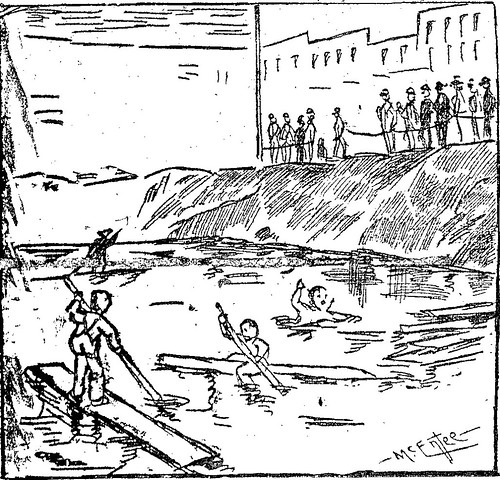
No trace of the old Joplin Hotel remained by late July, 1906.  Excavation was well underway for the new hotel when a summer torrential downpour occurred on July 20.  Over the hours as the rain fell the great pit, from which the Connor Hotel would eventually rise, filled with water.  When the sun rose the next day, to the delight of Joplin’s urchins, a veritable swimming hole at the corner of the city’s economic district reflected the morning light.  Encouraged by the July heat, boys quickly took advantage of the “hotel pool.”

A Joplin Globe article described the enthusiasm of the boys to partake in its cool, wet relief, “The youngsters did not disrobe before entering; such a move would have brought down upon them the wrath of the law.  They simply plunged in, clothes and all, a very few of them removing their outer shirts before the plunge.”  In addition to the swimming and diving, the boys soon discovered wooden boards that were quickly plied into use as rafts.  Envious youthful onlookers, who had failed to secure such craft when the opportunity allowed, willingly paid several cents, upward to a dime, to purchase either a ride on a raft or a raft itself.

Swimming pool at the old Joplin Hotel

A quick sketch of the swimming festivities at 4th and Main

The fun and games did not last forever, at least for a boy named Robert.  His aquatic fun ended upon the discovery of his mother of finding her son, fully clothed, splashing about the rain-filled pit.  The last that was seen of poor Robert was his mother leading him away with a firm grip on his ear.

Source: Joplin Globe

Clothes are like Baseball

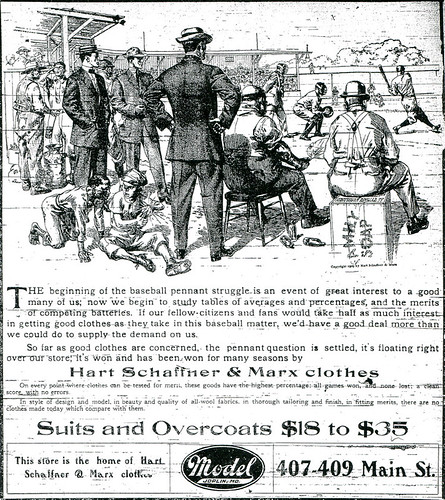
In the bustling boom town of Joplin, businesses needed to advertise, even those located on the prime real estate of the 400 block on Main Street.  Here the Model Company attempts to lure in fans of baseball.  It’s possible, if the drawing was done locally, that one of Joplin’s local fields was the model for this baseball scene.

Model company baseball ad

Baseball is as fertile an advertising ground in the past as it is today.

The Joplin Night Owls

Previously, Historic Joplin has mentioned one African-American baseball team in Joplin’s past, the Joplin Shadies of the 1890’s. This was not the only organized black baseball team, and perhaps it was the successor to a team that played for about half a century.

The Joplin Night Owls of 1910 were considered a championship team of Southwest Missouri. The year before the team had won twenty-six of twenty-eight games, losing only two. Not supported as the Joplin Miners, the Night Owls were forced to practice at the cemetery grounds of South Joplin. Though, an article that year reported an expectation that at some point the team would be able to practice in the “old” Miners Park. The same article announced the manager as Lindley. One of the first games of the season was to be in St. Louis against the Grays, likely the Murdock Grays, who later became the Homestead Grays (a noted Negro League team).

Sources: Joplin News Herald and Negro League Baseball Players Association.

Joplin’s First Florist

Pink rose

Thomas Green, a native of Manchester, England, was reportedly Joplin’s first florist.  He immigrated to the United States in 1867 with his wife, Caroline Hathaway Taylor Green.  The two were married on the Isle of Man and Mrs.  Taylor claimed William Shakespeare’s wife as a distant cousin.  In 1877, The Taylors arrived in Joplin and  Thomas Green bought property in “the western residence district of Joplin.” Within a few years he established flower gardens and later a greenhouse where he raised vegetables.

The glass greenhouses allegedly extended over the entire “half block between Second and Third Streets on Byers Avenue.” He could be seen “early every morning and late every evening working with his flowers.” Green hired Benjamin Crum, who went on to establish his own greenhouse business at the corner of Seventh and Jackson.  Green, it was remarked, supplied flowers for hundreds, if not thousands, of Joplin weddings and funerals.  He was undoubtedly a well known man who provided a service one might not expect in a rough and tumble mining town, but one certainly in demand with the dangers of the mines.

Sources: Joplin Globe, Livingston’s History of Jasper County

Alice Frances Britten, Globe Newsgirl

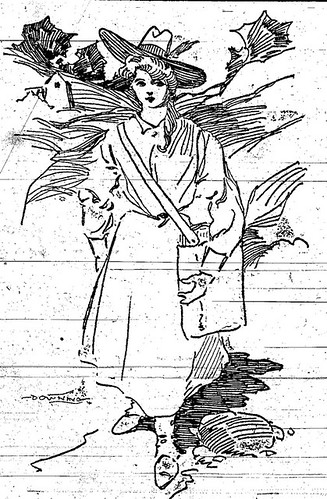
Although we often look back nostalgically on the days of the newsboy, there were also newsgirls, although it “was a department of activity not often invaded by girl folks.” Alice Frances Britten, an eleven-year-old newsgirl, was a welcome sight to the miners who lived in the Castle Rock and Brickyard Crossing neighborhoods of Joplin.  The sprightly young girl, who was described as having bright blue eyes, met the “early morning electric car from Joplin at the crossing between Midway Park and Oakland” to pick up her bundle of papers which she then carried to the homes of “the miners and gardeners of the region.”

Alice Bitten, Joplin Globe newsgirl

A sketch of Alice Britten

Originally from Texas, Britten came to Joplin where she “endured the restraint of city life, and as a result was not strong and rugged a year ago when she first undertook the task of representing The Globe in the Brickyard Crossing neighborhood.” But after a year of delivering the paper in sun, sleet, and snow, she radiated health and vitality.

Her meager earnings were deposited in a savings account “of no mean or inconsiderable proportions” which added “zest and incentive to the long and sometimes tiresome tramp over the narrow and difficult trails of the hill country.” Miners made sure to pay her for their subscriptions which was not always the case of the intercity newsboy who often got ripped off by customers.  She even delivered papers when not attending the Range School where she “fought out the difficult problems of the multiplication table and the nominative case.”

The Globe observed, “It has been said that heaven lies about us in our childhood, and surely this mythical land comes very near the Globe‘s ‘girl newsboy’ as she communes with Nature during these bright spring mornings.”

Four years later in 1910, Alice F.  Britten was living on Royal Heights Road in Jasper County, Missouri, with her parents and siblings.  Her father, William, was a building contractor for mining companies, as were her three brothers.  Her mother, Ida, listed her occupation as a farmer, while her sister, Nora, taught school.  Alice, however, did not have an occupation listed.

In July, 1913, Alice Britten married James Higgins in Jasper County, Missouri, and disappears from the historical record.  No matter where Alice ended up, she surely never forgot her time as a young newsgirl, carrying the Globe to the rough and tumble mining neighborhoods where she was warmly greeted.

Source: The Joplin Globe

Vada Corbus – Joplin Miners catcher

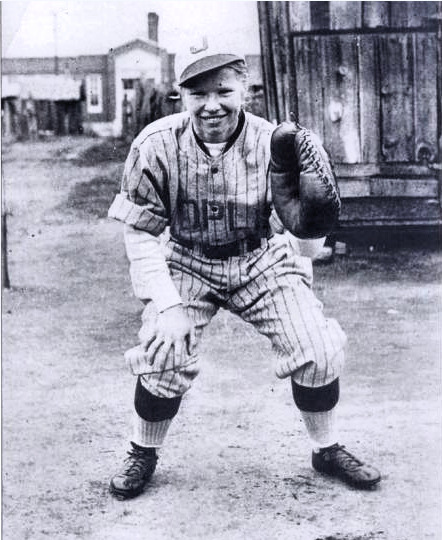
We recently covered Vada Corbus, a woman ballplayer who sought to play for the Joplin Miners.  By the permission of John Kovach, college archivist at St. Mary’s College, we secured a much better photograph of the near trailblazer.  The photograph comes from Mr. Kovach’s book, Women’s Baseball, (Images of Baseball).   For more on women in baseball, check and see if the traveling exhibit, “Linedrives and Lipstick: The Untold Story of Women’s Baseball,” is coming near you (or arrange to have it visit your local museum or history institution!).

Vada Corbus - Joplin Miners

Vada Corbus - Joplin Miners - personal collection of John Kovach.

Source: John Kovach’s “Women’s Baseball.”

House of Lords article in the Joplin Globe

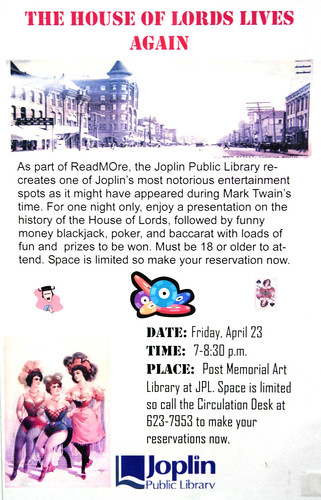
In support of ReadMOre Missouri, a statewide reading program, the House of Lords will be “recreated” at the Post-Memorial Library in the Joplin Public Library from 7:00 to 8:30 pm on Friday, April 23.  While the gambling history of the House of Lords will be brought to life with several games of chance, the focus will be on Mark Twain, the selected author for ReadMOre Missouri this year.  On Tuesday, a living history presenter will channel Mark Twain in a presentation to be given at the event.  For a brief history of the House of Lords, you can read the article at the Joplin Globe here.

House of Lords event poster for Post-Memorial Library

House of Lords event poster for Post-Memorial Library

A Snapshot of Race Relations in Joplin

African Americans played an important role in Joplin’s history.  Although segregation prevailed in the local mining industry, African Americans worked backbreaking labor intensive jobs as hod carriers, day laborers, carpenters, washerwomen, and other less desirable occupations.

Joplin newspapers often echoed the narrow minded racial beliefs of the time by perpetuating common stereotypes of African Americans as criminal, subhuman individuals.  In comparison to some local papers, such as the Stotts City Sunbeam and the Springfield Leader (which was founded by fire-breathing former Confederate Daniel Curran Kennedy), the Joplin papers were fairly tame.  While African Americans were most often portrayed in a negative light by the papers, sometimes a positive story would appear.

It’s often easy to look back over the last century, even two centuries, of American history and fall prey to dangerous generalizations.  This story illustrates that while racism certainly did exist in Joplin, it was not pervasive.

In the early fall of 1906, a crippled black man drove his blind mule along the streets of Joplin.  He was a well known figure as he drove a wagon that carried advertising signs to drum up business for local merchants.  The old man was, “old, feeble, and helpless, and few would take advantage of the poor old man’s infirmities to make him the object of a stinging jest.”

As the man and his mule approached Sixth Street and Moffet Avenue, a group of three white boys in a delivery wagon spied them.  One of the boys shouted, “Whoa there, mule.  Ha ha ha, look at the blind mule.  Look at the nigger.” The other two began laughing which a Globe reporter said, “sound as near like the braying of an ass as anything else.”

The elderly black man sat quietly but onlookers could see that “his feelings were deeply hurt.”

One of the boys called out, “Why don’t you get an automobile?” The other two began to yell when a white miner named Fred Winchel came upon the scene.  Winchel, incensed at the abuse the boys were heaping on the old man, jumped into the delivery wagon and grabbed one of the delivery boys.  He jerked the boy out of his seat and out onto the street.

Winchel growled, “Do you want to fight?” The boy, frightened by the miner, stammered, “N-n-n-no.” Winchel, still angry, snarled, “Then take that you cowardly whelp!” before he slapped the boy viciously on the ear.  The boy’s two companions tried to drive away but Winchel ordered them to stop.  The two boys complied.

Once again Winchel jumped into the wagon and drug the remaining two boys out.  He asked, “Do you want to fight?” The boys, like their companion, replied that they did not.  Winchel boxed their ears and sent them on their way.  He was overheard to say, “I ought to be kicked for not cleanin’ every one of them.”

Source: Joplin Globe

Joplin’s Potter’s Field

“Every wooden headstone in the potter’s field bears a name — some name.  No one guarantees it to be the correct name, but the name is there just the same.”

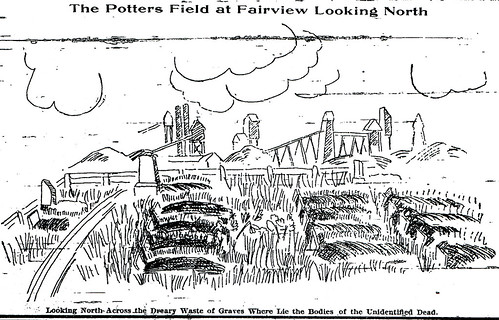
The unknown dead were the unwanted in Joplin just a few years after the turn of the century.  For those who perished in the city, without anyone present to claim their body, there were several cemeteries to be laid to rest.  For those unfortunates who died without any present to witness to their name or identity, a specific place in the earth was reserved.  It was located in Potter’s Field, a traditional name for burial spots for the poor and forgotten.  Joplin’s Potter’s Field was found at the western fringe of Joplin’s westernmost major cemetery, Fairview Cemetery.  There the dead rested beneath a landscape dominated by mines, from the mining houses to the chat piles.  It was a barren and lonely place.

The Potter's Field in Joplin, Missouri

A sketch of Joplin's Potter's Field.

The Joplin News Herald reflected on the visitors to the pauper’s cemetery, mothers in search for sons, brothers looking for brothers.  There was one exception, the News-Herald reported.  Husbands rarely, if ever, sought their wives in Joplin’s potter’s field, though it was surmised that sometimes it was husbands who sent their wives there to sleep amid the mines.

Source: Joplin News Herald