The Coal Pickers of Joplin

In the first few years of the new Twentieth Century, Joplin was a bustling and growing city.  New mines brought new wealth, and fortunes were made by men who operated businesses that serviced the mining industry.  The wealth did not reach all of Joplin’s residents.  Among the misfortunate were the coal pickers:

“The coal pickers of Joplin come from the classes of people who do not submit to the toll of the mines or mill, but depend upon chance employment…and live usually from day to day.”
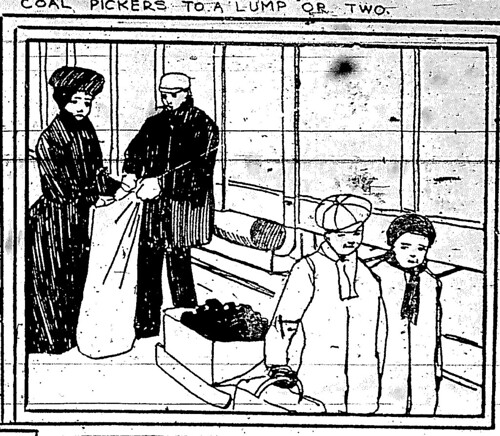
Coal Pickers of Joplin, Missouri

Coverage of the entrepreneurial poor by a Joplin Globe reporter noted the existence of two types of coal pickers.  There were those who operated at night and those during the day, and primarily, a difference between honest and not so honest.  In Joplin, it was legal to pick up coal that had fallen from coal cars, but not to take coal directly from the cars.  Those who wanted more substantial hauls often climbed into the cars at night with sacks to fill for profit.  The reporter noted that the worse the weather, be it blizzard or thunderstorm, the more likely the devious coal pickers were to swarm into the rail yards in search of unguarded coal.  Accordingly, the yard watchmen were forced to go out into the night when the elements were at their worse to assure the safety of the coal laden cars.

The “night pickers” as they were described, usually emerged after midnight.  One described pair was a father and son.  While the father climbed into the car and helped himself to large sacks of coal, his son darted back and forth along the tracks with a wary eye and ear for a patrolling night watchman.  As the sun began to rise, other coal pickers arrived.

“Sometimes it is a small boy whose father has passed away, sometimes the girl who wants to help mother earn a livelihood either by providing fuel or by selling it and turning the money into the maternal treasury.  Sometimes it is an old man, aged, bent, long past the years of active labor, or, saddest of all, a woman whose life sun is nearing the western horizon.”
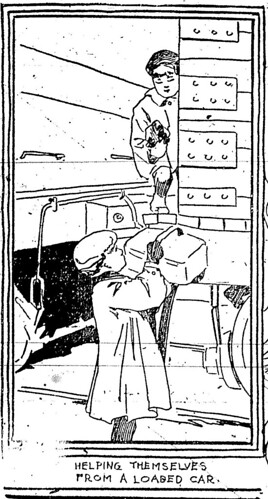
Coal Pickers of Joplin Missouri

The early hours of the day reportedly were the best for finding coal, often accidentally spilled from the cars by the “night pickers.”  The other coal came from the bumps in the track as the trains slowly made their way through the city.  Another source were the brakemen of the trains, who gazed upon the coal pickers with pity and on occasion walked across the top of the coal cars, and absently knocked off coal with their feet in the progress.  When questioned, one brakeman vehemently denied the act, but did so with a twinkle in his eye.

Of the coal pickers described by the reporter, two were an elderly couple.  The old man crawled about the cars to reach coal on the ground and handed them to his wife to place in a basket on her arm.  Another coal picker was a young boy who led a dog who pulled a small cart.  This boy was interviewed by the reporter and spoke of his Dickensian tale:

“You see, father’s dead and mamma’s been sick for a long time, so she couldn’t work.  Sister does the dishes for some of the neighbors, and runs errands, and makes about two dollars a week.  I make about four dollars picking coal, and that keeps us.”
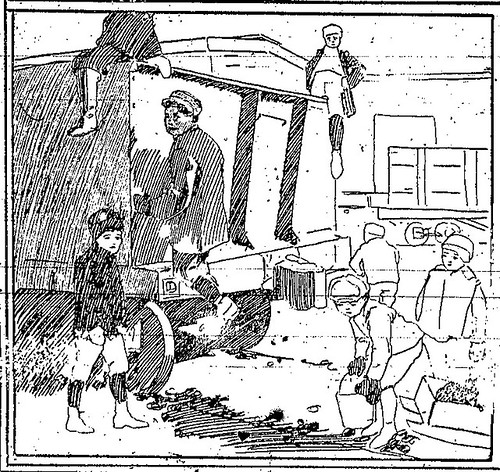
Joplin Coal Pickers

Some coal pickers found customers on South Main Street amongst the restaurants.  One restaurant owner claimed that the difference between buying coal from a coal picker or one of the coal companies was purely sentiment. “My coal costs me as much as anyone in the city…paying it to the coal dealers or to these people who actually need the money.  I give mine to these needy people.”

The two most popular spots for the coal pickers were the switch tracks at the Kansas City Bottoms and Smelter Hill, the Tenth Street yards, and the freight yards south of Tenth Street and west of Main Street.  Coal cars still rumble through Joplin to points north and south. The less fortunate of Joplin’s residents no longer stalk the rail yards in search of coal as the day of coal in homes and restaurants has long since vanished.  The coal pickers of that time were considered part of the “other half,” the poor and the impoverished, whom the daily citizen barely gave a passing glimpse.  As the Joplin Globe chose not to ignore them, it’s just as important for our study of Joplin’s history to cover them as all residents of Joplin’s past, whatever their socio-economic status, deserve the chance to be remembered.

Source:  Joplin Globe
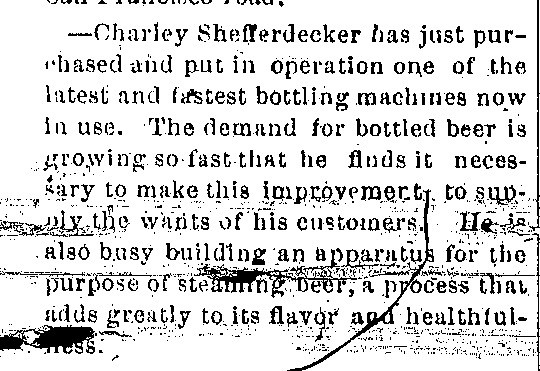
Charles Schifferdecker: Bottling Beer Even Faster

Charles Schifferdecker was one of the richest men in Joplin and his elaborate red stone home still stands. A source of his wealth was beer and this article from 1880 notes Schifferdecker’s purchase of a new bottling machine due to high demand of the young mining town.

Schifferdecker bottling machine article

Article from the 1880 Joplin News Herald

Source: Joplin News Herald

A Haunting in Joplin

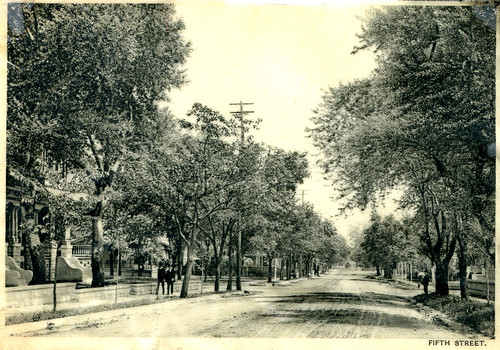
A typical Joplin residential neighborhood

A typical Joplin residential neighborhood

Some Victorian Americans participated in palmistry, séances, hypnotism, and several strains of spiritualism.  Despite this predilection for the occult, one rarely finds stories of ghosts or haunted houses in the early Joplin newspapers, although palmists and psychics would occasionally set up shop in town.  The morning after Halloween, the newspapers often mentioned pranks that had taken place, such as taking someone’s gate off its hinges and hiding it.  Perhaps Joplin was still too young to have ghost stories.

One of the few stories we have read in the papers is the story of a house that stood at the southeast corner of D and Wall streets.  Numerous former residents alleged that they heard “sounds weird and strange, which could only have been made by inhabitants of the spirit returning to earth.” Its reputation had left it neglected and forlorn.  The house sat the center of a fifty foot lot and stretched “from within about ten feet of the front walk to the rear fence, and is constructed in such a manner as to appear winding, the rooms being set in and out from a line connecting the center of the two ends of the building.” A front porch post had fallen.  Grass and weeds surrounded the house.

Neighboring residents used the house as a threat when faced with an unruly child.  When threatened with spending a night in the house, most neighborhood children “ready and willing to do most any task imposed on them or to comply with any request of their parents.”

Some people insisted the noise came from a large family of rats that had taken up residence in the house.  A reporter from the Joplin News-Herald spent the night in the house.  He reported that, “When all was still and quiet a sound as of a body falling to the floor caused a dull thud that sent the blood coursing through the arteries of all those sleeping in the house.” A search of the house turned up nothing.  Doors were heard to squeak as if they were being opened, but upon checking, the reporter and his cohorts found the doors were still securely looked.

Neighbors remarked that “there have been tow to five tenants each month, and most them have left with tales of hair raising experiences.” A woman interested in living there, however, told the reporter, “If the ghosts are real ones, the gun will not hurt them and if they belong to this earth, the gun will soon put a stop to them.”

Source: News-Herald, 1906

Globe Article Covers the Closing of Howsmon’s

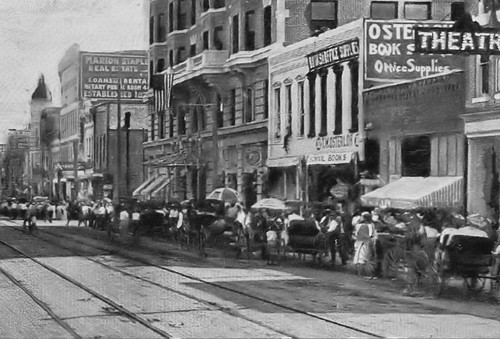
Last Friday, the Joplin Globe covered the shuttering of Howsmon’s Office Supply and Furniture Company, a 47 year old business.  As the article notes, Howsmon’s began with the purchase of Spurgeon’s Bookstore, which originally was Osterloh’s Bookstore that had opened in 1890.  Osterloh, in addition to selling books, was also an avid photographer and is responsible for a number of early Joplin photographs.  While Howsmon’s didn’t remain in the original building for long, Osterloh’s bookstore was located on the 300 block just a few yards north of its towering neighbor, the Connor Hotel.  Below is a photograph capturing a busy day in front of the bookstore:

Osterloh's Bookstore

Osterloh's larger sign, obstructed by its neighboring theater's sign, advertised book and office supplies. The structure two buildings down is the Connor Hotel, dating this photograph after 1908.

Source: The Joplin Globe

Memorial Day in Joplin

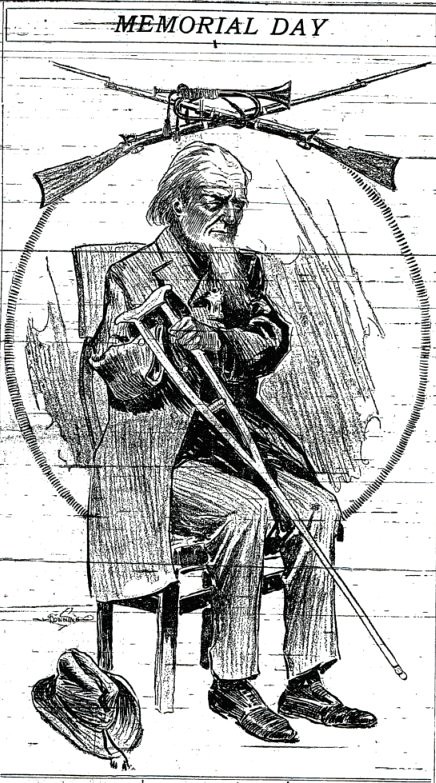
An illustration in a 1907 Joplin newspaper celebrating Memorial Day.  True to the holiday’s origins, it’s a sketch of a Civil War veteran.  Joplin had a unit of the Grand Army of the Republic and was home to a number of Civil War veterans.  We at Historic Joplin thank all our veterans for their service.

Joplin Memorial Day illustration

Joplin Memorial Day illustration

Source: The Joplin Globe

Joplin’s First Religious Services Were Held in a Saloon

Sometime in 1872, a group of citizens stood on Joplin’s muddy Main Street and discussed what measures could be taken to improve the community. Numerous suggestions were made when at last someone suggested that Joplin should have a church service.

Kit Bullock, half owner of the Bullock & Boucher saloon located on north Main Street jokingly suggested that, “they could hold church in his saloon.” What Bullock did not know is that one of the men standing in the group was a Methodist preacher. Upon hearing Bullock’s remark, the Methodist evangelist stepped forward and introduced himself as “Rev. Smith from St. Louis” and then told Bullock, “Now, sir, if you are as good as your word, I will conduct church services tomorrow and will be grateful for the use of your building.”

True to his word, Bullock cleaned up his saloon. Liquor bottles were taken from the shelves and candles put in their stead. Kegs that were not stowed out of sight were used to hold up pine boards as makeshift pews. When the next morning came, Rev. Smith found several earnest congregants gathered to listen to his sermon. The evangelist’s message went unrecorded, but according to the News-Herald, “From that first service who can tell what results have sprung up, for an interest was created, an ambition was awakened, that was never stilled until a house of worship was added to the other buildings that were spring up. The years have passed and the interest has never died, but has flowed on and on.” By 1902, Joplin was home to at least twenty-five churches.   Some of those churches still remain, others have replaced them, and while no longer a church meets in a saloon, one does meet in a movie theater.

Source: Joplin News-Herald

Joplin’s Flatiron Building Problem

When construction on New York’s iconic triangular Flatiron building was completed, pedestrians noticed that the shape and location of the building created strong, gusty winds. In 1907, Joplin residents experienced their own version of the Flatiron’s freak winds.

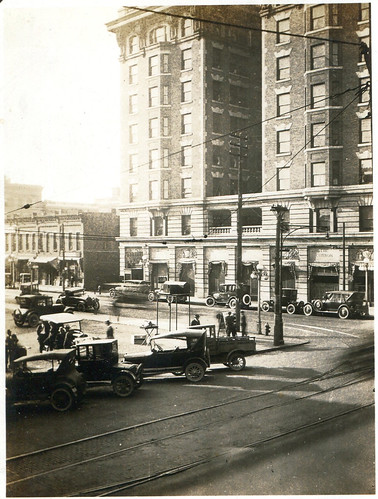
The intersection of Fourth and Main

The windy intersection of Fourth and Main

After the completion of the New Joplin Hotel (later known as the Connor Hotel) at the corner of Fourth and Main streets, strong winds wreaked havoc upon all who dared to pass by. As a reporter observed, on “calm, still days the wind blows in savage gusts around the corner of the new hotel at Fourth and Main and on windy days a veritable hurricane rages up and down Main street and the side streets that lead to Joplin’s ‘flatiron’ corner.”

He described the daily scenes as thus, “All the sights that are seen in New York on a windy day may be seen at the corner of Fourth and Main streets. The variegated display of hosiery, coattails flapping in the ungentle zephyrs, men chasing their hats, and everybody walking either like they were drawing a heavy loaded cart or if they chance to be going with the wind, moving with accelerate step, may be seen.”

On one day blustery day, the wind blew twenty wagon loads of dry sand up and down the nearby streets. The sand, which was to be used on the hotel site, was a total loss. “Flags and banners put up around the corner were whipped into threads by the blowing wind, and loosely nailed board signs were hurled to the street.” Women and girls held onto their skirts to keep them from blowing up and were forced to fix their hair after passing through the area. Men quickly learned to remove their hats, lest it be blown away, as with one man who watched as his prized hat was snatched by a young dog as the hat rolled down the street. One African American workman claimed that the wind was so fierce that he had been pinned up against the building.

The reporter remarked to a nearby workman about the wasted sand, but the workman just shook his head. “No; it isn’t that, but how do you think we can get men to pay strict attention to their work when there are so many funny sights in the street below?”

The wind held the advantage of surprise. It was not a steady, consistent wind. Instead, it gusted in sporadic bursts that caught pedestrians by surprise. “When the wind is from the south in most parts of town, it may be blowing from the north at Joplin’s ‘flatiron corner.’” In one case, a horse powered delivery wagon became unmanageable due to the wind. The young boy in charge of the wagon tried to hold on to both his hat and the horse, but as he did so, he accidentally backed the wagon into a buggy. This caused two street cars to stop, creating a traffic jam that took some time to straighten out. Unfortunately for the passengers in one of the street cars, the windows were down. Sand and dust blew in, creating a wall of blowing grit, sand, and dirt that stung their faces.

Unfortunately, with the demolition of the Keystone Hotel, the Connor Hotel, and the Worth Block, we modern day residents and visitors to downtown Joplin will never have the same blustery experience as the folks who traveled the streets of post-1907 Joplin.

Hello Girls Go On Strike!

Hello Girls

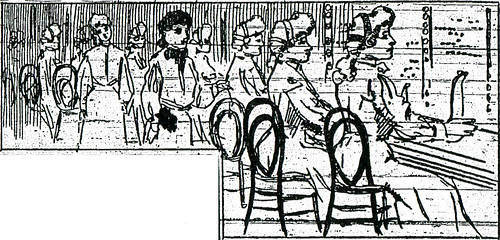
Hello Girls, which we have written about in previous posts, were known for their helpful and sunny disposition. Occasionally they found a reason to strike. In one instance that occurred in 1902, the sixteen day-shift Hello Girls employed at the central office of the Mineral Belt Telephone Company went on strike. Callers from 7:00 to 7:25 p.m. were undoubtedly confused when they picked up the phone and found that no operator could be reached.

Did they strike because of poor wages, low morale, or chauvinist bosses? No. They went on strike because the company hired one Winnie Arnold. Miss Arnold was a “blonde young lady from South Joplin. It was on her first night shift that her would-be colleagues decided, “her society was not acceptable to us, although she does work at night. We are endeavoring to keep within our ranks a class of workers, who are patient to all the whims of the patrons of the telephone.” After complaining about Miss  Arnold to the company’s superintendent, he promised, “she could work no longer.” Presumably she was asked to leave the company’s employ and found work somewhere else.

While just a brief episode in Joplin’s history, the article provides some insight into the social class thinking of turn-of-the-century Joplin society. Young men and women who did not meet the societal standards of Victorian America could expect to be frowned upon by members of the middle and upper classes. The best society women did not work, but for those young women who did seek to earn a living, a desk job under the watchful eye of male managers provided a safe and morally clean environment. Those who could not meet the social and moral code of the day were not tolerated, lest their influence corrupt or taint their fellow young women.

With the coming of women’s suffrage, prohibition, World War I, and the swift pace of change during the 1920s, life changed dramatically in the next few decades for women.  Such fears over the influence of individuals from one class or another, good or bad, waned.  The result was a post-Victorian society that has evolved into the present day.  Hopefully, the South Joplin girl was able to find a new job with better coworkers.

The Joplin Carnegie Library and the Origins of Joplin Public Library: Part Two

Under a bright October afternoon sun, a crowd of ten thousand gathered to watch a parade snake its way from Fourth and Joplin streets to Main Street.  It turned under the watchful gaze of the Keystone Hotel and then proceed south to Ninth, where it turned again to the right and came to a stop at Ninth and Wall.  It was October 8th, and the people of Joplin had come to celebrate the laying of the cornerstone of the new Carnegie Library.

The parade had formed at 2:30 pm and consisted of a number of different groups.  In the vanguard was Police Chief Jake Cofer with a platoon of police officers.  Behind the police, the South Joplin band played and stomped in celebration, and were followed by 66 members of the Knights Templar from Joplin and the surrounding area.  The contingent of Knights Templar was outnumbered by the 151 members of the Masonic Blue Lodge.  Behind the Masons came 2,386 excited school children, headed by 29 high school students and teachers, walked four abreast down the city streets.

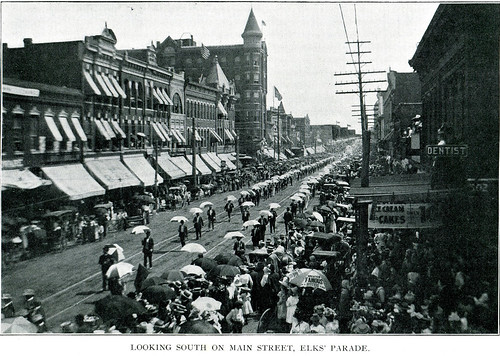
An Elks Parade on Joplin's Main Street

A different parade, but an example of a parade down Main Street and how the Elks might have marched that October afternoon.

Behind the flood of children came 24 grey headed members of the Grand Army of the Republic from  Joplin’s O.P. Morton Post. As in 1865, the veterans marched proudly behind a cherished battle flag.  Approximately 60 individuals of the Elks and Eagles followed the veterans and then bringing up the rear were thirty members of the Knights of Pythias commanded by Joplin attorney Joel T. Livingston.

Thousands surrounded the construction site of the library.  The limestone walls soared over the crowd, such was the progress that had been made since Augustus C. Michaelis was selected as the architect in February.  A platform rested against the side of the building next to where the cornerstone was to be laid.  Children, anxious to see the ceremony, climbed the surrounding trees and hung perilously from branches.

A band took up position beside the platform while the mayor of Joplin, John C. Trigg, climbed onto the platform to address the crowd.  His speech, the lengthiest of the day, began with the origin of the movement for the library.  The mayor boasted that the tax revenue from property valued at $4,000,000 was more than sufficient to support the library, but also noted that it had not been enough for the construction of the building.  For this, Mayor Trigg credited industrialist Andrew Carnegie who, “came to the rescue and dissipated all doubts and disquieting fears.”  Trigg continued:

“No event in the history of the city of Joplin will perhaps stand out in bolder or more prominent relief in the future than the laying of the corner stone of the Carnegie public library building…It should be accentuated as a distinct epoch in the annals of the city, from which to date as from the dawn of the new century, an augmented zeal in the material, moral and intellectual improvement of our people of all classes and conditions…”

After the mayor established the effect of the library on the city, he then described the benefit of books, “The inestimable value of books is no longer a vexed or mooted question.  The wise, the good and the great of all ages and nations, divines, poets, philosophers and statesmen, have contributed the most cogent and convincing testimony in support of the premise.”  Trigg went on, reading excerpts from such authors as Joseph Addison, Richard DeBury, and Louisa May Alcott.  Finally, and perhaps to the relief of some in the crowd, the mayor concluded his speech.  This was followed by a brief rendition of the song, “Remember Now Thy Creator,” that setup the next speaker, Reverend Paul Brown.  Brown was a substitute for Judge Picher, who had been unable to attend the ceremonies that day.

Reverend Brown reflected on the origin of free libraries and then spoke of libraries as essential to democracy:

“What is the end of democracy?  I answer the end of democracy is a natural aristocracy.  There is an aristocracy of nature which no contract or statute can ever abolish….Here in the district, our chief industry, mining, weeds out weaklings and cowards, and creates a natural aristocracy of physical courage and vision in the depths of the earth.  Now what does democracy guard against?  Not natural aristocracy, but artificial, the aristocracy of mere birth or place or force or accident.  Democracy means that equality of opportunity which will give the natural aristocracy a chance.”

It was books, Brown argued, that provided the opportunity for men to overcome the privileged aristocracy who were born to fame, title, or fortune.  Brown, after noting famous authors of history, praised the city’s superintendent, J.D. Elliff, whom Brown stated, had played the crucial role in seeing the library created.  Brown soon concluded his remarks, followed by a song from the band, and again, when the time finally came for the actual laying of the cornerstone.

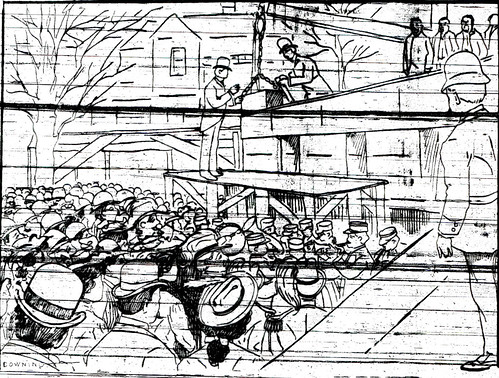
Laying of the Joplin Carnegie Library cornerstone

The laying of the cornerstone of the Joplin Carnegie Library.

This august moment was overseen by the Most Worshipful Grand Master of the Masons, John C. Yocum.  The Grand Master announced the placement of the cornerstone, as it was guided by a small crane and lowered carefully into place.  An invocation was given by the Mason’s Grand Chaplain, who was accompanied by the Masonic ceremonies of deposit and consecration.  One last speaker arose, Dr. W.P. Kuhn, a senior grand warden of the Masons from Kansas City.  Dr. Kuhn opted to win the crowd through praise of the children present, as well a quick joke about Methodist and Presbyterian preachers:

“ The Methodist preacher never prepared a sermon or at any rate never had any reference notes, but his services were largely attended, while the Presbyterian divine labored conscientiously over his discourses, wrote them painstakingly out and read them with painstaking fidelity.  But, his flock was few, and in a spirit of discouragement he came to the Methodist preacher and asked him why it was that the people crowded to hear him who never prepared a sermon while his own church was all but empty.  And the Methodist replied, “My good friend, you write out your sermons and the devil is right there behind you.  He knows every word that you’re going to say and he is able to circumvent every effort you make, no matter how praiseworthy.  Now I don’t know what I’m going to say and I know the devil don’t know what I’m going to say either, and that’s the difference between us.”

Dr. Kuhn concluded by stressing the importance of free libraries, as they were part of the “three planks that the structure of every American community is founded.”  The other two planks were free thought and free speech.  Immediately after the crowd sang, “America,” and the cornerstone laying ceremony ended with a benediction offered by the Rev. Charles A. Wood.

With the cornerstone laid, construction on the library resumed.  The building incomplete, the actual Joplin library, which was already in existence was housed at the Joplin high school and overseen by Lucile Baker, the first librarian.  Ms. Baker was a writer for the Joplin News-Herald and used the byline of “Becky Sharp” in a nod to Missouri’s own Mark Twain.

The library was finally completed a year later.  The city received its first check from Andrew Carnegie at a sum of $5,000.  Twelve years later, the city sought and received another $20,000 from the generous benefactor for an addition to the west side of the library.  In charge of the library, now at home in its new building, was Mary B. Swanwick, who was joined by assistant librarians Blanche Trigg, Mary Scott, and Hattie Ruddy Rice.

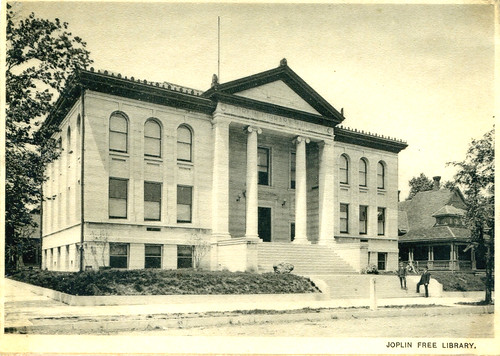
The Joplin Carnegie Library

The Joplin Carnegie Library not long after completion.

As of 1911, the library had 15,737 books as well as 2,643 magazines and periodicals.  Over the year, over ten thousand people used the library, around 1/4th of the city’s population, and almost 65,000 books were circulated.  Active card holders numbered almost 7,000.  Ten years later, the head librarian, Swanwick, passed away and was eventually replaced by Blanche Trigg, daughter of Joplin Mayor John Trigg. She oversaw the institution until 1949.  It was under the oversight of Trigg’s successor, Margaret Hager, who helped lead the movement in the 1970s to purchase the Connor Hotel and the rest of the 300 Block as the site of a new library building.  That building, the present home of the Joplin Public Library, opened in April, 1981.

Sources: Joplin News Herald, Joplin Globe, “A History of Jasper County, Missouri and its People,” by Joel Livingston, and Missouri Digital History.

That Froggy In the Window

Window shopping in early Joplin was undoubtedly entertaining. The Model clothing shop, Christman’s and Newman’s Department stores, T.W. Osterloh’s bookstore and bicycle shop, just to name a few, offered passersby a tantalizing look at shiny, new goods.

Bullfrog

A common bullfrog

The Saddle Rock Café, however, had perhaps the most mesmerizing display in the summer of 1905 when owner Dick Lapham put seven dozen bullfrogs in a water-filled zinc tank in the front window of the café. Pedestrians on Main Street stopped to gawk at the sight. For those in the mood for frog legs, they could choose their own from the tank to be prepared by the café staff. Lapham told a News-Herald reporter that he caught them six miles south of Joplin on Shoal Creek.

Conservation laws aside, it might seem unusual to hear that someone had caught that many bullfrogs today, but it was not uncommon for the Ozarks to send sack loads of bullfrogs to distant cities like St. Louis to fill the ravenous demand of city dwellers. For those in Joplin, though, all they had to do is mosey down Main Street.

Source: News Herald