Joplin Museum Complex Boards to Sit On Question of Union Depot

We mentioned earlier today that City Manager, Mark Rohr, was to give a presentation to the boards that oversee the Joplin Museum Complex on moving from Schifferdecker Park to a restored Union Depot building. Thanks to Morgan Schutters, of KODE tv, we now know how the meeting unfolded.

In the presentation, Mr. Rohr estimated the budget for the restoration of the building and associated costs would be around 7.7 million dollars. Of that 7.7 million dollars, no new taxes would be required (unlike the Joplin Museum Complex’s failed attempt to take over Memorial Hall) and it would be funded entirely by existing sources. Much of this would be done using currently available tax credits. Even more importantly, after the planned restoration of the Depot, the building would qualify as a Smithsonian approved museum. We belief, but have not yet confirmed, that this is related to the Smithsonian Affiliation program – in which museum affiliates are eligible to host Smithsonian exhibits and collections. To do that, the Smithsonian requires the museum to be:

“…a viable institution, capable of caring for, protecting, and exhibiting collections in a manner consistent with the standards set by the American Association of Museums, and meeting specific requirements for long-term care and maintenance of Smithsonian collections, as set forth in the Smithsonian’s Collections Management Policy.”

(This status, one would presume, should ease the fears raised by Museum Director Brad Belk last year on the ability to safeguard the JMC’s collections (currently collecting dust and cat hair in the current location).)

Quoted in the report, board member Angie Besendorfer, implied that “a lot of questions” still need to be answered before the boards could make a decision. Likewise, the board told Mr. Rohr that it would need more time to think about the issue.

Should the boards decide to agree to the plan to move the museum into a renovated Depot building, we will be wonderfully and happily surprised. However, we fear that the board members made their minds up quite some time ago. If they haven’t, we urge all those who want to continue to see Joplin move forward on the rise, to once again believe that better days are still ahead, to speak up and out. If you know a board member, tell them you support the move to the Depot. It is an urgent issue which has been delayed for too long, and as Mr. Rohr noted in the meeting, time is running out on the means to make it happen without extra cost to the city and her residents.
Joplin City Manager to Address JMC Boards

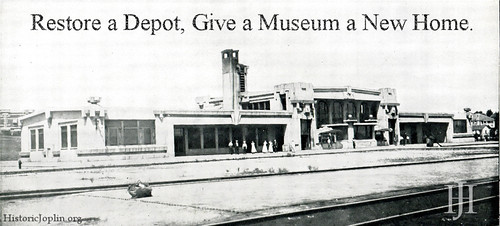
A step forward or a step backward may be the result of today’s meeting of City Manager Mark Rohr and Architect Chad Greer, with the boards of the Joplin Museum Complex. As reported here in the Joplin Globe, Rohr and Greer will put on a presentation with the hope of convincing the board members to affirm the hope of moving the Joplin Museum Complex to a restored Union Depot.

We wish Mr. Rohr the best of luck, but given the past attitudes of the board members, as well Museum Director Brad Belk, the presentation will likely be falling on deaf ears. While the city controls the purse strings which fund the museum, the city council so far has been unwilling to exert much in the way of pressure on the museum on what would be a spectacular combination of locating Joplin’s history inside Joplin’s history.

The reluctance to use the Depot as a new home for the museum stranded on the edge of town is akin to the same apathy which resulted in the destruction of many of Joplin’s most treasured architectural features. It’s far easier to cast an old building onto a rubbish heap to join others than to envision it as part of a brighter and more imaginative future of the city.

Patrick Murphy Living History Event, March 17, 2011

For those of you who might want to learn more about one of Joplin’s most successful Irish immigrants, The Dream Theatre Company and Historic Murphysburg Preservation Inc, will be putting on a living history event on the life and times of Patrick Murphy tonight from 5:30 to 8:30 pm at the First United Methodist Church and the Olivia Apartments.

For more details, check out this link.

Joplin Celebrates St. Patrick’s Day


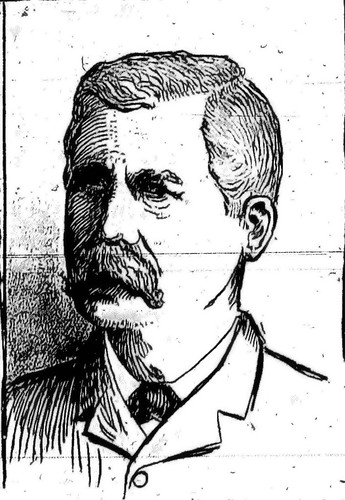
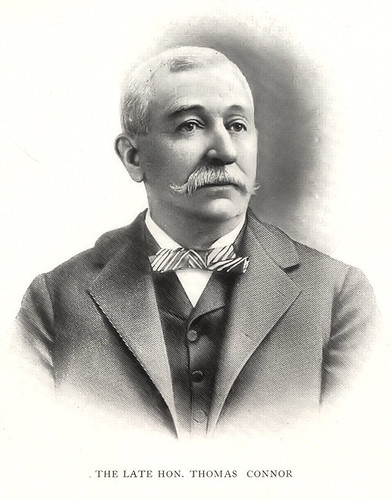
Thomas Connor, an immigrant from Ireland, was one of Joplin's wealthiest citizens.

With sons and daughters of Ireland calling Joplin home from its earliest days, it’s not surprising to know that the celebration of St. Patrick’s Day is more than a hundred years old in Joplin.  The Joplin News Herald noted the events held on March 17, 1908 and claimed that the day began with a “typical Irish fog enwrapping the city,” with every flag pole decorated with the Irish flag.  Thousands of green shamrocks decorated the lapels of Joplinites across the city, the paper declared.

In describing the events, the News Herald noted, “The Irishman lives everywhere, and everywhere has he well-wishers who long with him for the time when oppression and wrong in his native soil will cease to be and the Emerald Isle return to the control of the native son.”  I

Beyond political discourse, the paper reported that the Irish and those who intended to celebrate the day with them, were to attend an observance at a “little old church that was the religious home of Joplin Catholics for so many years.”  The program consisted of a boys’ choir singing “God Save Ireland,” the Catholic priest, Father Clinton singing “The Wearing of the Green,” and a instrumental selection from Miss Margaret Williams, Masters William and John Joseph Hennessey.

Patrick Murphy, also an Irish immigrant, was the benefactor and namesake of Murphy Park.

The instrumental was then followed by a recitation by a Father Lyona, another song, “Then You’ll remember Me” by Miss Anna Toohey, a selection from Mrs. E.F. Cameron, a song from Mrs. Will Moore, another instrumental, “The Irish Dance” again from Ms. Toohey, “The Irish Immigrant” by Mrs. W.F. Maher with another recitation from Father Lyona, “Kathleen Mavourneen” sung by Mrs. Kachelski; a concertino solo and song by D.M. Sayers, and concluded with the boys’ choir singing “My Country Tis of Thee.”


Happy St. Patrick’s Day!


Source: Joplin News Herald

Local Restaurateur Seeks Historic Menus

As previously reported,The folks behind the Cafe on the Route in Baxter Springs will soon open a new restaurant in the Gryphon Building. The Gryphon building, also known as the Bagcraft Building, once housed Joplin’s bustling Inter-State Grocery Company. The proprietors of the new eatery are looking for old menus from Joplin’s past so that they can get ideas about possible menu items. If you have an old menu sitting around, be it from the Connor Hotel or Hidden Acres or another historic Joplin restaurant, that you would be willing to share, let us know.  You can either comment here or send an email to our address under the About tab at the top.  Thanks!

A Business Man at the Connor

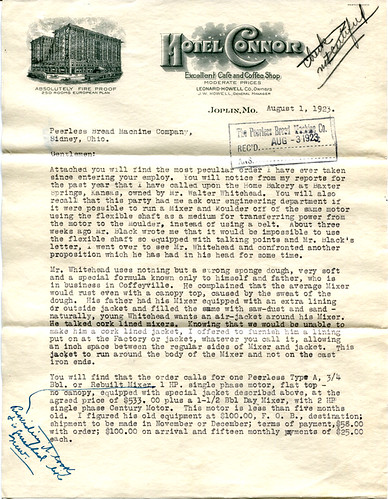
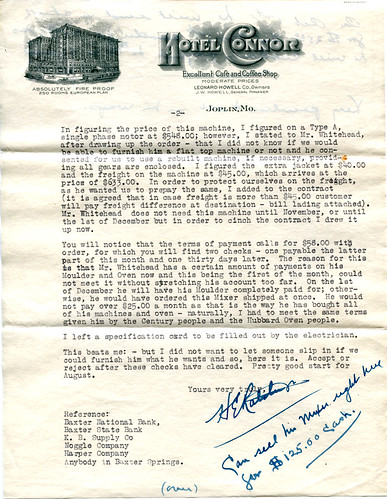
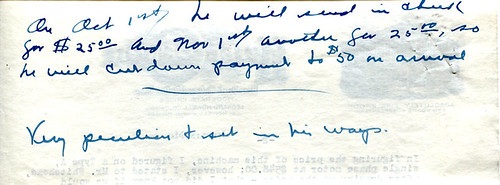
The gift of a donor, below you will find a letter written by a traveling business man from the Peerless Bread Machine Company of Sidney, Ohio.  The letter, presumably written on a portable typewriter, was typed on Connor Hotel letterhead in 1923.  As the premier hotel in the region, or as some might argue, the entire Southwest, the Connor was a customary stop over for business men like the writer of the letter.

Click on the Image for a larger version

Click on the Image for a Larger Version

Click on Image for Larger Version

The Love Pirate and the Bandit’s Son by Laura James – Review

The Love Pirate and the Bandit’s Son: Murder, Sin, and Scandal in the Shadow of Jesse James by attorney Laura James was published in 2009, but we thought we would mention it because the book contains a detailed look at one of Joplin’s lesser known scandals involving one of the most influential men in early Joplin history.

Zeo Zoe Wilkins was a charming osteopath who also a cunning opportunist. Her prediliction for marrying men, taking their money, and then divorcing them led some to call her a “vampire.”

After meeting 72 year old banker and former Joplin mayor Thomas W. Cunningham, Zeo Zoe sought to marry him and, in the process, seize his assets for herself. There was only one problem: Thomas had a common-law wife, Tabitha Carr Taylor Cunningham. Zeo, however, pushed ahead with her plans and married Cunningham. She kept him sequestered away from his friends, took over half a million dollars in cash, sold his bank to a rival, and disposed of his real estate holdings. Cunningham launched a divorce suit, claiming he was Zeo’s slave. In the end, the marriage was anulled. Zeo Zoe received a generous settlement while Cunningham returned to Joplin and to Tabitha. But Zeo Zoe’s story did not end in Joplin. She continued her scandalous ways until she met a brutal end in Kansas City. Her murder was never solved, but among those suspected of killing her was her one-time lover, Jesse James, Jr.

Despite the campy title, Laura James has produced an entertaining and well documented narrative account of Zeo Zoe Wilkin’s sinful life, and in the process has provided an in-depth look into one of Joplin’s lesser scandals that, for a brief moment in time, captured the nation’s attention.

Joplin’s Historic Districts

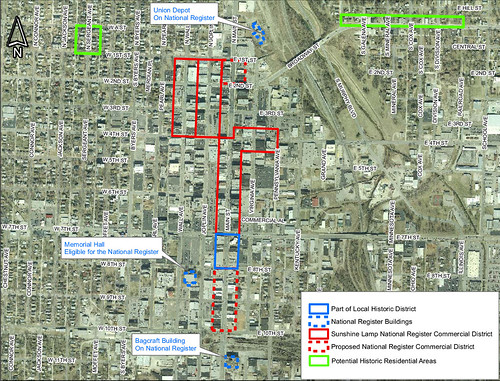
Last month we were greeted with the good news that the Missouri Advisory Council on Historic Preservation had approved 21 buildings in the 800 to 900 block of Main Street for registration on the National Register of Historic Places (it requires a final approval in D.C. from the keeper of the National Registry).  Later this week (hopefully!), we’ll bring you news and information on Joplin’s next proposed historic districts.  Until then, here’s a chance to understand where Joplin’s current historic districts are located, as well proposed districts.  For a larger view of the map, just click on the image. (Then click on the Back button on your browser to return here)

The Estimable Mr. Worth

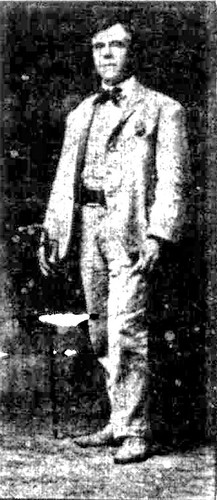
Jimmy Worth

Joplin’s flamboyant James “Jimmy” H. Worth, who was known to periodically advertise for a wife, announced to the Joplin News-Herald that he was returning to his farm in Franklin County, Indiana, to solve a mystery. Worth, in addition to his property in Indiana, was the eccentric owner of the Worth Block which is now the site of Spiva Park at the northeast corner of Fourth and Main streets.

Worth’s one hundred and fifty acre farm was planted in cherry, apple, peach, and pear trees. Perhaps more notable was the large cave located on the farm which, according to Worth, “ticks, ticks, ticks, just like a monster clock, day after day, year after year.” Previous attempts to explore the cave beyond three hundred yards ended prematurely due to bad air which Worth said made “one’s breath come in painful gasps.” But the bad air was not enough to stop at least one brave creature from calling the cave home.

Worth claimed “a big bear that escaped from a wrecked train ten miles from my farm once took refuge in the cavern and for weeks the natives of Franklin County enjoyed daily bear hunts that netted them nothing, for the big brute was successfully concealed in the far corners of the cave, the ominous clock-like ticking, apparently, holding no horrors for his bearship.” It was later discovered and removed from the cave.

Jimmy asserted his belief that the ticking noise was not the result of dripping water as the cave was reportedly dry. Instead, he claimed that the cave was the artificial construction of “cave-dwellers centuries ago” based on broken flint projectiles, bones of animals, and what Jimmy thought was a “deformed human skull.” He declared he would find out what types of bones were in the cave and discover the source of constant ticking.

If Jimmy did find out what caused the ticking noise, the News-Herald must have found his explanation dull, as it failed to report Worth’s findings.


Source: Joplin News Herald

February Joplin Metro Magazine History Offerings

The Joplin Metro Magazine has a couple offerings in the area of Joplin’s history for the February issue.  Perhaps its biggest piece covers the history of the Joplin Little Theater.  In operation since 1939, the Joplin Little Theater is purportedly the oldest running community theater west of the Mississippi.  The other facet of Joplin history presented concerns some of Joplin’s residents who have gone off to find a fortune in Hollywood, including the well known Dennis Weaver.  No stranger to Joplin after he found success, Weaver was more than happy to film commercials for Missouri Southern State University, which he had attended when the school was known as Joplin Junior College.

Joplin Metro Magazine can be found for free at various business locations around Joplin or you can read it online here.