Renovated Union Depot Proposed Home For Museum

At last night’s City Council meeting, City Manager Mark Rohr proposed that the Union Depot be renovated to be used as a new home for the Joplin Museum Complex. As covered by the Joplin Globe, Rohr believes that existing sources of funding exist and as a result, no new taxes would be required for the project.

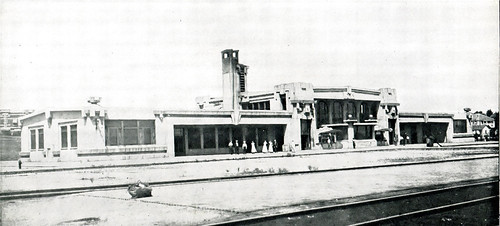
Joplin Union Depot

The Joplin Union Depot not long after it was opened. A great future home for the Joplin Museum Complex.

We, here at Historic Joplin, strongly support this proposal.  We hope that it becomes reality and that someday in the near future, we can walk in and enjoy a beautifully restored depot.  Even though the Carnegie Library appears not to have been part of the new plan, we hope it too has a bright future.

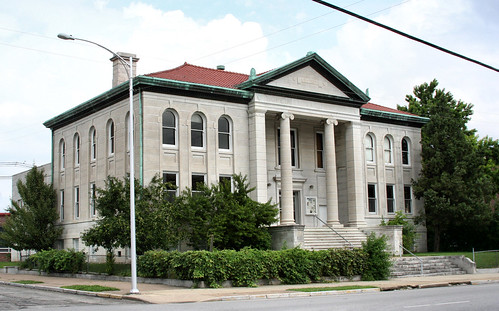
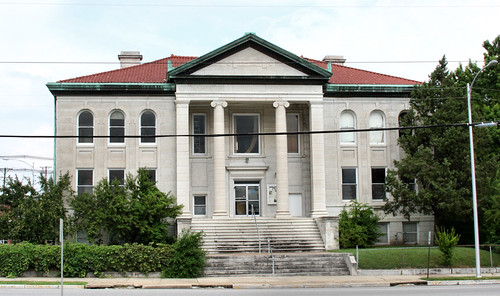
Joplin Carnegie Library

The Joplin Carnegie Library as it appears in 2010.

Joplin Carnegie Library – Then and Now

The Joplin Carnegie Library may come up in a city plan to be discussed tonight, July 6, 2010, by City Manager Mark Rohr, as part of the redevelopment plan for the city. As such, we figured to show a series of photographs (and one drawing) of the Joplin Carnegie Library.

First, we have the award winning sketch of the library by August Michaelis, a distinguished Joplin architect of the time.

August Michaelis' winning design for Joplin's Carnegie Library

August Michaelis' winning design for Joplin's Carnegie Library

Next we have a photograph not long after it was built:

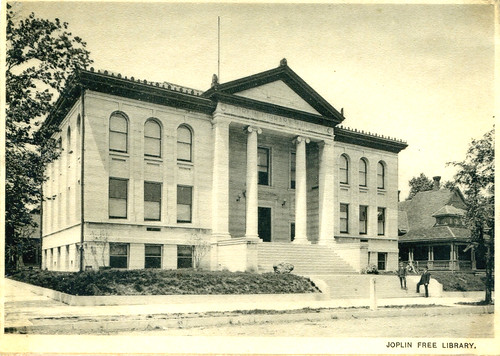
The Joplin Carnegie Library

The Joplin Carnegie Library not long after completion.

Now we have the library as it appears today. It is privately owned, but in need of restoration. It is easily one of the most beautiful buildings in Joplin.

Joplin Carnegie Library

The Joplin Carnegie Library as it appears today.

Source: Historic Joplin Collection

Joplin’s Flatiron Building Problem

When construction on New York’s iconic triangular Flatiron building was completed, pedestrians noticed that the shape and location of the building created strong, gusty winds. In 1907, Joplin residents experienced their own version of the Flatiron’s freak winds.

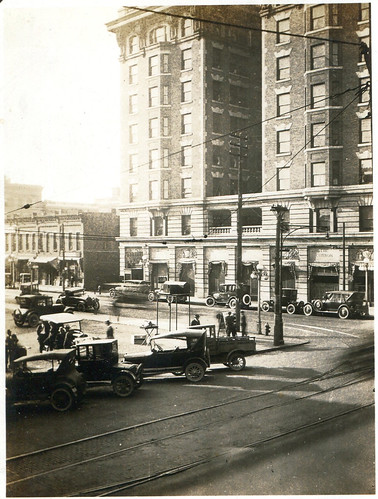
The intersection of Fourth and Main

The windy intersection of Fourth and Main

After the completion of the New Joplin Hotel (later known as the Connor Hotel) at the corner of Fourth and Main streets, strong winds wreaked havoc upon all who dared to pass by. As a reporter observed, on “calm, still days the wind blows in savage gusts around the corner of the new hotel at Fourth and Main and on windy days a veritable hurricane rages up and down Main street and the side streets that lead to Joplin’s ‘flatiron’ corner.”

He described the daily scenes as thus, “All the sights that are seen in New York on a windy day may be seen at the corner of Fourth and Main streets. The variegated display of hosiery, coattails flapping in the ungentle zephyrs, men chasing their hats, and everybody walking either like they were drawing a heavy loaded cart or if they chance to be going with the wind, moving with accelerate step, may be seen.”

On one day blustery day, the wind blew twenty wagon loads of dry sand up and down the nearby streets. The sand, which was to be used on the hotel site, was a total loss. “Flags and banners put up around the corner were whipped into threads by the blowing wind, and loosely nailed board signs were hurled to the street.” Women and girls held onto their skirts to keep them from blowing up and were forced to fix their hair after passing through the area. Men quickly learned to remove their hats, lest it be blown away, as with one man who watched as his prized hat was snatched by a young dog as the hat rolled down the street. One African American workman claimed that the wind was so fierce that he had been pinned up against the building.

The reporter remarked to a nearby workman about the wasted sand, but the workman just shook his head. “No; it isn’t that, but how do you think we can get men to pay strict attention to their work when there are so many funny sights in the street below?”

The wind held the advantage of surprise. It was not a steady, consistent wind. Instead, it gusted in sporadic bursts that caught pedestrians by surprise. “When the wind is from the south in most parts of town, it may be blowing from the north at Joplin’s ‘flatiron corner.’” In one case, a horse powered delivery wagon became unmanageable due to the wind. The young boy in charge of the wagon tried to hold on to both his hat and the horse, but as he did so, he accidentally backed the wagon into a buggy. This caused two street cars to stop, creating a traffic jam that took some time to straighten out. Unfortunately for the passengers in one of the street cars, the windows were down. Sand and dust blew in, creating a wall of blowing grit, sand, and dirt that stung their faces.

Unfortunately, with the demolition of the Keystone Hotel, the Connor Hotel, and the Worth Block, we modern day residents and visitors to downtown Joplin will never have the same blustery experience as the folks who traveled the streets of post-1907 Joplin.

The Joplin Carnegie Library and the Origins of Joplin Public Library: Part Two

Under a bright October afternoon sun, a crowd of ten thousand gathered to watch a parade snake its way from Fourth and Joplin streets to Main Street.  It turned under the watchful gaze of the Keystone Hotel and then proceed south to Ninth, where it turned again to the right and came to a stop at Ninth and Wall.  It was October 8th, and the people of Joplin had come to celebrate the laying of the cornerstone of the new Carnegie Library.

The parade had formed at 2:30 pm and consisted of a number of different groups.  In the vanguard was Police Chief Jake Cofer with a platoon of police officers.  Behind the police, the South Joplin band played and stomped in celebration, and were followed by 66 members of the Knights Templar from Joplin and the surrounding area.  The contingent of Knights Templar was outnumbered by the 151 members of the Masonic Blue Lodge.  Behind the Masons came 2,386 excited school children, headed by 29 high school students and teachers, walked four abreast down the city streets.

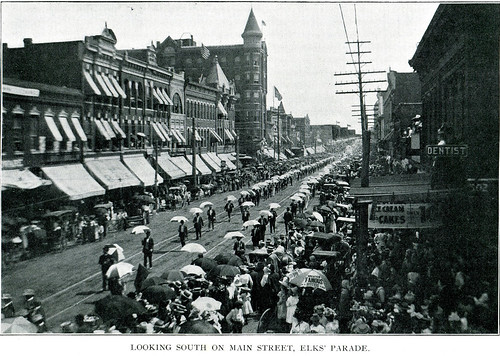
An Elks Parade on Joplin's Main Street

A different parade, but an example of a parade down Main Street and how the Elks might have marched that October afternoon.

Behind the flood of children came 24 grey headed members of the Grand Army of the Republic from  Joplin’s O.P. Morton Post. As in 1865, the veterans marched proudly behind a cherished battle flag.  Approximately 60 individuals of the Elks and Eagles followed the veterans and then bringing up the rear were thirty members of the Knights of Pythias commanded by Joplin attorney Joel T. Livingston.

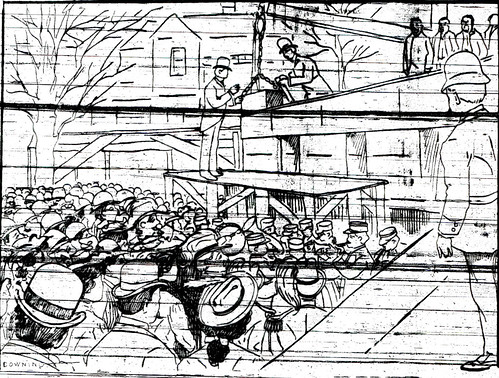
Thousands surrounded the construction site of the library.  The limestone walls soared over the crowd, such was the progress that had been made since Augustus C. Michaelis was selected as the architect in February.  A platform rested against the side of the building next to where the cornerstone was to be laid.  Children, anxious to see the ceremony, climbed the surrounding trees and hung perilously from branches.

A band took up position beside the platform while the mayor of Joplin, John C. Trigg, climbed onto the platform to address the crowd.  His speech, the lengthiest of the day, began with the origin of the movement for the library.  The mayor boasted that the tax revenue from property valued at $4,000,000 was more than sufficient to support the library, but also noted that it had not been enough for the construction of the building.  For this, Mayor Trigg credited industrialist Andrew Carnegie who, “came to the rescue and dissipated all doubts and disquieting fears.”  Trigg continued:

“No event in the history of the city of Joplin will perhaps stand out in bolder or more prominent relief in the future than the laying of the corner stone of the Carnegie public library building…It should be accentuated as a distinct epoch in the annals of the city, from which to date as from the dawn of the new century, an augmented zeal in the material, moral and intellectual improvement of our people of all classes and conditions…”

After the mayor established the effect of the library on the city, he then described the benefit of books, “The inestimable value of books is no longer a vexed or mooted question.  The wise, the good and the great of all ages and nations, divines, poets, philosophers and statesmen, have contributed the most cogent and convincing testimony in support of the premise.”  Trigg went on, reading excerpts from such authors as Joseph Addison, Richard DeBury, and Louisa May Alcott.  Finally, and perhaps to the relief of some in the crowd, the mayor concluded his speech.  This was followed by a brief rendition of the song, “Remember Now Thy Creator,” that setup the next speaker, Reverend Paul Brown.  Brown was a substitute for Judge Picher, who had been unable to attend the ceremonies that day.

Reverend Brown reflected on the origin of free libraries and then spoke of libraries as essential to democracy:

“What is the end of democracy?  I answer the end of democracy is a natural aristocracy.  There is an aristocracy of nature which no contract or statute can ever abolish….Here in the district, our chief industry, mining, weeds out weaklings and cowards, and creates a natural aristocracy of physical courage and vision in the depths of the earth.  Now what does democracy guard against?  Not natural aristocracy, but artificial, the aristocracy of mere birth or place or force or accident.  Democracy means that equality of opportunity which will give the natural aristocracy a chance.”

It was books, Brown argued, that provided the opportunity for men to overcome the privileged aristocracy who were born to fame, title, or fortune.  Brown, after noting famous authors of history, praised the city’s superintendent, J.D. Elliff, whom Brown stated, had played the crucial role in seeing the library created.  Brown soon concluded his remarks, followed by a song from the band, and again, when the time finally came for the actual laying of the cornerstone.

Laying of the Joplin Carnegie Library cornerstone

The laying of the cornerstone of the Joplin Carnegie Library.

This august moment was overseen by the Most Worshipful Grand Master of the Masons, John C. Yocum.  The Grand Master announced the placement of the cornerstone, as it was guided by a small crane and lowered carefully into place.  An invocation was given by the Mason’s Grand Chaplain, who was accompanied by the Masonic ceremonies of deposit and consecration.  One last speaker arose, Dr. W.P. Kuhn, a senior grand warden of the Masons from Kansas City.  Dr. Kuhn opted to win the crowd through praise of the children present, as well a quick joke about Methodist and Presbyterian preachers:

“ The Methodist preacher never prepared a sermon or at any rate never had any reference notes, but his services were largely attended, while the Presbyterian divine labored conscientiously over his discourses, wrote them painstakingly out and read them with painstaking fidelity.  But, his flock was few, and in a spirit of discouragement he came to the Methodist preacher and asked him why it was that the people crowded to hear him who never prepared a sermon while his own church was all but empty.  And the Methodist replied, “My good friend, you write out your sermons and the devil is right there behind you.  He knows every word that you’re going to say and he is able to circumvent every effort you make, no matter how praiseworthy.  Now I don’t know what I’m going to say and I know the devil don’t know what I’m going to say either, and that’s the difference between us.”

Dr. Kuhn concluded by stressing the importance of free libraries, as they were part of the “three planks that the structure of every American community is founded.”  The other two planks were free thought and free speech.  Immediately after the crowd sang, “America,” and the cornerstone laying ceremony ended with a benediction offered by the Rev. Charles A. Wood.

With the cornerstone laid, construction on the library resumed.  The building incomplete, the actual Joplin library, which was already in existence was housed at the Joplin high school and overseen by Lucile Baker, the first librarian.  Ms. Baker was a writer for the Joplin News-Herald and used the byline of “Becky Sharp” in a nod to Missouri’s own Mark Twain.

The library was finally completed a year later.  The city received its first check from Andrew Carnegie at a sum of $5,000.  Twelve years later, the city sought and received another $20,000 from the generous benefactor for an addition to the west side of the library.  In charge of the library, now at home in its new building, was Mary B. Swanwick, who was joined by assistant librarians Blanche Trigg, Mary Scott, and Hattie Ruddy Rice.

The Joplin Carnegie Library

The Joplin Carnegie Library not long after completion.

As of 1911, the library had 15,737 books as well as 2,643 magazines and periodicals.  Over the year, over ten thousand people used the library, around 1/4th of the city’s population, and almost 65,000 books were circulated.  Active card holders numbered almost 7,000.  Ten years later, the head librarian, Swanwick, passed away and was eventually replaced by Blanche Trigg, daughter of Joplin Mayor John Trigg. She oversaw the institution until 1949.  It was under the oversight of Trigg’s successor, Margaret Hager, who helped lead the movement in the 1970s to purchase the Connor Hotel and the rest of the 300 Block as the site of a new library building.  That building, the present home of the Joplin Public Library, opened in April, 1981.

Sources: Joplin News Herald, Joplin Globe, “A History of Jasper County, Missouri and its People,” by Joel Livingston, and Missouri Digital History.

A Hotel Pool at 4th and Main

Several youngsters who rode past the place on bicycles deliberately rode down the long board incline that leads into the pit and plunged, wheel, clothes, and all, into the murky pool.

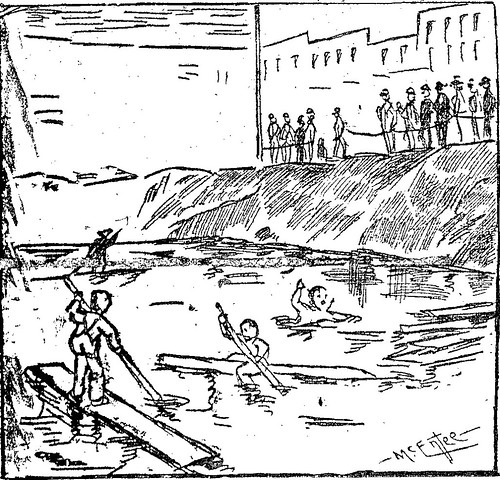
No trace of the old Joplin Hotel remained by late July, 1906.  Excavation was well underway for the new hotel when a summer torrential downpour occurred on July 20.  Over the hours as the rain fell the great pit, from which the Connor Hotel would eventually rise, filled with water.  When the sun rose the next day, to the delight of Joplin’s urchins, a veritable swimming hole at the corner of the city’s economic district reflected the morning light.  Encouraged by the July heat, boys quickly took advantage of the “hotel pool.”

A Joplin Globe article described the enthusiasm of the boys to partake in its cool, wet relief, “The youngsters did not disrobe before entering; such a move would have brought down upon them the wrath of the law.  They simply plunged in, clothes and all, a very few of them removing their outer shirts before the plunge.”  In addition to the swimming and diving, the boys soon discovered wooden boards that were quickly plied into use as rafts.  Envious youthful onlookers, who had failed to secure such craft when the opportunity allowed, willingly paid several cents, upward to a dime, to purchase either a ride on a raft or a raft itself.

Swimming pool at the old Joplin Hotel

A quick sketch of the swimming festivities at 4th and Main

The fun and games did not last forever, at least for a boy named Robert.  His aquatic fun ended upon the discovery of his mother of finding her son, fully clothed, splashing about the rain-filled pit.  The last that was seen of poor Robert was his mother leading him away with a firm grip on his ear.

Source: Joplin Globe

The Demolition of the Joplin Hotel

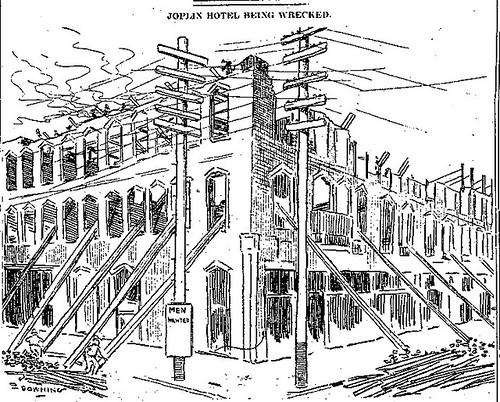
Demolition of the Joplin Hotel

The demolition of the Joplin Hotel

Wooden sluice-like conduits extended from the windows of the storied Joplin Hotel like slides and ended on the packed dirt surface of the streets below. Considered one of the most popular hostelries in the city, it had been the home to many cigar smoke laden conversations and political planning. One corner of the hotel building had been dedicated for use by the Miners’ Bank, but it had recently relocated down Fourth Street to the intersection of Fourth and Joplin, several blocks away. Instead, the Joplin Hotel was fated for demolition. It was to be wiped away to make room for a new Joplin Hotel, one that would rise an additional five to six stories above Main Street to become the tallest structure in Joplin.

The demolition of the hotel which proceeded in June, 1906, attracted onlookers who made quick bets as to how fast the workmen could dismantle the venerable institution. The speed of which surprised many and likely cost a few unfortunate bettors their gambled money. For as quickly as the hotel was torn apart, care was not sacrificed during the process. The owners of the hotel, likely with the cost of the expensive new hotel in mind, did what could be done to salvage the bits and pieces of the hotel. Door and window lintels, fire escapes and iron railings, all were carefully lowered to the ground. The worth of which, the Joplin Globe speculated, was valued in the thousands. Everything else, torn from the structure with hammers, hatchets, and picks, was sent down the wooden sluices. The piles that accumulated were quickly lifted onto wagons by teamsters who drove the debris away to be dumped.

By the end of the summer, all traces of the Joplin Hotel were gone. In its stead, was the foundation of the hotel that was to become the Connor, an institution whose reputation and luxury outshone the building it replaced.

Source: The Joplin Globe

The Joplin Carnegie Library and the Origins of Joplin Public Library: Part One

One of the major institutions of modern day downtown Joplin is the Joplin Public Library located in the 300 block between the Third and Fourth streets.  The prior occupant of this site was the Connor Hotel.  Plans to purchase the block, demolish the Connor, and to erect a new library building began in the 1970’s.  The Connor collapsed a day before its scheduled demolition in 1978, and all but a few minuscule pieces of the grand hotel remained on opening day of the new library building in April, 1981.  Up until that spring day twenty-nine years ago, the Joplin Public Library had been housed in a Romanesque building, a columned temple of knowledge, a few blocks to the southwest.  The origin of it and Joplin’s library system began more than a century ago.

Undoubtedly, the idea to establish a city library came into being not long after Joplin began to establish its schools and a professional class.  The dust of the lead and zinc mines was shaken off by a city that pulsed with a passionate desire for progress.  In April 1893, a gathering was held at the Young Men’s Christian Association building.  It was the first formal meeting of the Joplin Public Library Association.  Hamilton S. Wilks was elected president, along with Christopher Guengerich as treasurer, the Reverend E.E. Wilkey as secretary, and C.W. Squire as vice-president.  In addition, an executive committee was established with the following women: Mrs. W.H. Picher, Mrs. Clark Craycroft, Ms. Henry Weymen, Lola Spear and Mrs. W.C. Weatherill.

The initial funds to assist in the creation of a library came from a charity event hosted by the Century Club.  The club, established only three years previously, was a women’s literary society. Its members embarked on a campaign to create a city library through education and outreach.  While a public reading room had been the original idea for the city’s library, it became obvious that an independent library building was needed.  The Century Club, and other Joplin literary clubs, claimed victory in the city election of 1901.  The months before the vote had been spent campaigning for an annual tax of ten cents for every one hundred dollars appraised for the care and maintenance of a library building.  The measure was overwhelmingly approved.
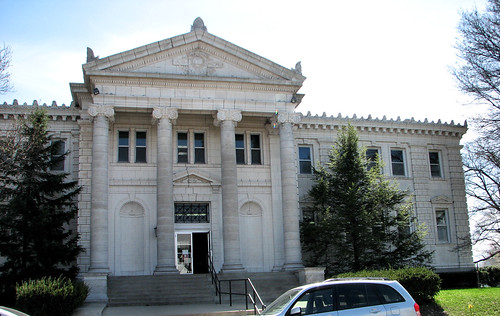
Sedalia's Carnegie Library

The Library Committee traveled to visit Sedalia's Carnegie Library, pictured here.

This tax was connected to a requirement to form a non-partisan board to oversee the construction and operation of the library.  Ten individuals were appointed to the board: William N. Carter, H. H. Gregg, J. D. Elliff, Henry Kost, E. L. Anderson, Reverend Paul Brown, O. H. Picher, Mrs. Ada Goss Briggs, Mrs. Emma Lichliter and Mrs. Hattie Ruddy Rice.  Elliff, the superintendent of Joplin’s public schools, was elected president by the board, while the position of board secretary was given to Rice.  Shortly after, the board created a committee tasked with overseeing the building and grounds of the future library.

Around May, 1901, that committee explored the possibility of contacting the capitalist Andrew Carnegie.  For just under twenty years, the Scotsman offered funds to cities for the construction of libraries.  Generally, these donations came upon the promise that the cities guarantee a specific amount of upkeep and continue funding of the institutions.  Not long after the president of the board, J.D. Eliff sent off a letter to Carnegie, a reply was received from James Bertram, Carnegie’s personal secretary. Addressed from Skibo Castle, Ardgar, Bertram wrote:

Dear Sir – Responding to your letter of May 6th–If the city of Joplin will furnish a suitable site and pledge Itself to maintain the library at a cost of not less than $4,000 a year. Mr. Carnegie will be glad to provide $40,000 for a suitable building.

Very Respectfully.

James Bertram. Private Sec’y.

The promised sum of $40,000 delighted the board.  The question then turned to what the library should look like and where that building should be located.

The discussion of location and design carried on through the months of 1901 and into the first quarter of 1902.  It was not until October, 1901, that the board finally came to a decision on the placement of the new library.  Proposed locations included the intersection of Eighth and Pearl streets, Cox Park (advocated by the people of South Joplin), and the intersection of Joplin and Ninth streets.  The two most popular sites, however, were the intersections of Fourth and Pearl and Ninth and Wall streets.  The former were owned by a man named Renfrow and the latter by Christopher Guengerich.  According to coverage by the Globe, the board’s primary concern was a location which benefited the entire population of the city.

The board came to a decision on the location on October 21, 1901, when by a vote of 5 to 4, the Ninth and Wall location barely beat out the Fourth and Pearl site. Prior to the vote, attorney and amateur historian Joel T. Livingston offered a presentation, complete with a special map of the city that how the population of Joplin was concentrated.  Incidentally, while Livingston claimed to favor no specific site, his analysis of the city’s population placed the epicenter around Eighth and Wall streets.  If this swayed the votes toward the Ninth and Wall location, the site was further helped by the testimony of J.W. Freeman, who claimed the location would satisfy the people of South Joplin.  It was future Missouri State Senator Hugh McIndoe, as well as Freeman Foundry owner J.W. Freeman, Oscar and C.M. DeGraff, as well as Clay Gregory, who introduced the successful proposition.  Thus, the chosen site had strong and influential supporters.  As to what type of building would be built at the corner of Ninth and Wall, the discussion continued into the next year.
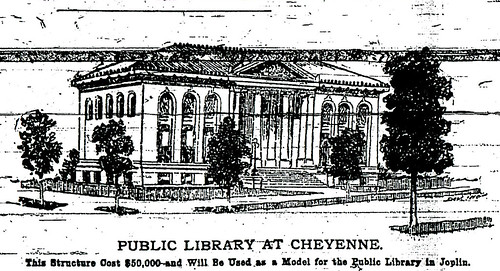
Cheyenne Carnegie Library

The Cheyenne Carengie Library design that William Carter favored and became the basis for Joplin's library.

The committee in charge of selecting the design of the library took their task seriously.  Initially, a question of whether the city would offer the local Joplin architects was debated.  One of the chief proponents against hiring local talent was William Carter, who when asked about the successful architect August Michaelis, sneered, “He learned his business in Joplin.”  Carter went on to point out that Joplin had no libraries or similar buildings, and as such, Michaelis had no experience in designing a library.  Another supporter of seeking a non-local architect was Ada Briggs, who read a letter written by the president of the Sedalia Library board.  Prior to this meeting, members of Joplin’s committee had visited the city to their north to view their Carnegie library.  In the letter, the president warned against allowing local architects to use Joplin’s library as an opportunity to learn how to design such a building.

Plans based on the designs of numerous libraries were pushed in an attempt to avoid hiring area architects.  One such architectural rendering was the Sedalia, Missouri, public library, which was quickly dismissed for a variety of reasons.  It was too big for the lot picked out previously; it failed to include a basement or a separate women’s assembly room; and it cost an additional $10,000 more than Joplin had budgeted.  Nevertheless, Ada Briggs described the building as, “beautiful simplicity.”

In lieu of the Sedalia design, Carter suggested the design of the Carnegie library in Cheyenne, Wyoming.  Apparently, the news of Joplin’s library design search had spread, as the architect of the Cheyenne library visited Carter the week before to sell him on the design of that building.  Carter went so far as to suggest a trip to Cheyenne, similar to that which had gone to Sedalia, but the expense and length of the trip resulted in no support for such an adventure.

In the end, the committee opted to allow local architects to submit plans, based on the fact that a majority of the committee believed that they had already proven themselves with many beautiful buildings about the city.  It was even remarked that this was a difference between Joplin and Sedalia.  One city had remarkable architecture and the other did not.  The committee then reasoned that the advice of the Sedalia library board’s president to seek elsewhere for an architect could be ignored simply because Sedalia did not have any local architects of considerable skill. The plans of three firms were accepted to be voted upon.  The three were Garstang & Rea, I.A. Hunter, and August C. Michaelis.
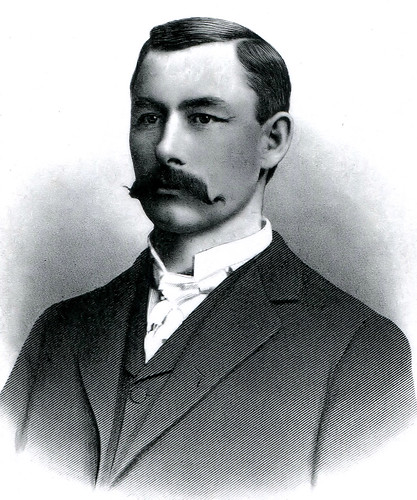
August C. Michaelis, Joplin Architect

August C. Michaelis, one of Joplin's preeminent architects.

At 2’o clock in the afternoon on February 3, 1902, the committee selected the plan presented by Michaelis.  By specification, the design was similar to that of the Cheyenne Library, but not an identical copy.  This requirement was probably added to soothe those members, like Carter, who did not want to trust the design to local architects.  It featured three floors, a basement, first floor, and second.  Located in the basement was to be the men’s reading room, advertised as a place men could visit in or out of work clothes, as well go so far as to enjoy a smoke while perusing book or newspaper.  Filling out the basement was a coal room, toilets, and the boiler.  Upon rising to the next floor, the visitor found a main hallway of 33 square foot of marble flooring.

On one side of the floor the general reading room was placed connected by doorway to a reference room.  Opposite the general reading room was a reading room expressly for children.  In addition to a reference room, a room was set aside for librarians and contained a fire proof vault.  At the rear of the floor was located a circular stacks, which at the time was supposed to be filled with steel fire proof shelving.  The shelves were to be arranged in a circular fashion with the librarian seated in the center and thus with a 360 degree view of the room.  The stacks were expected to hold approximately 30,000 books.
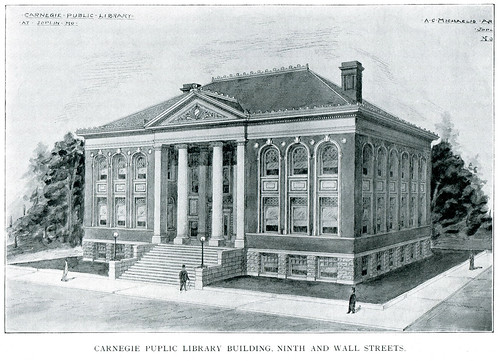
August Michaelis' winning design for Joplin's Carnegie Library

August Michaelis' winning design for Joplin's Carnegie Library

Also located on the first floor was a wide double staircase that rose to the second floor.  On this uppermost floor was located a room for the women’s club with attached rooms and bathroom.  A statuary hall mirrored the hallway below and at the time was thought to be an ideal display area for mineral examples. Separate rooms were set aside for art and for trustees, as well a private reading room.  The rooftop was shingled in zinc, though a brief controversy arose when someone claimed architect Michaelis had said otherwise.  Michaelis confirmed that the library would indeed have zinc roof tiles. The library was heated indirectly with steam.  The library was filled with oak furniture and countertops.

A plan in hand, all that remained was for construction to begin.  Part Two will continue the history of the Joplin Carnegie library.

Sources: Joplin News Herald, Joplin Globe, “A History of Jasper County, Missouri and its People,” by Joel Livingston, and Missouri Digital History.
Remnants of the Connor

When Joplin’s finest hotel and one of her great architectural gems vanished from the cityscape in 1978, it did not mean the complete disappearance of all traces of the fabled institution.  For those wishing to find glimpses into the Connor’s architectural past, there are at least three pieces of the Connor spread across two locations in Joplin today.  They are decorative pieces of the exterior of the Connor, which like the interior, were stripped from the hotel prior to her expected demolition.

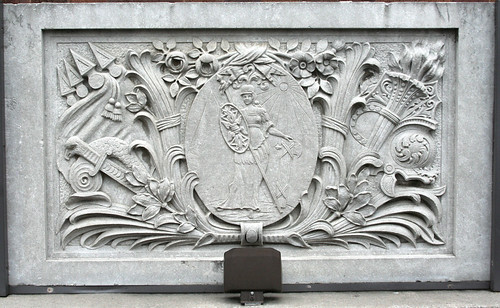
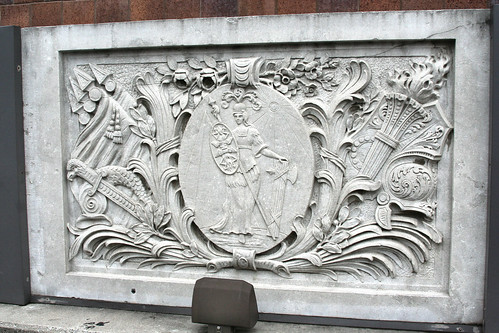
The first two pieces can be found in the same location that they arrived at around 1907, when delivered to the Connor to be placed upon her exterior.  They are at the Joplin Public Library at 3rd and Main.  The Connor property was purchased by the city in the 1970’s with the express intent of demolishing the hotel to build a new library on the spot.  It’s regrettable that the Connor could not have been renovated for the same task.  As a tribute to the marvelous building that the library replaced, two friezes from the exterior of the Connor were set on the west facing wall of the library on the parking lot (Inside, the library devotes a glass cabinet to the history of the Connor).

A frieze from the Connor Hotel

A frieze from the Connor Hotel

The frieze is joined by another, which at first glance appears identical.  However, closer scrutiny will show slight differences between the two pieces of artwork.

One of the two friezes from the Connor Hotel

One of the two friezes from the Connor Hotel

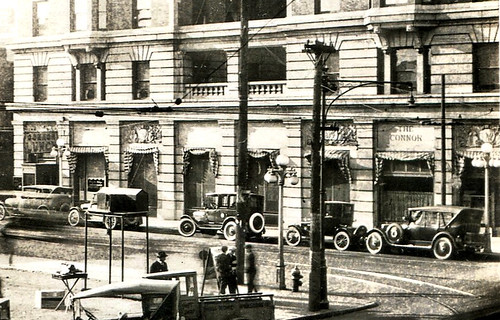
Below is a close up of the Connor prior to the addition of its annex.  Note the friezes above the windows.

Close up of the Connor Hotel

Close up of the Connor Hotel with friezes over the window.

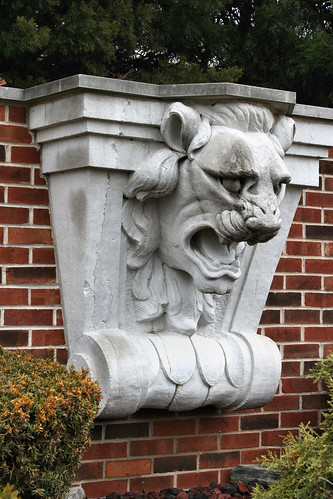
The third subject of this post is a lion’s head located across town from the Connor’s location and can be found on the campus of Missouri Southern State University.  Specifically, the lion’s head, which snarled above the main entrance of the Connor, is placed on a short brick wall in front of the Spiva Art Gallery.

A lion's head from the Connor Hotel

A lion's head from the Connor Hotel

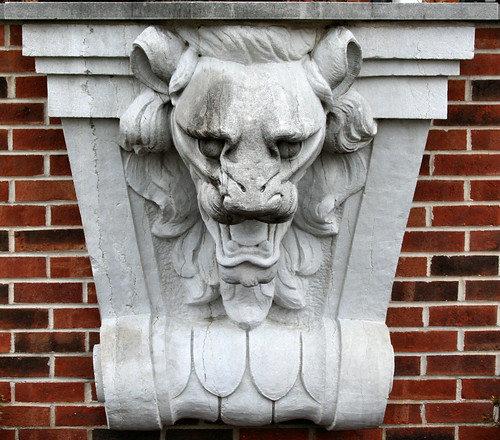
And now a full frontal view of the lion, which would have been seen by the men who affixed it to the exterior of the Connor, as well as those who took it down.

A front on view of one of the Connor's Lions

A front on view of the Connor's Lion Head

Know of any other remnants of the Connor?  Please feel free to comment or write us to let us know!

Joplin Museum Complex Proposal Shot Down

We would be remiss if we did not mention the recent Joplin Museum Complex proposal that was defeated at the polls.

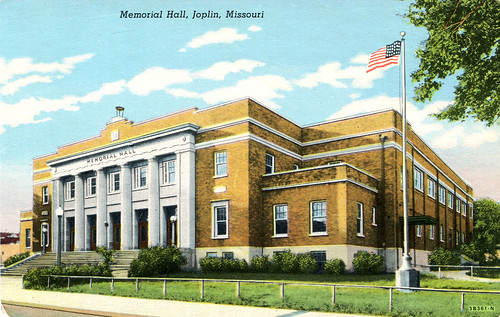
Yesterday, Joplin held its spring election and arguably the most contentious item on the ballot was Proposition A, which if passed would have created a sales tax to fund a $7 million dollar renovation of Memorial Hall to serve as the new home of the Joplin Museum Complex.  The sales tax would have indefinitely continued at a lower rate to perpetually support the museum.   The proposal was voted down.

Joplin Memorial Hall

Memorial Hall - At least for now, remaining Memorial Hall.

According to the Joplin Globe, the vote was 3,882 to 928, a four to one margin.   While we here at Historic Joplin believe that the museum complex could do with a new home, we agree with the result of the vote.  There are several reasons why.

First, it was a poor decision to spearhead a sales tax proposal during the recent recession.  Although many economists believe the country is recovering from the recent economic downturn, folks on Main Street are still feeling the pain of difficult times.  A new museum complex is the least of someone’s worries who is struggling to pay for healthcare, food, and other necessities.  Simply put, it’s hard to justify passing a new tax on people who are struggling to survive on a daily basis.

Second, the PR campaign was mediocre at best.  The Globe, which seemed to support the museum proposal, attempted to publicize both sides of the debate.  The museum, however, failed to articulate to the public why it matters.  Talking about the museum’s multi-million dollar collection of lead and zinc samples does not translate with folks.  It does not inspire passionate debate.  In the end, the museum failed to carry its message to the people, let alone sell it.

Third, the museum awkwardly proposed taking over Memorial Hall.  Why? It appears that “museum representatives” decided upon Memorial Hall and drew up plans without even consulting the public.  Some of the endorsements on its website are questionable, even dubious at best, such as the “National Cookie Cutter Historical Museum,” and the “Joplin Historical Society.” It is our understanding that the National Cookie Cutter Museum is part of the Joplin Museum Complex as is, or was, the Joplin Historical Society.  Essentially, two organizations that are part of the museum were supporting the museum proposal — isn’t that a conflict of interest?

Fourth, we here at Historic Joplin have conducted research in many of the finest archives and libraries in the world such as the Bodleian Library at Oxford; National Archives I and II in Washington, D.C.  and College Park, Maryland; the Library of Congress; the special collections of the University of Oklahoma, the University of Missouri, and the University of Arkansas; numerous state archives and county courthouses; as well as small town libraries and museums.  We can say that we have always had a pleasant experience save for interactions with the Joplin Museum Complex.

The Joplin Museum Complex does not allow members of the public access to its collections which is extremely unfortunate.  Excuses are made that the museum is simply unable to accommodate visitor requests for access to the museum’s collection.  This is unacceptable.  Dorothea B.  Hoover is rolling in her grave.  Years ago, the University of Arkansas Museum was shuttered and the multi-million dollar collection placed in storage.  Although housed in a very small space, the university museum collection is readily accessible to the public and is cared for by professional museum staff.

We cannot say the same of the Joplin Museum Complex (JMC).  The photo in the recent Globe article on the museum shows that the Joplin Museum Complex collection has not been taken care of by the museum staff.  Even if the conditions are not ideal, there is no excuse for sloppy storage methods, although the JMC staff members are not professionally trained curators or archivists.  Out of the many libraries, museums, and archives we have visited over the years, this is the first time we encountered such an unhelpful staff.  It is unacceptable that members of the public are denied access to museum collections when it is funded by taxpayer money.

So here are our suggestions for improvement:

First, the next time the Joplin Museum Complex embarks on a fundraising campaign, it must articulate its message.  Tell the public why its collections matter.  Sell it like Sam Walton sold cheap underwear back in the 1970s.

Second, the Joplin Museum Complex should get rid of collections that have nothing to do with the history of Joplin such as the Cookie Cutter collection in order to create adequate storage space.  In the museum world, this is called “deaccessioning.” Every museum will deaccession something in its lifetime, particularly items that do not fit with the museum’s mission.  Is the Cookie Cutter collection relevant to the history of Joplin? Probably not.  So get rid of it.  Focus on the real treasures in the collection.  This should alleviate some of the storage problems.

Third, please change exhibits as time and money allows.  The Joplin Museum Complex has not changed since I was in the third grade.  Consider not allowing an animal to run around the museum as they can damage and ruin museum artifacts.  No museum staff worth its salt lets live animals have free reign inside of a museum.

Joplin Union Depot

The Joplin Union Depot not long after being built.

Fourth, consider the Union Depot.  We realize it is a shell of a building.  We have read that the basement has water problems.  It is, however, an architectural jewel waiting to be reclaimed.  The Joplin Museum Complex could have gotten a lot of support from the numerous voters who want to see the Union Depot restored to its former glory.  Forget the basement.  Pour concrete in the basement for all we care.  Any architect worth his or her drawing board can come up with architectural additions that will compliment Union Depot’s fabulous design.  Incidentally, it was in the Kansas City Bottoms where Union Depot sits, where some of Joplin’s first lead mines were established.  Think of how relevant that is to the history of Joplin — what better location to preserve and explain the history of Joplin and its rough and tumble beginnings? Plus, the Joplin Museum Complex would be a hero for saving the depot.

Fifth, contemplate hiring someone to serve as museum director who has demonstrated experience in fundraising, community relations, and who preferably has a master’s degree in museum studies.

Comments? Thoughts? Let us know.

One Less Round Barn in America

In the spring blizzard experienced just a couple weeks ago, a great amount of snow was dumped onto the four states area.  A victim to this late winter hurrah was a unique and rare round barn located just south of Joplin on Saginaw road.  Incidentally, the farm was owned by John C. Cox, one of Joplin’s wealthiest citizens, and his family later had it built around 1909.  The Joplin Globe posted an article this weekend noting its history and the costly, and apparently fatal, damage that it sustained from the recent snows.

Read it here: Joplin Globe, “Storm Damages Local Landmark.”