Joplin’s Managers of Baseball

Recently, Joplin Museum Director Brad Belk chose to write briefly about Harry Francis Craft for the Joplin Globe. Craft was not the first nor last baseball manager to pass through Joplin either on the way to the Major Leagues or on their way after. Perhaps one of the earliest baseball managers was “Honest John” McCloskey.

McCloskey rolled into Joplin in 1887. 1887 was the year that the News Herald declared that Joplin finally decided to become serious about baseball. This resolve was put into effort by the construction of a baseball field at the end of a mule drawn trolley line on west 9th Street. The city advertised for players, apparently finding none at home who met their own criteria, and ended up hiring a number of players from the “Kerry Patch” area of St. Louis. At the same time, the paper noted, a boom in some eastern Kansas towns had led John McCloskey to managing in Arkansas City.

Successfully defeating the Kansas towns, McCloskey brought his team to Joplin and thrashed the hometown heroes. Henry Sapp, who had made money mining lead and later zinc, and had been a driving force behind the St. Louis hiring, quickly fired the team and promptly bought out McCloskey and his Arkansas City team. Victory followed for Joplin until summer came to an end and fall grew closer to winter. Eager to keep playing, McCloskey raised enough support among Joplin businessmen to fund a tour of Texas. Purportedly, the Joplin players may have been among the first to assume the title of “Joplin Miners” with the team name stitched on the front of their uniforms. In the process, the Joplin team defeated two national league teams traveling through the state, one from New York and the other from Cincinnati, and may have also contributed to the establishment of a Texas baseball league.

In the late 1890’s, McCloskey returned several times to Joplin to field a team. One team, the Giants, competed against the Bloomer Girls in 1898. A few years later, McCloskey found himself the manager of the St. Louis Cardinals from 1906 to 1908. By his later years, the manager found himself without the success that had brought him a job in Joplin. Friends helped out McCloskey by contributing money to purchase the on and off again Joplin manager a home in Louisville, Kentucky.

Perhaps Joplin’s most successful baseball manager was Charles “Gabby” Street. Street was a son of Alabama and had a baseball career cut short by what Joplin newspaper man, Robert Hutchison called, “overindulgence in the bottled stuff.” Hutchison counted Street a friend and met with him and others every weekday morning during the off season to share their passion for the sport. One of the other regulars was Joe Becker, namesake of Joplin’s Joe Becker Stadium. Hutchison noted that Street earned the most fame as a player for catching a ball “thrown” from the top of the Washington Monument and as the catcher for Walter Johnson, a fellow teammate on the Washington Senators.

Street managed the Joplin Miners from 1922 to 1923, the former season being the one where the Miners won the Western Association championship. The success in Joplin lead him away from the city, but he later returned to make a home and to invest in real estate. He kept this home, according to Hutchison, before his major league appointment as manager of the St. Louis Cardinals. At the Cards, Street managed from 1929 to 1933, taking the team to the World Series twice. Hutchison aptly described the two trips, “His Redbirds lost the 1930 World Series to Sly Connie Mack’s Philadelphia Athletics, four games to two. They met again the next year and the famed Gas House Gang ripped up the basepaths for a victory in seven hard fought contests.”

The World Series pennant was the highlight of Street’s career. Soon after he was let go from the Cardinals and only returned to the show one last time to manage a losing St. Louis Browns. As Hutchison then recalls, “Gabby came home to stay.” Later on, Street did return to St. Louis, but to provide color commentary for the Cardinals instead of coaching. At this time, a future radio commentator worked with him, Harry Caray. When Street passed away, he was buried in Mount Hope cemetery along with many of the other notable names in Joplin’s past. West 26th Street is named after the baseball coach, who likely will be remembered as the most successful of the baseball managers to find their way to Joplin.

Sources: Joplin News Herald, Robert L. Hutchison’s “Deadlines, Doxies & Demagogues,” and Baseball-reference.com.
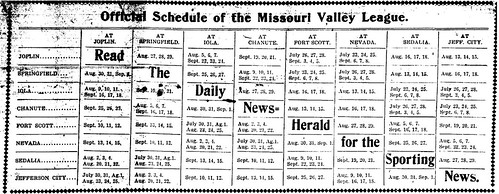
The Schedule of the 1902 Joplin Colts / Miners

We previously discussed the emergence of Joplin’s first professional baseball team, the Colts who soon after became the Miners.  After some research, we uncovered what appears to be the schedule for the team that season in the Missouri Valley League.

1902 Joplin Miners' Missouri Valley League schedule

For a larger version click on the photograph

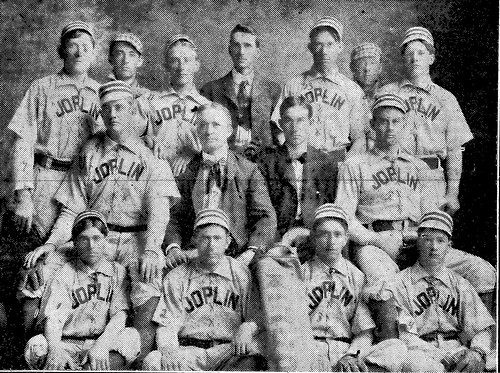
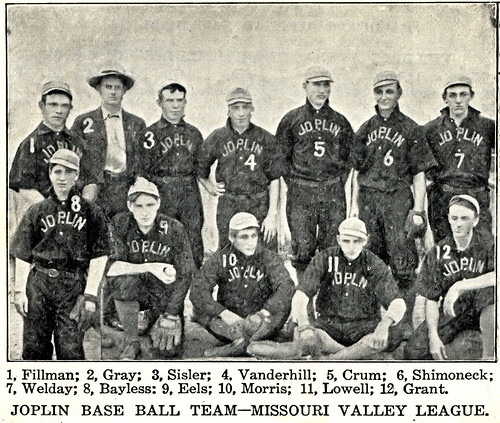
In the earlier post, we offered a team photo from that year.  To keep things fresh, we’ve added a photograph of the 1904 team.  A glance between the supplied rosters for the teams reveals some old faces and some new.

1904 Joplin Miners

1904 Joplin Miners

Sources: Joplin News Herald, Historic Joplin Collection

Reflections on Circus Life

In the not too distant past we published a post about Hardy Hardella and his dog Moxie.  Hardy and Moxie are among our favorite Joplin residents, so when we found an article about Hardy and his days with the circus, we knew it would end up as a post.  A more specific post on Hardy himself is in the works for later.

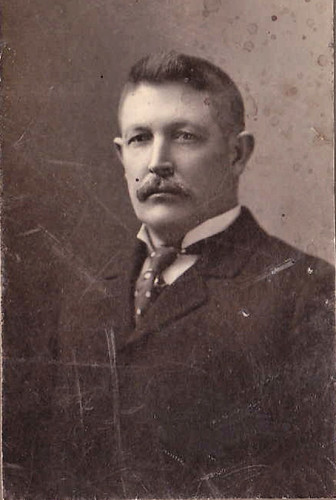
Hardy Hardella

A distinguished Hardy Hardella, courtesy of the private collection of Judy Hurdle.

Hardy Hardella moved to Joplin in 1905.  A few years later, one of Hardella’s old circus cronies arrived in town. The two had not seen each other in twenty-five years, but Hardy and William Underwood (his stage name was William Lucifer) took up where they left off the last time they had seen one another. Underwood, still working the vaudeville circuit, arrived in Joplin for a performance and decided to call upon his old friend.

The two men first met when they worked together in the Charles Hunter Circus which traveled through Nebraska, Kansas, and Missouri. Hunter, the former circus owner, still lived in the area, but instead of wrangling animals and acrobats, now proprietor of the Crescent Hotel in Pittsburg, Kansas. The two men said the circus consisted of one car, a camel, two ponies, six or seven mules, and two or three horses. Altogether there were twenty five men employed by the circus.

The circus car, an old condemned Pullman, had a secret compartment underneath it. When times were hard, half of the employees would hide in it when the conductor came around to collect train fares. One day, however, Hunter’s adopted son poked his head up out of the trap door when the conductor came through. Hunter’s circus “had hard luck on that road ever after.”

Underwood recalled the time he came to Joplin with the De Haven Circus and a fight broke out between circus employees and local miners. Angry miners cut up and destroyed the circus tents and half of the outfit was “broken up.”

After things seemed to have cooled down, another fight broke out after miners and circus workers got into a brawl at one of Joplin’s saloons. Underwood remembered “billiard cues and bottles were freely used” in the fight. Circus workers were arrested and thrown in Joplin’s city jail for a few days before they were released. Underwood remarked, “I have never forgotten that incident in Joplin. I have been all over the world since then and in every civilized nation, but I nearly always sign my residence as Joplin, MO., because of that fight and subsequent stay in jail.”

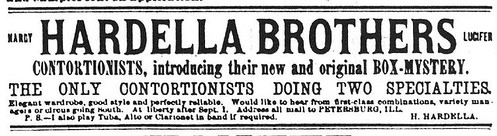
That same week, Hardy Hardella and William Underwood met old friend William McCall, who performed with Hardella as the “Hardella Brothers,” to discuss old times. The men recalled when Hardy was known as, “Hardella, the wonderful contortionist.”

Hardella Brothers ad

An advertisement for the Hardella Brothers, courtesy of Judy Hurdle.

Underwood remembered how the “old time circuses sure used to clean out a town. There was always a bunch of ‘fakirs’ that went along with the show and paid big concessions. The games they used to devise were many and varied. Yankee ingenuity being a mild term to apply to it. What money wasn’t taken in at the gates or by the shell games was usually cleaned up the ‘gooseberry crowd’ that followed the circus and while the people were watching the performance, raided the houses. Sometimes the ‘gooseberry’ bunch was in cahoots with the show and sometimes they were not, but they usually made a cleaning. Some small towns were literally wiped clean by the circus bunch.”

Locals, however, often lashed out after discovering their town had been “wiped clean.” Underwood recalled, “When they got a chance to get their breath and compare notes, they usually came down on the circus with blood in their eyes. The ‘fakirs’ had moved on to greener pastures by this time and were ready to work the next town. The circus hands had to bear the brunt of the storm. One experienced stake driver with the heavy, banded circus stake, could usually clean twelve or fifteen ‘rubes’ but just the same there was much bloodshed and cracked heads.”

He also somberly told the story of a young Kansan who had just sold a load of corn for a large sum of money, possibly as much as $200, and decided to bet it all on a shell game. He lost. The shell game operator, scared the crowd was going to attack him, fled. The young farmer chased him into a tent where the man cracked the rube over the head with a club. Underwood claimed, “It was one of the most cruel sights I have ever witnessed, but those were hard days in the circus business.”

Circuses are few and far between these days, but undoubtedly the big top once thrilled crowds all across the country, and Joplin was no exception.

Sources: Joplin Globe, Joplin News Herald, Livingston’s History of Jasper County, Bale Milling Odyssey by Judy Hurdle, Missouri Death Certificate Database 1910-1959, Judy Hurdle private collection

Joplin Celebrates the Fourth

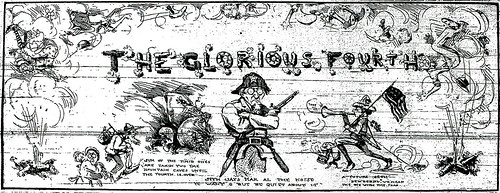
Bingville Bugler 4th of July

Bingville Bugler, insert of Joplin News Herald, 4th of July banner.

The celebration of America’s Independence Day was no less important a hundred years ago in Joplin than it is today.  A principal slogan of the city of Joplin in 1910 was to have a “Safe,  Saner Fourth of July for Joplin.”  In June of that year, the city council had passed the Kelso ordinance which oversaw the sale, display and use of fireworks.  Proponents of the safer and saner Fourth were women groups and the Ministers Alliance.   Both Mayor Guy Hume and Chief of Police John McManamy supported the measure and the idea of a “quieter Fourth.”   Further support was also sought by the local school systems.  Unsurprisingly, the motivation for the ordinance had been to reduce the injuries from the celebratory play with explosives.  If injuries could be reduced it was hoped the city could proceed with more support for the holiday.  The “Sane” Fourth motto was also raised the next year in 1911 and reinforced by a city ordinance that prevented the sale of firecrackers more than 2 inches in length, as well “exploding canes and blank pistols”.

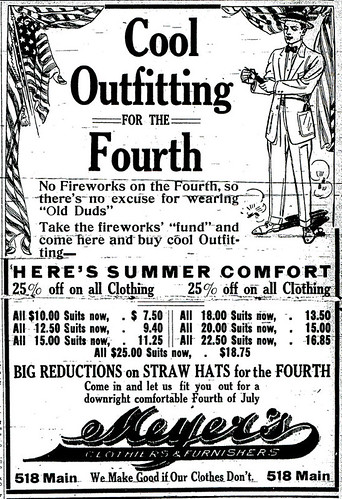
If people were not buying fireworks, Joplin shopkeepers likely hoped they would do some holiday shopping.  One such business was Meyers, which paid for a patriotic Fourth of July ad three years later (when the same belief in a “quieter Fourth” prevailed):

A patriotic ad from Meyers in 1913.

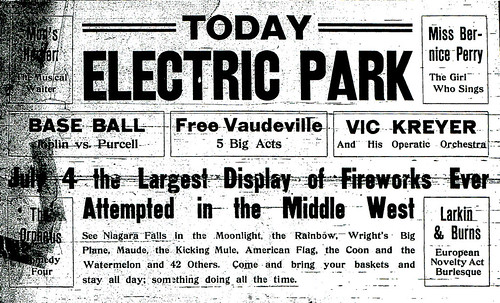
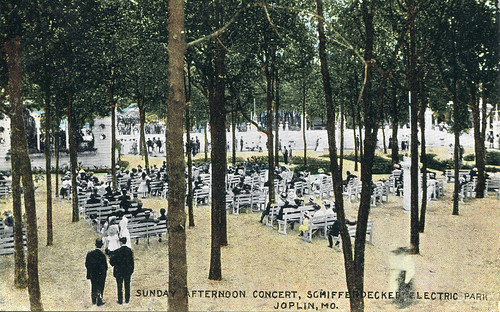
Many in Joplin opted instead of celebrating in town to travel to two of the popular recreational parks in the area, “Since early morning wagons, buggies, autos and street cars have been busy carrying people from the city.  Contrary to the usual custom, there seem few people from the country coming to town to spend the day.  Both Electric and Lakeside parks are the scenes of great activity.”  The bill of events in 1911 for the Electric Park in, located within Schifferdecker Park, advertised a fun and entertaining day:

Electric Park Fourth of July ad from 1911.

An advertisement for the Electric Park in 1911.

An entertaining area of the Electric Park of Joplin, Mo.

One area of the Electric Park where visitors enjoyed the nearby stage.

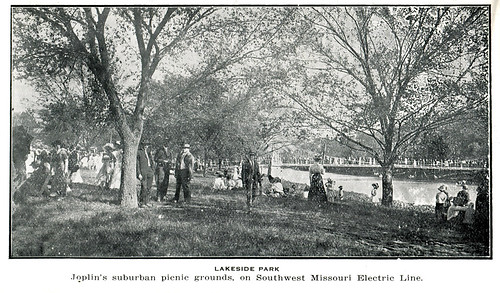
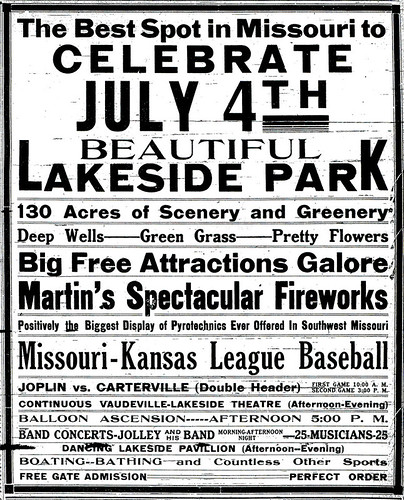
Not mentioned in the ad above was an inviting swimming pool, an escape from the hot July heat.  Likewise, as the name reveals, Lakeside Park also offered a cool, aquatic retreat.  The attractions at Lakeside in 1911 were several.  The Trolley League, a local baseball league of four teams, was scheduled to present a doubleheader.  A standard at Lakeside was boating, in addition to swimming, and a band had been secured for a patriotic performance.  For those in the mood for dancing, a ballroom was also available.

Lakeside Park, Joplin, Missouri

By accounts, the there was far less room to stroll, as presented here in the photograph of Lakeside Park

Lakeside Park 4th of July ad from 1913

A 1913 Fourth of July ad for Lakeside Park

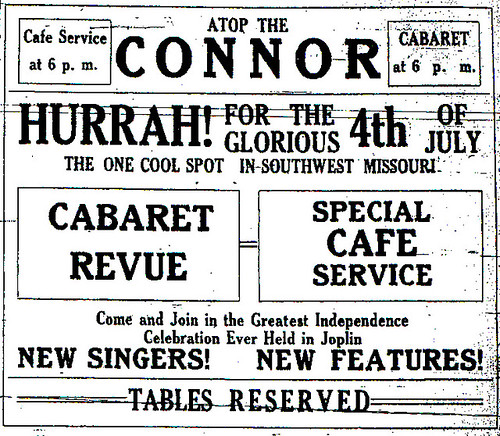
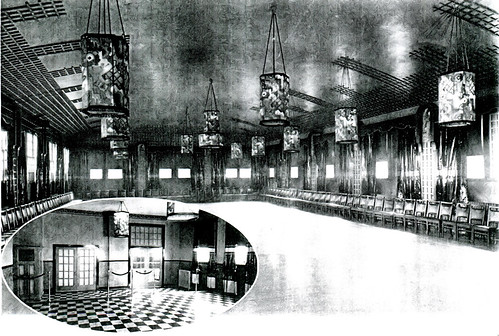
For those in Joplin who opted to celebrate without visiting the parks, one option was to enjoy a meal and music atop the Connor Hotel.  48 booths were made available in “The One Cool Spot in Southwest Missouri,” each designated with a separate flag which represented one of the 48 states of the United States.  “A telephone message to the Connor Hotel will be all that is necessary to have a state held.”  For those who opted to reserve “a state,” the rooftop garden was decorated with lanterns, flags, and festoonings, and the evening was filled with cabaret singers such as, “Ward Perry, Ned LaRose, Nell Scott and Grace Perry.”  Of course, fireworks of some sort were to be expected and for the Connor Hotel diners, a “grand illuminated display of pyrotechnics” among other novelties was offered.

Connor Fourth of July ad from 1913

Ad for the 4th of July entertainment atop the Connor Hotel

The Connor Hotel's rooftop garden.

A view of the renovated Connor's rooftop area where the 4th of July celebration was held.

From we at Historic Joplin, have a great Fourth of July!

Sources: The Joplin Globe, Joplin News-Herald

For more on the Connor Hotel, click here!

Blind Boone comes to Joplin

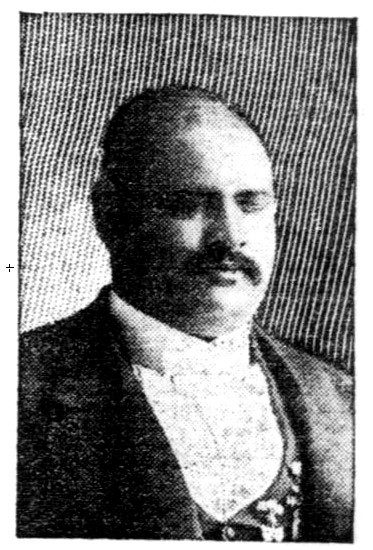
Blind Boone

Blind Boone, famed Ragtime piano player.

In June, 1907, a crowd in the large auditorium of the First Methodist church sat enraptured before the musical genius of John William Boone, better known as “Blind Boone.”  Boone had lost his eyesight at the age of six due to illness, but the handicap had not prevented him from finding a career as a piano player.  Managed by John Lange, Boone toured Missouri and the nation performing a mix between the classic and the popular.  His visit to Joplin coincided with his 26th season on the road with Lange.  Considered a Ragtime player, Boone entertained the Joplin crowd with songs from Chopin, Sidney Smith, Liszt, Gottschalk, and Wollenhaust.  Additionally, Boone performed songs of his composition.

The Daily Globe reporter who covered the event described Boone’s playing and its effect as, “He plays in perfect time and interprets the most difficult selections with ease.  He is very enthusiastic when about to begin a selection and his laughs at the end of his songs made a decided hit.”  The reporter continued on the laugh, noting that it, “enraptured his audience.” Furthermore, “Boone has a constant motion of the body backward and forward as he plays and sings which affects him only in appearance.”

Boone was not the sole performer, but was joined by a Miss Emma Smith who sang several songs, and then was called back by the crowd to sing several more.  Among the songs that Boone performed was the famed “Marshfield Tornado.”  Composed after a disastrous tornado swept through Marshfield, Missouri, the reporter stated of it, “so realistic a portrayal of the wind and storm that several small children in the audience cried out in alarm.”  Boone also exhibited imitations of various instruments on his piano, such as a violin, drum, and a fife.  The black performer closed with “The Mocking Bird” and “Home, Sweet, Home.”  For those Joplin residents who missed this performance, the article noted that Boone would be playing again a second night at Joplin’s First Christian church in South Joplin.

Source: Joplin Globe

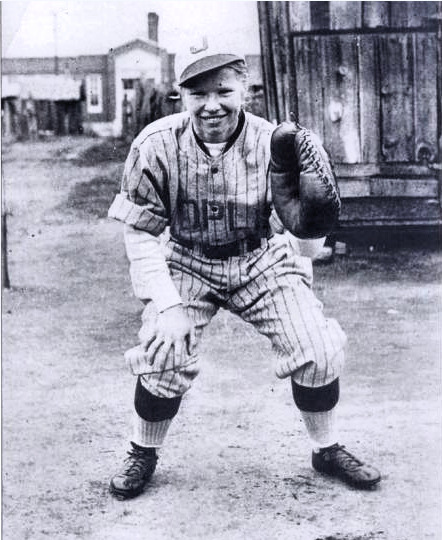
Vada Corbus – Joplin Miners catcher

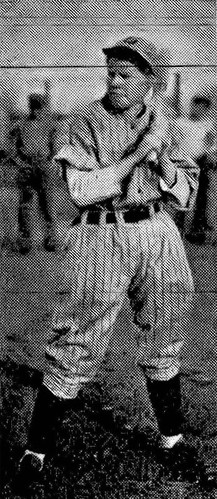
We recently covered Vada Corbus, a woman ballplayer who sought to play for the Joplin Miners.  By the permission of John Kovach, college archivist at St. Mary’s College, we secured a much better photograph of the near trailblazer.  The photograph comes from Mr. Kovach’s book, Women’s Baseball, (Images of Baseball).   For more on women in baseball, check and see if the traveling exhibit, “Linedrives and Lipstick: The Untold Story of Women’s Baseball,” is coming near you (or arrange to have it visit your local museum or history institution!).

Vada Corbus - Joplin Miners

Vada Corbus - Joplin Miners - personal collection of John Kovach.

Source: John Kovach’s “Women’s Baseball.”

Joplin’s First Organized Baseball Team – The Colts Who Became the Miners

By the turn of the century, baseball had an established presence in Joplin in the form of amateur teams, both black and white.  However, what Joplin did not have was a professional team and the Joplin Base Ball Association was created to change this fact and to “promote the great national game in this city.”  The lead men behind the club was Arthur C. Cox, treasurer, Don W. Stuart, secretary and a manager of the Club Theater, and John A. Campbell, president.  Joplin was to play in a six team league called the Missouri Valley League, the other teams involved were from Jefferson City, Springfield, Sedalia, Coffeyville, and Iola.

The Joplin Miners

The Joplin Miners of 1902

The Colts, as they were initially named, had their first home at Cox Park and were watched by cheering fans in a brand new grandstand that seated 1,500.  The grandstand featured special boxes for the scorekeeper and the press, plus 12 private boxes for those willing to pay for the privilege of a good seat.  A good seat was needed as apparently for the first time in Joplin baseball history, only the players and umpires were allowed on the field.  Under the grandstand, locker rooms complete with showers awaited the teams before and after the games.

The team was managed by Claud A. Marcum, considered locally as a seasoned baseball veteran who oversaw a “galaxy of stars.”  Outfitted in uniforms ordered from Rawlings Sporting Goods of St. Louis, the team won their season opener against Springfield at Springfield, 11 to 6.  Unfortunately, the Colts promptly loss their home opener against Springfield a few days later.  By the end of the season, two notable events had happened.  Joplin had failed to win the league pennant or even place in the upper half of the league and the Colts had changed their name to the Miners.  From the end of 1902 and for many decades to come, the Miners provided Joplin with a team to cheer for and a pastime to enjoy.

Featured left to right in the photograph above are: Top Row — Wright Wickizer, catcher; an unnamed pitcher; Bert Dunn, pitcher; Claud Marcum, manager; Arthur “Rip” Reagan, pitcher; Peck Harrington, catcher and outfielder; and Lefty Greer, pitcher.  Middle Row — Earl Taylor, pitcher, Don Stewart, secretary of the club; Arthur “Art” Cox, treasurer of the club; and William “Dolly” Gray, first baseman.  Bottom Row — Bert “Monk” Senter, shortstop; Jimmie Underwood, outfielder; Fred Tullar, third base; and Dick Bayless, outfielder.

Sources: The Joplin Globe, “Angling in the Archives” by Charles Gibbons.

Vada Corbus, Almost a Trailblazer

When it comes to women in baseball, many are likely familiar with the hit movie, A League of Their Own, which focused on the brief life of the All American Girl’s Professional Baseball League from the Second World War into the early 1950’s.   Few, however, may know about Vada Corbus.
In the spring of 1931, Vada Corbus lived with her widowed mother, brother Luke (or Lewis), and two sisters.   The family was supported by Luke’s work at a lead smelter and Vada’s two sisters employment at a pasta factory.   Luke was a catcher for the Joplin Miners, and in April, 1931, was moved to play right field.   This opened up competition for the catcher position and Vada Corbus tried out for the position.

Not much is known about Vada, the newspapers were surprisingly reticent on the subject of a girl playing for the city’s minor league team.   There were a few articles, a photo of Vada in uniform, but little else about her.  Prior to an exhibition game against the nearby Pierce City team, Vada served as a warm-up catcher.   Word was that Vada was going to be signed or was signed with the team to vie for the catcher position and was expected to play in the Miners’ season opener against Springfield.

The game was held on the evening of April 30, 1931.   The bright electric lights of Childress Field illuminated the Joplin skyline.   The bleachers were full with fans filled with hope for a winning start to the season.  Vendors walked the aisles hawking refreshments.  Yet when the time came for the home team to take the field for the first inning, Vada was not among them.  Her absence was explained by an article that appeared in the New York Times.

On April 18th, the New York Times picked up the story and the news of Vada’s hopeful experiment in the Western Association League.   This in turn alerted league officials who stubbornly insisted that there was no place for women in men’s minor league ball.   It seems that Vada Corbus fell from the attention of the newspapers and was forced to bid farewell to a dream of playing ball.   Her brother never made it out of Joplin.  Instead of playing in the big leagues, he remained in his hometown where he worked as welder for Eagle-Picher, before he died in 1952 at the age of 48 from kidney failure.

Vada Corbus, female baseball player.

Vada Corbus in her Joplin Miners uniform.

If anything can be said of Vada, it is that she was courageous for attempting to break into minor league baseball, following in the footsteps of the Bloomer baseball girls that barnstormed the country.   She had certainly proven she could play at their level, if unfortunately denied the chance to do it before a grandstand full of cheering fans, men, women, and little girls.   While the Joplin Miners may be best remembered for fielding a young Mickey Mantle on his way to the Yankees, Vada Corbus deserves a spot in the limelight of the club’s and city’s history as a pioneer of women’s baseball.

If you have any information on Vada, let us know.  We’d love to hear from you.

Sources: The Joplin Globe, Missouri Digital History, 1930 Federal Census, “Baseball: The People’s Game” by Harold Seymour, “Women Players in Organized Baseball” by Society for American Baseball Research.

There were Miners, and there were Bankers

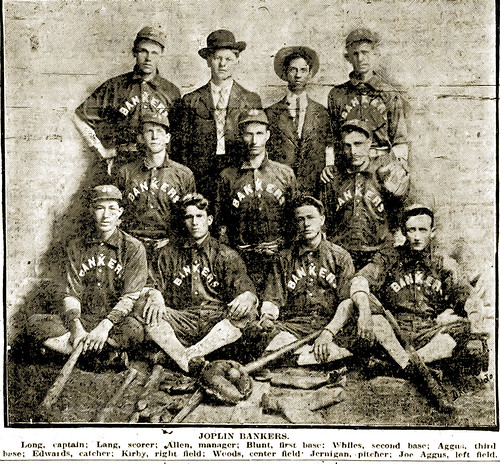
While Joplin had its first professional baseball team in the form of the Colts who became the Miners, it did not mean that others put down their gloves and bats.  One group of men who continued to play, perhaps as an amateur team, were the Joplin Bankers.  Note, the team consisted of the bare minimum to play with one man for every position.

1907 Joplin Bankers baseball team

The 1907 Joplin Bankers baseball team.

Source: The Joplin Globe

The Joplin Shadies

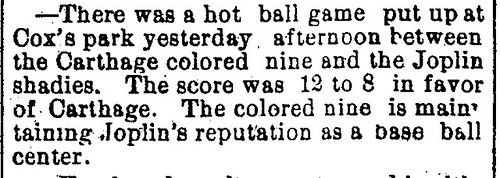
While Joplin did not have a professional baseball team until around 1901 / 1902 in the form of the Joplin Colts (who became the Miners), amateur teams were active and present before then.  Among them was this African American team called the Joplin Shadies.  Unfortunately for the Joplin team, on July 30, 1896, they lost to a Carthage team.

A brief score from an African American baseball team in 1896 Joplin, Missouri

A brief score from Joplin's African American baseball team in 1896.

Source: The Joplin Globe