The Shooting of Ben Collier

In previous posts we’ve covered shootouts, robberies, and prostitutes.  Sometimes, however, officers of the law made the headlines — for the wrong reasons.

On a fall evening in 1906, Joplin Patrolman Johnson was standing outside the Mascot Saloon at the corner of Tenth and Main.  It was 9:30 at night.  The sun had set and it was a cool Friday night.  Johnson may have anticipated trouble, but not until Saturday night, which was when the miners were paid their weekly wages.  Special Officer Ben Collier swiftly walked past Johnson and entered the Mascot.

Shots rang out from inside the saloon.  Johnson dashed inside and saw Police Day Captain Will J.  Cofer standing with a gun in each hand.  One gun belonged to Special Officer Ben Collier; the other, still smoking, belonged to Cofer.  Cofer laid Collier’s gun down on a beer keg and then began to holster his pistol.  Patrolman Johnson, however, demanded, “Give me those guns.” Cofer obliged.  Johnson then noticed the motionless body of Ben Collier lying on the floor of the saloon.  Johnson checked for a pulse, but found Collier was dead.
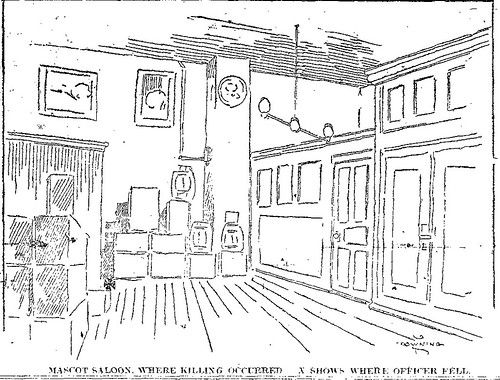
Interior of the Mascot Saloon

Sketch of the interior of the Mascot Saloon

Johnson took Cofer into custody and headed for the city jail.  On the way Johnson was met by Assistant Chief of Police Jake Cofer, who was Will Cofer’s uncle (and was commonly known around Joplin as “Uncle Jake” as he had served for several years on the police force), who took charge of his nephew.  Upon arriving at the city jail, Jake Cofer asked Will to remove his police badge, and then locked him in a jail cell.

It appears that the difficulty between Will Cofer and Ben Collier began over a woman named Rose Proctor.  She was described as a “small and pretty blonde” who lived at 1216 Main Street.  Proctor was reportedly estranged from her husband who still lived in Illinois.  She may have come to Joplin due to the fact she “had several married sisters” living in Joplin.

Will “Rabbit” Cofer was a twenty-three year old married father of five year old son.  At the age of 17, he married a woman from Pierce City who was ten years his senior.  His father, Tom Cofer, served as Joplin Chief of Police before moving to Portland, Oregon.  Will stayed in Joplin and worked as a blacksmith and in the mines before joining the police force.  He had only been on the police force for a year, but was supposedly a satisfactory officer.

Ben Collier, who, at age 55, was older than Cofer, arrived in Joplin in the mid-1880s.  He worked as a butcher for several years before became involved in mining.  Collier eventually served on the police force, but left to become a private watchman.  He was still working as a private watchman when he tangled with Cofer.  Collier’s first wife had died and was allegedly estranged from his second wife who lived in Hot Springs, Arkansas.

Cofer and Collier had quarreled in the past.  A Joplin Globe reporter had been standing on the street with Cofer the previous Wednesday when Cofer reportedly pointed to Collier and remarked, “There stands a fellow who has sworn he will kill me and I am afraid that he will try to do it before long.  If he would only come to me and tell me about it, it would be a different matter and we might get things straightened up, but he always talks behind my back.”

Members of the Joplin police force knew that the two men disliked one another and did their best to keep them apart.  Upon learning the Will Cofer was in the Mascot Saloon with Rose Proctor, Uncle Jake Cofer had sent word to his nephew that if he [Will] had any respect for him, Will would leave both the saloon and Rose.  Will Cofer, however, ignored his uncle.

Later that night, around 8 o’clock, Ben Collier appeared at the boarding house room that Rose Proctor called home, but was told she was not home.  Collier then spent an hour visiting with Proctor’s next door neighbor, May Stout, who told Collier that Rose was out with Will Cofer.  When he learned that Rose was with Will, Collier allegedly remarked, “I’ll kill him if I can find him tonight.” He then stalked out of the boarding house.  May Stout tried to call the Mascot Saloon to warn Will and Rose, but failed to reach them in time.  That’s when Ben Collier strode past Patrolman Johnson, entered the saloon, and a series of shots rang out.

There were only a few witnesses: “Red” Murphy, a cook at the Sapphire restaurant; Fred Palmer, bartender at the Mascot Saloon; and Rose Proctor.  In her statement to the police, Rose said she and Will Cofer were drinking a bottle of beer when Collier came in.  Collier called out, “Rose, come to me.” Rose coyly asked, “What do I want to come to you for?” Cofer, looking at Collier, offered to take Rose home.

Collier, enraged by Cofer’s interference, growled, “I have been looking for you and I have got you now!” The two men were standing roughly six feet apart when Collier drew his .44 caliber revolver but Cofer beat him to the draw.  Cofer managed to hit Ben Collier three times above the heart with his .38 caliber revolver.  Collier fell to the floor dead.
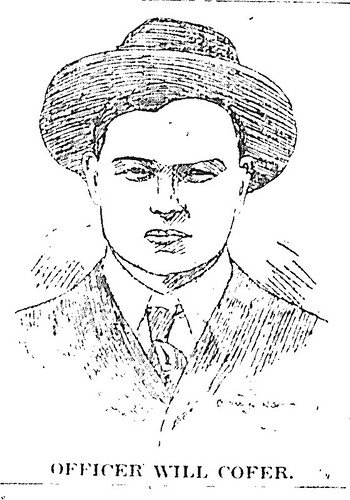
Will Cofer

A sketch of Will Cofer

Rose Proctor’s testimony was verified by the two other witnesses.   Upon examination, Collier’s revolver was half-cocked and had not been fired before Collier fell dead.  Jasper County Sheriff John Marrs arrived and ordered Collier’s body be sent to the Joplin Undertaking Company.

At the coroner’s inquest the next day, Rose Proctor and Fred Palmer, the bartender, testified that Collier pulled his gun on Cofer the minute he entered the saloon.  Proctor also testified she had attended “the races at Carthage” earlier in the week with Cofer.  After Collier found out, he waved his revolver at her and threatened to pull the trigger.

Patrolman Henry Burns testified that Collier had told him that morning that he would “get” Cofer “before night.” Joplin Police Night Captain Ogburn testified Collier had made threats against Cofer earlier in the year.  After the coroner’s jury made a trip to the Mascot Saloon to see the scene of the crime, the members made their decision: Cofer killed Collier in self-defense and was free to go.  Cofer shook hands with his friends and then resigned from the Joplin police force.

By 1910, Will Cofer and his wife Amelia were living in Portland, Oregon, where he shoed horses for a living.  According to the federal census, their son died between 1906 and 1910.  The couple was childless.

Curiously, in 1920, Will’s wife is listed as Rose.  His first wife, Amelia, either passed away or the couple divorced.  It seems unlikely, however, that this was Rose Proctor as this Rose listed her birth place as Oregon.  What is certain, though, is that a shooting took place in a Joplin saloon on a crisp fall night and Ben Collier lost much more than his heart.

Sources: Joplin Globe; 1900, 1910, 1920 federal census
The Joplin Carnegie Library and the Origins of Joplin Public Library: Part One

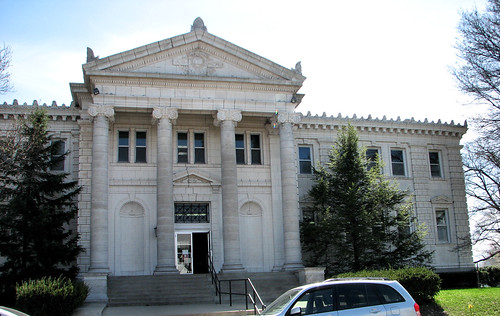
One of the major institutions of modern day downtown Joplin is the Joplin Public Library located in the 300 block between the Third and Fourth streets.  The prior occupant of this site was the Connor Hotel.  Plans to purchase the block, demolish the Connor, and to erect a new library building began in the 1970’s.  The Connor collapsed a day before its scheduled demolition in 1978, and all but a few minuscule pieces of the grand hotel remained on opening day of the new library building in April, 1981.  Up until that spring day twenty-nine years ago, the Joplin Public Library had been housed in a Romanesque building, a columned temple of knowledge, a few blocks to the southwest.  The origin of it and Joplin’s library system began more than a century ago.

Undoubtedly, the idea to establish a city library came into being not long after Joplin began to establish its schools and a professional class.  The dust of the lead and zinc mines was shaken off by a city that pulsed with a passionate desire for progress.  In April 1893, a gathering was held at the Young Men’s Christian Association building.  It was the first formal meeting of the Joplin Public Library Association.  Hamilton S. Wilks was elected president, along with Christopher Guengerich as treasurer, the Reverend E.E. Wilkey as secretary, and C.W. Squire as vice-president.  In addition, an executive committee was established with the following women: Mrs. W.H. Picher, Mrs. Clark Craycroft, Ms. Henry Weymen, Lola Spear and Mrs. W.C. Weatherill.

The initial funds to assist in the creation of a library came from a charity event hosted by the Century Club.  The club, established only three years previously, was a women’s literary society. Its members embarked on a campaign to create a city library through education and outreach.  While a public reading room had been the original idea for the city’s library, it became obvious that an independent library building was needed.  The Century Club, and other Joplin literary clubs, claimed victory in the city election of 1901.  The months before the vote had been spent campaigning for an annual tax of ten cents for every one hundred dollars appraised for the care and maintenance of a library building.  The measure was overwhelmingly approved.

Sedalia's Carnegie Library

The Library Committee traveled to visit Sedalia's Carnegie Library, pictured here.

This tax was connected to a requirement to form a non-partisan board to oversee the construction and operation of the library.  Ten individuals were appointed to the board: William N. Carter, H. H. Gregg, J. D. Elliff, Henry Kost, E. L. Anderson, Reverend Paul Brown, O. H. Picher, Mrs. Ada Goss Briggs, Mrs. Emma Lichliter and Mrs. Hattie Ruddy Rice.  Elliff, the superintendent of Joplin’s public schools, was elected president by the board, while the position of board secretary was given to Rice.  Shortly after, the board created a committee tasked with overseeing the building and grounds of the future library.

Around May, 1901, that committee explored the possibility of contacting the capitalist Andrew Carnegie.  For just under twenty years, the Scotsman offered funds to cities for the construction of libraries.  Generally, these donations came upon the promise that the cities guarantee a specific amount of upkeep and continue funding of the institutions.  Not long after the president of the board, J.D. Eliff sent off a letter to Carnegie, a reply was received from James Bertram, Carnegie’s personal secretary. Addressed from Skibo Castle, Ardgar, Bertram wrote:

Dear Sir – Responding to your letter of May 6th–If the city of Joplin will furnish a suitable site and pledge Itself to maintain the library at a cost of not less than $4,000 a year. Mr. Carnegie will be glad to provide $40,000 for a suitable building.

Very Respectfully.

James Bertram. Private Sec’y.

The promised sum of $40,000 delighted the board.  The question then turned to what the library should look like and where that building should be located.

The discussion of location and design carried on through the months of 1901 and into the first quarter of 1902.  It was not until October, 1901, that the board finally came to a decision on the placement of the new library.  Proposed locations included the intersection of Eighth and Pearl streets, Cox Park (advocated by the people of South Joplin), and the intersection of Joplin and Ninth streets.  The two most popular sites, however, were the intersections of Fourth and Pearl and Ninth and Wall streets.  The former were owned by a man named Renfrow and the latter by Christopher Guengerich.  According to coverage by the Globe, the board’s primary concern was a location which benefited the entire population of the city.

The board came to a decision on the location on October 21, 1901, when by a vote of 5 to 4, the Ninth and Wall location barely beat out the Fourth and Pearl site. Prior to the vote, attorney and amateur historian Joel T. Livingston offered a presentation, complete with a special map of the city that how the population of Joplin was concentrated.  Incidentally, while Livingston claimed to favor no specific site, his analysis of the city’s population placed the epicenter around Eighth and Wall streets.  If this swayed the votes toward the Ninth and Wall location, the site was further helped by the testimony of J.W. Freeman, who claimed the location would satisfy the people of South Joplin.  It was future Missouri State Senator Hugh McIndoe, as well as Freeman Foundry owner J.W. Freeman, Oscar and C.M. DeGraff, as well as Clay Gregory, who introduced the successful proposition.  Thus, the chosen site had strong and influential supporters.  As to what type of building would be built at the corner of Ninth and Wall, the discussion continued into the next year.

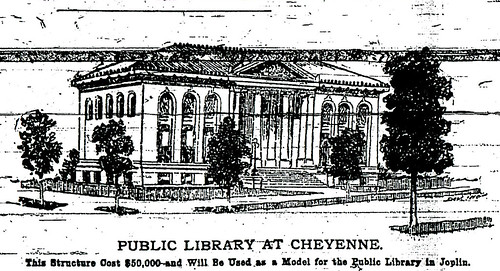
Cheyenne Carnegie Library

The Cheyenne Carengie Library design that William Carter favored and became the basis for Joplin's library.

The committee in charge of selecting the design of the library took their task seriously.  Initially, a question of whether the city would offer the local Joplin architects was debated.  One of the chief proponents against hiring local talent was William Carter, who when asked about the successful architect August Michaelis, sneered, “He learned his business in Joplin.”  Carter went on to point out that Joplin had no libraries or similar buildings, and as such, Michaelis had no experience in designing a library.  Another supporter of seeking a non-local architect was Ada Briggs, who read a letter written by the president of the Sedalia Library board.  Prior to this meeting, members of Joplin’s committee had visited the city to their north to view their Carnegie library.  In the letter, the president warned against allowing local architects to use Joplin’s library as an opportunity to learn how to design such a building.

Plans based on the designs of numerous libraries were pushed in an attempt to avoid hiring area architects.  One such architectural rendering was the Sedalia, Missouri, public library, which was quickly dismissed for a variety of reasons.  It was too big for the lot picked out previously; it failed to include a basement or a separate women’s assembly room; and it cost an additional $10,000 more than Joplin had budgeted.  Nevertheless, Ada Briggs described the building as, “beautiful simplicity.”

In lieu of the Sedalia design, Carter suggested the design of the Carnegie library in Cheyenne, Wyoming.  Apparently, the news of Joplin’s library design search had spread, as the architect of the Cheyenne library visited Carter the week before to sell him on the design of that building.  Carter went so far as to suggest a trip to Cheyenne, similar to that which had gone to Sedalia, but the expense and length of the trip resulted in no support for such an adventure.

In the end, the committee opted to allow local architects to submit plans, based on the fact that a majority of the committee believed that they had already proven themselves with many beautiful buildings about the city.  It was even remarked that this was a difference between Joplin and Sedalia.  One city had remarkable architecture and the other did not.  The committee then reasoned that the advice of the Sedalia library board’s president to seek elsewhere for an architect could be ignored simply because Sedalia did not have any local architects of considerable skill. The plans of three firms were accepted to be voted upon.  The three were Garstang & Rea, I.A. Hunter, and August C. Michaelis.

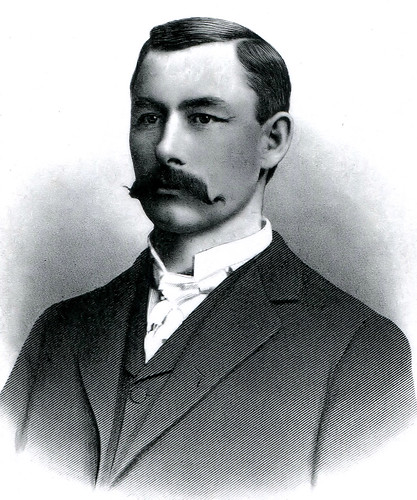
August C. Michaelis, Joplin Architect

August C. Michaelis, one of Joplin's preeminent architects.

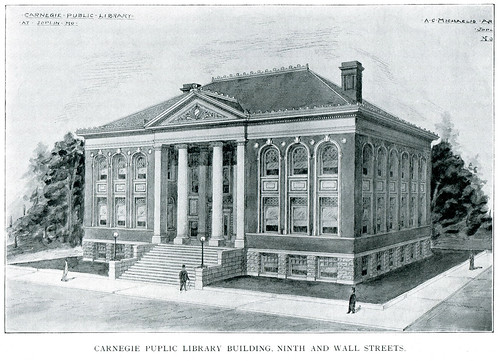
At 2’o clock in the afternoon on February 3, 1902, the committee selected the plan presented by Michaelis.  By specification, the design was similar to that of the Cheyenne Library, but not an identical copy.  This requirement was probably added to soothe those members, like Carter, who did not want to trust the design to local architects.  It featured three floors, a basement, first floor, and second.  Located in the basement was to be the men’s reading room, advertised as a place men could visit in or out of work clothes, as well go so far as to enjoy a smoke while perusing book or newspaper.  Filling out the basement was a coal room, toilets, and the boiler.  Upon rising to the next floor, the visitor found a main hallway of 33 square foot of marble flooring.

On one side of the floor the general reading room was placed connected by doorway to a reference room.  Opposite the general reading room was a reading room expressly for children.  In addition to a reference room, a room was set aside for librarians and contained a fire proof vault.  At the rear of the floor was located a circular stacks, which at the time was supposed to be filled with steel fire proof shelving.  The shelves were to be arranged in a circular fashion with the librarian seated in the center and thus with a 360 degree view of the room.  The stacks were expected to hold approximately 30,000 books.

August Michaelis' winning design for Joplin's Carnegie Library

August Michaelis' winning design for Joplin's Carnegie Library

Also located on the first floor was a wide double staircase that rose to the second floor.  On this uppermost floor was located a room for the women’s club with attached rooms and bathroom.  A statuary hall mirrored the hallway below and at the time was thought to be an ideal display area for mineral examples. Separate rooms were set aside for art and for trustees, as well a private reading room.  The rooftop was shingled in zinc, though a brief controversy arose when someone claimed architect Michaelis had said otherwise.  Michaelis confirmed that the library would indeed have zinc roof tiles. The library was heated indirectly with steam.  The library was filled with oak furniture and countertops.

A plan in hand, all that remained was for construction to begin.  Part Two will continue the history of the Joplin Carnegie library.

Sources: Joplin News Herald, Joplin Globe, “A History of Jasper County, Missouri and its People,” by Joel Livingston, and Missouri Digital History.

Joplin Museum Complex Proposal Shot Down

We would be remiss if we did not mention the recent Joplin Museum Complex proposal that was defeated at the polls.

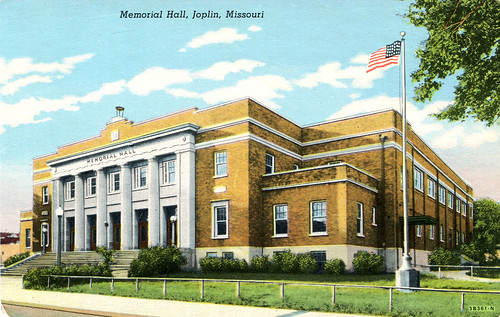
Yesterday, Joplin held its spring election and arguably the most contentious item on the ballot was Proposition A, which if passed would have created a sales tax to fund a $7 million dollar renovation of Memorial Hall to serve as the new home of the Joplin Museum Complex.  The sales tax would have indefinitely continued at a lower rate to perpetually support the museum.   The proposal was voted down.

Joplin Memorial Hall

Memorial Hall - At least for now, remaining Memorial Hall.

According to the Joplin Globe, the vote was 3,882 to 928, a four to one margin.   While we here at Historic Joplin believe that the museum complex could do with a new home, we agree with the result of the vote.  There are several reasons why.

First, it was a poor decision to spearhead a sales tax proposal during the recent recession.  Although many economists believe the country is recovering from the recent economic downturn, folks on Main Street are still feeling the pain of difficult times.  A new museum complex is the least of someone’s worries who is struggling to pay for healthcare, food, and other necessities.  Simply put, it’s hard to justify passing a new tax on people who are struggling to survive on a daily basis.

Second, the PR campaign was mediocre at best.  The Globe, which seemed to support the museum proposal, attempted to publicize both sides of the debate.  The museum, however, failed to articulate to the public why it matters.  Talking about the museum’s multi-million dollar collection of lead and zinc samples does not translate with folks.  It does not inspire passionate debate.  In the end, the museum failed to carry its message to the people, let alone sell it.

Third, the museum awkwardly proposed taking over Memorial Hall.  Why? It appears that “museum representatives” decided upon Memorial Hall and drew up plans without even consulting the public.  Some of the endorsements on its website are questionable, even dubious at best, such as the “National Cookie Cutter Historical Museum,” and the “Joplin Historical Society.” It is our understanding that the National Cookie Cutter Museum is part of the Joplin Museum Complex as is, or was, the Joplin Historical Society.  Essentially, two organizations that are part of the museum were supporting the museum proposal — isn’t that a conflict of interest?

Fourth, we here at Historic Joplin have conducted research in many of the finest archives and libraries in the world such as the Bodleian Library at Oxford; National Archives I and II in Washington, D.C.  and College Park, Maryland; the Library of Congress; the special collections of the University of Oklahoma, the University of Missouri, and the University of Arkansas; numerous state archives and county courthouses; as well as small town libraries and museums.  We can say that we have always had a pleasant experience save for interactions with the Joplin Museum Complex.

The Joplin Museum Complex does not allow members of the public access to its collections which is extremely unfortunate.  Excuses are made that the museum is simply unable to accommodate visitor requests for access to the museum’s collection.  This is unacceptable.  Dorothea B.  Hoover is rolling in her grave.  Years ago, the University of Arkansas Museum was shuttered and the multi-million dollar collection placed in storage.  Although housed in a very small space, the university museum collection is readily accessible to the public and is cared for by professional museum staff.

We cannot say the same of the Joplin Museum Complex (JMC).  The photo in the recent Globe article on the museum shows that the Joplin Museum Complex collection has not been taken care of by the museum staff.  Even if the conditions are not ideal, there is no excuse for sloppy storage methods, although the JMC staff members are not professionally trained curators or archivists.  Out of the many libraries, museums, and archives we have visited over the years, this is the first time we encountered such an unhelpful staff.  It is unacceptable that members of the public are denied access to museum collections when it is funded by taxpayer money.

So here are our suggestions for improvement:

First, the next time the Joplin Museum Complex embarks on a fundraising campaign, it must articulate its message.  Tell the public why its collections matter.  Sell it like Sam Walton sold cheap underwear back in the 1970s.

Second, the Joplin Museum Complex should get rid of collections that have nothing to do with the history of Joplin such as the Cookie Cutter collection in order to create adequate storage space.  In the museum world, this is called “deaccessioning.” Every museum will deaccession something in its lifetime, particularly items that do not fit with the museum’s mission.  Is the Cookie Cutter collection relevant to the history of Joplin? Probably not.  So get rid of it.  Focus on the real treasures in the collection.  This should alleviate some of the storage problems.

Third, please change exhibits as time and money allows.  The Joplin Museum Complex has not changed since I was in the third grade.  Consider not allowing an animal to run around the museum as they can damage and ruin museum artifacts.  No museum staff worth its salt lets live animals have free reign inside of a museum.

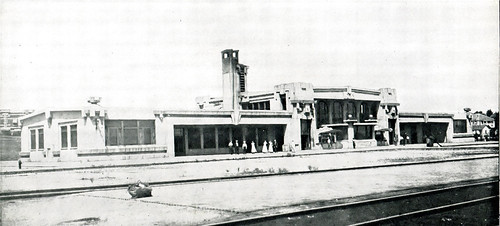
Joplin Union Depot

The Joplin Union Depot not long after being built.

Fourth, consider the Union Depot.  We realize it is a shell of a building.  We have read that the basement has water problems.  It is, however, an architectural jewel waiting to be reclaimed.  The Joplin Museum Complex could have gotten a lot of support from the numerous voters who want to see the Union Depot restored to its former glory.  Forget the basement.  Pour concrete in the basement for all we care.  Any architect worth his or her drawing board can come up with architectural additions that will compliment Union Depot’s fabulous design.  Incidentally, it was in the Kansas City Bottoms where Union Depot sits, where some of Joplin’s first lead mines were established.  Think of how relevant that is to the history of Joplin — what better location to preserve and explain the history of Joplin and its rough and tumble beginnings? Plus, the Joplin Museum Complex would be a hero for saving the depot.

Fifth, contemplate hiring someone to serve as museum director who has demonstrated experience in fundraising, community relations, and who preferably has a master’s degree in museum studies.

Comments? Thoughts? Let us know.

Letters to the Joplin Police Chief

In 1907, the Joplin Police Chief Myers shared some of the letters he received on a daily basis with the Joplin Globe.  The letters offer a glimpse of life in Joplin and the surrounding areas.  Some the letters he received were mundane, such as the following letter:

“Cherryvale, Kan., Oct., 21, 1907.
Joplin City Marshal, Joplin, Mo.

Will you please see and inform me if there are any girls wanted to attend to lunch counters.  If so, I can send an experienced one, and please give me the number and the price of wages.  Let me hear soon.  Respectfully,

S.A.T.”

The Globe jauntily remarked, “The chief of police has not answered the above letter because of the fact that he is not running an employment agency.  In fact, if the chief answered all of the letters of this nature he receives he would have to hire a private secretary.”

Another letter that Chief Myers received read,

“Cassville, Mo.  Oct.  22, 1907.
Chief of Police, Joplin, Mo.

Dear Sir — Will you please inform me by enclosed card if a woman by the name of Ella Hailey is in your city.  She may be working in one of your hotels.  Please phone hotels and see if she is there.  Oblige, A.C.H.”

The Globe noted that the “last letter is somewhat out of the ordinary as he addresses  the chief as ‘dear sir’ and actually says ‘oblige’ in ending his letter.  The majority of the letters simply tell the chief of what they desire him to do and let the matter pass.”

Other letters were in response to an earlier missive from a Joplin man, C.T.  Plimer, who was hunting a wife.  One woman from Platt City, Missouri, declared, “Now please understand I am not a man hunter, for I never gave this subject much thought.  I think that I will fill the bill and the description, except having the several thousand dollars.  I have some nice property here.  I have visited in Joplin and like your city very much.”

The “most amusing letter” that Chief Meyers received, according to the Globe was one from an African American man in Fort Scott, Kansas, who wrote,

City marshal, be on the lookout for a young colored woman by the name of Leatha B—-.  She is a brown skin, good looker, good hair, a pair of earrings with blue sets, and a finger ring with a blue set in it.  She might go by the name of Leatha C.  She wears a long black coat, a black hat turned up on the side with a band with a red stripe in it, a nice black dress, and a changeable silk underskirt.  I just bought them for her.  There is a young brown skin man by the name of Will Julien.  If you catch them arrest them both and lock them up until you hear from Butler or Mr.  George Julien.  If she is there and ain’t working and running the streets, make her leave town.  Yours truly, Andy B.

P.S.  — Make her come home; she ain’t got no business down there.  I have got a good home for her and she don’t want for nothing.  Make her leave town.  She left this afternoon at 3 o’clock.  Telephone back at my expense.” — Andy B.

We’re not sure if Leatha returned to Andy B.  in Fort Scott or not, but it was probably not the last time that Chief Myers received a letter from the hopeful and the lovelorn.

Source: The Joplin Globe

Happy Birthday, Joplin!

On March 23, 1873, the Missouri legislature passed a bill presented by T.M. Dorsey and Judge John H. Taylor.  On that day, the City of Joplin was born.  On that day in March, Joplin counted around four thousand citizens, no paved streets or roads, and only seventeen lead furnaces.  All but a few of Joplin’s buildings were built of wood and many homes were simply tents and small box-houses.  By appointment of the governor, E.R. Moffett was made the first mayor of Joplin.  Joel T. Livingston, in his massive History of Jasper County, republished an article from the St. Louis Globe-Democrat which described the people of Joplin as full of “pluck and industry” and who overcame severe disadvantages through sheer, “abundant nerve.”

Today, Joplin turns 137 years old.  Happy Birthday, Joplin!

Heck No — We Won’t Wear Helmets!

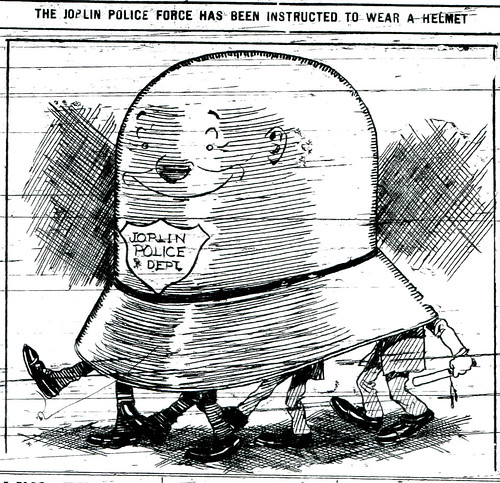
On a hot summer night 1904, the Joplin City Council was in session when someone raised the issue of the “dress of the Joplin policemen.”  A simple complaint about enforcing Joplin’s helmet ordinance revealed many of the underlying problems plaguing the Joplin police force.  Like many law enforcement agencies at this time, the Joplin police force was undermanned, underpaid, and overworked.  They were expected to maintain law and order in a city wracked by cocaine abuse, plagued by saloons, riddled with gambling dens, and infested with men ready to fight at the drop of a hat.  Wearing a helmet was of little concern to a member of the Joplin police force.

Cartoon concerning requirement of Joplin Police to wear a helmet.

The mood of the Joplin Police officers were quite the opposite as expressed in this cartoon.

Councilman Kost reminded attendees that the council had previously passed an ordinance requiring police officers to wear helmets and carry a “policeman’s club of certain size.”  According to Kost, few members of the Joplin police force were complying with the ordinance.  The Joplin Globe noted that prior to the ordinance, Joplin police officers were allowed to wear “slouch hats” and very few carried a club.

Councilman Lane shrugged off Kost’s remarks and suggested that the ordinance need not be enforced, but Mayor Thomas W. Cunningham disagreed. Cunningham opined, “the ordinance was not passed for amusement and that it should be lived up to by all policemen.”

One unnamed Joplin police officer who spoke to a Globe reporter proclaimed, “If I am compelled to wear a helmet or lose my position on the force, I will lose my position.  You cannot realize until you have worn one how hot a helmet is.  I wore one when I first went on the force, but will never do so again.  Fired up, the police officer continued, “And as for clubs, it is very foolish for the council to attempt to force a man to carry a club in his hand.  Every time a patrolman makes an arrest he has to drop his club in order to handle his man.”

The real problem, the police officer snorted, was that city council members “want to see a metropolitan police force on a suburban salary. If the council will pay its police force a salary, the city will not only be able to get better men, but the men will have enough money to buy a belt in which to carry the ornamental club.”

A second Joplin police officer agreed, “Not a helmet for me. I wear what I can get.  If the city of Joplin wants me to wear a helmet while on duty the city will have to put up for it as I can’t afford to buy one.”  He continued, “The police force of Joplin now numbers twelve men.  Five men patrol the business section of the city during the day and the same number are on at night.  From noon until midnight there is one man on duty in East Joplin and another at Smelter Hill.  The twelve men are doing the work of sixteen men.  One man on the force walks from Fourth Street to C Street covering six blocks of territory in the toughest section of the city.  There isn’t even a man to drive the patrol wagon yet we must make a showing and wear a helmet and a club.”

Curiously there was no mention of the death of Joplin police officer John Ledbetter who was killed the previous summer by a rock wielding assailant, though a helmet may not have been enough to save his life.  Unfortunately, helmets and clubs were not enough to save the lives of subsequent Joplin police officers killed in the first few decades of the twentieth century.

Source: The Joplin Globe