The Mobile Joplin Fire Department

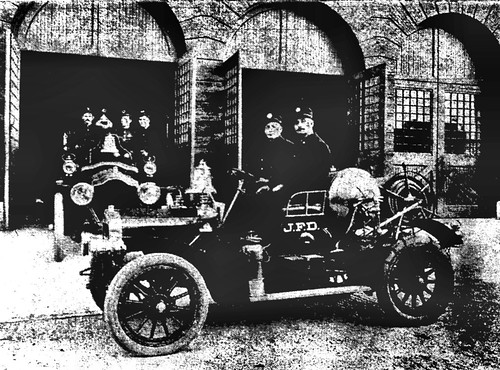
Here’s a view of the Joplin Fire Department proudly displaying their high tech fire fighting equipment in 1909.  The photograph was taken in front of the City Hall of the time, which served as both a jail, police station, and fire station.

Joplin Fire Department Goat

The accompanying article noted that the Kansas City Fire Department was impressed by Joplin's automotive capabilities.

Source: Joplin Daily Globe

Thomas Hart Benton Documentary to Air 7/10/2010 on KODE at 6pm

As reported by the Joplin Globe, a documentary produced by the late KODE newsman, Bob Phillips, of the creation of Thomas Hart Benton’s “Joplin at the Turn of the Century” mural, will air on KODE on Saturday, July 10, 2010, at 6pm.  The documentary is a rare look at how Benton created his artwork, from research to painting.  “Joplin at the Turn of the Century” is located in the Joplin administrative building on Main Street.

He Knew the West As It Was – Lovell McCown

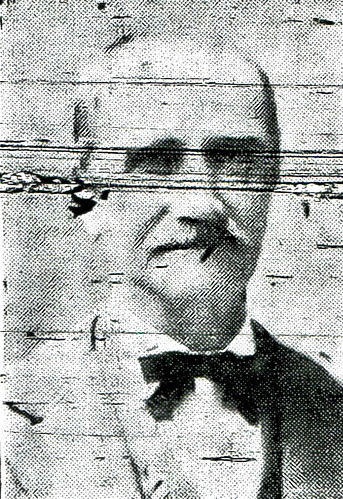
Lovell McCown - 1836 - 1911

Lovell McCown, He knew the West as it was.

Around the turn of the 20th Century and for a few decades after, a particular type of obituary could be found in the Joplin papers.  They were articles that noted the passing of one of the city’s pioneer citizens.  The pioneers were the men and women who first settled the area that became modern day Joplin and the eulogies often played up the hard conditions and hard pasts of these individuals.  In September, 1911, one such pioneer was Lovell McCown.

McCown’s pioneering past began approximately in 1838, when as a 2 year old, his parents moved their family across the Cumberland mountains to the Ohio River.  There they floated down the river to the Mississippi, where they then took a wagon to Independence, Missouri.  At age 17, the young pioneer set off seek his fortunes across the Western Plains to eventually participate in the California Gold Rush.  He later found success as a gold producer.  Sometime not long after on a freighting trip, McCown purportedly participated in a battle with Cheyenne Indians in the vicinity of the Big Sandy river.  The battle arose when Cheyenne warriors spot McCown and his fellow travelers and quickly amassed a number of over 500.  Thus outnumbering the “pale faces” by a margin of 5 to 1, the fight commenced.

In the battle, which McCown received a Indian lance to the leg, and at one point he was close to being brained by Indian clubs before rescued by his fellow travelers.  They eventually managed to fight off the attackers through superior firepower.  It was a battle, the obituary noted, that lasted for hours with an untold number of Cheyenne warriors slain.  Even after, the defeated Indians trailed the survivors for days.  More than half of the obituary concerned itself with the battle with the Cheyenne and offered little to McCown’s life in Joplin, which amounted to the last 27 years of his life.  It may well be that it was a story that McCown loved to tell and thus was essentially known for.

He succeeded in wrapping himself in the stories of the Old West, as for when the 75 year old passed away, the newspaper obituary began so:

Death came unexpectedly to Lovell McCown of 710 Hill street, East Joplin, and in his taking away Joplin lost a pioneer citizen, who knew the West as it was in the early days, when buffalo and Indians roamed the plains and when the life of the frontiersman was fraught with continuous perils.

Source: Joplin News Herald

Union Depot Renovation Has Support of Downtown Merchants

In follow up coverage by the Joplin Globe, merchants along Main Street have voiced their support for the depot renovation for use as a museum, along with the rest of the plans from Tuesday’s, July 6, 2010, meeting.  The Globe has also run an editorial supporting the plan, though with some worry about funding drying up in the current economic condition.  The Globe‘s suggestion for the City Council? Act  steadfastly.  Make it so, Joplin!

Support the renovation of the Joplin Union Depot as a new home for the Joplin Museum Complex!

Support the renovation of the Joplin Union Depot as a new home for the Joplin Museum Complex!

Renovated Union Depot Proposed Home For Museum

At last night’s City Council meeting, City Manager Mark Rohr proposed that the Union Depot be renovated to be used as a new home for the Joplin Museum Complex. As covered by the Joplin Globe, Rohr believes that existing sources of funding exist and as a result, no new taxes would be required for the project.

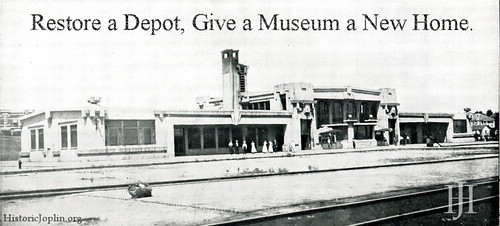
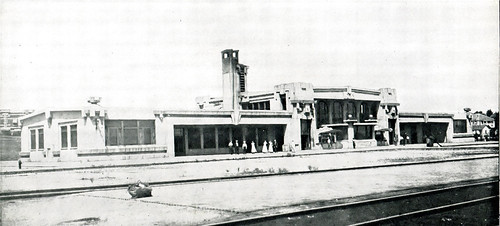
Joplin Union Depot

The Joplin Union Depot not long after it was opened. A great future home for the Joplin Museum Complex.

We, here at Historic Joplin, strongly support this proposal.  We hope that it becomes reality and that someday in the near future, we can walk in and enjoy a beautifully restored depot.  Even though the Carnegie Library appears not to have been part of the new plan, we hope it too has a bright future.

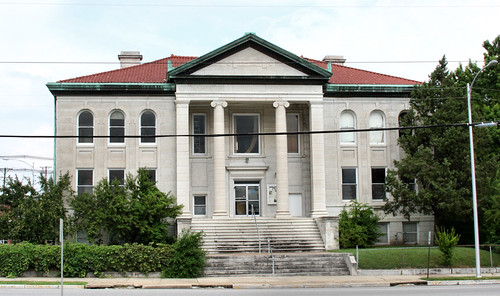
Joplin Carnegie Library

The Joplin Carnegie Library as it appears in 2010.

Joplin Carnegie Library – Then and Now

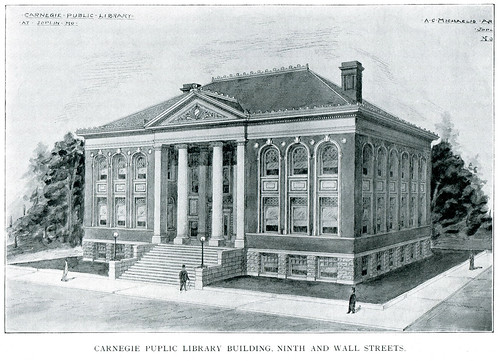
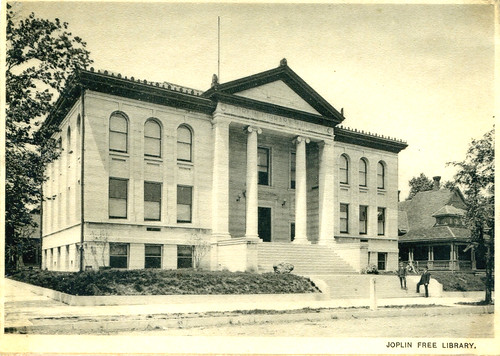
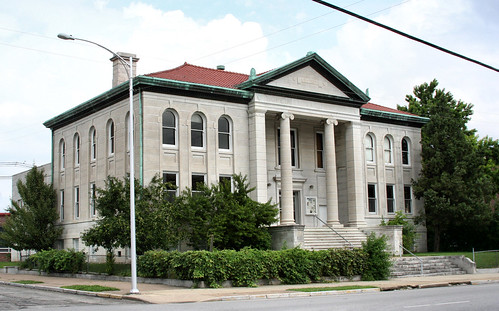
The Joplin Carnegie Library may come up in a city plan to be discussed tonight, July 6, 2010, by City Manager Mark Rohr, as part of the redevelopment plan for the city. As such, we figured to show a series of photographs (and one drawing) of the Joplin Carnegie Library.

First, we have the award winning sketch of the library by August Michaelis, a distinguished Joplin architect of the time.

August Michaelis' winning design for Joplin's Carnegie Library

August Michaelis' winning design for Joplin's Carnegie Library

Next we have a photograph not long after it was built:

The Joplin Carnegie Library

The Joplin Carnegie Library not long after completion.

Now we have the library as it appears today. It is privately owned, but in need of restoration. It is easily one of the most beautiful buildings in Joplin.

Joplin Carnegie Library

The Joplin Carnegie Library as it appears today.

Source: Historic Joplin Collection

Whistles for the Police

In April, 1911, it was announced that the Joplin Police Department had adopted a “metropolitan police” scheme of equipping the police officers with whistles.  Viewed as one more step toward imitating the police departments of large cities, the whistles were thought useful:

“Although it is seldom that an occasion arises in this city when an officer cannot take care of himself, it is thought best to be on the safe side.  When an officer hears one of these whistles, which are of a peculiar tone, he is to hasten at once to the scene of conflict, or wherever the sound comes from.”

It was thought at the time that the presence of a mere whistle may have prevented some of the deaths of Joplin’s police officers up to that point.  It’s unknown if the whistle dramatically changed the safety of the police in a city with the rowdy reputation of a mining town.

Source: Joplin News Herald

Joplin Celebrates the Fourth

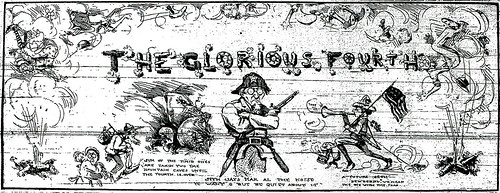
Bingville Bugler 4th of July

Bingville Bugler, insert of Joplin News Herald, 4th of July banner.

The celebration of America’s Independence Day was no less important a hundred years ago in Joplin than it is today.  A principal slogan of the city of Joplin in 1910 was to have a “Safe,  Saner Fourth of July for Joplin.”  In June of that year, the city council had passed the Kelso ordinance which oversaw the sale, display and use of fireworks.  Proponents of the safer and saner Fourth were women groups and the Ministers Alliance.   Both Mayor Guy Hume and Chief of Police John McManamy supported the measure and the idea of a “quieter Fourth.”   Further support was also sought by the local school systems.  Unsurprisingly, the motivation for the ordinance had been to reduce the injuries from the celebratory play with explosives.  If injuries could be reduced it was hoped the city could proceed with more support for the holiday.  The “Sane” Fourth motto was also raised the next year in 1911 and reinforced by a city ordinance that prevented the sale of firecrackers more than 2 inches in length, as well “exploding canes and blank pistols”.

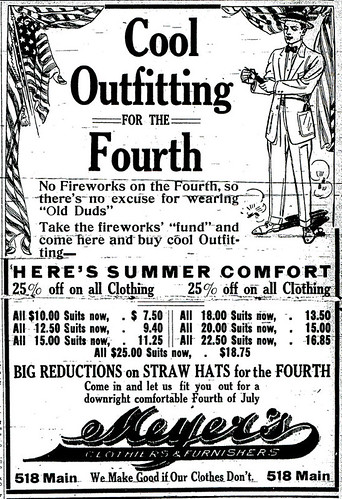
If people were not buying fireworks, Joplin shopkeepers likely hoped they would do some holiday shopping.  One such business was Meyers, which paid for a patriotic Fourth of July ad three years later (when the same belief in a “quieter Fourth” prevailed):

A patriotic ad from Meyers in 1913.

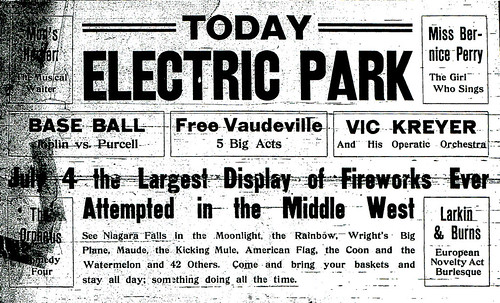
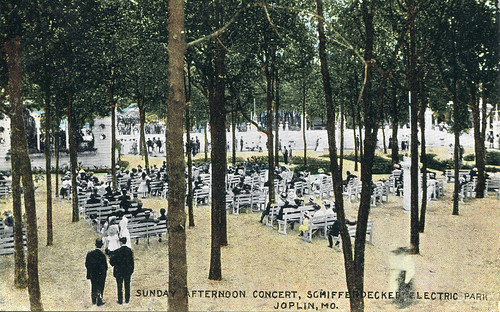
Many in Joplin opted instead of celebrating in town to travel to two of the popular recreational parks in the area, “Since early morning wagons, buggies, autos and street cars have been busy carrying people from the city.  Contrary to the usual custom, there seem few people from the country coming to town to spend the day.  Both Electric and Lakeside parks are the scenes of great activity.”  The bill of events in 1911 for the Electric Park in, located within Schifferdecker Park, advertised a fun and entertaining day:

Electric Park Fourth of July ad from 1911.

An advertisement for the Electric Park in 1911.

An entertaining area of the Electric Park of Joplin, Mo.

One area of the Electric Park where visitors enjoyed the nearby stage.

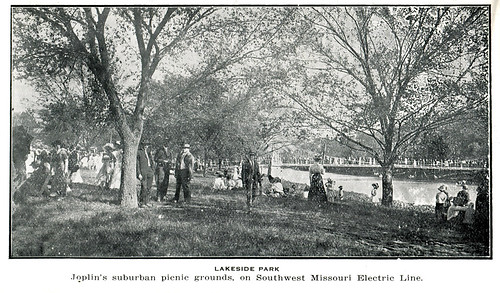
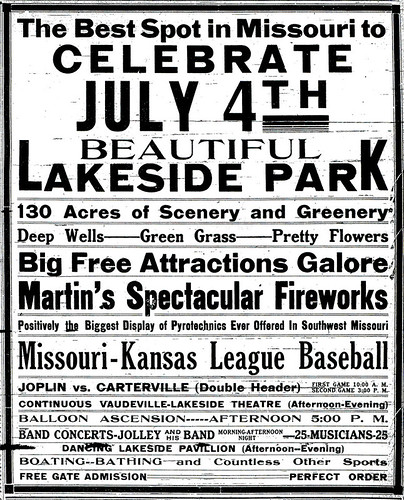
Not mentioned in the ad above was an inviting swimming pool, an escape from the hot July heat.  Likewise, as the name reveals, Lakeside Park also offered a cool, aquatic retreat.  The attractions at Lakeside in 1911 were several.  The Trolley League, a local baseball league of four teams, was scheduled to present a doubleheader.  A standard at Lakeside was boating, in addition to swimming, and a band had been secured for a patriotic performance.  For those in the mood for dancing, a ballroom was also available.

Lakeside Park, Joplin, Missouri

By accounts, the there was far less room to stroll, as presented here in the photograph of Lakeside Park

Lakeside Park 4th of July ad from 1913

A 1913 Fourth of July ad for Lakeside Park

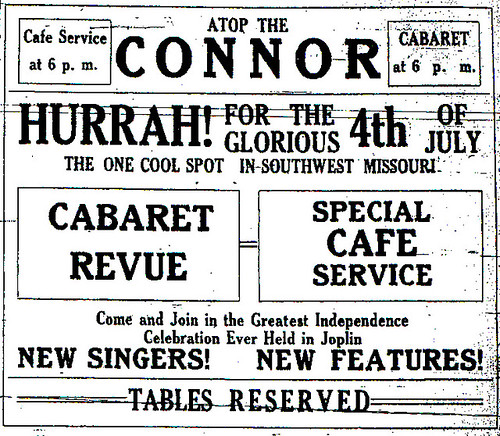
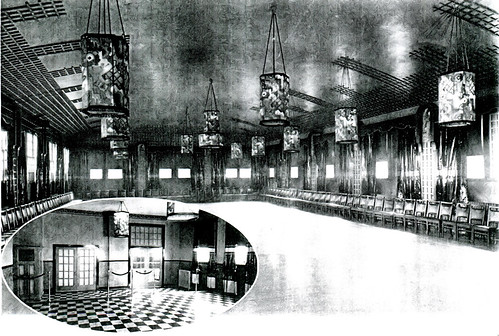
For those in Joplin who opted to celebrate without visiting the parks, one option was to enjoy a meal and music atop the Connor Hotel.  48 booths were made available in “The One Cool Spot in Southwest Missouri,” each designated with a separate flag which represented one of the 48 states of the United States.  “A telephone message to the Connor Hotel will be all that is necessary to have a state held.”  For those who opted to reserve “a state,” the rooftop garden was decorated with lanterns, flags, and festoonings, and the evening was filled with cabaret singers such as, “Ward Perry, Ned LaRose, Nell Scott and Grace Perry.”  Of course, fireworks of some sort were to be expected and for the Connor Hotel diners, a “grand illuminated display of pyrotechnics” among other novelties was offered.

Connor Fourth of July ad from 1913

Ad for the 4th of July entertainment atop the Connor Hotel

The Connor Hotel's rooftop garden.

A view of the renovated Connor's rooftop area where the 4th of July celebration was held.

From we at Historic Joplin, have a great Fourth of July!

Sources: The Joplin Globe, Joplin News-Herald

For more on the Connor Hotel, click here!

The Museum Issue May Rise Again

On Saturday, July 3, the Joplin Globe spoke with City Manager, Mark Rohr, about an announcement he will give on Tuesday, July 6.  Rohr was responsible for the planning behind the revitalization of the Sunshine Lamp district in 2005.  It was implied in the article that remaining elements of the 2005 plan may be addressed, those being the restoration and use of the neglected Union Depot, the currently privately owned Carnegie Library, and the Rains building.  It was in that plan that the Museum Complex was to theoretically be moved to the depot.

Historic Joplin supported this solution to the museum problem back in April and certainly continue to support it.  The depot is one of the city’s last remaining architectural beauties and there need not be any further Connor travesties by allowing it to fall to pieces or purposely tear it down.

For a two part history of Joplin’s Carnegie Library, click here and here.

No Rest for the Weary Willie

Today many Americans, unless they live in an urban metropolitan center, have little interaction with the country’s rail system.  Once in a while, one might find themselves stopped at a railroad crossing watching a train roll past, but gone are the days when the train would stop at the town depot to take on coal, passengers, mail, and freight before heading to its next destination.  Peruse an old Joplin newspaper and ads from the St.  Louis and San Francisco “Frisco” Railway touting summer excursions to Eureka Springs, St.  Louis, and Chicago spring from the pages.  Joplin was fortunate that it not only had an extensive interurban trolley system, but was home to a handful of rail lines that carried lead and zinc to industrial centers in the east.

With the trains came hoboes and tramps.  Just a few years after the turn of the century, the Joplin Daily Globe reported that local train crews were having problems with hoboes.  “According to trainmen,” the Globe recounted, “they are having more trouble with tramps this winter than for a great many years.  They are of the worst class and are exceedingly dangerous customers.  They are traveling around stealing rides when they can and endeavoring to find the most favorable places for looting stores or cracking safes.”

The trainmen claimed that the “harmless hoboes who would go out of their way rather than harm a human being are very much in the minority.” Instead, many trainmen told the Globe reporter that they had engaged in “hand to hand fights in an effort to rid the train of them.” Many of the fights broke out during the night when hoboes boldly roamed the rail yards in groups of four to six men.

Later that year, the Globe reported that the, “rail road yards have been especially infested with the merry willies of late.” Nels Milligan, a Joplin police officer detailed to keep an eye on the hoboes told a Globe reporter, “All up along the Kansas City Southern embankment from Broadway to Turkey Creek, you could see the bums lying stretched out in the warm afternoon air sunning themselves like alligators or mud turtles on a chilly afternoon, and here and there was a camp.”  According to Milligan, a hobo’s camp consisted of a “small fire that you could spit on and put out, between two or three blackened rocks, and a blackened old tin can, and an improvised pan or skillet made out of another tin can melted apart and flattened out.”
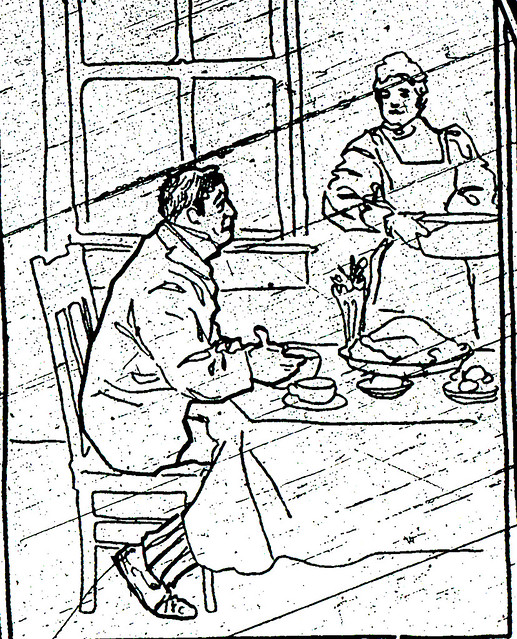
Hobo getting a free meal

Sometimes a hobo succeeded in getting a free meal.

The officer admitted there were too many hoboes and not enough room in the jail to house them.  He worried they would be “working the residence district for grub, hand-outs, punk, pie, panhandle, pellets, and any old thing they can get together.” Once they had food, Milligan claimed, the hoboes would “feed and gorge and lie around there like fat bears dormant in the winter time” until a bout of bad weather would send them on their way.

Five years later, the Joplin News Herald interviewed a railroad employee about the tramps who traveled through Joplin.  Watching a couple of hoboes jump off of a freight train in the Joplin rail yards, the railroad employee remarked, “See those fellows getting off up there? Now there is no telling where they got on, nor where they rode.” He shook his head.  “There’s another thing connected with this hauling of tramps.  Some of the most notorious criminals of the country have occupied places on the train and eluded the crew for hundreds of miles.”  According to the man, rail workers made every effort to assist law enforcement officers in locating wanted criminals who might be catching a ride on the trains.

Joplin was still struggling with hoboes eleven years later when Chief of Police Joseph Myers directed his officers to sweep the town for any weary willies.  Six men were arrested on charges of vagrancy, jailed, and then told to move on.  But as long as there were trains rolling into Joplin, there were always tramps and hoboes to contend with.
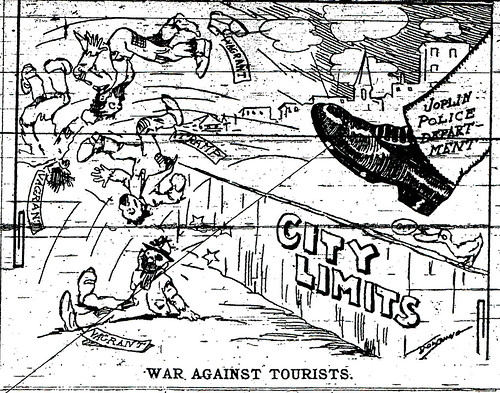
Hobos kicked out of Joplin

Joplin Police kicking out bums and hobos

Hoboes were sometimes looked at in a humorous light.  A hobo celebration was held at the “hobo cave one mile and a half north of the union depot in the hills of Turkey Creek.  Twenty of the Ancient Sons of Leisure gathered there in the cool cave.” One of the hoboes stood up to deliver an impromptu address about the significance of the Fourth of July and said, “Fellow brothers, you all realize what this day means.  It was on this day in 1776 that George Washington crossed the Delaware, whipped fifty thousand Redcoats and whacked out the Declaration of Independence.  Since that time we have been independent.  We do not have to work.  I now propose a committee of three raid a [chicken] coop so we can have an elaborate dinner as befitting Washington’s birthday.”

By 1918, the day of the hobo in Joplin had begun to wane.  Despite Joplin remaining an “oasis  in the great American desert created by prohibition” it was no longer “possible for police to spread a drag net in the railroad yards and gather in anywhere from a dozen to fifty ‘Knights of the Open Road.’”
Tim Graney, a former Joplin police officer and station master at Union Depot, declared he had not seen more than half a dozen hoboes in the last year and not one in the past six months.  The camps where the tramps and hoboes once gathered were empty.  The Globe, unable to explain their absence, mused, “Maybe they have all gone to work…At any rate, they’re gone! The genus Hobo is no more!”

Sources: Joplin Globe, Joplin News Herald