The Reminiscences of G.O. Boucher — Part IV

Historic Joplin believes in allowing the people of the past to speak for themselves.  As a result, the language they use may offend those sensitive to harmful words that are no longer acceptable in today’s present society.

The Story of Bear Fighting Blackwell

“The First dry goods store in West Joplin was started next to ‘Big Nigger’ Lee’s grocery store by a man the name of D.M.  Brazill, in the fall of 1871.

One old timer who arrived in Joplin about this time and who furnished considerable amusement was a man known as ‘Bear Fighting’ Blackwell.  He brought four big bears with him and for some time after he arrived he kept his business to himself.  Finally, after he had things ready, he advertised a dog and bear fight.  After all was ready he stretched a large canvas around a space which was filled on the day of the fight by the village sports.  In the center of the space he had a big grizzly chained to a stake and surrounding him were five or six youngsters holding their dogs.

Betting was at a high pitch and as well as I can remember it was about 2 to 3 to one on the bear.  When all was ready for the fight, Blackwell gave the bear a big plate of honey and after it had the plate he yelled, ‘Turn your dogs loose!’ The fur flew and it looked as if the dogs would soon use up the bear.  When it was all over the bear was uninjured while there were several dogs limping around.

The bears were turned over to the butcher and Mr.  Blackwell used the money which he had accumulated to build a nice brick building at the corner of Second and Main streets.  This was the first opera house in West Joplin, but the dog and bear fight or something else brought ‘Bear Fighting’ Blackwell bad luck, and the old man got into trouble and was sent to the penitentiary.  Several years after that he was turned out and went to Oklahoma, where he married a squaw who had a large tract of land and plenty of money.  He laid out the land in town lots and was the founder of the present city of Blackwell.”
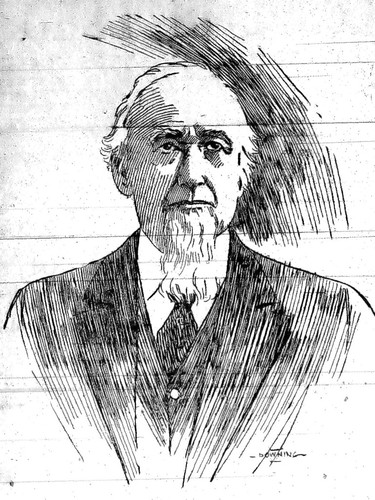
Drawing of A.J. "Bear Fighting" Blackwell

Drawing of Henry "Bear Fighting" Blackwell in his later years.

This concludes G.O.  Boucher’s memories of early Joplin.

Source: Joplin Globe.
Death of a Gambling Man

William “Bill” Chenault was a well-known “sporting man” throughout the four state region who made gambling his vocation.  He had lived in Joplin for years, but was living in Oklahoma City at the time of his death.  The son of a judge from Springfield, Missouri, Chenault “was on the border his entire life.”  As a young man, he arrived in Joplin and made “lots of money.”  When the town began to grow old, he moved further west to Dodge City and Wichita, Kansas.  Bill “was lucky” but made sure to look after the less fortunate.  He would reportedly hunt up “some poor stranger who had not been handled kindly by the world and help him, put clothes on his back, or a square meal in his stomach” even though his money was easy come, easy go.  That, according to the Globe, was Bill Chenault.

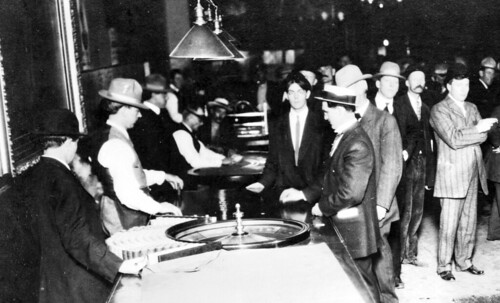
Photograph of gamblers from turn of the century.

From the same time period, an example of men gambling around a roulette wheel in Reno, Nevada.

He was also remembered for his sense of humor.  One winter in Fort Scott, Kansas, the temperature dropped below zero.  When his friends began to complain, Bill put on a thin linen duster and a straw hat, and then went out in the cold.  “It is said he nearly froze to death, but he had his fun.”  During another cold winter in Wichita, a movement began to try to help the less fortunate, but it was a sham.  When Bill found out, he personally went out and bought a carload of coal and oversaw its distribution to the poorest families of the city.

Bill, like most men, had his share of demons.  He began drinking and his health subsequently went into decline.  Still, the Globe remarked, “those who know him best appreciate the kind disposition he had and the ever willing hand that went out to a friend when something was needed.”

Source: Joplin Globe 1904, Library of Congress

The Bloomer Girls Come to Joplin

In turn-of-the-century America, teams of “Bloomer Girls” traveled across the country challenging men’s amateur, semi-pro, and professional baseball teams to exhibition games. Despite being nicknamed for the loose-fitting trousers that they wore on the diamond, Bloomer Girls were tough competitors. One such “Bloomer Girls” team arrived in Joplin in June 1898, to play a series of seven baseball games against McCloskey’s Giants at Cycle Park. Interest was so intense that promoters added additional seats in anticipation of large crowds of spectators.

Maud Nelson, star pitcher for the team, was hailed as “a twirler of exceptional speed, and it is a common occurrence for her to strike out the strongest batters on the opposing team.” Nelson, a native of Chicago whose real name was Clementina Brida, grew up playing baseball with her brother. As a pitcher, she was reportedly paid $250 a month.

Although the Bloomer Girls engaged in athletic competition with men at a time when women were still governed by stifling Victorian mores, their manager assured the Globe’s reporter that the Bloomers were “refined ladies, most of whom learned the art of ball playing on account of it being a health giving exercise, and only adopted it as a profession after becoming experts and receiving flattering offers to play in exhibition games.”

McCloskey, manager of the opposing team, asserted that the Bloomer Girls came “highly recommended, both as to their excellent playing and conduct on the diamond.” Potential spectators were assured that “the management guarantees that nothing will be said or done but what the most refined lady in the audience will approve.”

In one of their games prior to coming to Joplin, the Bloomer Girls played the Eurekas, a local men’s team in Richmond, Virginia. The Eurekas were warned that the Bloomer Girls “asked no favors, and wanted the game played on its merits.” Captain Boyne, manager of the Eureka team, instructed his players, “to knock the Bloomers silly.”

Whatever preconceived notions the men of the Eureka baseball team may have had about women baseball players were quickly overturned when it was found that it “would be no easy matter” to beat the Bloomer Girls. By the end of the ninth inning the Bloomer Girls led the Eurekas 11 to 5. Maud Nelson was hailed as “a peach, her work in the box alone is worth the price of admission to the game.” She “handles herself like a professional pitcher, throws well, gives the catcher curve signs, and can stop or catch a ball with either hand.”

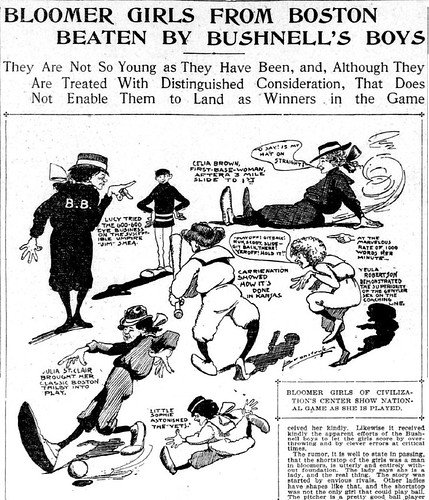
A 1901 cartoon of the Bloomer Girls from the San Francisco Call.

A 1901 cartoon of the Bloomer Girls from the San Francisco Call.

When the Bloomer Girls played McCloskey’s Giants at Cycle Park, they faced fierce competition from the Giants, who played as if “they had reputations to lose.” Managers McCloskey and Menefee livened up the game by having their men run between bases with the Bloomer Girls in hot pursuit. Unfortunately for the Bloomer Girls, they lost the first game 14 to 1.

Maud Nelson, who was “justly” billed as the “star of the team,” continued to be involved in baseball for years to come as a manager and team owner, anticipating the time when the women of the All-American Girls Professional Baseball League.

Sources: The Joplin Globe, the Library of Congress, www.Exploratorium.edu, Wikipedia: Maud Nelson.